Freedom vs security: how to choose between them in real decisions
By Juan Alejandre · Published · Reviewed
Industrial engineer and consultant, 25 years working with teams
There is no answer to "freedom or security?" that works for everyone. It depends on the decision in front of you and on which of the two you defend when both do not fit. This page is not about the political debate over liberties and public safety. It is about personal choices: a job, your savings, a move. It ends with a 10-minute exercise to see which one comes first in your case.
Hardly anyone wants only one. You want room to decide and, at the same time, to know what you can count on. The tension appears when something forces a choice: the steady contract or the uncertain offer, the savings untouched or the trip you keep postponing, the city you know or the one you do not. That is where you notice which one weighs more, even if in theory you say both.
None of what follows is financial or professional advice. It is a way to put in order what matters to you before you decide.
What each value protects
| What it protects | How it sounds in your head | |
|---|---|---|
| Freedom | Being able to choose your path, your time and your terms | "I want to be able to change my mind" |
| Security | Knowing what you can count on, and having a cushion for the unexpected | "I want to be able to rest easy" |
Neither is better than the other. Security is not fear, and freedom is not recklessness. Security often makes it possible to enjoy what you have without worry; freedom makes what you do a choice instead of an obligation. What differs between people is the order: which one wins when you have to give something up.
It helps to separate a value from a mood. If after a bad week you want to drop everything, tiredness may be talking, not freedom. If every change scares you, fear may be talking, not security. A value is what still matters when you are calm and have time to think.
Two scenes where they collide
These are made-up examples. They show how the same pair looks different depending on what is at stake. They do not say what anyone should do.
The job offer: the steady role or the uncertain one
Example. Daniel has worked four years at a logistics company with a permanent contract and a predictable schedule. A smaller company offers him a more interesting role: a better title, more say in how things are done, a contract with a six-month trial period and a salary that is only slightly higher.
- If security weighs more, the question may be: "What would I need to know before accepting?" Perhaps how long the company has been operating, what happens after the trial period, or how many months of expenses he could cover if it went wrong.
- If freedom weighs more, the question may be: "What does staying cost me, not just in money but in motivation?" Perhaps the role at his current company will not change in the next three years.
The useful question is the one that works for both: "What would make this risk small enough for me to take it?" To see how values show up in a job in general, read values at work.
Savings or the long trip
Example. Priya has saved a little each month for two years. A friend invites her on a three-month trip across South America, which would use about half of her savings and mean asking for unpaid leave. For her, the savings are security and the trip is freedom.
The question "What is the sensible thing?" tends to go nowhere, because both are sensible for someone. A more useful one is: "What do I need to have settled so I can enjoy this without guilt?" For one person that is three months of expenses in the bank. For another it is six. For another it is knowing that family could help in an emergency. Only Priya can set that number. It marks where the security she needs ends and where the money she can use freely begins.
The same logic applies to a move to a new city: for some people the support network is what makes them willing to try things, and for others leaving everything familiar is what frees them. Asking "Which of those two am I actually afraid of losing?" often says more than a list of pros and cons.
It is rarely all or nothing
The usual picture is two opposite ends. In practice they work more like two halves of one decision.
- Freedom without a base. If nothing is secured, every unexpected event becomes an emergency. Someone who "dropped everything" with no cushion may soon be looking for any job, which limits the very freedom they wanted.
- Security without room. If everything is secured, your life can become so protected that there is no space to change direction. You can have plenty of security and still feel that you are not choosing.
So a better question than "which one?" is: how much security do I need to choose without fear, and how much freedom do I need so that my security does not feel like a cage? Nearby values help you refine it: independence (deciding on your own), courage (taking the step even when it feels uncomfortable), balance (spreading your energy across areas of life) and family (when the people around you are part of the decision).
A 10-minute exercise: "next year"
You need paper, a pen and ten minutes without interruptions.
- Pick one real decision you have pending, not a hypothetical one. Write it in one line.
- Describe two versions of yourself a year from now: one who chose the safer path and one who chose the path with more freedom. In three sentences each, describe an ordinary Tuesday.
- Write what you miss in each version. Not what you gain, but what you lose. The loss that stings more often points to the value that weighs more.
- Complete two sentences: "To feel at ease I must have..." and "To not feel stuck I must be able to..." See whether any path satisfies both.
- Choose one small, reversible step for the next two weeks: talk to someone, work out one number, try something on a small scale.
If two or three pending decisions end in the same sentence, you have a clear sign of the value that moves you most.
What your Top 10 can tell you
The top10values game shows you pairs of values and asks you to pick one. It is about 100 quick comparisons, and at the end you get an ordered Top 10. For this topic, look at where freedom and security land:
- Freedom well above security: in a doubtful decision you may tend to choose room over guarantees. Ask yourself whether you have enough of a base to sustain that.
- Security well above freedom: you may tend to prioritize what is predictable. Ask yourself whether there is something you postpone only because you do not have everything secured.
- Both near the top: you have a dilemma that will repeat in several areas of life. That is not a flaw. It means both matter to you, so it is worth deciding each time which one weighs more instead of looking for one general answer.
The result describes what you choose today, not who you are or what you should do, and it does not decide for you. It is a self-knowledge tool, not a validated psychological test; the methodology page explains how the result is calculated. The game requires signing in with Google.
If you want a wider view first, the personal values list has 50 values to compare, and the personal values test explains how to read your result.
Frequently asked questions
Which is better, freedom or security?
Neither is better in the abstract. Security gives you calm and a base; freedom gives you room to choose. What changes is which one weighs more for you in each decision. It helps more to ask what you need settled to feel at ease and what you need to be able to do so you do not feel stuck.
Can you have freedom and security at the same time?
In many decisions, at least in part. A small fixed base (savings, a steady income, a place to live) often gives you room to leave the rest open. When everything does not fit, it helps to know which of the two you defend first.
Is this the same as the political freedom vs security debate?
No. This page is about personal decisions. The public debate about civil liberties and collective safety is a different subject, and this page takes no side in it.
Next step
Play the values game and see where freedom and security sit in your own Top 10. If you want to read more first, browse the full list of values.
Sources
Find your top 10 values with 100 quick comparisons
What does the paid report include?
When you finish the 100 comparisons you will see your Top 10 on screen. If you want to go further, there is a PDF report on your personal values: €9.95 (VAT included), one-off payment. To buy it you need to save your game with a Google account.
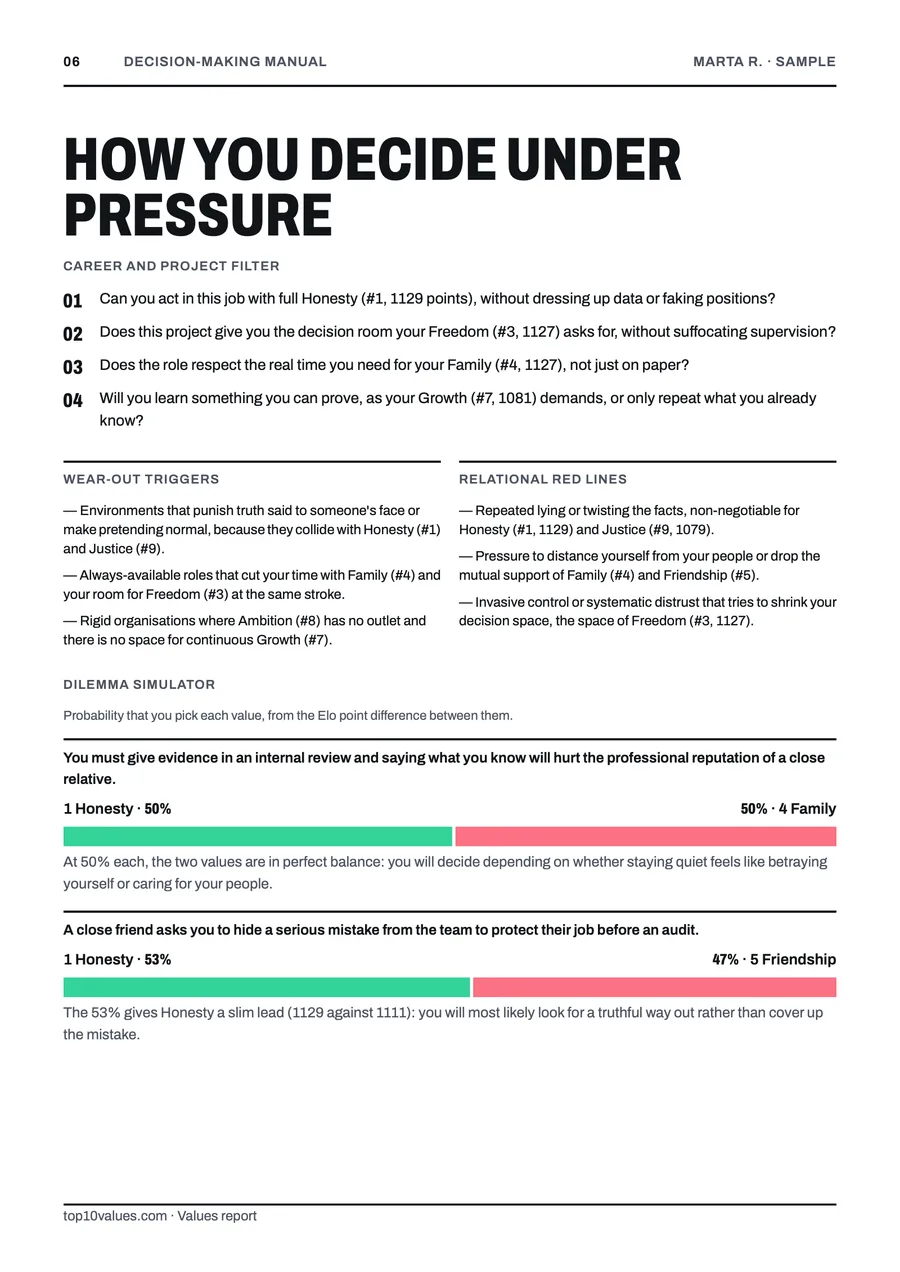
Sample page with fictional data (Marta R.), not yours. Your report is written from your own choices.