Relationships
Family
Importance of family bonds.
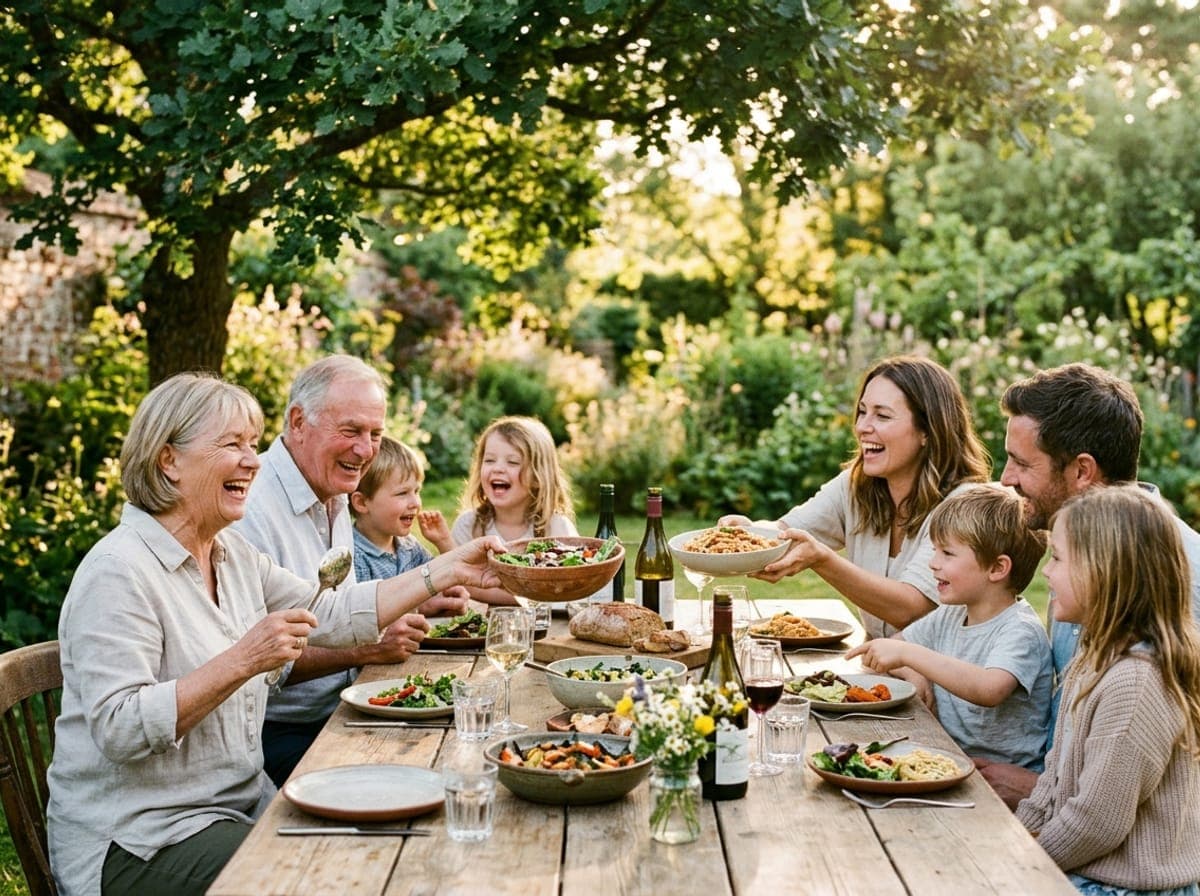
Family as a core value prioritizes the closest ties of blood or choice—parents, children, siblings, extended partners—above other spheres of life. People who value family organize important decisions, such as where to live or how much to travel for work, around keeping those bonds close and present. This value brings a sense of belonging and continuity that transcends the individual: it connects to a shared history and to responsibilities of mutual care across generations. For these people, professional or personal success rarely makes up for a sustained deterioration in the relationship with those they consider their nearest family circle.
What does this value mean?
Family, as a value, is the decision to treat bonds of care and shared history (by blood or by choice) as one of the pillars of your life, and to arrange your time, money and energy so those bonds stay alive instead of depending on luck.
It stands for the idea that you are not only an individual chasing personal goals but a link in a chain. Someone looked after you when you couldn't manage alone, and now it is your turn to look after people upwards (parents, grandparents, ageing aunts and uncles) and downwards (children, nieces and nephews, godchildren). For someone living this value, a good year is not measured only by what happened at the office: it also counts whether grandma had company in the hospital, whether your younger brother found a flat, and whether the table at the holidays still has room for everyone.
What it does NOT mean
It does not mean putting up with everything "because it's family", obeying whoever is older or loudest, or counting only blood ties. Nor does it require agreeing on politics, religion or how a child should be raised. You can love someone deeply and still set distance or limits when the relationship hurts you. And family as a value is not the same as a surname, a tradition or "what the neighbours will say": those may come along with it, but they don't define it.
Related concepts
Why might it matter to you?
There are moments when no company, app or recent friendship can replace the people who have been with you all your life: emergency surgery, a divorce, a bankruptcy, a move abroad, the death of someone dear. On those days you find out who answers the phone at odd hours and who offers to take your kids or lend you the van. Valuing family means investing in that network in advance, while you don't yet need it. Families are also where things get passed on that no manual contains: how Sunday's dish is cooked, what to do when someone loses a job, which stories explain why you are the way you are. Once that transmission is cut, it is very hard to restore.
How can you live this value?
- Set a modest recurring date, such as lunch every other Sunday or a Thursday video call with the relative who lives far away. A small, steady habit holds a bond together better than one big reunion a year.
- Before a big decision (accepting a job with travel, moving city, buying a house), list who is affected and talk to them before announcing what is already decided. Consulting is not asking for permission: it is counting them in.
- Record or write down a conversation with an older relative. Ask where they were born, how they met their partner, what work they did, what was the hardest thing they lived through. A thirty-minute voice memo on your phone will be worth more in twenty years than many photos without names.
- Divide caregiving tasks explicitly. If a parent needs help, sit down with your siblings and put on the table who does what (visits, medical paperwork, money, night shifts). What is not divided in words tends to fall on whoever is most available or least able to say no.
- When a conflict arises, send a short message within three days acknowledging what hurt you and what you regret, without yet demanding that anyone apologise. Family silences tend to harden, and the first step is usually the cheapest one.
- Include chosen family. Invite the friend who has nowhere to go to the holiday dinner, or the neighbour who was recently widowed. Widening the table is a way of living this value without needing kinship.
Advertisement
What happens when you don't live up to this value?
When this value is neglected, the typical feeling is being uprooted. Gatherings turn into chores with one eye on the clock, conversations stay on the weather and everyone's health, and you learn the important things through third parties: an uncle's surgery, a cousin's new job, a brother's divorce. One day you leave a funeral certain that there was a lot to ask and nobody left to ask. Sometimes the symptom is the opposite: you are physically close to your family but only in the role of provider, wallet always open and mind somewhere else.
The healthy side and the shadow
When does this value stop helping you and start limiting you?
Healthy expression
Care with roots
In excess
A smothering clan
Family becomes a trap when it turns into a permanent tribunal: what you choose (career, partner, city, beliefs) is judged by how well it fits expectations, and any deviation is experienced as disloyalty. It also happens when harmful behaviour is covered up, such as abuse, an addiction or a hidden debt, so as not to "stain the name". And when the person who cares the most ends up being taken for granted. A question that helps tell the difference is whether your family holds you up so you can grow, or holds you back so nothing changes.
This value at work
At work you value being allowed to attend the school play, take a relative to a medical appointment or close the laptop at a reasonable hour. You find it hard to accept always-on cultures, and you may be the one who suggests that meetings shouldn't be scheduled at six in the evening. In return, you tend to build teams where people look after each other: you remember that a colleague's father is ill and quietly cover a shift. Watch out for one concrete trap: companies that boast of being "one big family" sometimes use the phrase to ask for overtime, sacrifice and silence about unfairness, that is, loyalty without reciprocity. In a real family nobody lays you off for a budget cut, and it is worth remembering that when someone uses the word to ask you for more.
This value in relationships
Your way of making friends resembles adopting relatives. You learn the names of your friends' parents, turn up with a toolbox when someone moves, and struggle to understand people who only meet for a drink every six months. Sometimes this clashes with friends who prefer more distance and feel overwhelmed by so much closeness. It helps to ask each person how much contact they want, rather than assuming everyone understands friendship the way you do.
This value in love
With a partner, your family enters the house even when not invited: you see it in the holidays (with yours or with theirs?), in Sundays, in how much money gets lent to a sibling and in the role of the in-laws in raising children. Couples who do well tend to talk about this early and without victimhood, before the first disputed holiday does it for them. You need your partner not to experience your attachment as competition, and it is also on you to make clear that, when deciding as a household, what you agree on as a couple weighs more than a family opinion that points the other way. If you sweep it under the rug, it will come out as small, constant reproaches.
This value in family
You are probably the one who organises the birthday lunch, remembers each aunt's name day, and calls when someone has been quiet for too long. It is a valuable role and also an exhausting one, and it is often shared unevenly: it falls to whoever feels it most, not whoever can most. A simple test is to ask who would call you if you were the one struggling. If the answer is "nobody", you don't need to love less but to ask for more and stop being the only one holding the thread. Another common challenge is talking with your own children or nephews and nieces without repeating what you disliked about the upbringing you received.
This value and yourself
Having family among your core values suggests that you think long-term and in the plural. Few decisions feel purely yours: you almost always ask whom they affect. That makes you reliable, and it can also make you slow to make choices that benefit you more than anyone else. It is worth observing whether you care out of desire or out of fear that someone will reproach you for failing, because from outside they can look the same and from inside they feel very different.
What are you willing to sacrifice for this value?
Would you give up a promotion that obliges you to live a thousand kilometres from ageing parents, or a year of study abroad so as not to leave your children? Think of the last thing you gave up for your family and how you remember it. If you would do it again without hesitation, the value is healthy. If a sentence like "and nobody thanked me" comes to mind, you may be caring out of obligation rather than choice. A sacrifice that is asked of one person permanently, whoever that is, is not healthy either: the renunciations that hold a home together should rotate over time.
Signs you're betraying this value
You go against this value if you say your family comes first but your calendar tells another story: you arrive late to what matters, show up only at weddings and funerals, or count on your parents for babysitting hours and never for a real conversation. Also when you let a misunderstanding turn into years of silence out of pride, compare your siblings in front of others, or air the household's dirty laundry to win an argument.
Turning the value into goals
Value
Family
Behavior
Be present regularly and for no special reason, not only at birthdays, weddings and funerals
Goal
Before the end of the quarter, restore easy contact with a relative you haven't talked to about anything important for months or years
Habit
One unhurried call every week to someone in your family, rotating between people, with no other screen open while you talk
Questions to reflect on
- Which family member would you miss most if you didn't see them for a year, and when did you last tell them something that truly mattered?
- Which family tradition do you want to keep, and which would you like to end with you?
- Which decision in your life did you make thinking more about your family than about yourself, and how do you see it today?
- Who in your family carries more caregiving than their share, and what could you take on this week?
- Is there someone in your chosen family who deserves the same care as your blood relatives?
- What would you like the youngest people in your family to remember about you thirty years from now?
How much are you living this value?
From 1 to 10, how much real time and energy do you give your family compared with how important you say it is? Look through your last month of calendar and calls before answering. If the two numbers are far apart, begin with one small, fixed gesture this week rather than a big promise.
When two values clash
Family often clashes with Freedom and Independence. Moving far away, choosing a profession nobody at home understands or breaking with a religious tradition can feel like betrayal, and living without anyone's permission can hurt those left behind. It also pulls against Ambition: a good professional project asks for hours, travel and attention, and those hours come out of dinner, the weekend or someone's last years. With Honesty the clash is quieter: telling the truth about an illness, money or a personal orientation can break the apparent peace of a household. And with Loyalty comes the dilemma of sides when two relatives fall out. There is no universal answer. It helps to separate what your family truly needs (company, concrete help, information) from what it simply expects out of habit, and to check which of the two you are obeying when you decide.
Is “Family” one of your top 10 values?
Find out by playing and comparing this value with the other 49
How the Elo ranking works and its limits in the methodology.
What does the paid report include?
When you finish the 100 comparisons you will see your Top 10 on screen. If you want to go further, there is a PDF report on your personal values: €9.95 (VAT included), one-off payment. To buy it you need to save your game with a Google account.
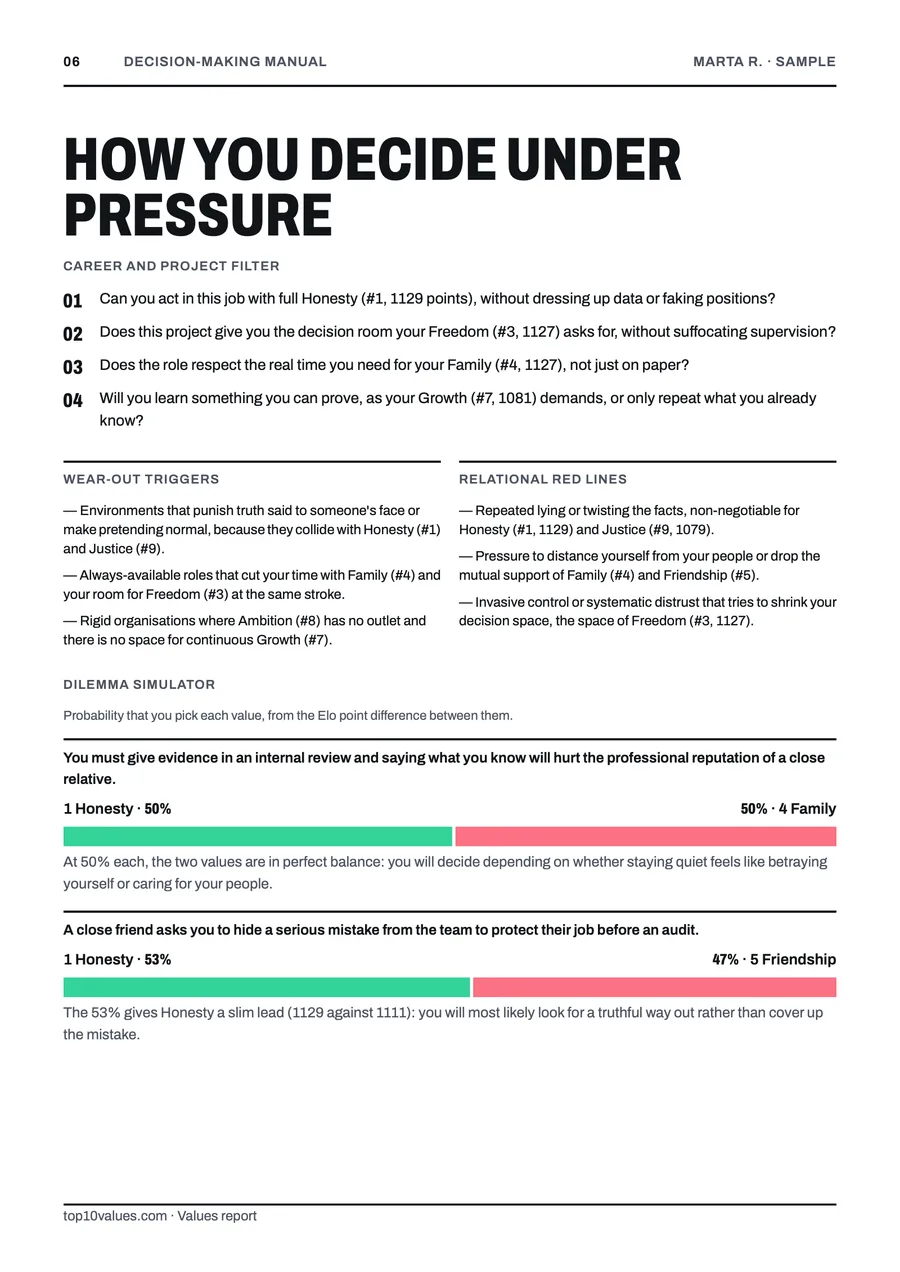
Sample page with fictional data (Marta R.), not yours. Your report is written from your own choices.
Frequently asked questions
Does valuing family mean putting up with relatives who hurt me?
No. Caring for your family includes protecting yourself. Keeping your distance, setting clear limits, or meeting only in public places with someone who mistreats you is compatible with this value. Sustaining a harmful relationship purely out of obligation usually ends in resentment on every side.
Does chosen family count?
Yes. For many people family includes lifelong friends, a partner without children, neighbours or a community. What defines the value is not kinship but the commitment to look after one another for years and to show up on the bad days.
How do I choose between my family and my career?
It is rarely an all-or-nothing choice. You can ask yourself which concrete things you do not want to lose (for example, having dinner at home three nights a week or living within two hours of your parents) and negotiate the rest. Writing those lines down before an offer arrives helps you avoid deciding under pressure. If an offer crosses them, at least you will know what you are trading for what.
What if my family doesn't respect my decisions?
Start by explaining your reasons once, calmly and at a neutral moment, rather than every time the subject comes up. If nothing changes, you can reduce the occasions for conflict (not arguing at meals, limiting topics) without cutting the bond. Holding your decision and holding your affection are not opposites, even if it sometimes takes years for others to see it that way.
Is it selfish to want to live far from my family?
Not necessarily. Leaving can be a way of growing or of finding work, and distance does not prevent presence: regular calls, planned visits and concrete help when needed weigh more than living in the same neighbourhood without talking. What does deserve an honest conversation is who will look after whom when someone grows old or ill.
When Family clashes with…
Invented scene. Sergio picks up his daughter from daycare at 5:00 pm. One Thursday his boss calls, for 5:30, the meeting where the year's projects are handed out. Family and ambition do not fight on principle: Sergio wants both, and that is why it hurts. Ambition reminds him that projects are handed out in that room and that whoever is absent does not count. Family reminds him that his daughter is waiting at the door and that the hour cannot be recovered. It is rarely one big dilemma; it is a hundred small ones that, added up, decide what comes first. Freedom enters from another side: being able to ask for an afternoon for yourself without it sounding like abandonment. Before choosing, look for a third way (moving the meeting, sharing the pickups) and what cost you accept if there is none. More cases in conflicting values.