Achievement
Ambition
Strong desire to achieve.

Ambition is the inner drive that pushes you to set demanding goals and pursue them with determination, even when the road is uncertain or long. People who value ambition are not satisfied with "enough": they want to grow, surpass their own limits and leave a measurable mark on their career or personal projects. This value is behind those who change jobs for a bigger challenge, start something new, or spend years mastering a discipline. Well channeled, ambition is an engine of individual and collective progress; poorly managed, it can create chronic dissatisfaction if the goalposts move before you get to enjoy what you've achieved.
What does this value mean?
Ambition is a sustained desire to get further than where you are now: to do something better, bigger or harder than what you are doing today, and to accept the effort and risk that this demands. It has two parts that belong together: a goal that genuinely matters to you, and the willingness to pay for it.
It represents refusing to settle for what you were handed when you sense you have more to give. You see it in someone studying for a professional qualification at night while working full time, in someone applying for a role before ticking every box on the job description, in someone opening their own workshop after fifteen years in somebody else's, or in someone deciding their novel will not stay in a drawer. What these share is a deliberate gap between where you are and where you want to be, and the decision to close it.
What it does NOT mean
It does not mean wanting more of everything or measuring yourself only by salary, job title or followers. Nor is it climbing over other people: ambition that needs to push others aside to advance is closer to greed or a hunger for power. Nor should it be confused with success, which is the result as others see it; ambition is the drive, and it can exist without success, just as some successes arrive without anyone chasing them. It is not growth either, which looks inward (being more capable than a year ago), whereas ambition points at a specific goal. And it is not discipline: discipline is the consistency to do what you decided; ambition decides what is worth being consistent about.
Related concepts
Why might it matter to you?
Almost everything that changes a life started with someone wanting something they did not yet have: studying a subject nobody in their family had studied, starting a business, moving to another city for a better job. Without some ambition, decisions are made by inertia and circumstance, and life fills up with things that happened to you rather than things you chose. Ambition also brings order: when you know what you want to achieve, it becomes easier to turn down distractions and to sit through the dull weeks that every long project contains. At its root lies a need to feel that your effort counts and that your life is heading somewhere, and often a specific memory: someone close who never dared, or a «that's not for people like us» that still stings.
How can you live this value?
- Write the goal as a sentence you could check, and give it a date. «I want to progress at work» points nowhere; «I want to be leading a team within eighteen months» forces you to ask what you are missing and who you need to tell.
- Separate your ambition from the one you inherited. For every important goal, ask whether you would still want it if nobody would ever find out. If the answer is no, what you may be chasing is approval, and approval never quite arrives.
- Ask out loud for the role, the project or the pay rise. Many opportunities go to the people who ask, not to those waiting for someone to notice their work. Bring three facts that support the request and, if the answer is «not yet», ask what you would need to show.
- Block out a fixed slot every week for what is important but not urgent: the course, the portfolio, the proposal nobody asked for. Ambition that only lives in your spare time gets pushed aside by email and errands.
- Settle beforehand what you refuse to sacrifice: Thursday dinner with your family, enough sleep on most nights, never signing anything you would be ashamed of. Deciding before the pressure arrives is far easier than deciding in the middle of it.
- When you fail, separate the outcome from the strategy. A rejected application says something about that application, that moment and that panel, not about your worth. Ask what you would change and try again, or change the goal if you have learned it was never yours.
Advertisement
What happens when you don't live up to this value?
When you have ambition and ignore it, a restlessness sets in that rest does not cure. Sunday evenings feel heavy, conversations about work bore you, and you catch yourself scrolling job adverts you never apply for or the LinkedIn profiles of old classmates. It is easy to mistake that discomfort for laziness or a bad mood. Over the years it can turn into something more bitter: the feeling that your moment has passed, envy dressed up as criticism («they just got lucky»), or the line that aiming higher is naive. Shelved ambition does not disappear; it tends to come back as resentment towards those who did try.
The healthy side and the shadow
When does this value stop helping you and start limiting you?
Healthy expression
Aspiration with clear limits
In excess
Bottomless ambition
Ambition goes wrong when the goal stops being a means and becomes your identity: if you are not moving up, you are worth nothing. Each achievement then lasts a weekend before you need the next one, because what you are chasing is no longer the job or the project but the feeling of being ahead. It shows in concrete signs: talking about people as obstacles, being unable to feel glad when someone else is promoted, counting holiday days as lost days, or excusing any shortcut with «that's how the world works». The useful question is what would happen if you did not get there. If the answer is «I'd be disappointed», your ambition is healthy; if it is «I wouldn't know who I am», it is worth looking at how much room it takes up.
This value at work
At work you are the one who volunteers for the difficult project, who asks in the annual review what it takes to reach the next level, and who pays for their own training before the company offers it. That tends to open doors, and it also creates friction. Some typical scenes: you are offered a promotion that means relocating; someone with weaker results but better connections gets the job you wanted; your team prefers a calmer pace than yours, and your proposals land as pressure. In each case it helps to separate what you want from how you pursue it. Asking for the role is fine; presenting someone else's work as your own is not. Demanding a lot of yourself is fine; demanding the same pace from people who never signed up for it tends to burn out the team and, eventually, your reputation. If your employer offers no route to progress, plan your exit rather than waiting for things to blow up.
This value in relationships
In friendship, ambition draws you towards people with projects and can quietly pull you away from those who chose a different pace. Watch the tone you use about friends who have «got comfortable»: what looks like a lack of drive is sometimes a different priority, such as caring for a sick parent, raising children without rushing, or simply enjoying a nine-to-five. Friendships also suffer when every conversation circles back to your goals, or when you only turn up to birthdays that do not clash with a deadline. What people value most in an ambitious friend is momentum without judgement: the friend who nudges you to finally send off your manuscript, not the one who reminds you that you have been talking about it for three years.
This value in love
In a relationship, ambition raises practical questions: who moves if one of you is offered a job in another city, who goes part-time when a baby arrives, how many evenings a week your project can take before the relationship turns into a shared timetable. You do not need the same level of ambition; you need each person to respect the other's and to negotiate sacrifices rather than assume them. The typical problem is not ambition but one-sided ambition: deciding on a job change that affects you both without asking, or asking for patience «just until this comes off» for five years running. If your partner has goals too, it helps to think in turns: periods when one career pulls harder and the other holds the fort, with a date to review it. And to celebrate their wins with the energy you bring to your own.
This value in family
Ambition often has family roots. Some people receive it as an order («you have to go further than we did») and others build it against the current, in surroundings where nobody expected much. It is worth knowing where yours comes from, because inherited ambition often feels more like a debt than a desire. With your children, if you have them, the risk is handing them your goals: choosing their degree for them, turning every school report into a test of your own worth, or praising only results and never effort. They learn more from watching you pursue something, fail and try again than from hearing that they must be the best.
This value and yourself
A high ranking for ambition suggests that standing still bothers you more than being tired: you would rather have an exhausting week that gets you closer to something than a calm one that leads nowhere. You are probably bored by repetition, find it hard to celebrate without already eyeing the next thing, and respect people who take risks even when they fail. It can also mean your self-esteem rests more on what you do than on who you are, and that stretches without goals unsettle you. Ask yourself honestly whether you could be at ease in a period with no clear targets.
What are you willing to sacrifice for this value?
Ambition nearly always charges in time: evenings studying instead of eating with friends, work trips that land on someone's birthday, years on a low income while a project gets going. What have you paid, and did you choose it or did it just happen? Think of a goal you reached: would you pay that price again? And one you dropped: did you give it up because what you wanted changed, or because the cost frightened you? Sometimes the hardest sacrifice is not giving something up for the goal, but giving up the goal once you realise it no longer belongs to you.
Signs you're betraying this value
You betray your ambition when you do not apply because «they'd never pick me», when you hide your project so nobody can watch you fail, or when you have been saying «next year» for years about the business, the book or the master's degree. Another form of betrayal is pursuing it in ways you could not defend out loud: taking credit for a colleague's work, padding your CV, or keeping quiet about something unfair because speaking up would cost you points. And there is a subtler sign: diligently chasing the goal other people expect of you while your own sits waiting in a drawer.
Turning the value into goals
Value
Ambition
Behavior
Ask out loud for the opportunity you want, with arguments and a date
Goal
Within the next three months, submit the application, proposal or project you have been putting off
Habit
Every Monday, spend one uninterrupted hour on that goal and write down the next concrete step
Questions to reflect on
- What goal would you pursue if you knew nobody around you would have an opinion about it?
- What have you stopped attempting because you were afraid of failing in front of others?
- Who gave you your idea of what «going far» means, and do you still agree with it?
- What are you paying for your ambition today that does not show up on any balance sheet?
- Which recent achievement did you not let yourself enjoy because you had already moved on to the next target?
- Whose ambition do you admire, and what makes theirs seem healthy to you?
How much are you living this value?
Give yourself a score out of 10 for how much your actual week pushes towards the goal you say you want. To answer, look at your calendar for the last seven days and count the hours you spent on your main goal. If the answer is zero, your score should not go above 4, however much you think about it; and if zero does not bother you, perhaps that goal is not really yours.
When two values clash
Ambition clashes with Inner peace, because chasing something difficult brings tension, uncertainty and nights spent turning things over. With Family, in seasons when a promotion, a relocation or a business of your own competes with raising children, caring for someone or simply being there. With Health, when sleep and exercise are the first things cut in a busy season. With Honesty and Integrity, if a shortcut, a massaged figure or someone else's credit would bring the goal closer. And with Friendship, when there is no room left for anyone outside the project. It sits well with Discipline and Growth, which give it method and meaning. To manage these tensions, settle in advance what is not for sale, to check every few months whether the goal is still yours, and to have someone who will tell you when you are overdoing it.
Is “Ambition” one of your top 10 values?
Find out by playing and comparing this value with the other 49
How the Elo ranking works and its limits in the methodology.
What does the paid report include?
When you finish the 100 comparisons you will see your Top 10 on screen. If you want to go further, there is a PDF report on your personal values: €9.95 (VAT included), one-off payment. To buy it you need to save your game with a Google account.
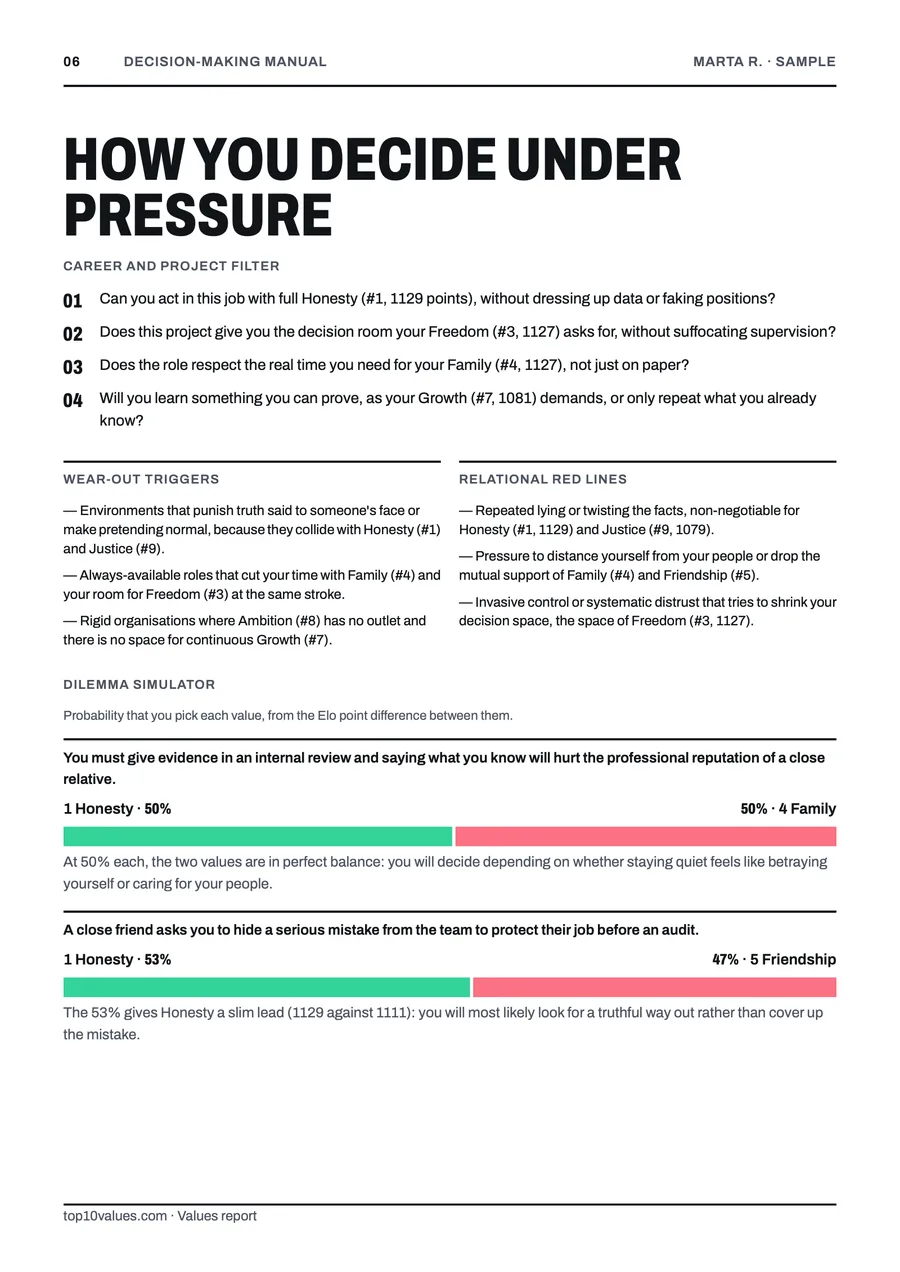
Sample page with fictional data (Marta R.), not yours. Your report is written from your own choices.
Frequently asked questions
How do I know if my ambition is healthy?
Look at three things: whether you can enjoy an achievement for more than a few days, whether you can feel glad about other people's successes, and whether there are things you would not do to reach your goal. If you fail all three, your ambition may be standing in for other needs, such as feeling that you are worth something or that you are loved. It is also worth reviewing if fear of not measuring up paralyses you: a goal should push you, not keep you awake for months.
Is it bad not to be ambitious?
No. Many full lives have modest goals or no career goals at all, and are guided instead by calm, family or enjoyment. If ambition is not among your core values, nothing is missing; other things move you. What is worth telling apart is a lack of ambition and suppressed ambition: if you catch yourself envying people who take risks or often imagining a different life, you may not lack ambition so much as permission to have it.
What if my partner does not share my ambition?
Differences in ambition are common in couples and are not a problem in themselves. The strain comes when one person feels that their life revolves around the other's project. Talk about specifics: hours, money, moves, who covers what. Agree on phases with a review date, and make sure the person holding the fort also has room for their own things, even if they are less visible.
How do I ask for a promotion without sounding demanding?
Book a meeting for that purpose rather than mentioning it in passing in a corridor. Bring three or four concrete facts (projects, results, responsibilities you already carry) and ask directly what it would take. If the answer is «not yet», ask for clear criteria and a date to revisit it. Asking with evidence is not arrogance: it makes the decision easier for whoever has to take it.
What if I realise my goal no longer matters to me?
Changing course is not failing. Having invested years is no reason to invest more in something you no longer want: that time is spent whether you carry on or not. Before you quit, tell the tiredness of a bad patch apart from genuine loss of interest. If the goal still leaves you cold after a proper break, let it go honestly and look for what excites you now. Ambition does not have to keep aiming at the summit you picked at twenty.
When Ambition clashes with…
Invented scene. Lucía designs interfaces at a mid-sized company, and she is offered the chance to present the new project to the leadership team. The core idea came from her colleague Aitor, although she developed and polished it. Ambition sees a chance that rarely comes twice in a year. Humility asks whether that room really needs to know whose idea it was, and honesty replies that it does, because letting people assume is a way of lying without saying anything false. There is a second front: the role that follows means moving to another city, and family points out that her mother lives alone two streets away. Wanting more is not the problem; not knowing what you are willing to give up is. Try presenting Aitor as co-author and see whether the promotion still feels like yours. More in conflicting values.