Conflicting values: what they are, six examples and a method for when two of yours collide
By Juan Alejandre · Published · Reviewed
Industrial engineer and consultant, 25 years working with teams
A conflict of values appears when two things that matter to you ask for incompatible actions at the same moment. It is not solved by picking "the good one", because both are good. It is solved by seeing which one you need to protect more today and what you will pay for leaving the other behind.
Most days your values fit together. The dilemma shows up on one specific day: a truth that will hurt someone, an offer in another city.
Below you get a definition, six short examples, a method of three questions and a 15-minute exercise with your own Top 10. It is not professional advice or a personality test; it helps you put words to what pulls in each direction.
What a values conflict is (and what it is not)
Here, a values conflict is an internal dilemma: two values of yours point in different directions. Two other situations are often mixed with it.
| Situation | What is happening | Example (made up) |
|---|---|---|
| Two of your values collide | Both matter and you cannot serve both fully | A friend asks what you think of a gift you did not like |
| You clash with another person | Your values and someone else's differ | You want to save, your partner wants to spend |
| Two pleasant options | No value is at stake, only a limit on time | Two concerts on the same night |
The first is the subject here. The second often contains the first: when you argue with someone, ask which value of yours is being touched. The third is a scheduling problem.
A sign the conflict is real: whichever way you choose, you will feel a cost.
Six examples of conflicting values
These are made-up scenes. They show how a tension looks when different things are at stake. They do not say what anyone should do.
Honesty and loyalty
Someone knows a friend's secret and a third person asks about it directly. Telling the truth betrays the friend; covering up means saying something false. The full guide is honesty vs loyalty; see also honesty and loyalty.
Kindness and honesty
Example. Ayasha has spent three months building an online ceramics shop. She sends her cousin Tomás the product photos and asks, "Be honest, are they good enough to launch?" Tomás thinks the lighting makes the pieces look flat. He also knows how tired she is.
- Kindness protects her morale now. "They look great" costs nothing today.
- Honesty protects what she asked for: a useful opinion. "They look great" may cost her the first month of sales.
Only kind, Tomás gives a comfortable answer that does not help; only honest, he may hurt her with nothing to act on. A version that respects both: "The pieces are lovely. The photos do not show it yet. Can I help you retake the first three in daylight?" It may still sting, but it keeps what each value was protecting.
Family and ambition
Example. Hana is a project engineer offered the lead of a new team. It means about eight more hours a week, a couple of trips a year, and an answer within ten days. Her father had surgery last spring and she has been at his house every Sunday since. Her brother lives abroad.
- Ambition says this chance may not come twice, and declining could leave her wondering what might have been.
- Family says the Sundays are how she is present for her father, and this is the stretch when it counts.
The method below uses this scene.
Freedom and security
A steady contract against a riskier offer: one value protects room to choose, the other what you can rely on. Freedom vs security explores two scenes for this pair; see also freedom and security.
Independence and love
Example. Nadia has lived alone for six years in a city she chose. Her partner gets a job offer in another country and says, "Come with me." Independence asks who she will be if her life depends on his plans. Love asks what she is protecting by staying put. The cost on each side is real, and a partial version (a trial period, a return date) is worth putting on the table.
Adventure and security
Someone dreams of a year of travel and has a mortgage and modest savings. Adventure wants the year; security wants the base to still be there afterwards. A better question than "which wins?" is "what would have to be arranged so the first does not destroy the second?"
Three questions to decide
This is a method, not a formula: there may be no right answer, but you can look at the decision from three angles first.
- What happens in six months if you give way on each one? Write two short paragraphs, one per option, describing an ordinary week. Look at what you miss in each, not what you gain: the loss that stings more often points to the value that weighs more.
- Who else depends on this decision, and which value of theirs does it touch? This is not about letting others choose for you; it is about not discovering the effect afterwards.
- Is there a partial version that respects both, even if it is uncomfortable? A time limit, a trial, a conversation or a smaller first step may keep part of both. If there is none, the question becomes which cost you accept.
The method applied to Hana
For question one, Hana writes two ordinary weeks: leading the team and seeing her father on alternate Sundays, or declining and keeping every Sunday. She notices that what stings more is having to explain to herself why she said no. For question two, she lists who is affected: her father, who has never asked her for anything, and her brother, who could call more often if she asked. For question three, she asks the company for a start date after her father's next medical review, and asks her brother to cover two Sundays in the first month. Either may say no. Still, the decision is no longer "family or ambition" in the abstract; it is a set of concrete conditions she can test.
A 15-minute exercise with your Top 10
The game does not detect conflicts or score compatibility; it gives you the order in which you place what matters to you today, a good starting point. You need paper or a notes app.
Step 1: make your comparisons and note your Top 10
Play the top10values game. It shows two values at a time and you pick one, in about 100 quick comparisons. At the end you get an ordered Top 10; copy it on paper. The game requires signing in with Google. If you would rather not, how to find your personal values explains other ways to get a first list.
Step 2: find the pairs that pull apart
Open the pages of the values in your top ten and read the section "When [value] clashes with…". Mark every pair where both values are on your list. Almost every Top 10 has some; three or four pairs are plenty.
Step 3: write one sentence per pair
For each pair, complete: "When they clash, I usually protect X because…". Be specific: "because when I give way on this one I am annoyed for weeks" is an answer; "because it matters more" is not. If you cannot finish it, write "I do not know yet".
Step 4: check it against a recent decision
Pick a real decision from the last year in which two of your values pulled apart. Did you protect what your sentence says? If not, look at the gap with curiosity, not blame.
A made-up example
Example. Rafael's Top 10 includes adventure and security. He writes: "I usually protect security because I do not enjoy a trip if I am worried about money." He checks last year's decision to turn down a job abroad, and the sentence fits, though he sees his mother's health weighed too, so he adds family to his note. The exercise gave him a clearer starting point, not an answer.
Conflicting values in a relationship or at work
When the tension is between you and another person, the tools change. In a couple, make both lists visible and talk about the pairs where you differ; values in a relationship has an exercise for two. At work, values at work explains how to name your values before an interview or a negotiation. In both, naming the value behind your position ("for me this is about security") tends to open more room than defending the position.
Common mistakes
- Looking for the "correct" answer. If both options protect something you care about, no answer is neutral. The goal is to choose knowing the cost, not to remove it.
- Treating one value as the enemy. Seeing ambition as "selfish" or family as "a brake" turns a dilemma into a fight with yourself.
- Expecting the cost to disappear. Feeling a loss does not mean you chose wrong.
How your Top 10 is calculated
The game orders your values from your comparisons, and the result describes what you choose today, not who you are. The methodology page explains how it is calculated.
Frequently asked questions
What are conflicting values?
They are two values of yours that ask for incompatible actions in the same situation. You care about both, and the circumstances do not let you serve both fully. It is a dilemma between things that matter, not a sign that something is wrong with you.
What are examples of conflicting values?
Honesty and loyalty (a friend's secret against a direct question), family and ambition (a demanding opportunity against people who depend on you) and independence and love (a life of your own against a shared plan). The scenes above develop them.
How do you decide when two of your values conflict?
Ask three things: what happens in six months if you give way on each one, who else depends on the decision, and whether a partial version respects both. The aim is not a perfect option but choosing knowing what you pay for it.
Is it normal to have conflicting values?
Yes. Almost any Top 10 includes pairs that pull in different directions, such as security and adventure or independence and family. It means several things matter to you.
Can the values game show me my conflicts?
No. It does not detect conflicts or measure compatibility. It shows the order in which you place your values, which is the starting point of the exercise above.
Next step
Play the values game to get your Top 10 and try the exercise with your own pairs. If you would rather read first, browse the full list of values.
Sources
Find your top 10 values with 100 quick comparisons
What does the paid report include?
When you finish the 100 comparisons you will see your Top 10 on screen. If you want to go further, there is a PDF report on your personal values: €9.95 (VAT included), one-off payment. To buy it you need to save your game with a Google account.
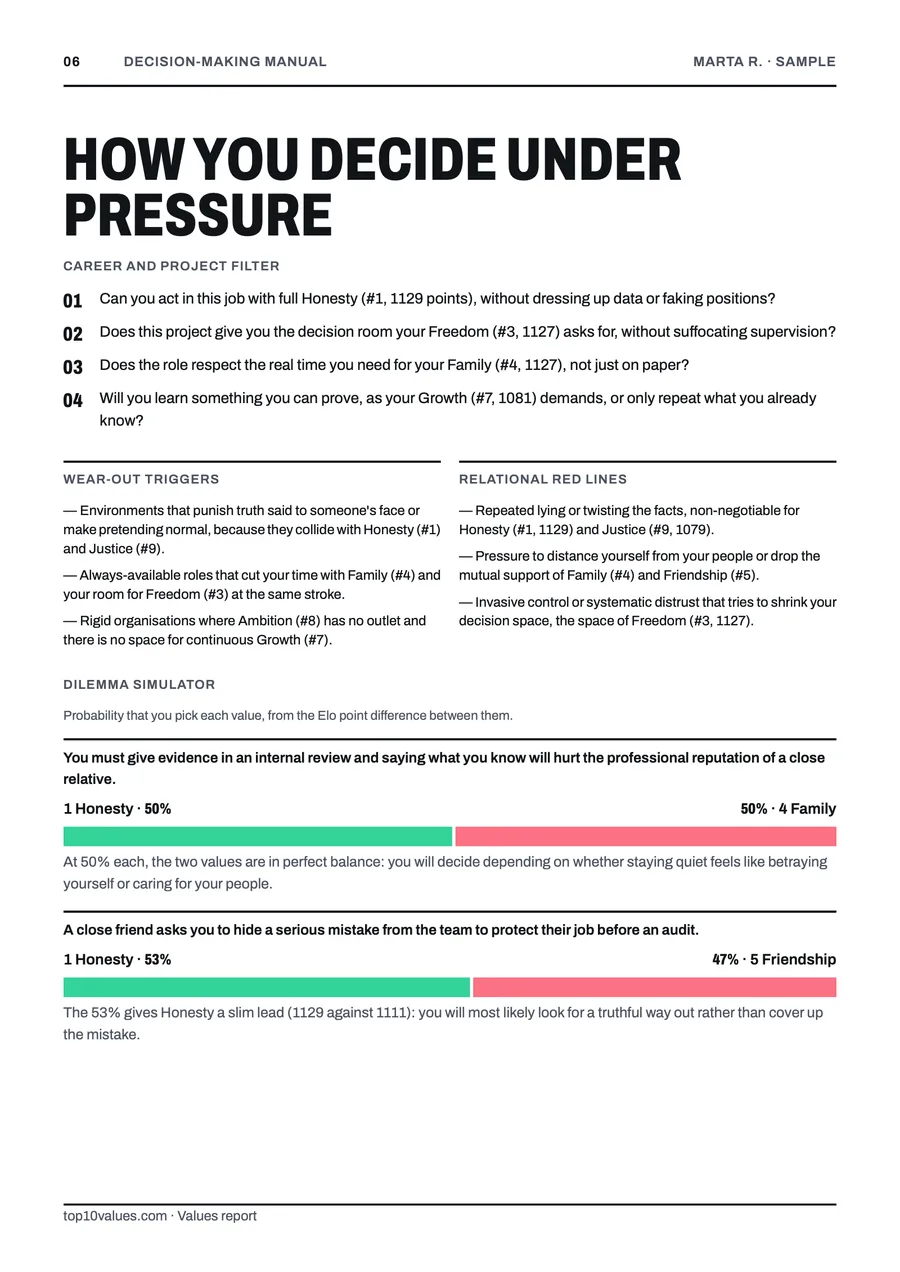
Sample page with fictional data (Marta R.), not yours. Your report is written from your own choices.