Relationships
Love
Deep emotional connection.

Love, understood as deep emotional connection, is the priority of bonding intimately with other people beyond the social surface. People who value love look for romantic, family or close relationships with genuine vulnerability, mutual care and emotional commitment sustained over time. This value shapes entire life decisions: where to live, which job to accept or how to divide free time are often subordinated to protecting those bonds. Prioritizing love doesn't imply dependence, but recognizing that your own wellbeing is intertwined with that of the people you choose to keep close on an ongoing basis.
What does this value mean?
Love, as a value, means treating intimate bonds as a real priority: relationships in which you let yourself be known without masks, look after the other person, accept being looked after, and keep your commitment when it no longer feels easy or fun.
It stands for the conviction that a full life runs through other people, and that loving is something you do as well as something you feel. The feeling comes and goes; what stays is what you do on an ordinary Tuesday: asking how the medical check-up went, leaving the coffee ready, hearing the same worry for the third time without sighing. This value is not limited to romance. It covers children, parents, close friends and any relationship that involves vulnerability and a willingness to keep the bond going over the long term.
What it does NOT mean
It does not mean permanent infatuation, needing someone in order to feel your life is worthwhile, or mistaking intensity for affection. Nor does it mean putting up with anything "for love": jealousy, control, contempt or fear are not proofs of affection. Mature love allows limits, serious disagreements and, sometimes, an honest goodbye when a relationship only does harm. And it is measured not by grand movie gestures but by consistency.
Related concepts
Why might it matter to you?
When people take stock of a life, they tend to mention the same few names: who you shared good news with before anyone else, who you called at three in the morning, who saw you at your worst and stayed. Valuing love means accepting that these relationships don't hold themselves up; they need time, attention and the occasional uncomfortable conversation. It also carries a risk: for someone to know you truly, you have to show what you are ashamed of, and that can hurt if it goes badly. This value reminds you that the exposure is worth it, because the alternative, a well-organised life with nobody who knows how you are, costs more as the years go by.
How can you live this value?
- Name the specifics. Instead of "you're great", say "when you helped me move without being asked, I felt I could count on you". Precision is what makes affection believable.
- Listen without fixing. When someone close tells you something hard, ask "do you want my opinion, or do you need me to listen?" Often they only want company.
- Ask for what you need in plain words: "today I need a hug for a while", "this weekend I'd like it to be just us". Waiting for others to guess is a quiet way of punishing them.
- Repair early after an argument. A single sentence that owns your part ("I took the wrong tone, I'm sorry") before getting into who was right is enough. The longer you wait, the harder the story each of you tells yourselves becomes.
- Look after small rituals: dinner without screens, the Sunday walk, the message when you get home. They are the skeleton of a long relationship and quietly vanish when calendars fill up.
- Let yourself be looked after. Accepting help, a gift or a "rest, I'll take care of it" is also a way of loving, because it gives the other person the chance to give.
Advertisement
What happens when you don't live up to this value?
If this value drops into the background, life can run very well on the outside and feel empty inside: a full calendar, plenty of contacts, few people who know how you really are. Accompanied loneliness appears, the kind where you laugh at dinners and go home with nobody to tell what matters. Relationships turn logistical (who picks up, who pays, who shops) and conversations shrink to coordination. Other times the symptom is a shell: you joke, help and organise, but when someone approaches the intimate you change the subject.
The healthy side and the shadow
When does this value stop helping you and start limiting you?
Healthy expression
Devotion with autonomy
In excess
Emotional dependence
Love becomes unbalanced when your wellbeing depends entirely on how another person treats you: you need constant reassurance, stop seeing your friends, drop hobbies, excuse disrespect or stay in a relationship that dims you out of fear of being alone. There is also a version that looks generous: loving so much that you decide for the other person, shield them from everything, or make their life so comfortable they never face anything. The line is whether the bond helps you grow or makes you smaller, and whether both sides can be who they are without fear of losing affection.
This value at work
At work you look for warm relationships and struggle with purely transactional ones. You are often the one who remembers a colleague's birthday, stays a little longer with someone who has had a bad day, and says thank you with names and specifics. That builds teams with trust, but it has a cost: you may take a criticism or someone else's layoff to heart, and find it hard to deliver bad news to people you like. It helps to separate affection for people from the professional decisions that sometimes have to be made, and to remember that giving clear, respectful feedback is also a form of care: avoiding it out of kindness usually costs the person receiving it more.
This value in relationships
In friendship you look for depth rather than numbers. You would rather have three people to talk to about anything than a large group where nobody knows how you really are. It matters to you that trust runs both ways, and a friend who vanishes hurts you more than one who argues. Watch the opposite risk: expecting every friendship to match the level of intimacy you offer can overwhelm people who show affection more quietly. Some people show it by fixing your computer or remembering your allergy, and they love you no less for it.
This value in love
In a couple, love is a shared project for you and not only a feeling. Everyday gestures (how you are greeted, whether your worries are remembered, whether someone asks about yesterday's meeting) matter more to you than spectacular surprises. Over the years that approach protects against empty routine, but it demands maintenance: talking about money, the division of chores, desire, children or not having them, and doing so before wear and tear decides for both of you. The risk is putting the relationship above everything and forgetting yourself: when your partner is your only source of plans, mood and opinion, every disagreement feels like a threat.
This value in family
In your family you express love through presence and patience, including with those who don't think like you. You know that loving someone doesn't require agreeing with them, and that lets you keep bonds others would write off: the father who can never say "I love you" but calls every Sunday, the brother you argue politics with and would still drive to the airport at dawn. With children, love is tested at the limits: saying no, holding a rule and enduring their anger without withdrawing affection. With ageing parents, love sometimes means reversing the roles without humiliating them.
This value and yourself
Having love among your core values says you measure your life by the quality of your bonds more than by your achievements. You are probably someone people turn to when they need to feel heard, and it may be harder for you to receive care than to give it. It is worth asking whether you give from abundance or from a need to be indispensable, because someone who needs to feel essential ends up exhausted and sometimes creates dependence in others without meaning to.
What are you willing to sacrifice for this value?
Would you change city, job or plans for a relationship? And for a friend going through a crisis? Think of the last thing you gave up for love and how you remember it. If you feel at peace and would do it again, this value is well directed. If you felt you were losing yourself, kept quiet about what you thought, or nobody noticed, you may be confusing love with fear of losing someone. A healthy sacrifice is negotiated and acknowledged out loud; one made in silence usually comes back later with interest.
Signs you're betraying this value
You go against this value when you take the people you love for granted, when they only appear in your life if you have spare time, or when silence replaces conversation as a form of punishment. Also when you look at your phone while someone tells you something important, keep grudges as bargaining chips in an argument, or stay in a relationship out of convenience, with no real affection on either side. Vanishing without explanation ("ghosting") on someone with whom there was intimacy is another kind of betrayal, even when done politely.
Turning the value into goals
Value
Love
Behavior
Express affection in concrete words and gestures, instead of waiting for the other person to guess
Goal
This month, have an honest conversation with someone important about how the relationship is going and what each side needs
Habit
Every day, one small, specific message or gesture to someone you love, not a calendar-driven greeting
Questions to reflect on
- Who are the three people you love most, and how much quality time did you give them last month?
- What is harder for you: giving affection or letting yourself be cared for?
- Is there a relationship in which you are making yourself smaller so that it works?
- What would someone who has watched you argue say about how you love?
- Which sentence is hardest for you to say out loud to someone dear, and what do you think would happen if you said it?
- What would you tell someone you love if you knew you would never see them again?
How much are you living this value?
Give yourself a score from 1 to 10 for how visible the love you feel for your people is in this week's calendar and gestures. Then pick one person from your list and do something concrete for them today, however small. Scores are only useful if they end in a gesture.
When two values clash
Love often clashes with Freedom and Independence: committing to someone means giving up options, negotiating plans and adapting to another pace. It clashes with Ambition too, when work takes the hours and energy the relationship needs and the person you love ends up with the leftovers. With Honesty the tension is delicate: a hard truth can wound, and keeping quiet out of tenderness can be a slow way of drifting apart. With Authenticity the doubt is how much of yourself you can show without risking the bond, and how much you are trimming away to fit in. With Respect the line is clear: nothing that involves control, humiliation or fear can be called love. There is no formula. It usually helps to decide together what is non-negotiable for each side and what can be taken in turns, instead of one person always giving way without saying so.
Is “Love” one of your top 10 values?
Find out by playing and comparing this value with the other 49
How the Elo ranking works and its limits in the methodology.
What does the paid report include?
When you finish the 100 comparisons you will see your Top 10 on screen. If you want to go further, there is a PDF report on your personal values: €9.95 (VAT included), one-off payment. To buy it you need to save your game with a Google account.
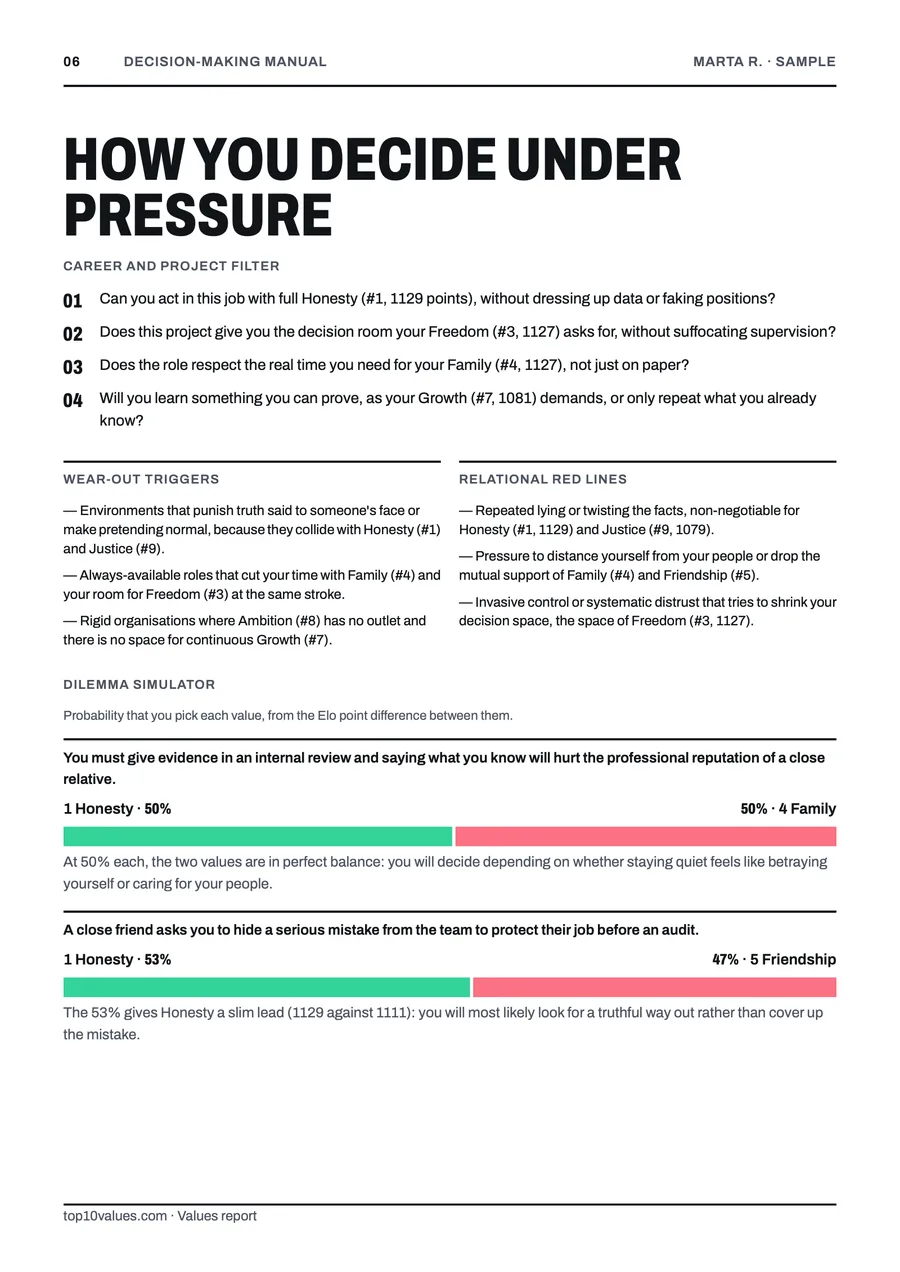
Sample page with fictional data (Marta R.), not yours. Your report is written from your own choices.
Frequently asked questions
Does valuing love mean needing a partner?
No. The value is about intimate bonds in general: close friends, family, children, a partner. Some people live it intensely without a partner, and some people with a partner barely cultivate it. What matters is whether there are people with whom you are vulnerable and whom you care for steadily.
How can I tell love from dependence?
A useful clue: in love you still have a life of your own (friends, hobbies, opinions) and the relationship enriches it. In dependence, your mood and decisions revolve around the other person, and fear of losing them weighs more than the enjoyment of the relationship. Another sign: if you can't imagine disagreeing without everything falling apart, there is probably more fear than love.
Can you love someone and still leave the relationship?
Yes. Caring for someone is not enough when values are incompatible, disrespect is repeated or life plans don't fit. Ending a relationship clearly, without humiliation and acknowledging what was shared is compatible with this value, and is often more honest than dragging it out of guilt.
What if the other person doesn't show affection the way I do?
Before concluding that they love you less, ask which gestures come naturally to them and which are hard, and tell them with examples which ones you need. Some people show affection through practical actions and others through words; understanding each other usually takes translation, not a change of person. If, after speaking clearly, there is no willingness to meet you partway, that is worth paying attention to as well.
How do I look after love when I have little time?
Put regularity before duration: ten minutes of full daily attention are worth more than one getaway a year. Protect two or three fixed rituals, say so when you are going to be away, and don't use tiredness as a permanent excuse. If the calendar leaves nothing, the pending conversation is a different one: what are you sacrificing, and do you want it to be that way?
When Love clashes with…
Invented scene. Inés is offered two years in Rotterdam, in the lab she has dreamed about since university. Marcos has just opened his carpentry workshop and cannot move it. Love does not ask either of them to give up everything, but it cannot settle on its own who gives way. Inés's ambition says this chance will not return and that, if she stays, she may resent it in silence. Marcos's freedom reminds him that following her would mean starting from zero for someone else's project. The hard part is not the distance but that each is trying to spare the other their own disappointment and ends up never voicing it. Before deciding, write separately what leaving would cost and what staying would cost, then compare the lists out loud. More situations in conflicting values.