Relationships
Empathy
Understanding others emotions.

Empathy is the ability to genuinely recognize and understand what another person feels, putting yourself in their perspective without having to have lived exactly the same thing. People who value empathy listen with real attention, validate other people's emotions before giving advice, and adjust their communication to the emotional state of the person in front of them. This value is fundamental for building trusting relationships and for leading teams with human sensitivity, not just technical effectiveness. Empathy, properly understood, doesn't mean carrying someone else's suffering as your own, but accompanying them from a place of understanding, which is usually more useful than offering quick solutions without having fully listened.
What does this value mean?
Empathy is picking up on what someone else is feeling and why, and letting that shape how you speak to them and what you do, even if you wouldn't feel the same way. It has two sides worth telling apart: understanding what is going on for someone, the more cognitive part, and feeling something of their emotion, the more affective part. As a value, what counts is what you then do with it.
At its core is a choice: to look at a situation from inside another person's shoes before you judge it. People who put empathy first ask "what's going on with them?" when someone snaps, turns up late or falls apart over something that looks small from the outside. You see it in ordinary moments: slowing down when you talk an elderly neighbour through a banking app that is clearly stressing them out; realising that the colleague tearing into your proposal has just come out of a bruising appraisal; steering the conversation away from wedding plans when a friend has recently split up.
What it does NOT mean
Empathising doesn't require agreeing, excusing everything or carrying other people's feelings around as if they were yours. Nor is it handing out quick advice: "if I were you…" usually says more about you than about them. It isn't the same as being emotional or soft-hearted either: some very emotional people barely listen, and some quite reserved people read others with real accuracy. And understanding someone well is no guarantee of treating them well. A pushy salesperson or a manipulative partner can read feelings precisely in order to use them. Empathy as a value includes a commitment not to exploit what you pick up.
Related concepts
Why might it matter to you?
Plenty of everyday conflicts come not from what was said but from how it landed. Empathy lets you read what sits behind a "whatever" or a slammed door and respond to that rather than to the surface. It also pushes back against a very human habit that social psychologists call the fundamental attribution error: putting other people's behaviour down to their character ("he's just rude") and your own down to circumstances ("I was in a rush"). Stepping into someone's position doesn't mean taking their side, but it gives you information you wouldn't otherwise have: why a customer is about to leave, why your teenager has gone quiet, why a negotiation has stalled. Nor is it a fixed gift. It rises and falls with attention, tiredness and closeness, so it can be looked after or neglected. Those who rank it highly tend to remember someone who didn't get them when it mattered most, or someone who did and turned a bad day around.
How can you live this value?
- When someone tells you about a problem, ask "do you want ideas, or would you rather I just listened?" before offering fixes. A lot of people aren't after a plan; they want to sort out their feelings out loud. Jump to the solution in the first minute and the conversation ends just as it was getting started.
- Swap "it's not a big deal" for a line that names what you notice: "it sounds like this hurt more than you're letting on." You don't have to get it exactly right. If you're off, they'll correct you, and that correction is part of understanding them.
- Before replying to a message that annoyed you, come up with three different reasons the other person might have written it that way: they were rushed, worried, or read something into your last email. The point isn't to make excuses for them, but to avoid answering the worst possible version before you know which one is true.
- Check rather than assume. "Have I got this right? It's not the new rota that bothers you, it's that nobody asked you first" stops you solving a problem they don't have. Playing back what you heard in your own words is the simplest and most underused way of showing you're listening.
- Spend time with people whose lives look little like yours: a different age, postcode, job or politics. It's hard to imagine a place you've never seen. Novels, memoirs and first-person accounts help too, because they keep you inside someone else's life for hours at a time.
- Protect your reserves. If you're supporting someone through an illness, a bereavement or a long crisis, build in time to recover and lean on other people. Empathy stretched without a break tends to end in burnout or in a defensive coldness, and then it helps neither them nor you.
Advertisement
What happens when you don't live up to this value?
Without empathy, conversations turn into taking turns to talk about yourself. A friend shares something sad and you answer with your own story; someone is upset and you correct their facts; you consider a topic closed while it is still raw for the other person. People stop telling you things that matter, not because you are unkind, but because they can tell it isn't getting through. At work it shows up as decisions that look flawless on a spreadsheet and that nobody accepts, because no one thought about how they would feel to the people who had to live with them. And if empathy is one of your core values, you'll feel the gap inside too: a twinge when you remember cutting someone off, or the sense of having been in a conversation without really being there.
The healthy side and the shadow
When does this value stop helping you and start limiting you?
Healthy expression
Understanding with limits
In excess
Emotional sponge and selective concern
Too much empathy means soaking up the mood of everyone around you: a dinner leaves you drained by someone else's problem and you can't say no to anyone who is struggling. It also makes you easy to play: anyone who knows you go soft can get their way with a sad story. Understanding someone doesn't make their life your job to fix. You can stand beside people without carrying them. There is a second, less obvious risk: empathy works like a spotlight, lighting up one person and leaving everyone else in the dark. The psychologist Paul Bloom makes this case in "Against Empathy" (2016): we feel more for the victim with a name and a face than for many anonymous ones, and more for people who resemble us. In experiments by Daniel Batson, stirring up empathy for one particular person led many participants to move that person up a waiting list, at the expense of those ahead of them. The healthy version combines feeling with thinking: let the emotion move you, then ask whether you're being fair to the people who aren't in front of you.
This value at work
You're the one who notices a colleague has been off for days, or that a client is upset about something other than what the email says. That is a real asset in customer-facing roles, sales, healthcare, teaching and any management job. Someone ringing up furious about a bill is often more worried about making rent than about the mistake itself, and responding to that worry takes the heat out of the call. In a negotiation, empathy helps you see what the other side actually needs, which is rarely what they ask for in the opening line. If you manage people, empathy doesn't mean dodging hard conversations; it means having them well: telling someone their role is being cut face to face, with time for questions, rather than hiding behind "it's out of my hands". The risk is becoming the whole team's sounding board, or putting off necessary calls, like flagging weak work, because you don't want anyone to have a bad afternoon.
This value in relationships
With friends, empathy shows up as remembering: asking how the hospital appointment went that they mentioned last week, or noticing someone is quieter than usual. Your friends come to you when things go wrong. A common slip is competitive empathy: a friend tells you about their break-up and you reply with yours, meaning to show you understand. Sometimes that lands, but often it shifts the spotlight onto you. Empathy also means accepting that people process things differently: the friend who jokes their way through a redundancy, or the one who goes quiet for a week, isn't reacting "wrong". And make sure it isn't a one-way street; you deserve to be listened to as well.
This value in love
In a relationship, empathy helps you see that a row about the washing-up is rarely about the washing-up; more often it's about feeling the housework isn't shared. Empathy isn't mind-reading, and "what do you need right now?" beats guessing. It counts in the good moments too: being properly pleased about your partner's promotion, without downplaying it or turning it into a comparison with your own job, is as much empathy as offering comfort. Watch for the opposite trap as well: understanding your partner so well that you stop saying what you need.
This value in family
Empathy is often hardest at home, because you think you know everyone by heart. Your mum is still "the worrier" and your brother "the one who never helps", and those labels stop you seeing what's happening with them now. Try asking a relative how they experienced a period you remember your own way. The story often changes. With children, empathy doesn't mean giving in to the four-year-old who won't leave the playground; it means naming the feeling ("you were having such a good time and you're cross we have to go") and leaving anyway. With ageing parents, it means imagining what losing independence feels like: giving up the car keys or having your children make decisions for you can sting more than the physical limitation itself.
This value and yourself
Choosing empathy as a core value usually means it matters a great deal to you that people feel understood, and that you pick up on tension in a room, or a change of tone in a message, before most people do. Watching someone struggle without stepping in may be hard for you, and cold environments where only results count may wear you down. It's worth asking whether you extend that understanding to yourself: those who empathise most with others are sometimes the slowest to cut themselves any slack, forgiving everyone's mistakes except their own.
What are you willing to sacrifice for this value?
Empathy costs time and comfort: staying when you wanted to leave, hearing out a complaint you think is unfair, sitting through a silence with someone who is grieving without filling it with stock phrases. Would you show up late to something important to stay with someone who is having a hard time? Would you listen properly to the reasoning of someone who votes the opposite way, knowing you won't change your mind? Think of the last time someone needed you at a bad moment. If you were there, even when it was inconvenient, empathy is part of how you act and not just something you believe in. If you gave some quick advice and left, you may admire it more than you practise it.
Signs you're betraying this value
You betray empathy when you say "everyone goes through that" to wrap up a conversation, when you use what you know about someone to hit where it hurts most, or when you decide a person is overreacting without asking how they feel. Also when you save it for people you like and withhold it from those who think differently, or when you feel deeply for strangers on the news and very little for the people you live with. And an uncomfortable one: understanding exactly how someone feels and using it to win the argument, close the sale or make them feel guilty.
Turning the value into goals
Value
Empathy
Behavior
Ask before you advise
Goal
Have a proper conversation this month with someone you tend to judge quickly, with the sole aim of understanding their point of view
Habit
Once a day, sum up what the other person is feeling before you give your opinion
Questions to reflect on
- Whose shoes do you find hardest to step into, and what gets in the way?
- Who do you find it easiest to empathise with, and what do they have in common with you?
- When did you mistake giving advice for listening?
- Whose emotions are you carrying as if they were your own?
- Who have you labelled in a way that no longer fits them?
- Can you remember someone who really understood you at a bad moment? What exactly did they do?
How much are you living this value?
Think of the last three people who brought you a problem. From 1 to 10, how far do you think they left feeling understood, rather than just advised? If it's below 7, try asking two questions this week before sharing anything about yourself.
When two values clash
Empathy clashes with Justice: understanding why someone did something wrong doesn't undo the harm, and sometimes you have to hold accountable a person you fully understand. It also pulls against Honesty, when you know the truth will hurt someone who is already struggling; against Loyalty, when you start to see the point of view of someone who has fallen out with a friend of yours; and against Success and Discipline, because listening well takes time that a meeting or a deadline doesn't always allow. On the other hand, it works well alongside Kindness, which turns what you understand into action, and Respect, which reminds you that understanding someone doesn't give you the right to decide for them. A workable rule is to keep the two stages apart: understand first, decide afterwards. You can say "I can see why you did it" and, in the next breath, "and there are still consequences".
Is “Empathy” one of your top 10 values?
Find out by playing and comparing this value with the other 49
How the Elo ranking works and its limits in the methodology.
What does the paid report include?
When you finish the 100 comparisons you will see your Top 10 on screen. If you want to go further, there is a PDF report on your personal values: €9.95 (VAT included), one-off payment. To buy it you need to save your game with a Google account.
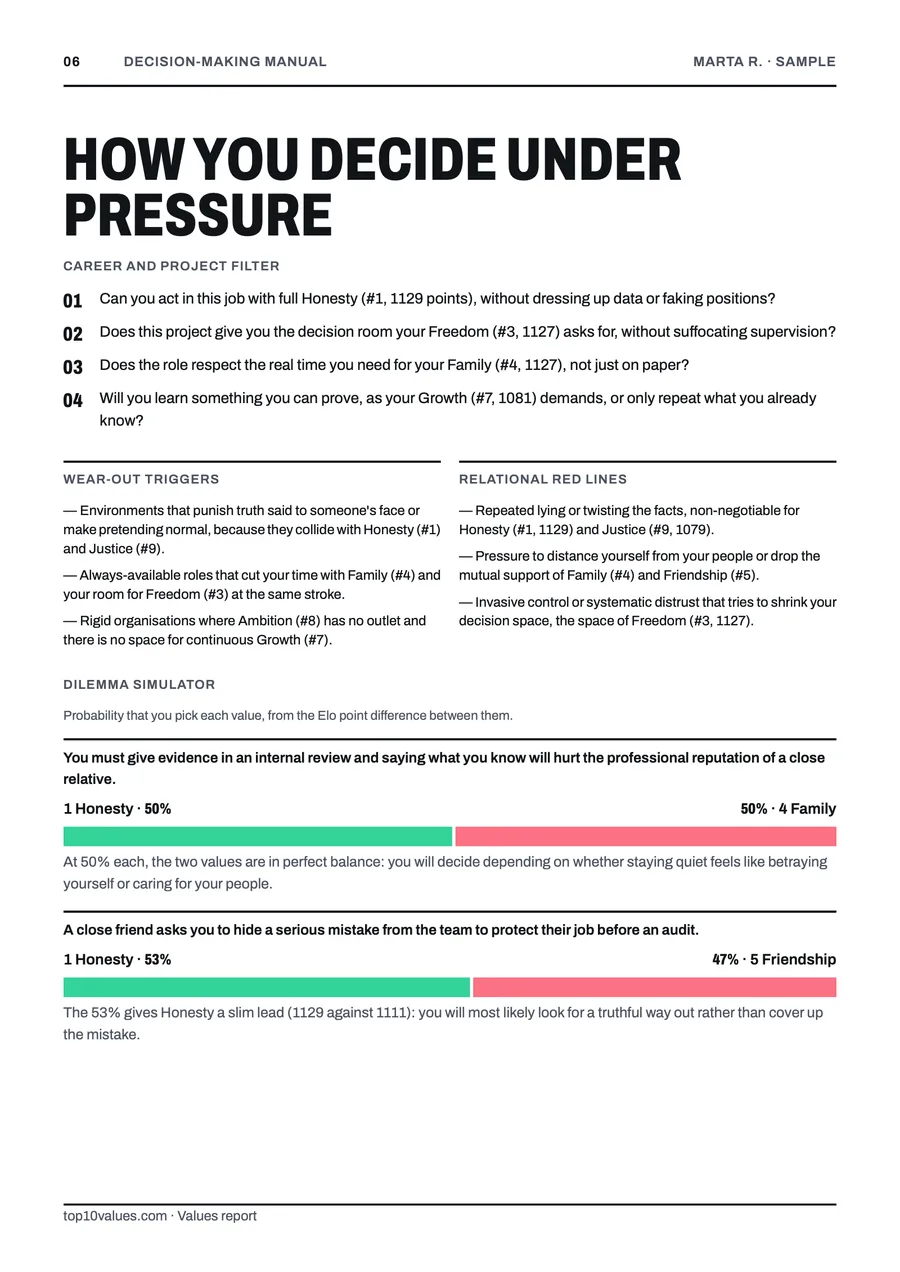
Sample page with fictional data (Marta R.), not yours. Your report is written from your own choices.
Frequently asked questions
Are empathy and compassion the same thing?
They overlap, but they're not identical. Empathy is understanding or sharing what someone else is going through; compassion adds the wish to ease it. The researchers Tania Singer and Olga Klimecki distinguish empathic distress, which makes you suffer alongside the other person and can push you to withdraw to protect yourself, from compassion, which combines concern and a wish to help with a little more distance. That's why you can empathise without acting, and help someone without sharing their feelings.
Can empathy be learned?
It can be practised, like any habit of attention. Listening without rehearsing your reply, asking instead of assuming and getting to know lives unlike yours are all concrete ways to do it. Context matters too: almost everyone empathises less well when rushed, tired or stressed, so choosing a better moment for a difficult conversation can do more than simply trying harder.
Is it possible to have too much empathy?
It's possible to feel a lot without the distance you need to help. The warning signs are fairly clear: you come away from certain people drained, you lose sleep over problems that aren't yours, or you agree to requests you can't realistically take on. It's common in caring professions and among people looking after an ill relative. The answer isn't to feel less, but to move from "I'm suffering with you" to "I'm here with you": staying alongside without soaking everything up, and asking for support when you need it.
How do you empathise with someone you disagree with?
Separate the person from the position. You can ask yourself what experience or fear sits behind a view you think is wrong without adopting it. A useful question is "what led you to see it that way?", asked out of genuine curiosity rather than as a trap. If, by the end, you can explain their view in a way they would recognise, you've empathised, even if you still disagree.
Can you be empathetic and still set boundaries?
Yes, and boundaries are often what make empathy sustainable. You can say "I can see you're overwhelmed, and I can't stay tonight" without either half of the sentence cancelling the other. Without limits, empathy turns into being permanently on call and ends in resentment. Acknowledging someone's feelings while holding to your decision is a grown-up way of taking both them and yourself seriously.
When Empathy clashes with…
Invented scene. Marisol teaches the final year of high school and is grading a decisive exam. Daniela, a student whose grandmother died a week ago, hands in a weak paper and asks her to mark it kindly. Empathy understands the grief and wants to help her. Justice asks about the other twenty-nine students, who prepared without going through that, and about the university entrance score, which does not take circumstances into account. Honesty points at something uncomfortable: if Marisol raises the mark without saying so, she misleads Daniela about her real level. Feeling what another person feels does not oblige you to fix their life. There is a middle route: offer her a retake on another date, something she would offer anyone in the same position, and support her outside the classroom. More cases in conflicting values.