Personal Growth
Respect
Valuing others.

Respect is the willingness to value other people's dignity, opinions and boundaries, even when they differ markedly from your own. People who prioritize respect listen to different points of view without dismissing them outright, keep the agreements they make with others and avoid imposing their judgment through force or authority. This value is the foundation of any healthy coexistence, in both personal and professional settings, because it allows differences to coexist without automatically turning into conflict. Genuine respect doesn't depend on agreeing with the other person, but on recognizing their right to think, feel or decide differently.
What does this value mean?
Respect is treating every person as someone with a mind of their own and a right to their own boundaries, even when you disagree with them or simply don't like them. It means recognising their dignity, their right to run their own life and their right not to be belittled, in big matters and small ones.
It stands for the decision that other people's dignity doesn't depend on their opinions, their job title or how useful they are to you. People who put respect first judge themselves by how they treat those who can do nothing for them: the waiter, the intern, the relative who votes the other way at Christmas dinner. It shows in ordinary moments: knocking before you go into your daughter's room, not reading your partner's phone when they've left it unlocked on the sofa, accepting that a colleague would rather not say why they were off sick, talking your dad through his treatment options instead of choosing for him. Quite often, respect lies more in what you hold back from doing than in anything you do.
What it does NOT mean
It does not mean agreeing with everything, keeping quiet to dodge conflict or doing whatever the most powerful person in the room wants. You can challenge an idea hard and still respect the person who holds it. Nor is it the same as kindness. Kindness sets out to do someone good and usually comes with warmth; respect recognises their right to decide, and can be reserved, even cool. You can be kind and disrespectful, like the neighbour who reorganises your garden as a favour while you're away, and respectful without much warmth, like the consultant who lays out every option in a flat voice and then lets you choose. And respect isn't admiration: basic respect is owed to everyone, while admiration has to be earned.
Related concepts
Why might it matter to you?
Respect is what lets very different people live and work side by side without every disagreement turning into a fight. You notice it most under pressure: an argument with your partner, or a group chat split down political lines. It's also what keeps other values from going sour: candour without respect turns into cruelty, and help without respect turns into control. Kant put it as a moral principle: treat people always as ends in themselves and never merely as means, which is to say, never use anyone purely as a tool for your own goals. Day to day, that comes down to plain questions. Did I ask what they thought? Did I take their time into account? Would they be comfortable hearing how I talked about them when they weren't there? Valuing respect usually comes from two needs at once: to be treated as an equal, and to feel at peace with how you treat everyone else.
Advertisement
How can you live this value?
- When someone says "no", treat it as a complete answer. Don't ask three times or demand reasons they don't owe you.
- In an argument, sum up the other person's position in your own words before you push back. If they wouldn't recognise your summary, you haven't understood them yet.
- Be on time, and let people know if you're running late: other people's time deserves respect too.
- Talk about people who aren't in the room the way you would if they were. If a comment only works behind someone's back, leave it out.
- Ask before you advise, help or decide on someone's behalf. "Do you want my take, or do you just need to vent?" stops a friend's offloading turning into a lecture. With older or disabled people it matters even more: speak to them, not to whoever is with them, and explain rather than impose.
- Extend respect to people's digital privacy: don't forward screenshots of private conversations, don't post photos of other people without asking, and don't go through anyone else's devices. Before posting a picture of your children, ask yourself whether they'd be happy to find it at sixteen.
What happens when you don't live up to this value?
When respect slips, it rarely starts with an insult. It shows up in small things: talking over people, scrolling your phone while someone is speaking to you, walking into a teenager's bedroom without knocking, correcting your partner in front of friends. Each one looks trivial, but together they send a clear message: what matters to you counts for less than what matters to me. Over time, people who don't feel respected stop offering opinions, ideas and news, not because they have nothing to say but because they've learned it gets them nowhere. In a team you see it in meetings where the same two people do all the talking; in a family, in teenagers who disappear upstairs; in a couple, in a silence that has replaced the arguments.
The healthy side and the shadow
When does this value stop helping you and start limiting you?
Healthy expression
Consideration with backbone
In excess
Politeness that paralyses
Respect turns into a problem when it gets confused with never rocking the boat: you hold back feedback someone needs "out of respect", or put up with any behaviour because "that's just how they are". There is a rigid version too: demanding respect when what you really mean is obedience, especially from younger people or junior staff. And a third, more comfortable one: the "all opinions deserve respect" line, which confuses respecting people with treating every idea as equally sound. People are always owed respect; ideas get only as much as their arguments earn. Respecting someone includes telling them things they won't enjoy hearing, carefully.
This value at work
It shows in how you treat people further down the org chart and how you behave in meetings: you let others finish and you don't pass off someone else's idea as yours. In practice that means answering emails from people who can't promote you, not booking a 5.30pm Friday meeting unless something is genuinely on fire, naming whoever had the idea when you present it to senior management, and keeping criticism private while praise goes public. If you're hiring, you let unsuccessful candidates know rather than leaving them to work it out from the silence. If you manage people, checking someone's work doesn't require treating them as a suspect. Your challenge is usually setting limits with a client or manager who doesn't return the courtesy. The respect you give doesn't oblige you to tolerate disrespect.
This value in relationships
Your friends know they can disagree with you without losing you. You back their choices even when you wouldn't make them yourself: moving across the country, quitting a secure job, dating someone you have doubts about. You respect their pace as well: the friend who takes days to reply, or the one who needs to be left alone after a break-up, owes you no explanation. And what they tell you stays with you, even when passing it on could be dressed up as "I only mention it because I'm worried". Watch out for polite silence, though. Sometimes respect means asking "can I tell you what I'm seeing?" and accepting the answer.
This value in love
In a relationship, respect lives in the everyday: your tone in an argument, never using something shared in confidence as ammunition, making room for their friends and their time alone. Couples who respect each other can argue loudly without crossing certain lines, such as mockery, constant sarcasm or contempt. The psychologist John Gottman, who has spent decades studying how couples argue, identifies contempt (eye-rolling, sneering, talking down) as one of the strongest warning signs that a relationship is heading for a break-up. Respect between partners also means letting the other person change: their tastes, friendships and plans don't have to stay frozen at the day you met.
This value in family
In families, respect often runs into hierarchy: parents who expect obedience, adult children who want to be treated as equals. Here, respect means accepting that your children will make decisions you wouldn't, and, from the other side, listening to your parents without letting them decide for you. With young children, respect doesn't mean letting them decide everything; it means explaining the rules, apologising when you get it wrong with them and never making fun of them in front of others. With teenagers, privacy carries a lot of weight: their room, their phone, their friendships. With ageing parents the challenge flips: respecting their independence for as long as they can exercise it, even when their choices worry you, and talking it through with them rather than sorting it out behind their backs on the siblings' group chat.
This value and yourself
If respect is high on your list, what you value most in any interaction is probably how people are treated, not just what gets done. You are probably bothered by people who belittle others, interrupt or make fun of them, and you may remember a moment of disrespect for years. You may have a sharp nose for being patronised, and find it as grating to be talked down to as to be ignored. It can also mean that at some point you weren't given that respect, and you want to make sure it doesn't happen again. Check the other side too: if you demand respect strongly, ask whether you give it in equal measure.
What are you willing to sacrifice for this value?
Would you lose an argument, a sale or the approval of a group rather than humiliate someone? Think of the last time everyone in a conversation was laughing at a person who wasn't there. If you stopped the joke, respect already shapes how you act. If you joined in, you may value respect more when you receive it than when it's your turn to give it. Respect also costs something in small ways: giving up the last word, accepting your grown-up son's "no" about how he's planning his wedding, letting a colleague finish a slow explanation without completing their sentences for them.
Signs you're betraying this value
You drift from respect when you make a decision for someone "for their own good" without asking them, when you answer a simple question with sarcasm, or when you are charming to your boss and curt with the delivery driver. Another sign is lumping whole groups together under dismissive labels ("the interns", "pensioners", "people from that estate") that you'd never use to a specific person's face. You also betray it when you don't respect yourself: saying yes to everything and then resenting that nobody notices your limits.
Turning the value into goals
Value
Respect
Behavior
Let people finish before you respond
Goal
Go a full month without interrupting anyone in meetings or at family meals
Habit
Each evening, recall one conversation from the day and ask whether the other person felt heard
Questions to reflect on
- Who do you treat with less respect than you would want for yourself, and why?
- Whose boundary do you find hard to accept without trying to negotiate it?
- When have you called it "respect" when you were really just afraid to speak?
- Which opinion you disagree with could you explain well enough that someone who holds it would nod along?
- Which of your own limits have you stopped defending because it felt awkward?
- Who did you give unasked-for advice to this week?
How much are you living this value?
Give yourself a mark out of 10: how does the way you treat people who can do nothing for you (whoever serves you, the newest person on the team, whoever keeps you waiting) compare with how you treat those who can? Under 7? Start small: learn the name of someone you see every day and use it.
When two values clash
Respect often clashes with Honesty: do you tell your brother you think he's making a mistake with his kids, or do you accept that they're his kids? It also pulls against Justice, when someone you look up to has treated another person badly and it falls to you to say so. With Kindness the tension is quieter: the urge to help can trample someone's autonomy, as when you do your child's homework or fix a problem a colleague wanted to solve on their own. With Freedom it surfaces when your way of living bothers other people, from music through the party wall to a speakerphone call on a packed train. With Loyalty, when a friend humiliates someone and staying quiet feels like the loyal thing to do. It works well with Empathy, which helps you find out what respect looks like to each person, because it isn't the same for everyone: for some it's punctuality, for others it's not being offered advice they didn't ask for. It usually helps to separate the person from the behaviour: you can respect someone and still tell them plainly that what they did wasn't okay.
Is “Respect” one of your top 10 values?
Find out by playing and comparing this value with the other 49
How the Elo ranking works and its limits in the methodology.
What does the paid report include?
When you finish the 100 comparisons you will see your Top 10 on screen. If you want to go further, there is a PDF report on your personal values: €9.95 (VAT included), one-off payment. To buy it you need to save your game with a Google account.
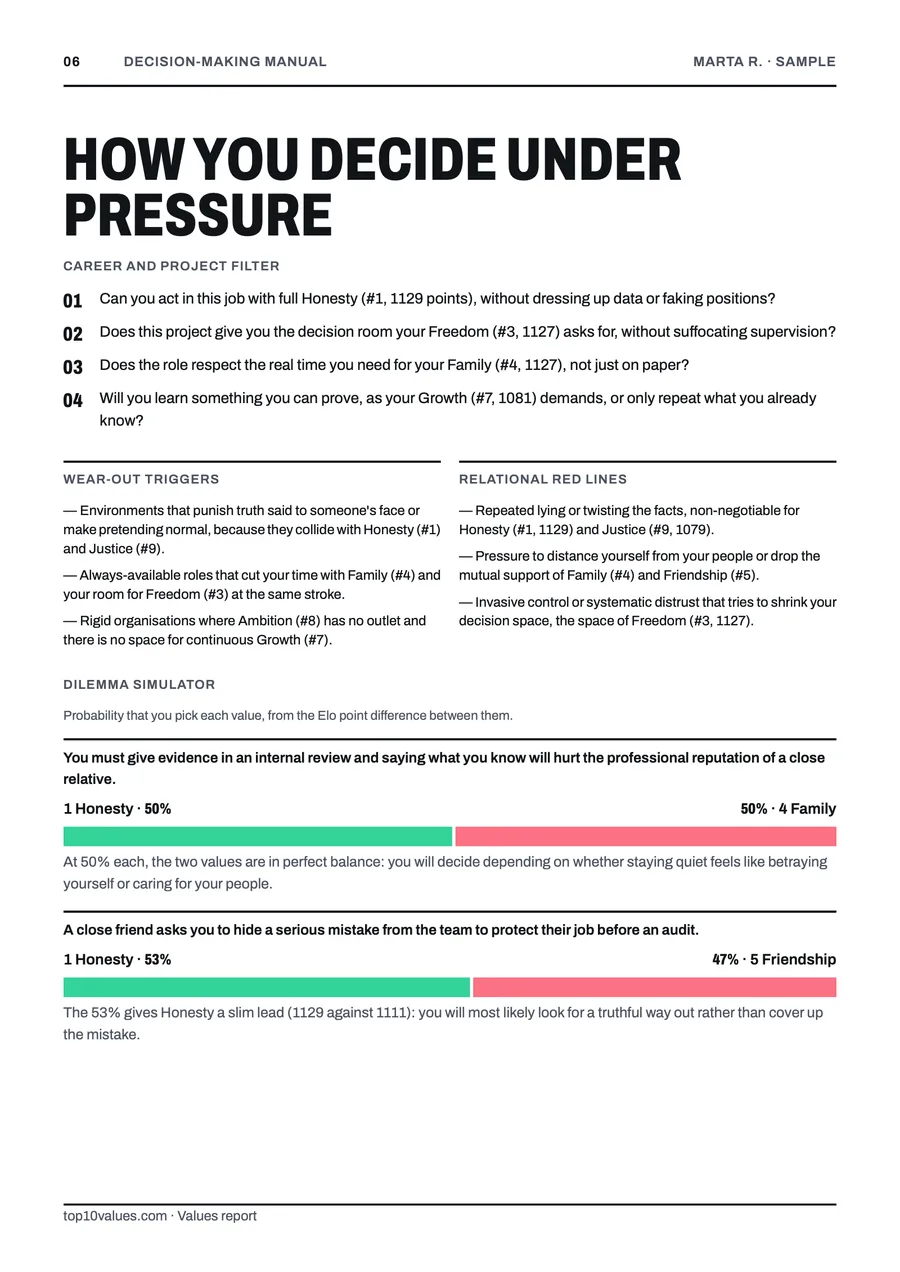
Sample page with fictional data (Marta R.), not yours. Your report is written from your own choices.
Frequently asked questions
Is respecting someone the same as tolerating them?
Not quite. Tolerating means putting up with something you dislike; respecting means recognising that the other person has a right to think or live differently, even if you don't share their view. You can tolerate someone with contempt, but you can't respect them with contempt. That's why an office where people merely tolerate each other can feel cold and tense, while one built on respect lets people disagree without fear.
Should you respect people who don't respect you?
You can stay civil with them without accepting poor treatment. Respect isn't passivity: it includes setting limits or cutting contact. What respect rules out is paying the humiliation back. Holding on to your standards when someone else has dropped theirs isn't weakness; it means they don't get to decide how you behave.
Is respect earned or given?
Both, because the word covers two different ideas. The philosopher Stephen Darwall separated them in a 1977 paper, "Two Kinds of Respect": recognition respect, owed to anyone simply because they are a person, and appraisal respect, the esteem someone earns through their qualities or achievements. You might not rate a colleague at all and still owe them decent treatment. Blurring the two produces lines like "respect has to be earned", which sometimes serve as cover for treating the new starter badly.
How do you ask for respect without sounding aggressive?
Describe the behaviour, its effect and what you want, without labels: "When you cut in during meetings I can't finish my point; I'd like you to let me get to the end." That works better than "you're so rude", because it points to something the other person can actually change. If it happens again, flag it calmly in the moment ("let me finish, please") and, if nothing changes, raise it with whoever is responsible. Asking firmly isn't aggression; aggression is humiliating someone while you ask.
What does self-respect look like?
It's giving yourself the treatment you stand up for on behalf of others: not accepting comments you wouldn't let anyone make to a friend, keeping the commitments you make to yourself and holding your boundaries even when that disappoints someone. It shows in concrete things, like leaving a conversation where you're being mocked, or not apologising for asking for what you're owed. Without self-respect, respect for others tends to slide into deference.
When Respect clashes with…
Saying what you think without disrespecting the other person.