Personal Growth
Authenticity
Being true to yourself.

Authenticity is the commitment to act, speak and decide in line with what you truly think and feel, even when that means going against the current. People who prioritize this value avoid playing a role just to fit in socially and prefer to show up as they are, contradictions included. This doesn't mean having no filter; it means refusing to wear a permanent mask. Authenticity first demands self-knowledge—knowing what you really think—and then the courage to hold to it under outside pressure. Over the long run, living authentically reduces the emotional toll of maintaining an image that differs from your real identity.
What does this value mean?
Authenticity means that what you say, what you do and what you actually think point in the same direction, even when a different version of you would be better received. It doesn't require telling everything or being identical in every setting; it requires that what you show is true, and that your actions answer to what you value and not only to what is expected of you.
It stands for refusing to play a part just to be accepted. People who put authenticity first give their real opinion even when the room leans the other way, admit when a career or a relationship no longer fits, and don't fake enthusiasm they don't feel. It isn't about telling everyone everything; it's about making sure what you show is true. You can keep something private and still be authentic. What doesn't fit is claiming the opposite of what you believe. It is measured in small gestures: saying "I don't fancy that plan" without inventing an excuse, admitting you haven't read the book everyone is talking about, or owning up in an interview that you don't know a tool instead of dressing it up. Philosophy has turned the idea over for centuries. In Hamlet, Polonius tells his son "to thine own self be true", though the advice comes from a character who spends the play spying and scheming, which says something about how easy the idea is to quote and how hard to practise. Jean-Paul Sartre used the term "bad faith" for the self-deception of hiding behind a role ("that's just how I am", "my job requires it") so that you never have to admit you could choose otherwise. And the philosopher Charles Taylor, in The Ethics of Authenticity (1991), argued that being true to yourself doesn't mean inventing yourself from scratch but recognising what matters to you within a shared world of people, traditions and commitments; without that background, authenticity shrinks into whim.
What it does NOT mean
It does not mean blurting out whatever crosses your mind and calling it "just being myself". Telling a colleague their presentation was a disaster because "that's how I am" isn't authenticity; it's carelessness with a flattering label. Nor does it mean freezing the person you were at twenty. Changing your mind, your tastes or your city doesn't make you fake, as long as the change is real and not simply a new costume. It isn't rebelliousness either: contradicting people systematically is another way of depending on what others think, only in reverse. It doesn't mean putting your private life on display: you can be very reserved and perfectly consistent. And it isn't a hunt for a "true self" hidden somewhere and waiting to be found; more often it emerges as you decide, get things wrong and correct course.
Related concepts
Why might it matter to you?
Keeping up an image that doesn't match who you are is exhausting. You have to remember what you told whom, watch every gesture and worry that someone will spot the crack. Authenticity takes that effort off your plate and gives the energy back to things that matter. It also changes what affection means: you can only be loved for what you actually show, and if people love a character, the warmth never quite lands on you. Valuing it often grows out of a stretch spent pleasing everyone, perhaps at work, in a relationship or at home, and noticing the emptiness of nobody knowing who you really were. Think of someone who studied what their parents wanted, moved in a circle where people joked about things they didn't find funny and, around thirty, realises they haven't made a single decision in ten years that started from a wish of their own. It matters for the people around you as well: a team in which nobody says what they think takes worse decisions, and a friendship in which each person plays a part is company without intimacy. Authenticity is also contagious: when someone calmly says "I'm not sure about this", others dare to admit they aren't either. And it gives you a decision test. Faced with a choice, you ask not only what will look best but what you could stand behind without feeling you are betraying yourself.
How can you live this value?
- Before answering "I don't mind" or "whatever you all want", check whether it's true. If you do have a preference, say it, even about something small like where to eat. Small preferences are the best training: they cost little and, over time, you get used to your voice counting.
- When something bothers you, say so within a day and calmly, rather than storing it until it explodes or turns into distance. A formula that helps: "when this happened, I felt this, and I'd like...". Talk about what occurred and what you felt, not about what the other person is like.
- List three things you do only because they're expected of you: a friendship group, a commitment, a habit. Pick one to drop or change this quarter. You don't need to break anything noisily; sometimes it is enough to space a plan out or to say you won't be going this year.
- Tell one trusted person something you normally hide, such as not enjoying your job as much as you let on, and notice that the world carries on. Choose someone who can listen without trying to fix your life; if the reaction is good, the next confession will cost less.
- When someone asks your opinion in a meeting, give the one you have, not the one you think the boss wants. If you need time, say "let me think about it and get back to you tomorrow." Asking for time is authentic; improvising an agreement you don't feel is not.
- Look at your social media. If the person there wouldn't be recognisable to your close friends, start by sharing something ordinary and unfiltered. You don't have to confess anything: it is enough that what you post is true and not so carefully selected that it no longer represents you.
- Tell apart what you want from what you want people to think of you. Before buying something, accepting a challenge or signing up for something, ask yourself: "would I do this if nobody ever found out?" If the answer is no, perhaps what you want is the photo, not the experience.
- When you change your mind, say so plainly and explain why: "I used to think this; after what has happened, I think that". Changing position in plain sight is a form of consistency, not inconsistency.
Advertisement
What happens when you don't live up to this value?
Without authenticity you end up living in translation mode: before speaking you work out which version of you is most convenient, and over time you lose track of which one is yours. You say yes to plans you don't want, laugh at jokes that make you uncomfortable and nod along with opinions you don't hold. A tiredness builds up with no obvious cause, along with resentment towards people who never knew what you wanted because you never told them. Big decisions, like a career or a partner, get made on autopilot, and years later you discover they were somebody else's. The signs are discreet: relief when a plan you agreed to gets cancelled, the feeling of getting home and taking a character apart, dread at the thought of two groups of friends meeting because you are a different person with each. In the long run intimacy suffers: the people who love you don't know who they love, and you can't quite believe their affection because you know it is aimed at a trimmed version. Someone who lives like this can also lose the ability to know what they like; after years of choosing whatever pleases, the question "what do you prefer?" stops having an instant answer. Getting it back takes time, and it starts with small things.
The healthy side and the shadow
When does this value stop helping you and start limiting you?
Healthy expression
Consistency with tact
In excess
Unfiltered bluntness
Authenticity goes wrong when it becomes a licence to be inconsiderate: "that's just me" turns into an excuse to change nothing and let others absorb your bad moods. It also goes wrong in the opposite direction, when you cling to a rigid identity ("I'm a country person, don't ask me to attend a formal dinner") and refuse to grow because growing would mean no longer being who you think you are. The healthy version separates being true to your values from being true to your habits. The first deserves defending; the second deserves a second look. There is a third, more modern drift: authenticity as a personal brand. When every confession is calculated for its effect, sincerity turns into performance. The critic Lionel Trilling, in Sincerity and Authenticity (1972), traced how modern culture moved from prizing sincerity towards others to prizing fidelity to oneself; today the temptation is to turn that fidelity into a brand. It is also worth distrusting authenticity that is only demanded of other people: "just be yourself" often means "be the way that suits me". A useful test: does what I'm about to say serve the person listening, the relationship, or only my need to let off steam? If it is the last, it probably pays to wait or to find another outlet.
This value at work
At work, authenticity shows in not changing personality depending on who is in front of you: you are recognisably the same person with the director and with the intern. You can say "this deadline isn't realistic" before anyone else has dared to, or turn down a project that clashes with what you stand for. It also appears in less heroic details: asking for an instruction to be repeated instead of nodding without having understood it, admitting to your team that you got something wrong before somebody else finds out, or saying you have no experience in a subject instead of bluffing with confidence. The risk is naivety. Not everything you think needs saying at that moment or to that person, and choosing when and how to speak doesn't make you fake. A useful test is whether what you're holding back is discretion or fear. In interviews, authenticity doesn't mean confessing flaws indiscriminately but avoiding the inflated version of yourself; it is better to be hired for what you are than to find out three months later that the role needs someone else. If you lead, your authenticity sets the climate: a manager who admits doubts and mistakes gives others permission to do so, and one who demands transparency while hiding information drains the word of meaning. Be wary of company cultures that say "bring your whole self to work" and punish disagreement; it is an invitation with small print. Before committing, watch what happens to the person who openly dissents.
This value in relationships
In friendship, authenticity tends to give you fewer relationships, but sturdier ones. At some point you stop going to dinners out of duty and laughing out of politeness, and some friendships cool. That is often a sign they were resting on the character. The people who stay actually know you. Be careful not to turn every chat into a confession: being authentic with someone doesn't mean telling them everything at once, and trust is built in layers. A common example: a friend asks what you think of her new partner and you have doubts. Being authentic doesn't mean blurting "I don't like him"; it means not faking enthusiasm, asking how she feels and keeping your opinion for when she really asks for it or when you see something that truly harms her. It also counts when a friend tells you about a risky plan: flattery is comfortable, but real friendship includes saying "I see it with these doubts, and I'm still behind you". Another side is how you handle your own changes: if you stop drinking, stop going to certain places or stop sharing certain views, your friendships will rearrange themselves, and nobody needs to be blamed. And finally, authenticity in today's friendship networks: do you speak with the same nuance in the group chat as in a dinner for two? If the gap is large, it deserves attention.
This value in love
In a relationship, authenticity starts early and it's hard: showing that commitment scares you, that you have a past you're not proud of, or that sometimes you don't know what you want. Playing the perfect partner for the first few months creates a relationship with two actors, and sooner or later one of them gets tired. Talking about what you feel rather than what you "should" feel is awkward at first and saves you long misunderstandings. It also means allowing your partner to be authentic with you, even when what they show isn't what you expected. Concrete situations: saying you don't want to mark an anniversary with an expensive dinner and suggesting something else; admitting that you don't want children, or that you do, before time decides for you; recognising that you need more time alone than your partner imagined; confessing that a taste you pretended to share isn't one you share. The couples who last best aren't the ones who never disagree but the ones who can disagree without either fearing they will lose the other. One important caution: authenticity is not cruelty in intimacy. Saying "I don't feel the same any more" is sincere, but it deserves care in timing and manner; saying it mid-argument, as a weapon, is something else. And if you find you have changed so much that the relationship no longer represents you, authenticity asks you to face it clearly and respectfully instead of letting it fade out in silence.
This value in family
Family is where assigned roles weigh the most: the responsible sibling, the daughter who never causes trouble, the one who always jokes. Being authentic can mean tactfully breaking that script, for instance by saying you won't spend every holiday with them, or that your life won't follow the path they imagined. Some will take it as a reproach. It usually helps to explain that you're doing it to be truly present rather than present out of obligation, and to hold that line patiently across more than one conversation. Some delicate ground: telling your parents you don't practise the religion you were raised in, that your orientation or way of living isn't what they expected, that you have left the family profession or the business everyone assumed you would inherit, or that your marriage is struggling. Not every family reacts the same way and it isn't always wise to say everything at once: you can go in stages, start with the most receptive person, and think about what safety net you have if the reaction is bad. With your children, authenticity works by modelling: they can learn more from hearing you say "I got that wrong, I'm sorry" than from a speech about honesty. And with older relatives, authenticity also means not imposing your new version all at once; sometimes it is enough to show, consistently, that you are still the same person who loves them, even if you think differently.
This value and yourself
Having authenticity among your values suggests that you're put off by anything staged, that you find faking hard, and that you've probably had a moment when playing a part cost you something. You may spot insincerity in others quickly, and certain settings, like work dinners where everyone exaggerates how well they're doing, may wear you out. It's worth asking yourself whether you demand a transparency from other people that you don't offer, or whether you use the word "authenticity" to justify behaviour that is really just convenience or impulse. Notice the situations in which it is hardest to be yourself: with authority, with family, with people you are attracted to, in large groups? That map shows you where your fear of not being accepted sits. You probably find it easier to say an awkward truth than to fake a joy you don't feel, and you may be more at ease with a few people who know you than with many who applaud you. If you meet someone else who values authenticity, you will probably understand each other without detours, but you may also say hard things with too little tact; practising a filter on delivery will spare you some quarrels.
What are you willing to sacrifice for this value?
Would you accept losing a group's approval to stand by an opinion you truly hold? Would you leave a well-regarded job for one that represents you better, even if it pays less? Would you tell your family you've changed direction, knowing not everyone will applaud? Would you give up an image you have cultivated for years if it stops you being consistent? Think about the last time you stayed quiet about something important in order to be liked. If it stung and you would still do it again, authenticity may not yet weigh as much as you think. The price of this value is usually relational: fewer invitations, a friendship that cools, a hard conversation with someone you love. It helps to decide in advance what price you accept, because in the heat of the moment almost everyone backs down.
Signs you're betraying this value
You betray authenticity when you change your opinion depending on who is listening, when you embellish your life on social media or in an interview, when you say "I'm fine" knowing it isn't true, and when you accept a role in your family or team that doesn't suit you just to avoid conflict. You also betray it when you use frankness as a weapon: saying something true with the sole aim of hurting takes you as far from honesty as lying does. Other signs are laughing at a joke that hurts you so as not to seem sensitive, showing enthusiasm for something that leaves you indifferent, buying or doing things with an eye on how they will look in a photo, adopting the group's opinions so as not to stand out, or retreating to "that's just me" every time someone asks for a small change. And a subtle one: when you notice you are explaining yourself too much, you may not be saying what you think but what you believe will be accepted.
Turning the value into goals
Value
Authenticity
Behavior
Give your real opinion when asked, instead of the one that will go down well
Goal
Hold, within this month, the conversation you've been postponing with someone whose reaction you fear
Habit
Each evening, note one moment of the day when you said or did something you didn't feel, and what you would have said instead
Questions to reflect on
- With which people or in which places are you clearly a different version of yourself, and what does that version give you in return?
- Which important decision in your life did you make to meet someone else's expectations?
- Which truth about yourself is hardest to admit, even privately?
- When have you used "that's just how I am" to avoid changing something you could change?
- If nobody were going to judge you for a year, what would you stop doing and what would you start?
- Which opinion do you defend in public that you don't entirely hold, and whom are you trying to please with it?
- What role were you assigned in your family or friendship group, and which part of it do you still play out of habit?
How much are you living this value?
On a scale of 1 to 10, how closely does the person your loved ones see match the person you are when you're alone? If it's below 7, pick one area, such as work or family, and this week begin by saying one true thing you would normally hold back. Then do the reverse check: how many times this week did you say "yes" while thinking "no"? Simply counting them, without judging yourself, is a first step.
When two values clash
Authenticity collides with Respect and Kindness when the truth you hold could hurt: telling a friend her new business looks risky is sincere, but it may be neither kind nor well timed. Loyalty brings another clash, because a close family or team sometimes expects you to keep disagreements to yourself. With Humility the tension appears when showing who you are includes showing what you've achieved. With Security it shows up when staying true to yourself means changing city, job or partner. With Family, when your way of living doesn't fit what was expected of you and choosing your own means disappointing someone you love. With Honesty it lives next door but isn't the same: honesty is about not deceiving others, authenticity about not deceiving yourself or playing a part, and you can be very truthful in what you say and not very authentic in how you live. With Peace, because being authentic sometimes means opening a conflict you had avoided for years. And with Integrity, which is close but looks at the principles you uphold, while authenticity looks at whether what you show matches what you are. It often helps to separate substance from delivery. Authenticity asks you not to lie and not to betray your values, but it doesn't require you to voice every thought or to pick the worst moment. You can be honest and kind if you first ask what the other person needs to know and what is simply you venting.
Is “Authenticity” one of your top 10 values?
Find out by playing and comparing this value with the other 49
How the Elo ranking works and its limits in the methodology.
What does the paid report include?
When you finish the 100 comparisons you will see your Top 10 on screen. If you want to go further, there is a PDF report on your personal values: €9.95 (VAT included), one-off payment. To buy it you need to save your game with a Google account.
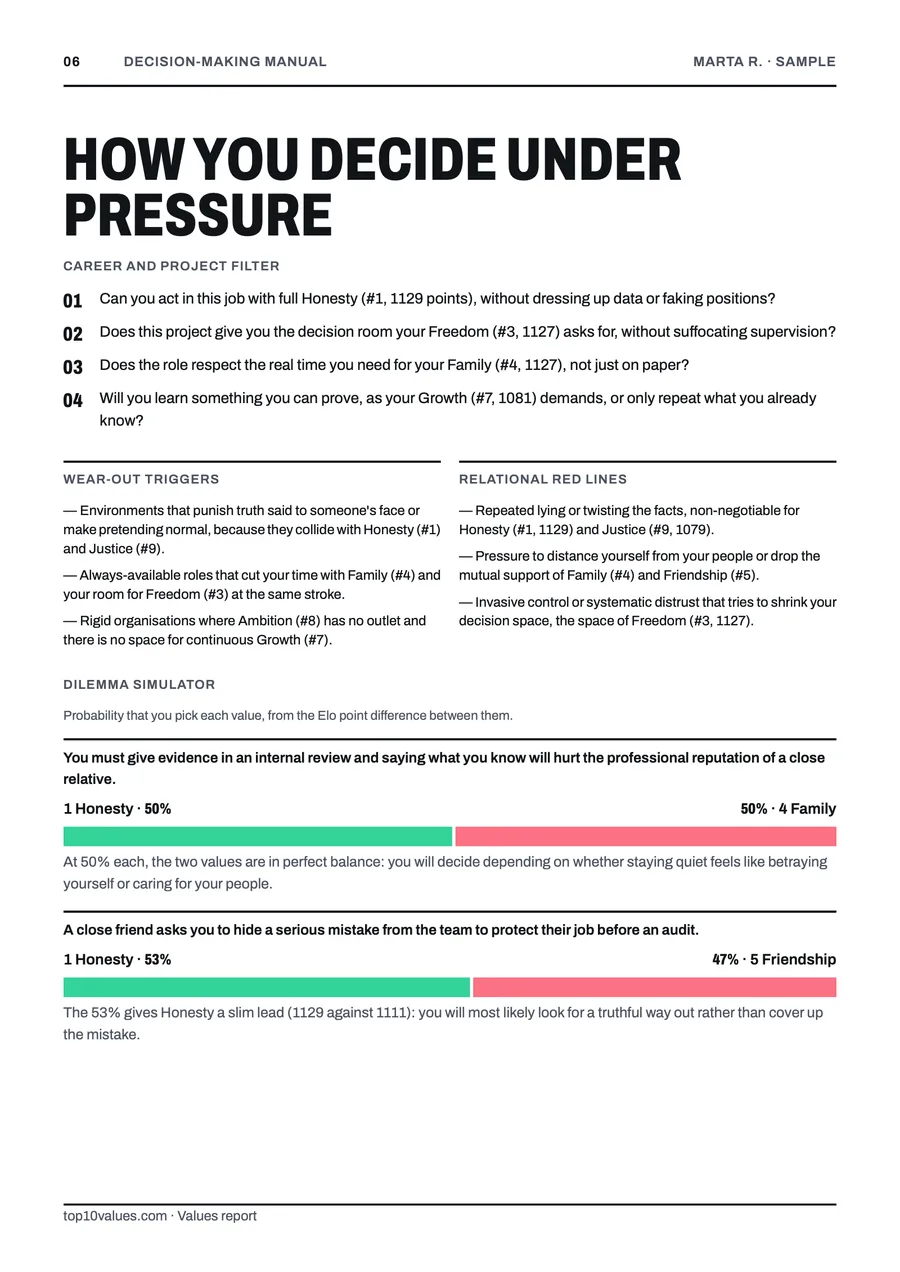
Sample page with fictional data (Marta R.), not yours. Your report is written from your own choices.
Frequently asked questions
Does being authentic mean always saying what you think?
No. It means not saying the opposite of what you think and not faking what you don't feel. You can stay quiet out of respect, prudence or because the moment is wrong. What moves you away from authenticity is active lying and a role you keep up constantly, not discretion.
How can I tell whether my way of being is authentic or just a habit?
A good clue is how you react to change. If something about your behaviour weighs on you, limits you or hurts people, and you still defend it with "that's just me", it is probably a habit. What is authentic usually connects to what you value and holds up even when nobody applauds.
What if being myself causes problems at work?
Distinguish the essential from the incidental. You can adjust tone, timing and register without giving up what you stand for. If you're repeatedly asked to act against your values, it is worth asking whether that environment suits you, and weighing it over time rather than deciding in the heat of the moment.
Can I be authentic and still adapt to different settings?
Yes. Adjusting your language, humour or dress to a setting is courtesy, not falseness: nobody speaks the same way at a funeral and at a party. The line lies in values and facts: if what changes from one setting to another is what you defend, what you claim or what you do to other people, it is no longer adaptation but a double life. Ask yourself whether you could tell each group how you behave with the others without feeling ashamed.
What if I don't really know who I am?
It is more common than it seems, especially after years of pleasing others. You don't need a complete answer to begin: pick small preferences and notice how you feel exercising them. Pay attention to what gives you energy, what irritates you when you have to do it and what you would do even if nobody knew. Identity becomes clearer by acting and reviewing. If the sense of emptiness is intense or lasts a long time, talking to a psychology professional may help.
Is it authentic to change my mind or my life many times?
It can be, if each change answers to something real: new information, another stage of life, a value you hadn't seen before. The warning sign is not changing but always changing towards whatever earns applause or spares you a conflict. Ask where the change comes from: if it is a discovery of your own, it is consistent; if it is a reaction to pressure, it may be just another role.
When Authenticity clashes with…
Being who you are, versus what others expect of you.