Values vs beliefs: how to tell them apart when you decide
By Juan Alejandre · Published · Reviewed
Industrial engineer and consultant, 25 years working with teams
Short answer: what a value is and what a belief is
- A value is something you consider important and use to choose between options: "honesty", "time with my people", "independence". It answers the question what do I want to protect?
- A belief is something you hold to be true about how people, work or life are: "asking for help makes you a burden", "hard work always pays off". It answers the question what do I think is the case?
The practical difference is that a belief can be checked against facts and a value cannot. "Remote workers get overlooked for promotion" is a claim you can test. "I want to decide where I live" is not true or false; it is a choice you make, or do not.
Advertisement
The two get tangled because most beliefs lean on a value. Someone who values ambition often believes effort gets noticed; someone who values kindness often believes treating people well comes back to you. The trouble starts when the belief is stiffer than the value behind it.
Below: a table, three invented scenes, four test questions and a short exercise. It is not a psychological test, and it does not tell you which beliefs to drop.
Table: value, belief, principle, norm and moral on the same case
People also search for "values vs principles", "values vs morals" and "values vs norms". The quickest way to see the differences is to say one case five ways. The case here is working remotely, and every sentence is made up.
| Concept | What it is | A sentence about remote work |
|---|---|---|
| Value | What matters to you; it guides your choices | "I want control over how I organize my day." |
| Belief | What you hold to be true about how something works | "People do their best work when nobody is watching." |
| Principle | A general rule of conduct that comes from a value | "I only take jobs where my hours are mine to arrange." |
| Norm | A rule that comes from outside (employer, team, law) | "Everyone is in the office on Tuesdays and Thursdays." |
| Moral | A shared view of what is right or wrong, usually from a culture or tradition | "Employers should trust their staff to do what they agreed." |
Two points to keep them apart. A principle is a value turned into a rule: it says what to do, and the value says why. A norm was not chosen by you, even if after some years it feels like yours; ask whether you follow it out of conviction or habit. Philosophy, sociology and psychology each define these words their own way, and this guide uses them in the everyday sense only.
Three scenes where a belief contradicts a value
These are invented scenes. They do not say what anyone should do; they show how the clash looks from the inside.
Scene A: Priya and "asking for help is a burden"
Example. Priya, 31, leads a small team and says that what she values most is independence. She has been three weeks behind on a client report and has told nobody. Asked why, she says: "Asking for help just makes you a burden."
Two sentences are mixed up here. "I like to work things out myself" is a value. "Asking for help makes you a burden" is a belief, and she can check it: when a teammate asked her for help last month, she did not feel burdened, she felt useful. The belief is stricter for herself than for anyone else.
It also works against a second value of hers, trust. She wants a team that can count on each other, yet she shows them a leader who never needs anyone. Her independence is not the problem; the sentence is. "I handle most things myself, and I ask when a deadline is at risk" keeps the value. A short message to one colleague is a small test of the old belief.
Scene B: Tom, Ellen and "the oldest child pays"
Example. Tom and Ellen are married. His mother needs help with the cost of a care home, and every conversation about it ends in an argument. They both value family, and neither doubts that the other does.
The disagreement is elsewhere. Tom grew up hearing that "the oldest child pays", and he is the oldest. Ellen believes costs should be split by what each sibling earns, and his sister earns more than he does. The value is shared; the beliefs about what family duty looks like are not.
Once they see this, the question changes from "do you care about my mother?" to "what does caring for her look like in practice, and who says so?". That does not settle the sums, but it stops each from reading the other's belief as a lack of love. When two values do pull apart, conflicting values covers the next step.
Scene C: Sam, "honesty" and "always tell the truth"
Example. Sam is a student writing an assignment on personal values. He writes "honesty" and "always tell the truth" as if they were one idea. His teacher asks him: "What would you do if telling the truth would hurt someone for no good reason?"
Sam separates them. Honesty is the value: he wants what he says and does to match what he knows, and he does not want to leave a false picture in someone's mind. "Always tell the truth" is a principle, a rule derived from the value, and it can fail in particular cases. If his grandmother asks whether he liked a gift he did not, the rule says to answer in full. The value does not demand that: he can say what he does appreciate without lying.
His conclusion is not that the rule is wrong, but that the rule serves the value and not the other way round. For the harder version, see kindness vs honesty.
Is it a value or a belief? Four test questions
Take one sentence of your own and run it through these four questions. They need not all point the same way; you are looking at which way it leans.
1. Can it be checked against facts?
"Managers do not listen to staff" can be checked: you can look at what happened when somebody spoke up. "I want to be honest" cannot; it is neither true nor false, it is a choice. If facts can confirm or refute it, it is a belief.
2. Does it describe how the world is or how you want to live?
"The job market is brutal" describes. "I want time for my own projects" chooses. Describing is belief; choosing is value.
3. Could you be wrong?
About a belief, yes. About a value, being wrong does not quite make sense; the only question is whether it is still yours.
4. What would you do if shown the opposite?
Imagine someone shows you a case that disproves the sentence. If you would change it, it was a belief. If you would keep defending it anyway, it is closer to a value.
Mixed sentences are the norm. "You should be straight with everyone" combines a value (honesty) and a belief (that saying everything is always the best way to be straight). Split it in two and look at each half.
A 15-minute exercise: from beliefs to values
You need paper and a timer.
- Five minutes: write six sentences that start with "I believe that...". Choose topics where you hold firm views: work, money, family, friends, how people should treat each other. Do not polish them.
- Five minutes: next to each one, write the value it seems to protect. Ask: "if this were true, what would be safe?". "I believe you should never owe anyone" might protect independence, or security, depending on who says it. If you are unsure, write two candidates.
- Five minutes: look for repeats. Underline any value that appears twice or more. Those are good candidates for your own list. Values that appear only once may belong to a particular situation.
If a sentence does not seem to protect any value you recognize, it may be an inherited norm. Mark it and come back to it later.
Once you have a short list, the next step is to rank it, or to find where two of your values pull apart in conflicting values. To start from a wider vocabulary, use the list of 50 personal values, and for six more ways to find your own, knowing my personal values.
What to do when a belief clashes with a value
This guide will not tell you which belief to give up, but there is a reasonable order in which to look:
- Test the belief, not yourself. Find at least one case around you that fits it and one that does not.
- Separate "always" from "sometimes". "Managers do not listen" leaves little room; "some managers do not listen on some topics" leaves a lot more to work with.
- Try it on a small scale. One email, one ten-minute conversation, one week of a different schedule.
- Allow that it may be true. Then the clash is real, and one value has to give way. That is the territory of conflicting values.
How the game shows values, not beliefs
The top10values game never asks what you believe. It offers two values at a time, and you pick the one you would protect if you could only keep one. What comes out is an ordered list of values, drawn from your choices, not a list of opinions. It records what weighed more when you had to give something up. The methodology page explains how the list is calculated.
If your Top 10 surprises you, it may be the gap between what you think matters to you and what you actually chose. That is a good starting point for the exercise above. The result describes what you choose today; it is a tool for thinking about yourself, not an assessment or a diagnosis.
Frequently asked questions
What is the difference between values and beliefs?
A value is what you consider important, and it guides your choices. A belief is an idea you hold to be true about how something is. Beliefs can be checked against facts; values are chosen and lived.
Can a belief change while a value stays the same?
Yes, and it is common. Someone can keep family at the top for decades while their belief about what it requires moves from "the oldest child pays" to "we split it by what each can afford". Beliefs tend to move when new facts arrive; values tend to change order when your situation does, such as a child, a move or a new job. Neither changes at will.
Are values and morals the same thing?
No, although they overlap. Morals are views about right and wrong that a society, religion or tradition shares. Your values are personal: what you decide to protect. You can agree with the moral views around you and still rank your own values differently, and the other way round.
Are values and principles the same?
No. A value says what matters; a principle is a rule that follows from it. If you value honesty, a principle could be "I do not promise what I will not deliver". Principles are easier to apply and easier to break, because rules do not cover every case.
Can I have a value I do not believe in?
You can have a value you do not always live up to, which is different from not believing in it. People often name a value they think they should hold, such as ambition or freedom, while their choices point elsewhere. The choices that cost you something are a better guide than the word you picked. If a value only shows up when somebody is watching, it may be a norm you took on; ask what you would choose if nobody else knew.
Related guides
- Conflicting values: what to do when two of your values ask for different things.
- Values hierarchy: how to rank the values you identified, with a worksheet.
- Knowing my personal values: six exercises to find your own.
- Personal values list: 50 values with their meaning, to pick from.
- Schwartz's theory of basic values: how this theory separates values from attitudes, beliefs, norms and traits.
Next step
Run one sentence you said with conviction this week through the four questions. To see your order of values from what you choose, play the values game; or read the full list of values first.
Sources
Find your top 10 values with 100 quick comparisons
What does the paid report include?
When you finish the 100 comparisons you will see your Top 10 on screen. If you want to go further, there is a PDF report on your personal values: €9.95 (VAT included), one-off payment. To buy it you need to save your game with a Google account.
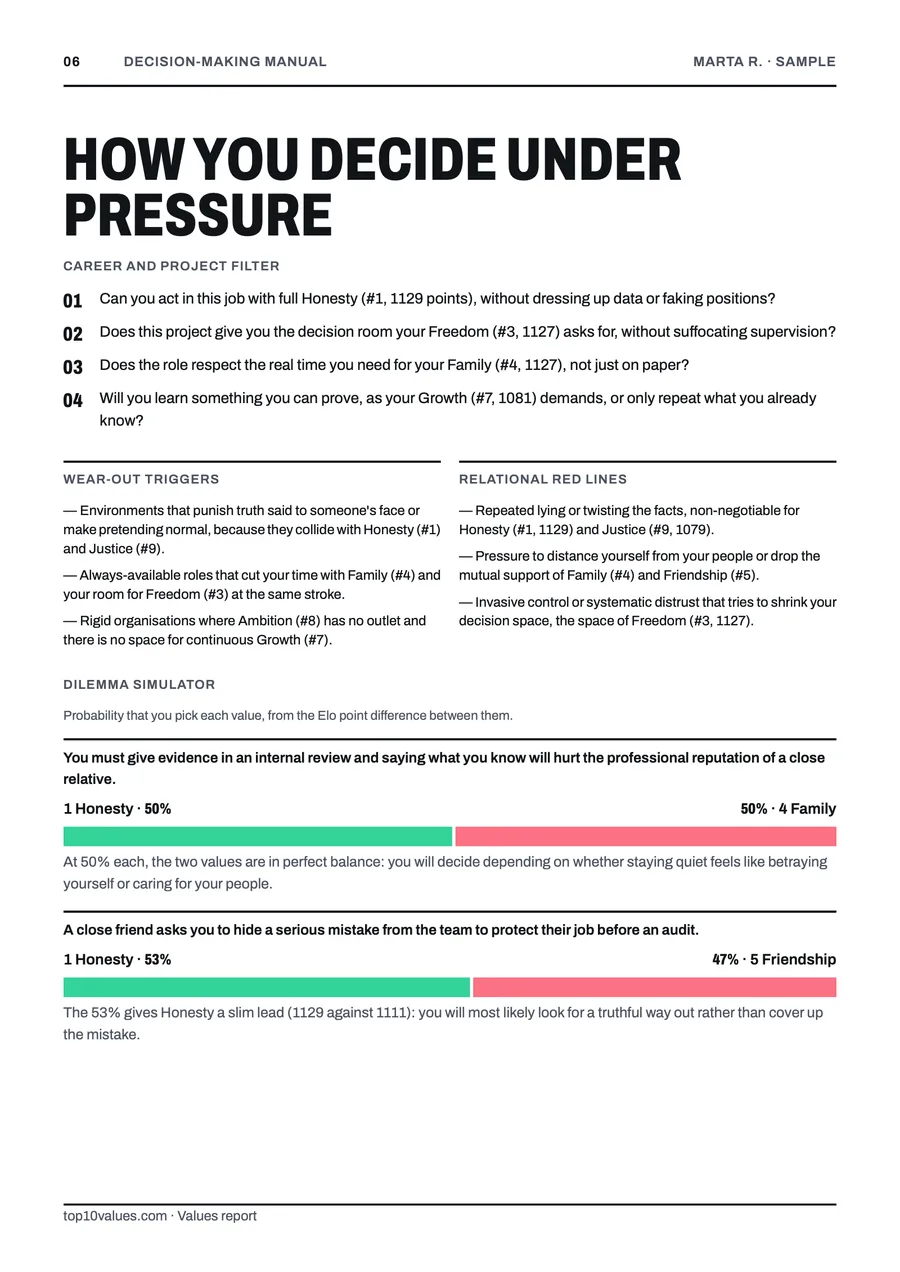
Sample page with fictional data (Marta R.), not yours. Your report is written from your own choices.