Relationships
Trust
Belief in others and yourself.

Trust is the willingness to believe in other people's good faith and word, as well as in your own ability to handle the challenges that come up. People who value trust build relationships without needing to control everything, delegate responsibilities and make decisions without constantly suspecting other people's intentions. It also includes trust in yourself: relying on your own judgment even in the face of uncertainty. This value reduces the strain of monitoring every interaction and makes genuine collaboration easier. When it is broken, however, it is hard to rebuild, because it depends on sustained consistency between what is promised and what is actually delivered.
What does this value mean?
Trust is the willingness to depend on someone (or on something, such as an institution or a system) knowing they could let you down, because you have good reasons to believe they will keep their word. It always involves an accepted risk: if you could check and control everything, you would not need to trust.
It represents the decision not to live on guard. When you trust, you leave your house keys with a neighbour while you travel, let a colleague present the project to the client, or tell a friend something that embarrasses you. In every case you accept that it might go wrong, and you prefer the occasional cost of a disappointment to the daily cost of watching. It weighs most in long relationships, where accumulated control ends up costing more than the mistakes it was meant to prevent.
What it does NOT mean
It does not mean believing everyone or ignoring warning signs. Nor is it the same as liking someone: you can be very fond of a person who is not reliable, and you can rely on a curt person who always delivers. Trusting without looking at who you are trusting, or carrying on trusting someone who has lied repeatedly, is not generosity: it is carelessness. It is also not honesty or integrity. Honesty is about what you say; integrity is about acting on your principles when nobody is watching; trust is about what you leave in other people's hands and what they leave in yours.
Related concepts
Why might it matter to you?
Almost nothing that matters gets done alone. A home, a business, a friendship or the raising of a child all require leaving things in other people's hands, and those hands will not always act as yours would. Without trust, every task becomes supervision and every relationship becomes surveillance, and that tiredness never ends because there is always something else to check. With trust, the effort is shared: you can sleep while someone else drives, ask for help without feeling you have taken on a debt, or follow medical advice without reading all the literature yourself. Behind this value there is often a need to rest, to stop holding everything up on your own.
How can you live this value?
- Before checking something you have already delegated, ask what concrete evidence you have that it is going wrong. If it is only a feeling, let the work finish and look at the result, not the process. If there is a real signal (a missed deadline, a figure that does not add up), ask about what you have seen, not about what you fear.
- Extend trust in stages. A small, reversible task first (picking up a parcel, looking after your plant or your cat) and a bigger one afterwards. Each step rests on what you have already seen, and the other person has a chance to earn something instead of starting under suspicion.
- When someone gets something minor wrong, describe the fact and ask what happened before drawing conclusions about what they are like. «The report arrived a day late» opens a conversation; «you can't be counted on» closes it.
- Make your expectations explicit. Many disappointments come from agreements that only existed in one person's head: «I thought you were calling the plumber». Saying who does what, by when, and what to do if a problem comes up lets you trust properly, because you no longer depend on guessing.
- Keep your small commitments: arrive on time, reply when you said you would, return what you borrowed. Someone who slips on small things will find it hard to demand reliability on big ones.
Advertisement
What happens when you don't live up to this value?
Without trust, life looks like a checklist. You go over a colleague's work before it goes out, you end up redoing what someone has already done, and you complain that you have no time. In a couple, a twenty-minute delay turns into an interrogation in your head. Every disagreement is read as a sign of something worse and every silence as concealment. Over time people stop telling you things because they expect your control, and that proves you right: your suspicion is confirmed precisely because you provoked it.
The healthy side and the shadow
When does this value stop helping you and start limiting you?
Healthy expression
Calibrated trust
In excess
Gullibility
The excess is gullibility: still believing the person who has spent months promising that this time will be different, lending money to someone who never repaid the last loan, or signing without reading because «they're surely fine». Healthy trust is not an act of faith but an informed bet, adjusted with facts: what that person has done before, what would happen if they failed. The useful question is how much risk you can take with them on this matter, not whether they are a good or bad person in general. You can trust a friend completely to look after your child for an afternoon and still not to manage your savings.
This value at work
At work, trusting makes real delegation possible: giving someone the expected result, the date and the limits, and letting them decide how to get there. It shows in concrete gestures: not asking to be copied on every email, asking what can be learned from a mistake before looking for someone to blame, speaking up early when something starts to slip. The clearest sign of a team that trusts is that bad news arrives sooner: the person who sees the delay says so on Tuesday rather than Friday, because they do not fear it will cost them. Watch out for the manager who «trusts» by handing over a task without saying what is expected and then complaining that it did not turn out as imagined: delegating without clear criteria is not trust, it is abandonment.
This value in relationships
In friendships, trust is built through small, repeated proofs: keeping a secret when the temptation to tell it was strong, showing up when you said you would, not speaking badly of someone behind their back. It is lost by drips more than by one big betrayal: plans always cancelled at the last minute, confidences passed on «to just one more person», promises to call that never arrive. When it breaks, repairing it means acknowledging what happened without minimising it, explaining what changes from now on, and allowing time, because someone who was hurt does not recover trust the moment they hear an apology.
This value in love
In a couple, trust is what spares you from justifying every move. It is lost through lies, but also through surveillance: checking a phone, tracking the other person's location or asking who they were with every night wears things down even when nothing is found, because your partner starts to feel suspect by default. A common warning sign is that one side starts to check and the other starts to hide unimportant things just to avoid an argument, so that distrust ends up creating real secrets. Saying «I've felt left out this week, can we talk?» is healthier than checking in silence, even if it is more embarrassing.
This value in family
In families, trust is often inherited along with the old roles: the eldest child who is given everything to handle, the sister nobody lets take charge of anything because «you know what she's like». Trusting here means dropping those labels and letting each person try other ways of doing things, even if they get it wrong. With children it means widening freedom at the pace they show responsibility: the first outing without adults, the first money of their own, walking home from school alone.
This value and yourself
Having trust among your main values says that it matters to you to be able to lean on others without living on alert, and also to be someone who can be relied on. It may also mean that you find it hard to let go of control, or that you learned to distrust through experiences that still weigh on you: a boss who singled you out in public, a partner who lied, a business partner who vanished with the money. It helps to separate what hurt you once from what is true today of the person in front of you. If you trust quickly and are often surprised, you may be taking early friendliness as proof of reliability.
What are you willing to sacrifice for this value?
Would you accept someone doing something their way, even if it is not yours and does not turn out as well as you would have done it? And accept being let down once before writing a relationship off? Think of the last time you delegated and the result differed from what you expected. If it was hard not to step in, trust asks you to work on your need for control. If it was a relief, this value already has a good place in your life. Trusting also sometimes means accepting a concrete loss, such as money that does not come back, to keep a bond alive.
Signs you're betraying this value
Trust is broken when you promise something you know you will not deliver, when you repeat to others what was told to you in confidence «in case it helps them», or when you boast of delegating while checking behind everyone's back. Also when you stop believing in someone without ever asking what is going on and treat them coldly, as if they had already been judged. That silent distrust often does more harm than the mistake that caused it, because the person does not know what to defend against.
Turning the value into goals
Value
Trust
Behavior
Delegate a complete task, with the expected result in writing, and do not review it until the agreed date
Goal
Before the end of next quarter, have at least one work or household process that runs without your daily supervision
Habit
Every Monday, write down what you are checking out of fear and what real evidence you have for continuing; if there is none, let go of one of those checks that week
Questions to reflect on
- What task have you been doing yourself for months because you do not trust how others would do it, and what is the worst that would happen if they did it worse than you?
- In which relationship do you trust more than the evidence justifies, and what is hard to look at in it?
- Whom do you distrust although they have done nothing today, and where does that distrust come from?
- When did someone last give you their trust and surprise you for the better, and how did it make you behave?
- What would have to happen for you to trust again someone who let you down, and have you ever told them?
- What has been entrusted to you in the past year, and how have you looked after it?
How much are you living this value?
From 1 to 10, how much of what you delegate do you end up reviewing yourself anyway? If the answer is above 5, pick a single task this week, explain the result you expect and leave it in someone else's hands without looking until the end. Then note what you felt while you were not looking: that discomfort says more about your relationship with control than the result does.
When two values clash
Trust clashes with Financial security when trusting means risk with your money: lending to a relative, investing with a partner or guaranteeing a loan. Here prudence recommends clear limits, in writing, and not for lack of affection. It clashes with Justice when trusting someone means overlooking a fault that affects third parties: giving a friend another chance can harm whoever suffered their mistake. With Honesty the link is close but not identical: you can be sincere and unreliable (you tell the truth and then do not deliver) or reliable without being entirely sincere (you always deliver, but keep your thoughts to yourself). With Independence the clash is one of style: someone who values self-sufficiency finds it hard to ask for help, and trusting requires admitting you cannot do everything. And with Efficiency comes the temptation to do it yourself «because it's faster», which in the long run stops others from learning. There is no universal rule. It often helps to trust the process and reserve vigilance for what has serious, hard-to-reverse consequences.
Is “Trust” one of your top 10 values?
Find out by playing and comparing this value with the other 49
How the Elo ranking works and its limits in the methodology.
What does the paid report include?
When you finish the 100 comparisons you will see your Top 10 on screen. If you want to go further, there is a PDF report on your personal values: €9.95 (VAT included), one-off payment. To buy it you need to save your game with a Google account.
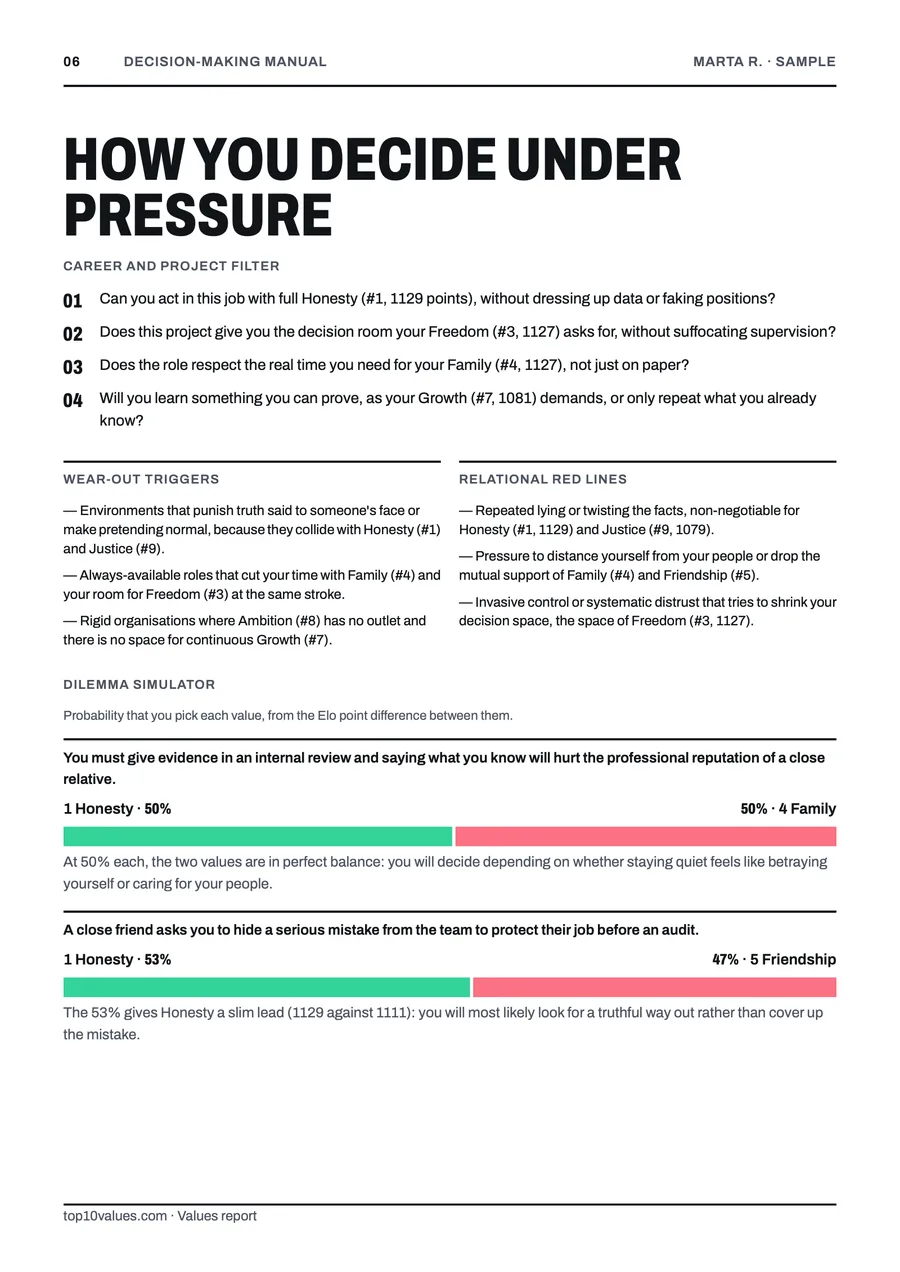
Sample page with fictional data (Marta R.), not yours. Your report is written from your own choices.
Frequently asked questions
How do I trust someone who has already let me down?
Trusting again is not forgetting. Start by clarifying what happened and what has changed, and take small steps with limited risk, as you would with someone new. Notice whether the person accepts that pace without pressuring you: someone who wants to win back your trust does not demand it all at once. It is rebuilt with repeated actions, not promises, and you may decide that some things, such as money or certain secrets, will no longer go into their hands.
Is trusting always a virtue?
No. Trusting without looking at the evidence is carelessness. The value lies in trusting with judgement: giving room to those who have shown they deliver and checking more closely on those who have not yet, or who have failed at what you are now asking. Distrust is not always a flaw either; sometimes it is a reasonable response to what you have lived through.
How do I know whether my distrust is justified or comes from my fears?
A useful test is to write down the concrete, recent facts you have: what that person did or failed to do, when, and with what consequence. If the list is empty and all you have is a feeling, you are probably speaking about your history more than about them. If the list is long, the distrust is information, not a flaw in you. In in-between cases, ask the question directly instead of checking behind their back.
How do I delegate without feeling I am losing control?
Define the result, not every step. If the task is long, set a midway check and explain why, so it is not read as suspicion. Accept that the result will differ from yours and ask yourself whether it is worse or just different. With practice, what felt like lost control becomes recovered time.
Does asking for proof or checking something mean I do not trust?
Not necessarily. Verifying what carries high risk, such as a contract, a large payment or a medical decision, is part of responsible trust, and in healthy relationships it is done openly and without offence. What wears things down is checking in secret, repeating the check again and again, or doing it to punish. A good rule: do not check anything you would not be willing to say out loud.
When Trust clashes with…
Trusting, versus controlling or verifying.