Personal Growth
Integrity
Acting according to principles.

Integrity is the sustained consistency between the principles you declare and the actions you actually take, even when no one is watching. People who value integrity resist making convenient exceptions to their own ethical standards, even if it means losing a short-term advantage. This value builds a solid reputation over the long term, because the person's words and actions are predictable and reliable. Integrity doesn't demand absolute moral perfection, but a genuine commitment to correct course when a gap is detected between what you believe is right and what you have actually done.
What does this value mean?
Integrity is acting on your principles even when nobody is watching, nobody would ever find out and doing the right thing costs you something. The word shares its Latin root with "integer": whole, undivided. A person of integrity doesn't split into different versions depending on the room, the company or the stakes.
At its core is a refusal to run one set of ethics at work, another at home and a third for when you're alone. People who put integrity first pay attention to the small moments: handing back the extra change, not padding a timesheet, keeping a handshake deal with no contract behind it. And to the awkward ones: telling the team the missed deadline was down to you, not upselling an elderly customer a warranty they'll never use even though they'd sign without a second look, not putting a night out with friends through on expenses. Integrity isn't proved by announcing your principles. It shows in the gap, small or large, between what you say you stand for and what you do when something tempts you the other way.
What it does NOT mean
It isn't the same as honesty, though it includes it. Honesty is about the truth of what you communicate; you can never tell a lie and still act against what you claim to stand for. Nor is it rigidity. Changing your mind because you've learned something is a sign of integrity; changing it because it suits you is not. It isn't perfection either: people with integrity slip and contradict themselves like everyone else, but they own the inconsistency and fix it rather than explain it away. And it isn't simply following the rules, because you can obey the letter of a rule while betraying its purpose, like the large firm that honours every clause of the contract and still leaves a small supplier waiting four months to be paid because it legally can.
Related concepts
Why might it matter to you?
Integrity means people can predict how you'll act without having to keep an eye on you. That has a very practical payoff: people with integrity get handed decisions, trusted with sensitive information and believed when they say "this can't be done faster without cutting corners". At work it becomes your reputation, which takes years to build and one episode to lose. In private life it brings a specific kind of calm: not having to argue your case with yourself at the end of the day, and not having to remember which version of yourself you showed to whom. Plato put the underlying question in the Republic through the myth of the Ring of Gyges, which makes its wearer invisible: would you still behave well if you knew for certain you'd never be caught? Integrity is your working answer to that question. Valuing it often comes from wanting a life that isn't split into compartments you'd rather not open.
Advertisement
How can you live this value?
- Write down three principles that genuinely guide your decisions, not the ones that sound good, and test a recent decision against each. If one doesn't pass, you have two honest options: change the decision, or admit that principle was never as much yours as you thought.
- When you're tempted by an exception such as "just this once" or "everyone does it", ask whether you'd be comfortable seeing it published under your name. Serious lapses rarely start big; they start as a small exception that gets repeated until it feels normal.
- Treat small commitments as seriously as big ones: if you said you'd return the book on Monday, return it on Monday. If you can't keep a commitment, say so before the deadline, not after it. How you handle the promises you can't keep says more about your integrity than the ones that cost you nothing.
- When you change your position, say so out loud: "I used to think this, now I think that, and here's why." It stops people mistaking learning for switching sides.
- Draw your red lines before you need them. Note down two or three things you wouldn't do for any amount of money or pressure (signing off figures you haven't checked, lying to a client about a deadline, looking away from bullying) and tell someone you trust. Under pressure, reasons to give in are easy to find; a decision made calmly and shared with another person is much harder to renegotiate with yourself.
- When you catch an inconsistency in yourself, repair it rather than explain it. If you were overpaid, return the difference; if you ran someone down, correct it in front of the people who heard you. Repairing is harder than justifying, which is exactly why it counts.
What happens when you don't live up to this value?
When integrity is missing, life starts to split: you speak up for equality over dinner, then laugh at your boss's sexist joke; you demand punctuality from your team and turn up late to everything. Nobody notices at first, but you do, and each contradiction makes the next one easier. Over time a particular kind of tiredness sets in, the effort of managing versions of yourself: remembering what you told whom, keeping certain people from comparing notes, having an explanation ready just in case. Others may not be able to say exactly what's off, but they sense your word isn't fully reliable, and they start asking you to put things in writing.
The healthy side and the shadow
When does this value stop helping you and start limiting you?
Healthy expression
Principled flexibility
In excess
Purity that judges
Integrity becomes a problem when it hardens into purity: you forgive no inconsistency, in yourself or anyone else, and judge so harshly that you can't work with people who see things differently. It also goes wrong when you mistake preferences for principles and turn every detail into a moral issue, from how a flatmate loads the dishwasher to which supermarket a colleague shops at. A third trap is integrity as a shop window: broadcasting your principles so they're seen, more concerned with looking upright than with being it. Healthy integrity separates what is non-negotiable from what is a matter of taste, and accepts that everyone slips sometimes, you included.
This value at work
You're the one who won't massage the numbers in a report even when the quarterly target depends on it, and who says "I'm not signing this" when something is unclear. That builds trust over time, even if in the short run it costs you a promotion or a client. The tests tend to be very specific: a colleague asks you to tick a document as reviewed when you haven't read it; your manager suggests dating an invoice so it lands in the right quarter; a supplier offers you tickets to a big match a week before the contract is awarded. In most of these, integrity doesn't mean causing a scene. It means saying calmly what you won't do, why, and what you'd suggest instead. If you manage people, your integrity shows above all in holding your top performer to the rules everyone else follows. Decide in advance what you wouldn't do for any bonus; a line drawn in advance is easier to hold in a tense meeting.
This value in relationships
Your friends know that what you say to their face is what you say when they're not around. If you promise to keep a secret, you keep it; if someone starts picking apart an absent friend, you don't join in. It shows in plans too: if you say you'll come, you come, and if you've overcommitted, you say so early rather than vanishing on the day. There are no hidden agendas with you: if something bothered you, you take it up with the person concerned instead of airing it in the group chat. That makes for solid friendships, though it can distance you from groups that run on gossip.
This value in love
In a relationship, integrity is tested by the agreements nobody checks: what you decided about money, about other people, about who does which chores. Not lying isn't enough; what matters is that your behaviour fits what you agreed, even if your partner would never find out. A common test is the small betrayal that breaks no explicit rule: the message you delete before they see it, the purchase you'd rather not mention, the conversation you wouldn't want them to scroll through. If you feel the need to hide it, you probably already know it doesn't fit what you agreed. If an agreement no longer works for you, the honourable move is to renegotiate it, not to quietly break it.
This value in family
In families, integrity gets tested over inheritances, over caring for ageing parents and in what you teach by example. It's hard to ask a child not to lie when they hear you tell a caller you're not home, or watch you sneak them in at the child price when they're a year too old. It matters in less visible ways too: doing your share of looking after a parent even though you live further away than your siblings, or not threatening a punishment or promising a treat you have no intention of following through on. Children are quick to notice when the house rules apply to them and not to the adults. What you do when you think nobody is watching tends to carry more weight than any lecture.
This value and yourself
If integrity sits near the top of your list, you probably need to be able to stand behind your decisions in front of anyone, including the person they affect. People who change their story depending on the audience make you uneasy, and you may find it hard to forgive your own inconsistencies. You might also have felt out of place in workplaces or groups where "that's how we do things here" settled every question, or even left one for that reason. That high bar is a strength, as long as you don't use it to beat yourself up.
What are you willing to sacrifice for this value?
Would you give up a promotion, a commission or your group's approval rather than do something that goes against what you stand for? Think of a specific situation where "everyone was doing it". If you held firm and don't regret it, integrity is already part of how you act. If you gave in and justified it afterwards, it may be more of an aspiration than a practice for you. It's worth being realistic: integrity has costs and isn't always rewarded. Sometimes the person who refused to fudge the figures gets passed over and the one who fudged them gets promoted. Valuing integrity properly means accepting that possibility without letting it turn into bitterness.
Signs you're betraying this value
You drift from integrity when you hold others to rules you don't follow, when you do in private what you criticise in public, or when you accept special treatment you'd call out if someone else got it. Also when you let the setting decide for you: "that's how things are done here" isn't a principle, it's an excuse. A subtler sign is in your vocabulary: if you catch yourself using soft words for what you're doing ("rounding up" an expenses claim, "tidying" a number), you may be cushioning something that wouldn't survive a plain description.
Turning the value into goals
Value
Integrity
Behavior
Act the same with or without an audience
Goal
Spot and resolve one specific gap between what you stand for and what you do this month
Habit
Every Sunday, review one decision from the week and ask whether you'd tell it without changing a detail
Questions to reflect on
- What do you do when nobody can see you that you wouldn't do with someone watching?
- Which rule do you expect others to follow that you don't follow yourself?
- Which principle has been hardest to stick to, and what did it cost you?
- Which exception have you made so often that it no longer feels like an exception?
- If for one day nobody could see you or hold you to account, what would you do differently?
- Which small commitment have you broken recently without telling anyone?
How much are you living this value?
Hold last week's diary and bank statement up against what you say matters to you, and give the match a mark out of 10. Anything under 7 is a cue to choose one specific inconsistency and sort it out this month before hunting for others.
When two values clash
Integrity clashes with Loyalty when a friend or colleague asks you to cover for something you're not comfortable with. One way through is neither to cover nor to report behind their back, but to tell them directly that you won't lie for them. It also pulls against Success and Ambition: some shortcuts would speed up your career but don't sit right with your principles. With Family it surfaces when a sibling asks you to go along with something inaccurate in sorting out an estate or filling in a form. And it strains against Kindness, when saying "I won't do that" disappoints someone you love. With Honesty it usually works in tandem, but the two don't always coincide: you can confess something you did wrong with complete candour and still have let your integrity down by doing it. It fits naturally with Trust, which rests on it, and with Courage, which supplies the nerve to hold a principle when it has a price. It usually helps to decide in advance what is non-negotiable for you, so you don't have to work it out under pressure.
Is “Integrity” one of your top 10 values?
Find out by playing and comparing this value with the other 49
How the Elo ranking works and its limits in the methodology.
What does the paid report include?
When you finish the 100 comparisons you will see your Top 10 on screen. If you want to go further, there is a PDF report on your personal values: €9.95 (VAT included), one-off payment. To buy it you need to save your game with a Google account.
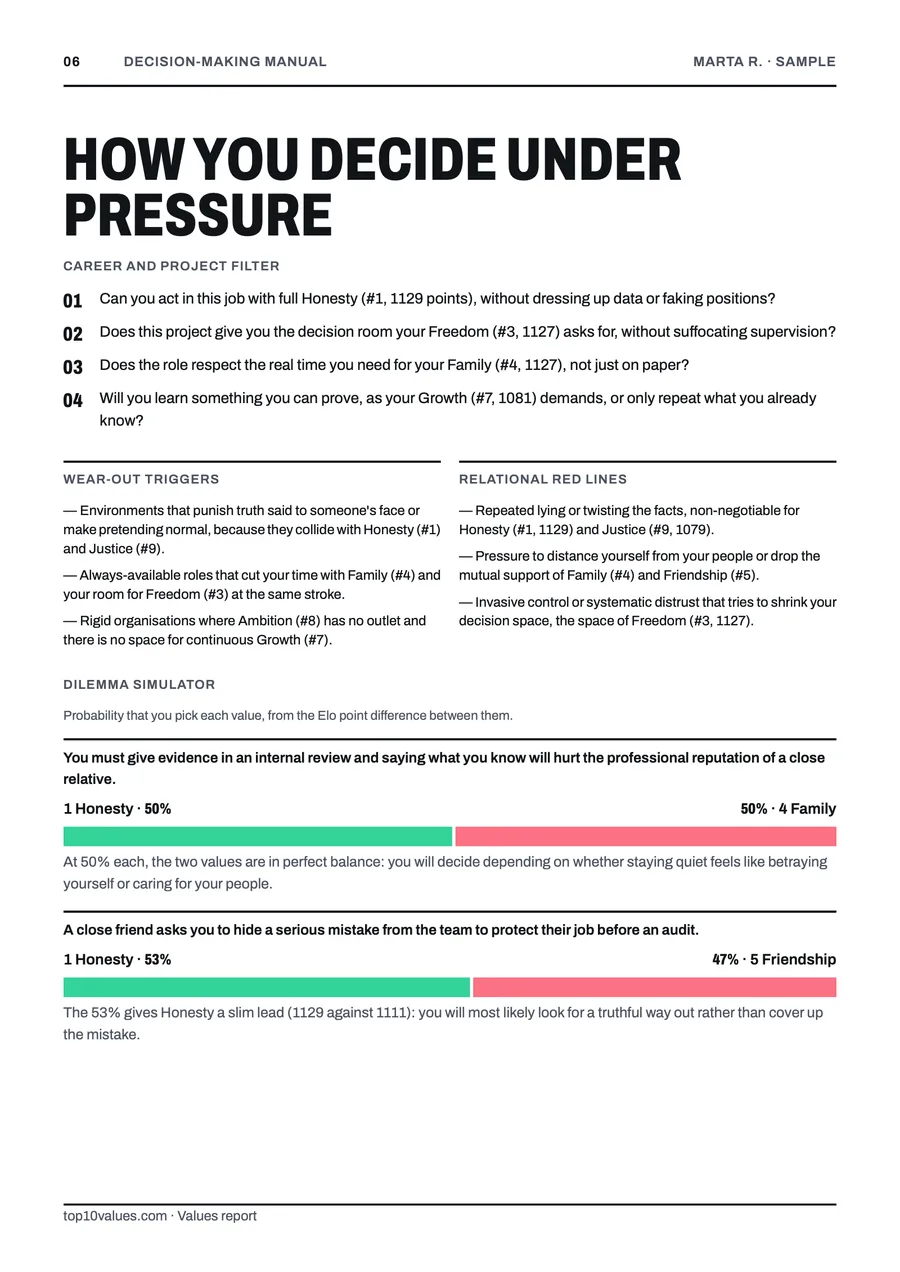
Sample page with fictional data (Marta R.), not yours. Your report is written from your own choices.
Frequently asked questions
What's the difference between integrity and honesty?
Honesty is mainly about not deceiving people: what you say matches what you know. Integrity is broader: your actions, decisions and words all answering to the same principles. Someone can avoid every lie and still act against what they say they value, for instance championing local shops while never thinking twice about buying everything online. Honesty is one part of integrity, not another word for it.
Is changing your mind a lack of integrity?
Not if the change comes from new information or honest reflection, and you explain it. What wears integrity down is shifting your position depending on who's listening or what suits you at the time. A useful test: would you defend your new view just as readily in front of the people who shared your old one?
Can you keep your integrity at a company with questionable practices?
Up to a point. Start by separating what's within your control: you can refuse to sign off what you haven't checked, put your objections in writing and use whatever internal or whistleblowing channels exist. Not every battle is worth the same cost, and integrity doesn't demand heroics every day. But if keeping your job means regularly taking part in something you consider serious, the inconsistency takes its toll, and moving on may be the only coherent option.
What should you do if you've already acted against your principles?
Acknowledge it without melodrama, put right what can be put right, and work out how you got there: pressure, tiredness, an exception that quietly became a habit. Then set up a specific safeguard for next time, such as asking for a day before answering or running it past someone you trust. Weeks of self-punishment repair nothing; changing course does.
How is integrity defined in ethics?
One well-known definition comes from the American legal scholar Stephen L. Carter in his book Integrity (1996). He describes three steps: working out what is right and wrong, acting on that judgement even at personal cost, and saying openly that you are acting on your understanding of right and wrong. The third step is the one people forget: doing the right thing quietly, without ever standing up for what you believe, only gets you halfway.
When Integrity clashes with…
Invented scene. Carmen is a site manager at a small construction firm. Her friend and foreman, Pablo, has installed a cheaper material than the one in the contract, and the client will not notice for years. If she has it fixed, the firm loses margin and Pablo may lose his job; if she keeps quiet, the handover is on time and Carmen is in line for the promotion she has waited two years for. Integrity is not arguing with the rulebook but with the person she would become by letting it pass. Loyalty asks her to give Pablo the chance to explain himself before going to management, and that is a reasonable request. Ambition whispers that the promotion depends on a clean handover. Having integrity does not mean being ruthless: she can talk to Pablo first, require him to repair it by a set date and put the decision in writing. What she cannot do is sign off as sound something she knows is not. More cases in conflicting values.