Values at work: what they are, real-life examples and what to do when they clash with yours
By Juan Alejandre · Published · Reviewed
Industrial engineer and consultant, 25 years working with teams
Some weeks work wears you out more than the workload explains. It is not the hours or the pay: it is a feeling that something does not fit. A decision you cannot make sense of, a colleague who gets away with what would cost you dearly, a client you say "yes" to while thinking "no". Often, behind that feeling sits a clash of values: what matters to you set against what really matters in your workplace.
This page helps you name it: personal versus company values, eight values shown in everyday work scenes, how to recognize a clash and what to do about it, a 45-minute exercise with the values game, and a short section for people who manage a team. If you are preparing for a job interview, this is not that guide: it is about the job you already have.
What are values at work (and what are they not)?
A value at work is a criterion you use, often without noticing, when no clear rule applies. Choosing between fast and flawless, between an uncomfortable truth and keeping the peace, between helping a colleague and finishing your own task: your choice shows what weighs most for you. Three things are easily confused with values:
- Skills. Building a spreadsheet is a skill; caring about accuracy is a value. Skills are learned by practice, values are discovered and tested.
- Slogans. "Excellence" on an office wall is not a value until someone gives something up for it. A value shows in what it costs.
- A universal moral code. Two people can value different things without one being wrong. One puts stability first, another freedom. The trouble starts when your environment systematically rewards the opposite of what matters to you.
Personal values vs company values
Your personal values
These are the ones you bring to any job. They show in what you find hard to give up, in what annoys you when you see it, and in what you do when nobody checks. A quick way to find them: think of your best day at work this year and your worst. On the best day, what was being respected? On the worst, what was being trampled? The answers usually point to two or three values.
Stated values and lived values
Most companies publish a list of values on the careers page, in the handbook or on a poster. Those are the stated values. The culture, though, looks more like what happens than what is written: the lived values. To tell them apart, watch four things:
- Who gets promoted, and why.
- What is tolerated when someone hits their numbers but breaks the stated values.
- What happens to bad news. If it is welcomed, there is trust; if it is punished or ignored, there is not, whatever the poster says.
- How credit is shared: who takes the praise and who carries the blame.
If honesty is your value and the company claims "transparency" while hiding the bad numbers from the team, you are not clashing with the written value but with the lived one.
Professional values
A third layer is the unwritten code of your craft: nurses, auditors and journalists inherit one (care for people, do not fudge figures, check your sources). You can feel at home in your craft and uneasy with your employer, which suggests changing company rather than career. If you call honesty a personal value yet stay quiet at work about something you know is wrong, your working value is closer to caution, and it is better to know that.
Examples of values at work
The scenes below are made-up examples showing what a value looks like on an ordinary day, each with the tension that usually comes with it. Follow the links for the full meaning of each value.
Honesty: the number that does not add up
Example. Marta, reviewing the quarter-end close, finds an item booked to the wrong account that makes her department look better. Nobody has noticed. Guided by honesty, she flags it, though her team will look worse. The tension: the truth costs today and pays later. Where such warnings are thanked, trust grows; where they are punished, the team learns to stay quiet.
Integrity: acting the same with or without an audience
Example. A client asks Dani, a consultant, to change a conclusion so the report reads better. It is not illegal, but it is not what he found. Integrity means what you do matches what you say you stand for, even unobserved. He offers to reword the tone, not the content. The tension: he may lose the contract.
Trust: delegating without hovering
Example. Lucía, a team lead, replaces daily status updates with a goal and a weekly check-in. For her, trust is a starting point, not a prize. The tension: she sees less, feels less in control, and learns later if someone drops the ball. Colleagues used to every step being laid out may find the change disorienting before it feels freeing.
Freedom: deciding how the work gets done
Example. Iván takes a lower salary in exchange for flexible hours and goal-based work. Freedom at work usually means autonomy over the how, the when and the where. The tension: autonomy demands self-discipline, and where being seen at your desk counts, it can be read as a lack of commitment.
Ambition: wanting more scope
Example. Carla asks to take on a project nobody wants because she sees a chance to grow. Well-directed ambition is a hunger to learn and take responsibility. The tension: on teams that prize stability, her drive may read as competitiveness, and if it becomes the only criterion, fairness and respect fade.
Justice: when the workload does not look balanced
Example. In a shop, Sergio notices weekend shifts always fall on the same three people and proposes a rotation to the manager. For him, justice means rules that apply to everybody, not going after anyone. The tension: pointing out an unfair split can embarrass whoever benefits from it, or set it up with good intentions.
Loyalty: not leaving the team in the lurch
Example. Aitana gets a better-paid offer just before a major launch. She waits until it is over and tells her manager well in advance. Loyalty at work does not mean staying forever; it means caring how you join and how you leave. The tension: loyalty without limits becomes a trap if the organization does not return it.
Respect: disagreeing without putting people down
Example. Omar disagrees with a junior colleague's proposal. He voices his doubts as questions and acknowledges what works. Respect shows most in disagreement: how you criticise, interrupt and treat someone with less power. The tension: it takes time, and in rushed environments it goes first.
Two more values turn up on almost every team that works well, usually in the background. Humility is admitting what you do not know and asking for help without feeling you lose status. Empathy is noticing how the other person receives what you say and adjusting. You notice quickly when either is missing.
How to spot a values clash
Signs
A clash does not always show up as open conflict. It usually appears as small, repeated signals:
- A knot before certain meetings or decisions, not because they are hard but because of what you are asked to do or keep quiet about.
- You keep justifying something you are not convinced by ("that is just how things work here").
- One behavior irritates you out of proportion (lack of transparency, favoritism, rushing at the expense of quality).
- You do good work but no longer care what it achieves; or the reverse: you care about the result but cannot stand how it is reached.
- Your energy rises on tasks that barely appear in your job description and drops on the ones that get measured most.
None of these proves anything alone. If they repeat for weeks and point to one thing, look at it calmly.
A clash with the task, the team or the organization
Ask where the friction is, because the fix changes.
- The task. What you do every day does not fit what matters to you, for example someone who values human contact spending eight hours in front of a data sheet. Often it is enough to redesign part of the role or move to another project.
- The team. The people around you have other priorities: frankness on a team that avoids conflict, calm on a team that lives on urgency. Talk about ground rules and how decisions get made.
- The organization. What is rewarded and tolerated clashes with your core criteria. This is the hardest to change from the inside, because other people make those decisions.
A real clash or a rough patch?
- Has it lasted weeks, or was it a specific stretch (a deadline crunch, a conflict, a new boss)?
- Does it repeat across projects and people, or only in one situation?
- If your workload changed, would the feeling go? If so, it was probably exhaustion, not values.
- Can you name the specific value being stepped on? If not, you need more information before deciding anything.
Big decisions over a rough patch are expensive, and so is putting up for years with a real clash because "it must be a phase".
What you can do about a clash
The right answer depends on your finances, stage of life and room to manoeuvre. The usual routes, from least to most drastic:
- Name it precisely. Moving from "I do not feel right here" to "it bothers me that bad news is hidden from the team" changes the conversation; a concrete sentence can be discussed.
- Raise it with the right person. Frame it through your value ("it matters to me that the team sees the real numbers") and offer an alternative instead of criticising anyone.
- Adjust your role. Change tasks, project, schedule or team.
- Make up for it elsewhere. Give those values room in volunteering, a side project or training. This works when the clash is mild.
- Decide whether to stay. If the clash is deep, persistent and touches something non-negotiable, another environment may be reasonable. Do it with savings or alternatives, and use the values you miss as a filter for judging offers.
Exercise: test your Top 10 against your job (45 minutes)
This uses the top10values comparison game, with no account needed to start: 100 choices between two values, then an ordered Top 10. The methodology page explains the calculation; it is a self-knowledge tool, not a validated psychological test.
- Play without thinking about work (15 to 20 minutes). Picturing your job while choosing tilts the result towards what the job asks of you.
- Keep your top five, one per row on paper.
- Answer in one line each: Where does it live in my job? Where is it stepped on? What price do I pay?
- Score from 0 to 10 how much room each value has in your current job. It is not a scientific grade, just a way to see the balance.
- Look at the extremes. A value high in your Top 10 with little room at work marks your main friction. One with plenty of room but outside your top five may explain why some things go well.
- Pick one small action for the next two weeks: a goals meeting if your value is clarity, a rotation proposal if it is justice, an hour of uninterrupted work if it is freedom.
Your Top 10 is a snapshot of what you choose now and can change with your stage of life; it says nothing about how well you perform. If the exercise stirs up more than you expected, go slowly and talk it through with someone you trust or a professional.
If you manage a team or work in HR
Your behavior is what turns values into practice. Some ideas that need no big programme:
- Turn each value into observable behaviors. "Transparency" is a word; "quarterly figures are shared with the whole team at the monthly meeting" is a behavior. If you cannot describe it, the value is decoration.
- Pick few values and accept giving up others. A list of twelve commits you to nothing; a value is credible when people see what it costs.
- Check what you reward. Who is promoted, praised in public or forgiven is the best thermometer for lived values.
- Accept different values on the team. Agree how to disagree, how to ask for help and how to deliver bad news.
- Make it a conversation, not an evaluation. Voluntarily sharing two or three values and a scene where you live them builds more understanding than a ranking.
The top10values game is not designed to select or assess people: it is not validated, compares nobody with a population and does not predict performance. Using it to hire, promote or let go would be a misuse.
Frequently asked questions
What are the most important values at work?
No list fits everyone. The most important value for you is the one you find hardest to give up; find it with the game.
What if my values do not match my company's?
Separate stated from lived values, locate the friction (task, team or organization) and try the routes above from least to most drastic. If the clash is deep and persistent, looking elsewhere may make sense.
Can a team with different values work well?
Yes, with clear agreements on how to disagree, decide and treat mistakes. Different priorities can complement each other (one person pushes, another brakes in time); without ground rules they become friction.
Can the game be used to choose whom to hire?
No. It ranks the values each person chooses, to help them know themselves. It does not measure skills and must not be used to select, assess or compare candidates.
Next step
The quickest next step is to play the game: 100 comparisons, no account needed to start, and an ordered Top 10 to work through with the exercise above. For the meaning of each value, browse the full list of values.
Sources
Find your top 10 values with 100 quick comparisons
What does the paid report include?
When you finish the 100 comparisons you will see your Top 10 on screen. If you want to go further, there is a PDF report on your personal values: €9.95 (VAT included), one-off payment. To buy it you need to save your game with a Google account.
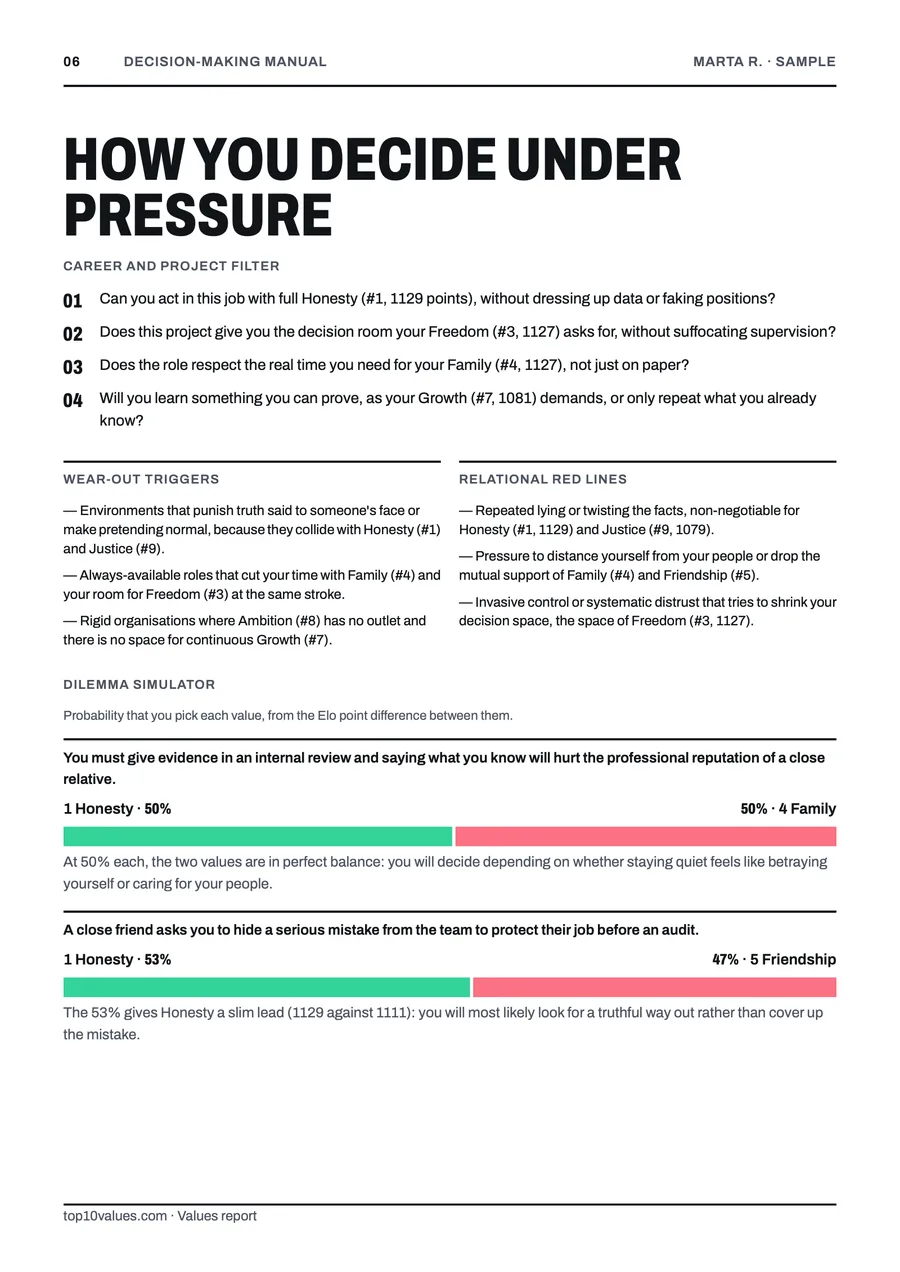
Sample page with fictional data (Marta R.), not yours. Your report is written from your own choices.