Personal Growth
Humility
Recognizing limitations.
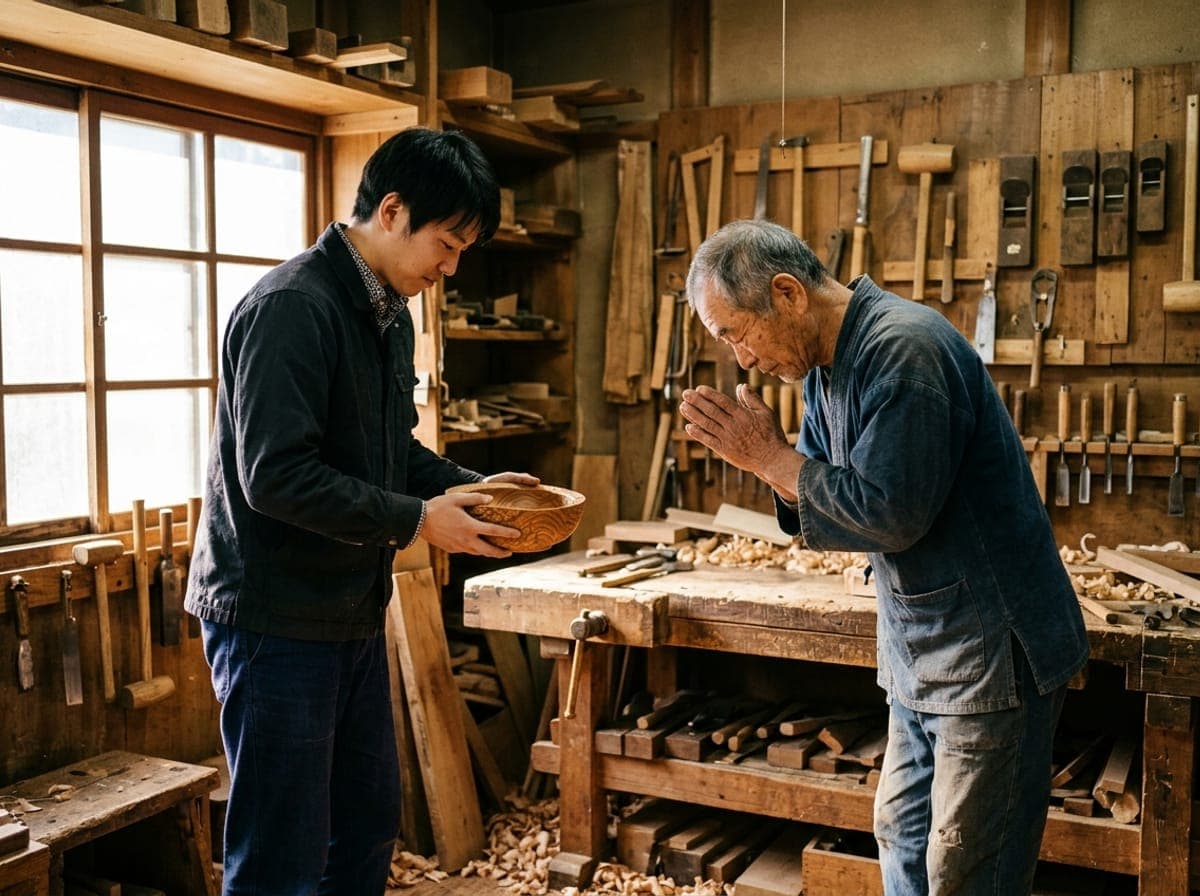
Humility is the ability to honestly recognize your own limitations and give others the credit they deserve, without needing to push your own achievements into every conversation. People who value humility listen more than they talk about themselves, admit when they don't know something and acknowledge others' contributions to shared success. This doesn't mean underestimating yourself or giving up ambition, but keeping a realistic assessment of your abilities in the face of ego. Humility often accompanies people with a high level of real competence, since the deeper you go into a subject, the more obvious it becomes how much is still left to learn.
What does this value mean?
Humility is having an accurate sense of what you know and what you're worth: not inflating it to impress, and not shrinking it so less is expected of you. It involves owning your mistakes and the gaps in your knowledge, staying open to ideas and advice that contradict your own, and not needing to be the centre of every conversation.
In practice, it means refusing to let your ego run your conversations. People who put humility first can say "I don't know", "I got that wrong" or "that was Sarah's idea" without feeling diminished. They care more about getting it right than about being right. You see it in moments like these: the GP who tells a patient "I'm not sure, let me check with a colleague"; the manager who opens the project review with what they got wrong; the tradesperson with twenty years' experience who asks the apprentice to show them an app they've never used. And in something less visible: changing your mind when you hear a good argument, without needing anyone to notice that you have.
What it does NOT mean
It does not mean selling yourself short, brushing off every compliment or letting others take credit for your work. Saying "oh, it was nothing" about something that took you three weeks isn't humility; it's hiding. And false modesty, the kind fishing for reassurance, is its opposite. Nor is it passivity or having no opinions: you can argue a position firmly while accepting that you might be wrong. And it isn't shyness, which is a matter of temperament. Some very outgoing people are deeply humble, and some quiet people have enormous egos.
Related concepts
Why might it matter to you?
Humility lets you learn from people who know more than you, even if they are younger, more junior or see the world differently. It also makes you easier to be around: people relax when they don't have to compete for your attention or worry that their mistakes will become your chance to shine. It has a very practical side too: if you admit early what you don't know, your mistakes come sooner and cost less. In an operating theatre, on a building site or in a software release, a well-timed "I'm not sure about this" catches the error nobody else dared to flag. And in a culture of hot takes, intellectual humility, the awareness that your beliefs might be wrong, is what lets you learn from an argument instead of just trying to win it. Those who prize it usually enjoy relationships between equals, and have little patience left for people who always need to come out on top.
How can you live this value?
- In your next meeting, ask at least one question about something you don't understand instead of nodding along. There is almost always someone else with the same question, and you've just spared them from having to ask it.
- When a project goes well, name out loud the person who contributed something specific: "the scheduling idea was Luke's." The more specific, the better; a blanket "thanks to the whole team" doesn't actually credit anyone.
- Ask someone you trust to tell you one thing you do badly, and listen without defending yourself. Then sleep on it before replying. Your first reaction to criticism is usually to justify yourself; your second, the next morning, is usually more useful.
- When someone compliments you, say "thank you" and stop there. Don't play it down or bounce it back with a reflex compliment. Accepting praise you've earned is part of seeing yourself accurately.
- Before you defend a strong opinion, ask yourself what evidence would change your mind. If you can't think of any, you're probably protecting an identity rather than reasoning. Trying this on the subjects you care most about, such as politics, parenting or your own industry, is uncomfortable and very revealing.
- Apologise without conditions. "I'm sorry if you were offended" isn't an apology; "I was late and didn't let you know, and I'm sorry" is. Naming exactly what you did, without minimising it or over-explaining, is one of the clearest forms of humility there is.
Advertisement
What happens when you don't live up to this value?
Without humility, every conversation becomes a small contest: you correct details that don't matter, use someone else's story as a cue to tell a bigger one of your own, and struggle to ask for help even after days of getting nowhere. You learn less because you don't ask, and people stop correcting you because they know you won't thank them for it. Mistakes surface late, when they're already expensive. Over time something else happens: you end up surrounded by people who agree with you, because the ones who used to push back have given up, and your decisions get worse without you noticing. If humility is one of your values, you'll feel it inside too: discomfort when you remember talking down to someone, or the strain of maintaining a front that doesn't quite match what you really know.
The healthy side and the shadow
When does this value stop helping you and start limiting you?
Healthy expression
Confidence without arrogance
In excess
Self-erasure
Misunderstood humility leads you to hide your achievements, skip asking for the raise you've earned and always give up the floor, even when you have the best idea in the room. Sometimes it's fear in disguise: if you never stand out, nobody can criticise you. There is also humility as a tactic: running yourself down in public so that people reassure you, or so that nobody hands you responsibility. And some workplaces confuse humility with compliance and use it to discourage people from asking for what they're owed. Healthy humility sees what you do well as clearly as what you don't; downplaying yourself is just another way of not seeing yourself accurately. The test is practical: it lets you ask for a pay rise with evidence, put your name on your work and say "I did this" without squirming.
This value at work
At work, humility makes you the person who asks what others are afraid to ask, and who owns up to a mistake before it snowballs. That makes teamwork much easier. Without a title, humility looks like asking for a code review or a second pair of eyes on a report without treating it as an attack, and writing up your mistakes so others don't repeat them. With a title, it looks like saying "I don't know, I'll find out" in front of your team. The researcher Bradley Owens, who has studied humble leadership with David Hekman and other colleagues, describes it through three observable behaviours: seeing yourself accurately, acknowledging other people's strengths and contributions, and being visibly willing to learn. The risk is that your work goes unnoticed: in many organisations doing a good job isn't enough, you also have to say so. Laying out what you've achieved, with evidence, isn't bragging.
This value in relationships
Your friends appreciate that you don't compete with them: you celebrate their wins without measuring them against yours, and you can say "you were right" without hedging. Humility also means accepting that someone may know a side of you better than you do. When a friend points out that you always cancel plans at the last minute, the humble response isn't to defend yourself but to ask how long they've noticed it. In a group, it means letting the friend with news to celebrate have the evening, without steering the talk back to your own achievements. Be careful, though, about always keeping your own needs quiet so as not to seem demanding; a healthy friendship has room for your wins and your problems too.
This value in love
In a relationship, humility shows at the end of an argument: saying "I got that wrong" without tacking on "but you…" defuses a lot of conflict. It also shows in letting your partner teach you things, from a recipe to a new way of looking at a problem. And in accepting that your way of doing things isn't the only correct one: how to load the dishwasher, how strict to be with the kids or how to handle money all have more than one reasonable answer. Plenty of long-running rows are really two people each convinced that the way their family did it is simply normal. Without humility, arguments pile up unresolved because neither of you wants to back down first.
This value in family
In families, humility is especially hard for parents and older siblings, who are used to having the last word. Admitting to a teenager that a punishment was unfair, or asking your daughter to show you something she's better at, changes the relationship more than any lecture. It works the other way too: as an adult, it takes humility to admit your parents were right about something you argued over for years. Between siblings, it lets you drop childhood roles. The "clever one" and the "one who's always late" may have changed a great deal, and treating a forty-year-old brother as if he were still twelve denies him the chance to be who he is now.
This value and yourself
Choosing humility as a core value suggests that arrogance and showing off make you uncomfortable, and that you'd rather let your actions speak. You're probably most at ease with people who admit their doubts, and slow to trust anyone who never admits a mistake. It's worth checking whether you sometimes use humility as a shield to avoid exposure: not asking, not proposing, not aiming higher. And if you find compliments hard to accept, ask yourself whether that's humility or a harshness towards yourself you'd never apply to anyone else.
What are you willing to sacrifice for this value?
Humility mostly costs you image. Would you let someone else take the credit for a success you worked on, if it helped the project? Would you admit in public that your proposal was weaker than one from a less experienced colleague? Would you correct a report already sent to the board after spotting that your figure was wrong, knowing nobody would have noticed? Recall a time you owned a mistake in front of someone you wanted to impress. If you did it without much inner struggle, humility is already guiding what you do. If you looked for a way to make it the circumstances' fault, you may value it more in others than in yourself.
Signs you're betraying this value
You betray humility when you pretend to know something to avoid looking bad, when you claim someone else's idea in a meeting, or when you interrupt to correct a detail that changes nothing. Also when you slip into false modesty: saying "I'm hopeless at this" in the hope that someone will contradict you. And a subtler one: only really listening to people with a job title, qualification or age you respect, and dismissing a good idea out of hand when it comes from anyone else.
Turning the value into goals
Value
Humility
Behavior
Say "I don't know" when you don't know
Goal
Ask two people whose judgement you respect for honest feedback on your work this month
Habit
Every Friday, note one thing you learned that week from someone with less experience or seniority
Questions to reflect on
- Who do you find it hard to learn from, and how much does that have to do with their age, role or views?
- When did you last say "I was wrong" without adding an excuse?
- Which of your achievements do you play down out of habit, and what if you described it plainly?
- In which conversations do you feel the need to come out on top?
- On which important issue have you changed your mind in recent years, and what convinced you?
- What would you find hardest to admit you don't know at work?
How much are you living this value?
Think back to the last disagreement in which it turned out you were wrong. From 1 to 10, how readily did you say so out loud, without a "yes, but…"? If it's below 7, start this week with one person you trust and something small: a figure you got wrong or a plan you suggested that didn't work.
When two values clash
Humility clashes with Ambition and Success: to move forward you sometimes have to show what you've done and ask for what you think you deserve, and in a job interview or a pay negotiation too much modesty is expensive. It also pulls against Leadership, which calls for deciding with confidence even when you don't have every answer, and against Authenticity, when hiding your achievements stops people from really knowing you. It can clash with Courage and Justice if you mistake humility for never pushing back: standing up for what you know is right in front of someone more senior isn't arrogance. On the other hand, it sits naturally with Growth, since you can only learn once you admit something is missing, and with Gratitude, which acknowledges what you owe to others. It usually helps to stick to facts: describing what you did with evidence isn't boasting, and admitting what you don't know doesn't cost you authority.
Is “Humility” one of your top 10 values?
Find out by playing and comparing this value with the other 49
How the Elo ranking works and its limits in the methodology.
What does the paid report include?
When you finish the 100 comparisons you will see your Top 10 on screen. If you want to go further, there is a PDF report on your personal values: €9.95 (VAT included), one-off payment. To buy it you need to save your game with a Google account.
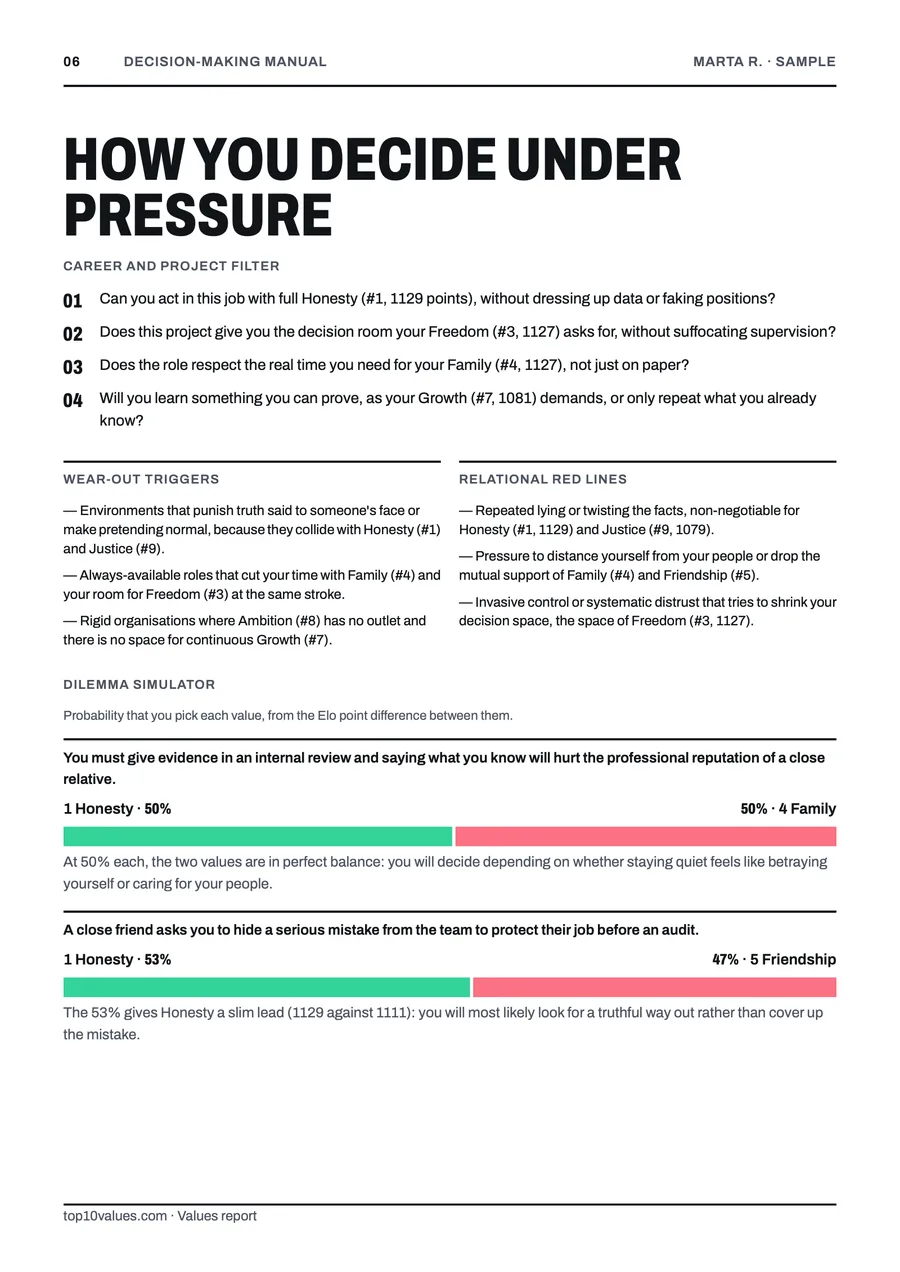
Sample page with fictional data (Marta R.), not yours. Your report is written from your own choices.
Frequently asked questions
Does being humble mean never talking about your achievements?
No. You can share what you've accomplished plainly and with evidence. The difference is the purpose: informing people or crediting those who helped you is healthy; seeking admiration in every conversation, or ranking your wins against other people's, is not. A useful rule of thumb: describe the result and how it was achieved, name the people involved and let others draw their own conclusions.
How can you tell humility from insecurity?
Humility lets you see clearly both what you do well and what you don't. Insecurity, or fear of standing out, only lets you see the second part. If you struggle to accept a compliment you've earned or to ask for what you're owed, it probably isn't humility at work. Another difference: a humble person can take criticism without collapsing, while an insecure one tends to hear it as proof of what they already feared.
Does humility undermine someone who leads a team?
Not necessarily, and it often strengthens them. In "Good to Great" (2001), Jim Collins described the leaders who took their companies from good to great as combining personal humility with intense professional will. The key is not to confuse humility with indecision: you can say "I don't know yet, give me until Thursday" and on Thursday make a clear call. What really undermines authority is projecting certainty that later falls apart.
What is intellectual humility?
It's the part of humility that concerns what you think you know: recognising that your views might be wrong and being prepared to revise them in the face of good arguments. Psychologists such as Mark Leary have studied it as a trait in its own right, separate from modesty about your achievements. It shows in simple habits: seeking out the best case the other side can make, saying "I hadn't thought of it that way", and keeping track of what you know, what you're assuming and what you've merely heard.
"Humility isn't thinking less of yourself, it's thinking of yourself less": who said it?
It is usually attributed to C. S. Lewis, but it doesn't appear in those words in his books. It's a later paraphrase of an idea from "Mere Christianity", where Lewis argues that a truly humble person won't be thinking about their humility, or indeed about themselves much at all. The underlying point is a useful one: humility has less to do with putting yourself down than with no longer measuring everything against yourself.
When Humility clashes with…
Invented scene. In the final interview, Carla is asked what her role was in the project listed on her CV. She delivered it with three other people, although she designed the part that won the contract. Humility asks her not to claim credit that is not hers alone. Ambition reminds her that nobody hires a "we did" and that the interviewer can only weigh what she says. Authenticity points to a subtler risk: saying "it was everyone's work" to avoid standing out hides what she did do, and that does not sound like her either. False modesty would play it down so that they press her; boasting would be taking all of it. One possible answer: "There were four of us; I designed the pricing model, and that is why it was signed." Name whoever deserves it, and give the figure. More scenes in conflicting values.