Wellbeing
Gratitude
Appreciation for what you have.

Gratitude is the ability to consciously recognize and appreciate what you already have, instead of focusing only on what is still missing. People who prioritize this value take time to notice and give thanks for both big events and everyday details: a conversation, a safe roof over their heads, present health. This practice reduces constant comparison with those who seem to have more and increases satisfaction with your current situation. Gratitude doesn't imply complacency or giving up on improving, but balancing the ambition to grow with an honest acknowledgment of the resources and relationships that already sustain your present life.
What does this value mean?
Gratitude as a value means honestly acknowledging what you have received from other people, from life, or from your own effort, and responding to it with attention and concrete gestures instead of taking it for granted.
It represents the habit of looking first at what works and only then at what is missing. It is not complacency: someone who practises gratitude can still want to change things, but does so from what is already standing and not from a sense of lack. It is also a form of accuracy: realising that today's meal depends on people who grew, transported and sold it, that your job exists because someone created it before you, that almost everything you know was taught to you by someone. And it is a value that points outward: it does not stay a pleasant feeling, it becomes a "thank you, this helped me in this way" said to the right person.
What it does NOT mean
It does not mean saying thank you out of obligation, putting up with unfair treatment with a smile, or forcing yourself into permanent optimism. Being grateful does not require staying silent about what hurts, or thanking someone for something that harmed you: a loss, an abuse or an injustice is not a gift in disguise. Nor is it an exercise in comparison ("others have it worse") used to silence your own difficulties. And it is not a debt to be settled: gratitude is acknowledging, not returning the favour in equal measure.
Related concepts
Why might it matter to you?
With habit, good things become invisible: you stop noticing the salary that arrives, the health that lets you walk, or the person who has been by your side for years, while what goes wrong draws your attention at once. Gratitude corrects that drift: it makes you stop at what holds up your daily life (a phone call, a job that pays the bills, a neighbour who waters the plants while you are away) and notice how much depends on other people. That changes how you relate to others: it is harder to feel entitled to everything when you see how many people make your day possible. It also affects how you look after what you have, because what is appreciated is better protected. And behind this value there is often a need to feel enough, without having to prove anything more to deserve what you already have. It does not promise that everything will turn out well; it offers a foothold for looking at problems without letting them eclipse everything else.
How can you live this value?
- Every night, write down three concrete things that went well today or that someone did for you. "My sister sent me the recipe I asked for" says more than "my family". Being concrete forces you to look properly, and the next week's list fills itself with details you would otherwise have missed.
- When someone helps you, say what it helped with, not just "thanks": "your explanation of the contract saved me a whole afternoon". A specific thank-you tells the other person what was useful and what is worth repeating.
- Write a thank-you letter to someone who changed something in your life (a teacher, a former boss, a childhood neighbour) and, if you can, read it to them in person or send it. Make it concrete: what they did, what changed in you and how you are today because of it. Most people have no idea what effect they had.
- Also appreciate things you do not usually count as achievements: a body that got you through the week, the bus that arrived on time, the report someone checked without being asked, the bread from the bakery downstairs.
- When you complain about something that keeps happening, ask yourself which part of it holds your life up. Traffic comes with having a car, meetings with having a job, courtyard noise with a lively neighbourhood. You can acknowledge that without denying what bothers you.
- Thank the people who usually go unnoticed: the cleaner, the person who delivers the post, the bus driver. Look them in the eye and say something more than routine; on an ordinary day it may be the first kind word they hear.
- When you close a chapter (a project, a course, a job), list the people who helped you get there and write to each one. It is a simple habit and almost nobody has it.
Advertisement
What happens when you don't live up to this value?
When gratitude fades, everything turns into debt or entitlement: what you are given feels like an obligation and what you receive feels small. Each achievement lasts less because you are already looking at the next one, and you start comparing your life with that of someone who has more, without realising that others compare you with what they lack. Relationships suffer when one side feels they always give and nobody notices: favours are taken for granted, gestures pass without comment and, one day, the person who did the most stops doing it. A constant complaint also appears, often justified, but with no counterweight: conversations revolve around what is failing and it becomes hard to see what works. And you lose something harder to measure: the ability to enjoy the present without immediately adding a "but".
The healthy side and the shadow
When does this value stop helping you and start limiting you?
Healthy expression
Specific appreciation
In excess
Gratitude that stays silent
When gratitude turns into obligation, it stops being a value and becomes a way of putting up with things. Thanking someone for unfair treatment, or not asking for what you need because you "already have enough", means giving up your own voice. Think of the person who does not ask for a raise because "at least I have a job", who puts up with disrespect from a relative because "they raised me", or who feels in perpetual debt to someone who helped once and now uses it as an argument to ask for more. There is also the opposite version, showcase gratitude: thanking people in grand phrases to look good, without changing anything about how you act. The useful question is whether what you are grateful for also does you good, or whether it mainly serves to avoid a conflict.
This value at work
At work, gratitude shows in the person who recognises the team's effort without claiming the credit, in the person who thanks a colleague for a review that improved a document, and in the person who names whoever came up with an idea when it is presented to management. Thanking people does not make you less demanding: you can ask someone for specific changes after telling them, in detail, what they did well. A specific thank-you ("the way you organised the incidents saved us hours") motivates more than generic praise, and it tends to reinforce exactly the behaviour you want repeated. The risk lies in using thanks as a substitute for what is owed: if someone works overtime again and again, a "thanks, you're a star" does not make up for the recognition and pay they deserve. Thanking people in low-visibility roles (administration, maintenance, support) also says a lot about how a team works.
This value in relationships
With friends and colleagues, gratitude keeps the bond alive. A message that says "I thought of you when I saw this, and I still owe you for the other day" carries more weight than many empty "how are you?" messages. It also helps you notice who is always available and give some of your time back, not just words. With people who care quietly, those who listen, link several people together or remember birthdays, an explicit thank-you lets them know their contribution is seen. And there is an important nuance in friendship: not keeping score. Healthy gratitude does not tally favours; it simply acknowledges what the other person does and lets each give when they can.
This value in love
In a couple, gratitude is often lost in everyday life: the coffee someone made, the house kept in order, the support during a hard week, the call to the doctor that nobody else was going to make. Naming it stops living together from turning into a list of pending tasks, and stops each side feeling that their contribution counts for less than the other's. A useful habit is to tell each other at the end of the day one concrete thing the other has done well, however small. And if something weighs on you, thanking the other person for what they do does not stop you from saying what you are missing: both fit in the same conversation and make it easier to hear. By contrast, whoever only points out what is missing usually gets defensiveness, not change.
This value in family
In families, gratitude often arrives late: when someone is no longer there, or after an argument has left wounds. Thanking parents, siblings or grandparents for something specific while they can still hear it changes the tone of your time together. It can be as simple as "that time you took me to the doctor, I never told you". It is also a value learned by imitation: children learn to say thank you above all by watching you do it, with them and with other people, rather than from an imposed rule. With elderly parents, acknowledging what they did, mistakes included, opens a conversation that has sometimes been pending for decades. And among siblings, thanking each one for what they contribute to caring for a sick relative stops an uneven split from turning into resentment.
This value and yourself
Having gratitude among your values says that it matters to you to feel your life has meaning beyond what you achieve, and that you value what sustains you more than what you show off. Perhaps it also means that receiving is harder for you than giving: accepting help, a compliment or a gift makes you more uncomfortable than offering one, and you answer with a "you shouldn't have" that takes value away from the gesture. Being grateful means admitting you depend on others, and that is not a weakness: it is an accurate description of how any life works. You may still tend to claim all the credit for your results or, the other way round, to give yourself none. A healthy balance is to recognise what you owe to others and what you put in yourself.
What are you willing to sacrifice for this value?
Would you be willing to set aside the pride of having done it alone, in order to recognise someone else's contribution, in public and by name? Think of someone to whom you owe something important and whom you have never properly thanked: a teacher, a former boss, a friend who took you in during a bad time. If saying it embarrasses you, gratitude is not as settled in you as you think. If you do it and the relationship improves, this value deserves more room in your life. There is an opposite sacrifice worth looking at too: how many times have you said thank you for something you actually deserved, just to avoid asking for it clearly?
Signs you're betraying this value
You go against this value when you take credit for other people's work in a meeting, when you assume someone will always be available, or when you treat with contempt those who serve you: the person who waits on you in a restaurant, whoever cleans the office, the colleague who covered your shift. Also when you remember the favour you did and forget the ones done for you, when you answer help with a "yes, but" or a complaint about what did not turn out perfectly, or when you look for someone only when you need them and vanish when all is well. And when you talk about your life only in terms of what is missing and let what you do have pass without noticing it.
Turning the value into goals
Value
Gratitude
Behavior
Thank someone specifically for something every day, naming what they did and what it gave you
Goal
Have told someone important, in person and before the end of the year, what they have given you
Habit
Every night, write down three things that went well and who took part in them
Questions to reflect on
- Who do you owe a specific thank-you that you have not yet given, and what has stopped you so far?
- What do you take for granted every day that you would notice straight away if it were missing?
- When do you use "thanks" to close a conversation instead of to acknowledge something real?
- How much of what you have comes from your own effort, and how much from luck or from other people?
- Which things do you take for granted because they are constant, and what would happen if they disappeared tomorrow?
- Is it harder for you to give thanks or to let others thank you? What does that say about how you receive?
How much are you living this value?
From 1 to 10, how often do you give specific thanks in an ordinary week? If the answer is below 5, start with one person: the one who does the most for you without you noticing. Write them two sentences today with one concrete example of what they did and what it meant for you.
When two values clash
Gratitude clashes with Justice when thanking someone seems to accept unfair treatment, such as thanking a boss who does not pay what they owe. You can thank someone for the gesture and still claim what you are owed: the first acknowledges the person, the second demands a fair deal. It also strains against Ambition, when appreciating what you have achieved seems to take away your drive. You can feel grateful for the road you have travelled and still want more; what changes is that you no longer chase the next thing from the feeling that what you have is worthless. With Honesty, the conflict appears when you thank someone, out of politeness, for something that did not actually help: a gift you did not want, help that complicated things. You can appreciate the intention and tactfully say what did not work. And with Humility, gratitude often goes hand in hand but the two differ: humility recognises your limits, gratitude recognises what others have contributed. When both are missing, it is easy to believe everything you have achieved is your own doing.
Is “Gratitude” one of your top 10 values?
Find out by playing and comparing this value with the other 49
How the Elo ranking works and its limits in the methodology.
What does the paid report include?
When you finish the 100 comparisons you will see your Top 10 on screen. If you want to go further, there is a PDF report on your personal values: €9.95 (VAT included), one-off payment. To buy it you need to save your game with a Google account.
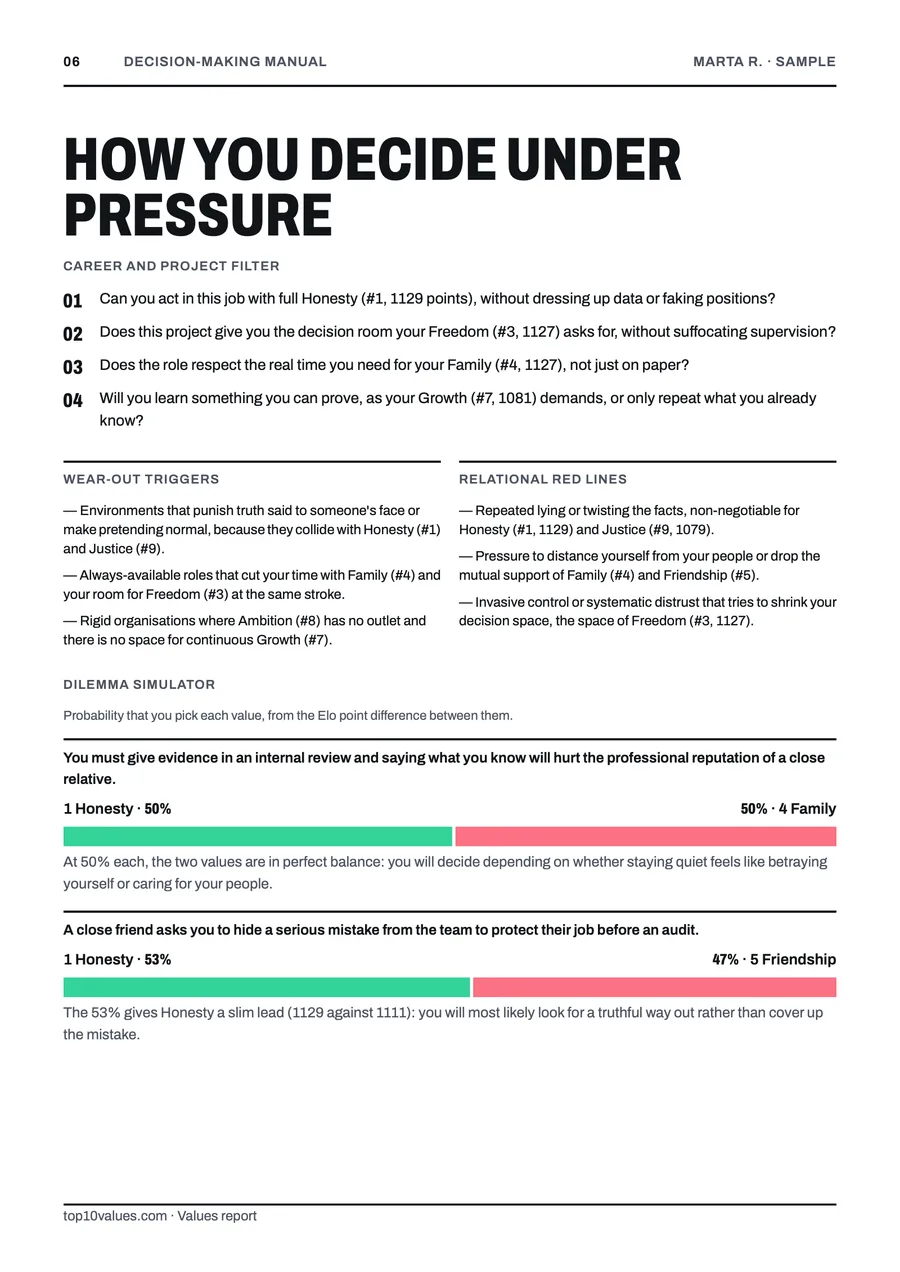
Sample page with fictional data (Marta R.), not yours. Your report is written from your own choices.
Frequently asked questions
Is gratitude useful when things are going badly?
It helps you see more precisely what is still standing. It does not ask you to pretend everything is fine: it asks you not to forget what still works while you deal with what does not. In moments of doubt, it often helps to write down just one concrete thing, even a small one (a person who listened to you, a kind gesture in the street). If you are going through a bereavement, an illness or a deep crisis, do not force it: gratitude is not an obligation and not a substitute for professional help.
How can I thank someone without feeling in debt?
Debt appears when you thank someone while expecting to return the favour in kind. Gratitude is acknowledging, not paying back. Say it sincerely and in detail, and let the relationship continue without keeping score. If helping makes you feel good, understand that the same is true for the person who helped you: accepting graciously is also a form of generosity.
What is the difference between gratitude and good manners?
Manners are a social norm: you say "thank you" because it is expected. Gratitude goes one step further: it means realising what someone did for you and that they were under no obligation to do it. The words can be the same, but the content changes. A simple test: if you could say exactly what that person did and what changed for you, it is gratitude; if it is automatic, it is courtesy.
How do I deal with someone who helps me and then reminds me of it constantly?
Thank them for what you received, and tell help apart from pressure. Help given generously does not become a weapon. If someone uses their favour to ask things of you or to control you, you can acknowledge the gesture and set a limit at the same time: "I'm very grateful for what you did, and that is why I want to be clear: I can't do this". Gratitude does not oblige you to obey.
How do I teach children gratitude without it feeling forced?
Avoid making them say "thank you" on the spot. It works better when they see you thanking people naturally, when you talk at home about what other people have done for the family ("today the neighbour brought us bread"), and when they can take part in small gestures towards others, like writing a note to a grandmother. Over the years, gratitude that comes from understanding tends to last longer than gratitude repeated out of duty.
When Gratitude clashes with…
Being grateful for what you have, versus wanting more or saying no.