Wellbeing
Enjoyment
Ability to enjoy the present.

Enjoyment is the ability to be present and fully savor the current moment, without constantly subordinating it to future goals. People who prioritize this value look for experiences that bring immediate, genuine pleasure: a good meal, a relaxed conversation, a hobby with no productive purpose. It isn't about avoiding effort, but about remembering that life is also lived in the present, not only in planning for tomorrow. This value balances highly achievement-oriented personalities, reminding them that constantly chasing the next goal without real pauses for enjoyment can drain the meaning even from the successes they eventually reach.
What does this value mean?
Enjoyment, as a value, is the ability to notice and savour what is good about a moment while it is happening, and the decision to give yourself permission to do so without postponing it or justifying it. It is not about what you have but about how you are present in what you do: the difference between eating a meal you love while scrolling through email and eating it while actually tasting it. Putting it among your values means that when you decide how to spend an evening, a dinner or an hour at work, you also ask “am I going to be here, or just pass through?”, and that question changes what you choose.
People who rank enjoyment highly tend to recognise themselves in small scenes. It is the nurse who, coming off a night shift, sits for ten minutes on a bench outside the hospital to watch the sun come up before catching the bus, phone left in a pocket. It is the grandfather who laughs out loud when his nine-year-old granddaughter beats him at cards by cheating. It is the guest at a wedding who gets up to dance despite dancing terribly, because they love the song and have no intention of watching from the side. It is the developer who, after finally finding the bug they have been hunting for two hours, allows a moment of satisfaction before opening the next ticket. It is the teenager drumming in the garage with no plan to start a band. And it is the commuter who, in the middle of a hard week, looks up on the train to take in a field of sunflowers passing by the window. What they share is not a life packed with wonderful plans but a way of being present: attention to what is going on, little hurry to get to the next thing, and no need for the moment to be useful for anything else. Enjoyment is less like a reward and more like a muscle. People who exercise it find reasons on ordinary days, and people who neglect it can spend a week on a beautiful beach without noticing a thing.
What it does NOT mean
It is not consuming more. A purchase, one more episode or an expensive trip can give pleasure, but enjoyment as a value is not measured in the number of stimuli; often it is the opposite, doing fewer things so you can notice them better. Nor is it unchecked hedonism. Chasing only what feels good right now, even when it costs you tomorrow, is closer to a way of avoiding the present, because what you are really after is covering something up. It is not irresponsibility: you can enjoy life a great deal and still pay your bills, hit deadlines and look after the people who depend on you; what changes is that you do not turn every minute into an obligation. It is not happiness either. Happiness looks at your life as a whole and asks whether it is heading somewhere good; enjoyment looks at this particular hour and asks whether you are living it. You can go through a hard period and still enjoy a long lunch with friends, and you can have a reasonably happy life and savour almost nothing because you are always in a rush. And it is not performing. Enjoyment does not require putting on a cheerful face at a boring dinner or looking delighted in a photo. Enjoyment staged for other people stops being enjoyment.
Related concepts
Why might it matter to you?
Much of the good that happens to you happens in moments that never come back in quite the same form: the afternoon your child learns to swim, the long dinner with friends before one of them moves abroad, the first warm day of the year. If you live them with your mind elsewhere, they still happen, but you keep nothing. Enjoyment matters because it turns experience into something you have actually lived rather than something that was merely in your calendar. There is also a practical reason. People who know how to enjoy small things depend less on big events to feel good. You do not need to wait for the promotion, the summer holiday or retirement, because an ordinary Tuesday has something worth having if you look for it. That makes long stretches of effort easier to bear, because you are not holding your breath all the way through. Psychologists have studied this kind of attention under the name “savouring”, and they usually distinguish three forms: enjoying what is happening now, what you are looking forward to and what you remember. All three can be practised. Finally, enjoyment is contagious. A parent who enjoys playing shows that play is worth something; a colleague who laughs in a tense meeting lowers the temperature in the room; a friend who relishes the food you cooked makes the effort feel worthwhile. It works the other way too: someone who treats every hour as a chore ends up turning other people’s time into a chore as well.
How can you live this value?
- Do just one thing for the first five minutes of something you like. The first sip of coffee, the opening minutes of a film, the start of a walk: no phone, no side conversation, no thinking about what comes next. You do not have to keep it up the whole time; simply entering the experience properly changes how you live the rest of it.
- Bring back a hobby with no goal attached. Something you do because you like it, not to improve, earn money or show anyone: watercolours nobody will see, baking bread, three chords on a guitar, running without a watch. If you notice yourself tracking progress or thinking about posting it, stop and ask whether you are still enjoying it or have started performing.
- Stretch the good moments instead of rushing to the next one. When something goes well, such as passing an exam, a lovely conversation or a dish that turned out delicious, stay there a minute longer. Tell someone, say what you liked about it, or simply notice it before you open the next tab. It is the simplest habit and the one most often forgotten.
- Enjoy the before and the after as well. Looking at the map of Saturday’s hike on Thursday night, or going back through the photos of a trip with your partner a few weeks later, stretches the pleasure of an experience. Set aside time to look forward to what is coming and time to remember what has passed, without letting it turn into nostalgia.
- Change things up so the good does not become invisible. What you repeat without variation stops registering: the usual route to work, the identical Friday dinner, the series that plays in the background every night. Try a different route, invite someone new to the regular dinner, or give up a habit you like for a few weeks so you come back to it with an appetite.
- Name the guilt when it shows up. If, halfway through a nap or an afternoon of reading, you hear the voice that says “you should be doing something useful”, ask whose sentence that is and whether anything is actually urgent. Often nothing is. If something is, deal with it and come back; if not, stay.
Advertisement
What happens when you don't live up to this value?
When enjoyment is neglected, life does not usually look as if it is going badly. You keep your commitments, you make progress, perhaps you are even doing well. What happens is that everything is lived at half strength. You eat standing up or in front of a screen, you go on holiday and take four days to stop checking email, and by the time you finally relax it is time to go home. Weekends fill up with errands, and on Sunday night you cannot remember a single pleasant moment, although there were some. One sentence comes up again and again: “I’ll enjoy it once this is over.” When it is over, something else begins. Another sign is that hobbies turn into duties: the gym becomes a programme to complete, reading becomes a list of unread books and a trip becomes a timed itinerary. The people close to you notice too. Your children stop asking you to play because they know you will say “not now”, your partner stops suggesting plans because your head is always somewhere else, and at dinner with friends you keep glancing at the time. In the long run, the risk is reaching a stage when you finally have time and discovering you have lost the habit of enjoying it. Some people retire and do not know what to do with an empty morning, not because they lack options, but because they have gone decades without practice.
The healthy side and the shadow
When does this value stop helping you and start limiting you?
Healthy expression
Savouring what is already happening
In excess
Fleeing anything that does not feel good
The shadow side of enjoyment appears when it stops being a way of being present and becomes your only criterion for deciding. Then you drop the course as soon as it stops being fun, leave the relationship when the first dull stretch arrives, switch jobs whenever a task feels heavy and avoid any conversation that might spoil the mood. What gets presented as “living in the moment” turns into never committing to anything with an uphill section, and almost everything worth having has one. Another version is enjoyment as anaesthetic: the drink every night, the purchase that lifts your mood for an hour, the binge-watching that runs until two in the morning. At that point you are not savouring anything; you are using pleasure so as not to feel something else. There is also shop-window enjoyment, where every plate and every sunset is photographed to be shown and barely looked at. To tell which side you are on, try three questions. Does what I do for enjoyment leave me better or worse off the next day? Could I enjoy it just as much without telling anyone? Can I stick with something I dislike when I know it leads somewhere I care about? If the answer to any of these is often “no”, enjoyment is working against you.
This value at work
At work, enjoyment plays out on two levels. The first is the task itself. Almost every job has parts that can be savoured: the carpenter who enjoys the moment a joint slots into place, the teacher who lights up when a student’s face shows they have got it, the analyst who pauses for a second over a spreadsheet that finally balances. People who value enjoyment learn to spot these moments and not to rush past them. When choosing a job, they also ask what they will spend most of the day actually doing, not just what title will be on the business card: a better salary in a role made of eight hours of meetings you dread can turn out to be expensive. The second level is breaks. Eating lunch at your desk, running video calls back to back without standing up, or answering messages while having coffee with a colleague are habits that hollow out the day. Protecting half an hour to eat properly, going outside for five minutes between two long meetings, or taking the end-of-project celebration seriously is not wasting time; it is what makes the rest of the day bearable. If you work from home the risk is greater, because nobody drops by to suggest a coffee. Humour counts too: a team that can laugh at a mistake without humiliating anyone works in a more relaxed way and tends to raise problems earlier. Watch out for the excess, though. Not all work can be pleasant, and someone who systematically turns down the tedious tasks ends up handing them to somebody else. Enjoying your work does not mean choosing only what you like; it means not missing what you do like because you are in a hurry.
This value in relationships
In friendship, enjoyment shows in how present you are when you get together. You can see your friends every week and never quite be there: phone on the table, watching the clock, thinking about tomorrow. Or you can see them once a month and have that dinner run on until the restaurant closes. The friendships people enjoy most tend to have their own rituals: the Tuesday five-a-side, the quarterly board-game night, the group that rents a cottage together once a year. Suggesting them and keeping them going is a way of looking after enjoyment, not only the friendship. It also helps to accept that people enjoy different things: one friend loves karaoke and another finds it a form of punishment, and there is nothing wrong with having different plans with different people. A common mistake is always needing something extra to have a good time, such as the drinks, the late night or the special plan, and not knowing how to enjoy a walk or a quiet evening in with someone. Another is becoming the person who organises everything and enjoys nothing because they are busy making sure it all goes well. If that is you, try handing over one dinner and turning up to your own group without having arranged a thing. And pay attention to how you feel when you say goodbye. If you leave a get-together with no wish to repeat it, that friendship may need a different format, a different plan or simply an honest conversation.
This value in love
In a couple, enjoyment fades without anyone deciding it should. At the beginning everything is new and savoured without effort; over the years, shared time fills with logistics: who picks up the kids, what is for dinner, when the insurance is due. A couple can run perfectly well and not have enjoyed an hour together in months. Looking after it takes small, deliberate decisions: cooking something together on a Friday with music on instead of ordering in and eating it on separate phones, a one-night getaway without a tight itinerary, or simply going to bed without screens and talking for a while. Physical pleasure is part of this too, and it helps to be able to talk about it without embarrassment: what you like, what you miss, what has changed. Another key is enjoying the other person’s enjoyment. Going with them to a concert by a band you are lukewarm about and noticing what a great time they are having can be a pleasure in itself. The reverse is a common source of conflict: when one partner ranks enjoyment very high and the other very low, the one who ranks it high feels their partner never relaxes, and the other feels their partner only cares about having fun. Talking about it in those terms, as a difference in values rather than a character flaw, usually takes some heat out of it. And watch out for resenting your partner’s fun: the fact that they have a brilliant time with their friends is not a threat but good news for both of you.
This value in family
In families, young children are often the best teachers of enjoyment. A four-year-old can spend a whole hour with a puddle, a cardboard box or a snail without wondering whether the time is being well spent. Many adults interrupt that play to move on to the next useful activity, and others sit beside it without looking up from their phone. Lying on the floor building with blocks for twenty minutes, without trying to make the game teach anything, is one of the clearest ways to live this value with your children. With teenagers the setting changes: sometimes shared enjoyment is as simple as letting them play their music in the car and asking what they like about it, without passing judgement. In the wider family, long meals are a test. For some relatives they are the best afternoon of the month; for others, a duty to get through. If you are in the second group, finding your own share of enjoyment, such as bringing a dish you love to make, sitting next to the aunt who makes you laugh or getting out a pack of cards after dessert, changes the experience a great deal. With ageing parents, enjoyment becomes smaller and more precious: sharing an ice cream on a walk in the care home garden, listening with them to the songs of their youth, or letting them tell, for the hundredth time, a story that still delights them. Then there is what you pass on. Children learn from what they see. If they see you never resting, always rushing and without hobbies, they learn that adult life is about getting things done; if they see you enjoying simple things, they learn that this is possible too.
This value and yourself
If enjoyment is among your highest values, you probably find it hard to put up with periods when everything is effort and nothing is pleasant, and you are irritated by people who seem to treat having fun as a waste of time. You likely remember your best moments through sensory details, like the light one evening, the taste of something or someone’s laugh, more than through what was achieved. People may tell you that you are easy to please, and that is true in the good sense: you do not need big events to have a good time. You may also need to keep an eye on a tendency to put off whatever you do not like, to avoid conflict so as not to spoil a good mood, or to change course when a project gets heavy. If, on the other hand, enjoyment appears in your top 10 but you do not recognise it in your daily life, it may be a sign that you miss it. Some people choose it precisely because they have not practised it for a long time. In that case the useful question is not “how can I have more fun?” but “what stops me noticing the good that is already here?”: hurry, guilt, exhaustion, or an inherited idea that pleasure has to be earned.
What are you willing to sacrifice for this value?
Really enjoying life has costs that do not always look like sacrifices. It costs apparent productivity: would you give up an afternoon of ticking items off your list to spend it in a park? It costs image: in some workplaces, leaving on time for a pottery class looks less committed than staying late. It sometimes costs money, because some of the experiences you enjoy have a price, and sometimes it costs the opposite: turning down extra income to keep some time to yourself. It costs control as well: savouring a moment means not preparing for the next one, and for someone who lives by anticipating, that is unsettling. And it means facing the guilt, the voice that says you have not earned it. The underlying question is what you would be willing to stop doing in order to enjoy what you already do. If the answer is “nothing”, enjoyment may be a nice idea for you rather than a value.
Signs you're betraying this value
You betray enjoyment when you say you are on holiday and keep answering emails every day, when you see someone you love and spend half the time on your phone, or when you let a beautiful moment slip by because you were thinking about how to describe it. You also betray it when you turn a hobby into another source of pressure, with targets, comparisons and hurry, or when you answer “not now” to every invitation to play, go out or stop. And you betray it from the other direction when you use “I live in the moment” to get out of a promise, to leave the heavy lifting to others or to avoid looking at something that worries you.
Turning the value into goals
Value
Enjoyment
Behavior
For one meal a day, eat without screens and pay attention to the taste and the company for at least the first five minutes
Goal
This quarter, bring back a hobby you do purely for pleasure, without measuring results or showing it to anyone, and give it at least one afternoon a week
Habit
Before going to sleep, recall one moment from the day that you enjoyed and go over in detail what made it pleasant
Questions to reflect on
- When did you last lose track of time doing something you loved, and what were you doing?
- What did you enjoy as a child that you no longer do, and what really stops you today?
- At which moments of the week are you physically in one place and mentally in another, and what do you miss because of it?
- What did you hear at home about pleasure or rest, and how much does it still weigh on your decisions?
- Who are the people you find it easiest to enjoy things with, and when did you last seek them out?
- If you had a whole afternoon tomorrow with no obligations, would you know what to do with it, or would you fill it with tasks?
How much are you living this value?
Think about the past week and look for three moments you genuinely enjoyed, with attention and no rush to move on. If they come easily and you remember the details, enjoyment is present in your life. If you struggle to find one, or you remember that there were good moments but you did not really live them, rate this value according to what you do, not what you would like to do.
When two values clash
Enjoyment clashes with Discipline almost every day: discipline asks you to get up and train when bed is far more pleasant, or to study when you would rather go out. The point is not for one to win every time, but to tell the enjoyment of the moment from the enjoyment that comes later, the satisfaction of having followed through, and to look for ways of training or studying that also have something pleasant about them. With Productivity and Efficiency the tension is about pace. Enjoyment needs slowness and attention, while productivity tends to optimise every minute, leisure included. If you catch yourself reading novels at double speed or listening to podcasts while walking somewhere beautiful, productivity is gaining ground. With Ambition and Success, the risk is postponement: “once I get where I want to be, I’ll enjoy it.” Many people get there and find they have lost the habit. With Financial Security, the conflict is between spending now on an experience and saving for later; a useful rule is to set aside a small, fixed amount for enjoyment rather than arguing about it every time. With Health, enjoyment is an ally when it means moving because you like it or eating with attention, and a rival when it gets confused with too much food, alcohol or lost sleep. With Family and Service, the clash appears when caring for others leaves little room of your own; there, enjoyment tends to live in very small things, and having none at all eventually wears the caring down. With Excellence it clashes when perfectionism stops you enjoying doing something badly just for fun. It also has clear allies: Gratitude, which helps you notice what you already have; Inner Peace, which gives you the calm needed to savour; Adventure, which brings novelty; and Happiness, which looks at your life as a whole while enjoyment takes care of each hour.
Is “Enjoyment” one of your top 10 values?
Find out by playing and comparing this value with the other 49
How the Elo ranking works and its limits in the methodology.
What does the paid report include?
When you finish the 100 comparisons you will see your Top 10 on screen. If you want to go further, there is a PDF report on your personal values: €9.95 (VAT included), one-off payment. To buy it you need to save your game with a Google account.
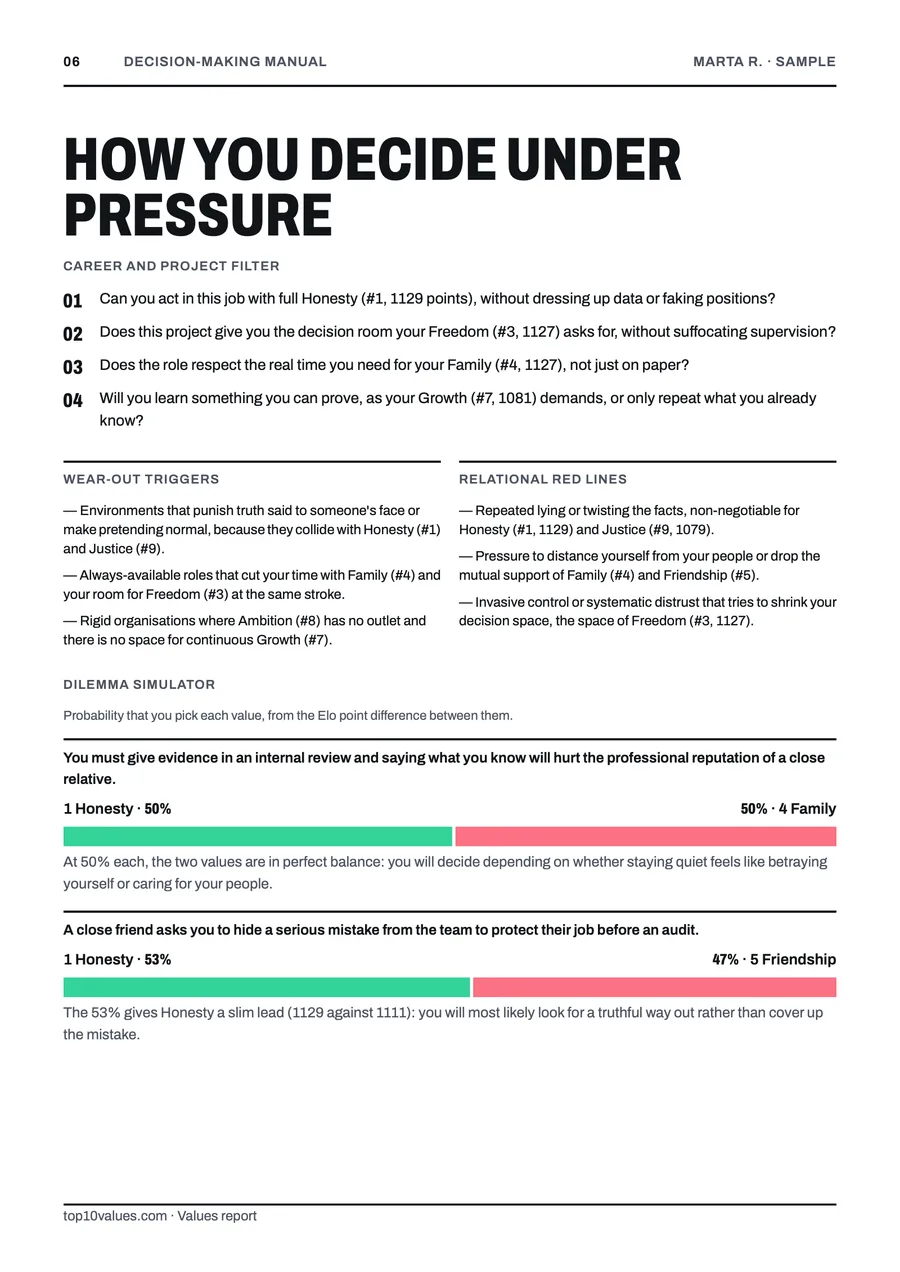
Sample page with fictional data (Marta R.), not yours. Your report is written from your own choices.
Frequently asked questions
What does enjoyment mean as a personal value, and what are some everyday examples?
Enjoyment as a value is the importance you give to living good moments with attention while they happen, and to letting yourself savour them without guilt or hurry. Everyday examples: eating without screens and noticing what you eat, staying a little longer at the table after a meal instead of jumping up to clear it, playing with a child without checking the time, keeping a hobby that serves no purpose except having a good time, or stopping to look at a view on the way to work. It does not require money or extra time, just a different way of being present in what you already do. You can tell it is a value and not just a preference when you protect it from hurry: for example, when you turn down an extra task on a Friday so that you do not arrive with your head still at work at the dinner you have been looking forward to for weeks.
What is the difference between enjoyment, happiness and pleasure?
Pleasure is a pleasant sensation, often brief: something sweet, a hot shower, a song. Enjoyment is the capacity to notice and savour that sensation, or any good moment, with attention; you can enjoy things that are not strictly pleasurable, such as a tough hike or a deep conversation. Happiness looks further ahead: it is your judgement of how your life is going as a whole and the sense that what you do is worthwhile. So you can have plenty of pleasure and little enjoyment, if you consume without paying attention, and you can go through a difficult period when happiness is low but you still enjoy particular moments. The three feed each other, but they are not interchangeable.
Is valuing enjoyment the same as being a hedonist?
It depends on what you mean by hedonism. In everyday use, a “hedonist” is someone who puts immediate pleasure above everything, and that is not what this value describes. Interestingly, the Greek philosopher Epicurus, whose name is often linked with hedonism, argued for something rather different. In his Letter to Menoeceus he explains that the pleasure he has in mind is not that of excess but the absence of pain in the body and of trouble in the soul, and he recommends choosing pleasures with prudence, because some bring more discomfort afterwards than they give. That idea is much closer to enjoyment as a value: savouring what is good without letting it rule you.
Why do I feel guilty when I enjoy myself or rest?
It is very common, and it usually has learned roots. Many people grow up hearing that duty comes first and fun comes later, if there is time left, or watch their parents never stop. Others work in places where a permanently full diary is read as commitment. That voice switches on the moment you sit down to read or lie down for a nap. It helps to identify it and ask it a concrete question: is anything genuinely urgent right now? If so, deal with it and come back. If not, the guilt is not pointing at a problem, only at a habit. It also helps to schedule rest like any other appointment, so that it does not depend on finishing everything else first, which rarely happens.
How can I enjoy the present without neglecting the future?
They are not opposites. Planning, saving or studying for an exam are necessary, and enjoyment does not ask you to give them up. What it asks is that you do not live in the future all the time. One practical way to balance them is to separate the moments: set aside specific times for planning and others for being in what you are doing, rather than planning while you have dinner with your family. Another is to choose routes to your goals that also contain something pleasant: a sport you like rather than the one that burns the most calories, studying in a group if studying on your own drains you. And remember that looking forward to something good is itself a form of enjoyment.
What should I do if nothing feels enjoyable any more?
If you have gone a while without enjoying things because of heavy workload or too little sleep, getting some rest back and a little time of your own is often enough. But if for weeks you notice that you have lost interest or pleasure in almost everything you used to like, even when you have time, it is worth taking seriously: a persistent loss of interest or of the ability to enjoy things is one of the symptoms mental health professionals look at when assessing depression. It is not something you can fix with willpower or a list of plans. Talk to your GP or a psychologist, and tell someone you trust as well.
Can you enjoy a job or a task you do not like?
Sometimes, partly. Some tasks will never be pleasant, and there is no need to pretend they are. But there is almost always something to savour around them: a chat with a colleague, the satisfaction of finishing something well, music while you sort out a filing system, the mid-morning coffee. It also helps to change how you do them: batch the tedious tasks into one block and reward yourself afterwards, or do them in company. If, after trying, your job leaves you not a single moment of enjoyment for months, it may be a question of fit rather than attitude, and worth considering a change, even in the medium term.
When Enjoyment clashes with…
Invented scene. Nora has spent four months preparing for a public-sector exam, and her plan says to study from nine to two. One Tuesday her cousin invites her to an impromptu lunch on the beach, with sun and no phones. Joy asks for no explanations: it knows the day will not come back and that laughing with people you love is part of living, not a reward. Discipline argues that if every special day counts as an excuse, the exam will be lost without anyone deciding it. Ambition adds that this post is what Nora has wanted for years and that eight weeks remain. The uncomfortable part is that neither voice is lying. Before deciding she can agree a rule with herself: one real day off every two weeks, chosen in advance, and two hours made up this afternoon. Enjoying yourself without guilt usually needs a plan that already made room for rest. More cases in conflicting values.