Personal values test: how it works and how to read your Top 10 result
By Juan Alejandre · Published · Reviewed
Industrial engineer and consultant, 25 years working with teams
If you are searching for a personal values test, you probably want two things: to take it now, and to know whether it will tell you anything useful. This page answers both. It explains what a values test measures (and what it does not), how the test on top10values works, what you get at the end, and how to read your result without over-reading it.
If you would rather start right away, you can take the personal values test. It is 100 quick choices between two values, and you can begin without creating an account.
What a personal values test actually does
A personal values test, sometimes called a core values test or a values assessment, puts in order the things that matter to you: honesty, freedom, family, ambition, creativity, security, and so on. It does not describe what you are like. It shows what you put first when you cannot have everything.
That is the main difference from a personality test:
- A personality test describes tendencies. It asks how you usually react, whether you plan or improvise, whether people energise you or tire you out. The result is a description of your style.
- A values test describes priorities. It asks what you pick when two good things collide. The result is an order: what comes first and what comes after.
An example makes the gap visible. Someone can be shy (a personality trait) and still value courage (a value). They know public speaking is hard for them, and they still think it matters to do it when it counts. The two kinds of test would say different things about that person, and neither would contradict the other.
This is why a values test is useful in a different set of situations. You can use it to weigh two job offers, to understand why a situation bothers you more than seems reasonable, to prepare a conversation about priorities with a partner, or simply to sort out your thoughts before a big change.
"What are my values?" Where a quiz helps and where it does not
Most people who type "what are my values quiz" are stuck on the same thing: every value on the list sounds right. A quiz helps with exactly that problem, because it makes you rank things you would never rank on your own. It does not help if you expect it to tell you who you are. It shows you what you chose today, in this order, from this list. What you do with it is up to you.
Why rating values from 1 to 10 gives you a flat list
The most common way to measure values is the rating scale: a list of statements, each with a score (1 to 5, 1 to 10, or "not important" to "very important"). It is quick and easy to score, but it has a practical flaw. Almost everything comes out high.
Think about three statements: "family matters to me", "health matters to me", "freedom matters to me". You will probably give all three a 9. You end up with a list of important values, but you still do not know which one would win if you had to give one up. And the hard decisions in life are almost always of that kind: taking a better-paid job in another city (freedom and ambition against family), saying an uncomfortable truth (honesty against kindness), staying with someone who is going through a rough time (loyalty against comfort).
The other classic technique is the values card sort. You get a deck of values and place them in piles such as "very important", "important" and "less important". It works well in a guided session, where someone asks you questions as you sort. Done alone, it tends to repeat the rating-scale problem: the "very important" pile ends up with too many cards.
The approach on top10values works like a digital card sort with one rule changed: you have to choose. Faced with two values, only one wins. There is no tie and no "both".
How the top10values test works
The test has three parts.
1. A fixed list of 50 values
The test uses a fixed list of 50 values, from the familiar ones (family, honesty, freedom) to less obvious ones such as mastery, simplicity or contribution. You can see all of them, with a short note on how each shows up in daily life, in the personal values list. The values with their own page (for example freedom or integrity) explain what the value means, what its excessive side looks like and how to live it.
The list is not exhaustive. You will probably miss some (responsibility, patience, solidarity and tolerance are the ones people look for most), and that is normal: every list leaves things out. What matters is that, among the 50, the order comes from your choices and not from how good each word sounds.
2. 100 pairwise comparisons
At each step you see two values and pick the one that matters more to you at this point in your life. You tap or swipe to choose. There are 100 choices in total. With 50 values, that means each value appears about four times on average. There are no right answers and no "good" or "bad" result: honesty against kindness, or ambition against balance, are both legitimate pairs, and the choice is yours.
We do not give a duration in minutes because we do not yet have enough measured sessions to state one. The choices are quick, and you can do them in one go or in several sittings. One practical tip is not to linger on any one pair. Your first reaction is usually more telling than the answer you reason your way to after three minutes of doubt. If a pair is truly hard, that is information as well, because those two values will come back in other combinations.
3. ELO scoring and pair selection
This is what separates the test from a simple count of "which one you picked more often".
ELO scoring. ELO is the system used to rank chess players. Every value starts at 1,000 points. Each time you pick one, it goes up and the other goes down. The key point is how much: it depends on how expected the result was. If a value that is already far ahead beats one that is behind, the change is small. If the one that was behind wins, the change is large.
Here are numbers from the implementation, which uses an adjustment factor of 32 points. Say one value has 1,100 points and the other 900. The system expects the first to win with a probability of about 76%. If the favorite wins, it gains roughly 8 points. If the other one wins, it gains roughly 24. So a surprising choice weighs more than a predictable one, and the final order reflects the whole path of your choices and not just a tally.
Pair selection. The test does not show you random pairs. Each time it needs the next pair, it scores every possible combination and shows the best one. The score combines three criteria:
- Uncertainty (the criterion with the most weight): pairs of values with similar scores, where the outcome is hardest to predict. Asking whether you prefer your number 1 value over your number 50 tells you nothing. Asking about your 4th against your 6th does.
- Exploration: values that have appeared only a few times, so that none is left unassessed.
- Novelty: pairs you have not seen yet, so that comparisons do not repeat.
This idea is called active selection: using the answers you already have to decide what to ask next. The aim is to get more information out of 100 comparisons than out of 100 random ones. The full details, with their limits, are on the methodology page.
What you get when you finish
When you reach 100 comparisons, the following unlocks at no charge:
- Your ordered Top 10: the ten values that climbed the most.
- A radar by category: it shows the average score of the values in each category. There are six categories with values today: personal growth, relationships, freedom, creativity, achievement and wellbeing. Keep in mind that the radar averages all 50 values, not only your Top 10, and that the categories differ in size: personal growth holds many more values than freedom. Read it as a hint, not as a verdict.
You can keep playing after 100. The order keeps sharpening, especially between neighbouring positions.
The only paid item is the complete report, which is optional: EUR 9.95, VAT included, a one-off payment with no subscription, processed by Stripe. It is written by an AI (Google Gemini) from your comparisons and delivered as a PDF; the purchase includes two regenerations. It is meant as a guide for reflection, not as a psychological assessment or professional advice, and it may contain inaccuracies. To buy it you need to sign in with Google, and at checkout you accept that it is delivered immediately, which means you lose the 14-day right of withdrawal (details in the terms). You do not need the report to see, save or share your Top 10.
About accounts: you can start playing without creating one. The game is tied to your browser, and it is lost if you clear its data or go 30 days without playing. Google sign-in is asked for only if you want to keep your result in your account, share it or buy the report.
Five checks before you trust any values test
Whatever test you choose, it deserves your time if it passes these checks. Apply them to ours as well:
- Does it make you prioritize? If everything can score high, you get a flat list.
- Does it explain how the order is calculated? A result with no visible method is a black box.
- Does it say what it cannot tell you? A serious test admits it does not diagnose or predict behavior.
- Is it clear what costs money and what does not, before you start? Better to know before you spend time on it.
- Can you start without handing over your details? A self-reflection test should not need an account just to show you the pairs.
Our test is designed to meet all five, but you do not have to take our word for it: check each point against this page and read the limits below.
An example of a result
Here is what a Top 10 looks like. This one is fictional, invented for the example, and does not belong to a real person:
One possible reading: relationships dominate (family, love, friendship, trust), and honesty is the value that sets the terms for how people treat each other. Freedom in third place suggests this person values choosing their own path, and ambition in last place suggests it matters but not at the cost of the rest. It is a reading, not a verdict. Another person with this Top 10 could have very different stories behind each position.
How to read your own result
A Top 10 is a starting point for thinking. Before you start, write down on paper the three values you expect to land on top. When you finish, the gap between what you expected and what came out is the most useful part. Then these five questions help you get more out of it.
1. What surprises you? Look for what you did not expect: a value you thought was central that landed at 15th, or one you had never named that showed up at 4th. The surprises often point to a gap between the person you describe and the person who actually decides.
2. What do you see in positions 1 to 3, and what in 8 to 10? The top places are your clearest priorities. The bottom ones, very close to each other, can swap with a few different choices. Do not read much into the gap between 9th and 10th.
3. Do your top values pull against each other? Ambition and balance, freedom and family, honesty and kindness. Two high values that clash are not a flaw. They show where your dilemmas will tend to appear.
4. Does what you do match what you chose? Think of three recent, important decisions. Did the value near the top win? If not, it does not mean the test is wrong. Something may be stopping you from living that value, or you may pick it in the abstract and trade it away in practice.
5. What would you change this week? Pick one value from your top three and one small action that reflects it. A value is something you live, not something you frame.
If two people take the test, comparing Top 10 lists often opens conversations that would not come up otherwise.
Three common tensions and how to look at them
Many Top 10 lists contain two high values that pull in opposite directions. You do not need to resolve them, but it helps to recognize them:
- Honesty and loyalty. Telling a friend the truth about something they did wrong can feel like betrayal, and staying quiet can feel like lying. If both are near the top, look at which one has won in real situations.
- Ambition and balance. Wanting to go far at work and wanting evenings off compete for the hours of the week. A Top 10 with both usually describes someone who renegotiates their time every week.
- Freedom and family. Deciding without explaining yourself and caring for the people who depend on you do not always fit in one plan. Seeing it in writing makes it easier to talk through with the people involved.
These are common pairs, not a diagnosis of anyone. Your own combination may be very different.
What a personal values test cannot do
It is better to be clear about the limits:
- It is not a validated psychometric test, and it does not diagnose anything. It is a self-reflection tool. It does not assess mental health, measure abilities or replace a professional. It has not been validated in scientific studies.
- It does not compare you with other people. There is no average and no "normal" score. Your Top 10 is compared only with your own choices.
- The result depends on the moment. Your priorities shift with your stage of life, a change of job, a new child or a loss. If you repeat the test in a few months and the order changes, it is not an error. It is information.
- It depends on the 50 values available. If your most important value is not on the list, the test cannot detect it.
- With 100 comparisons, the order between neighbours is approximate. That is why you can keep playing to refine it.
- It does not predict behavior. A high value does not guarantee that you live it, and a low one does not mean you ignore it.
How this differs from other core values tests
| Approach | How it works | What usually comes out | Where it fits best |
|---|---|---|---|
| Rating-scale questionnaire | You score each statement | Many values with a high score | Measuring many things quickly |
| Values card sort | You place values in piles | Depends on how you define the piles | A guided session with another person |
| Academic instruments (Schwartz-type surveys) | Research questionnaires | General dimensions, not a list of your own specific values | Studies and academic settings |
| top10values | Pairwise comparisons with ELO | An ordered Top 10 of specific values | Individual self-reflection at your own pace |
We are not saying one approach is better than another. They answer different questions. If the academic route interests you, go to the original source of each instrument. One point you can check in the literature, and not a result of top10values: in its classic form (Schwartz, 1992), Shalom Schwartz's theory of basic values distinguishes ten value types, such as self-direction, achievement, security and benevolence, and a later version (Schwartz and others, 2012, Journal of Personality and Social Psychology) refines them to 19. It is measured with his own questionnaires. It is a research framework with a different goal: it does not rank a list of values like ours, and our test is neither based on it nor a replacement for it.
Getting more from the test
- Choose for this stage of your life, not for the person you would like to be.
- Do not worry about how it looks. If honesty sits near the top only because it sounds good, the repeated pairs tend to expose that.
- Repeat it when something big changes. A move, a new job or a change in a relationship are good moments.
Frequently asked questions
How much does the personal values test cost?
The test and your Top 10 have no charge. The only paid item is an optional complete report (EUR 9.95, VAT included), which you do not need to see or keep your result.
How long does the test take?
It is 100 quick comparisons between two values. We do not give an exact time because it depends on how long you pause on each pair.
Do I need to create an account?
Not to start. You can play without one. The game is tied to your browser and is lost if you clear its data or go 30 days without playing. Google sign-in is asked for only to keep your result in your account, share it or buy the report.
Is this a psychological test?
No. It is a tool for reflecting on what matters to you. It is not an assessment, it does not diagnose anything and it does not compare your answers with those of other people.
Can I take it more than once?
Yes, and it is a good idea when your circumstances change. If the order varies from one time to the next, that is normal, because your priorities change too.
What do I do with my result?
Start with the five questions in the section on reading your result. Then read the pages for the values in your Top 10 (for example family, honesty, purpose or freedom) to see what each means, what its excessive side looks like and how to live it. You can also go through the full list of values to compare with the ones that missed your Top 10.
Discover your personal values
Now you know how it works, what you get and what it cannot tell you. All that is left is to try it: discover your personal values. It is 100 comparisons, and you do not need an account to begin. At the end you will have your ordered Top 10 and a radar by category, a solid starting point for thinking about what matters to you.
To find out who is behind the tool and how its texts are reviewed, read the about page.
Sources
Find your top 10 values with 100 quick comparisons
What does the paid report include?
When you finish the 100 comparisons you will see your Top 10 on screen. If you want to go further, there is a PDF report on your personal values: €9.95 (VAT included), one-off payment. To buy it you need to save your game with a Google account.
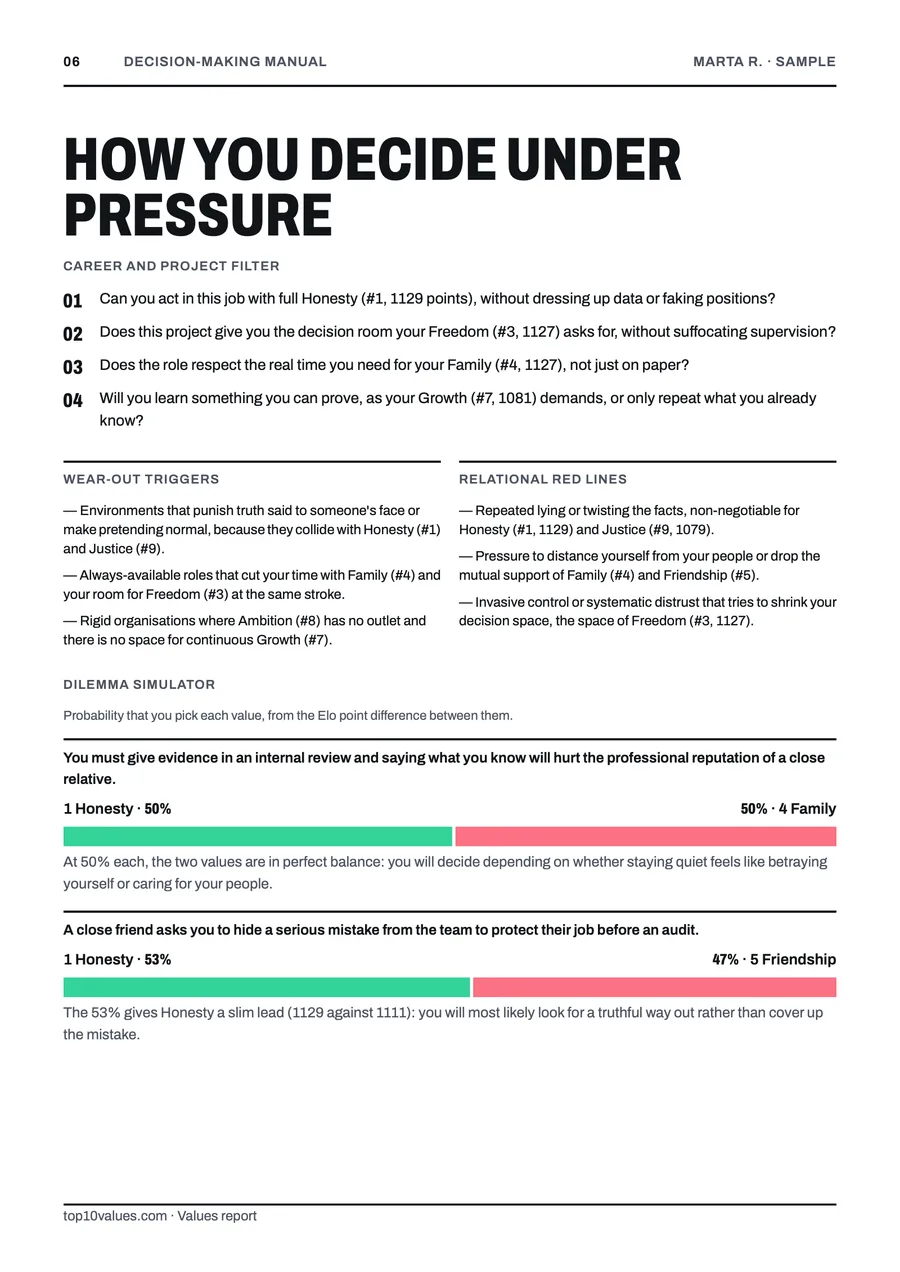
Sample page with fictional data (Marta R.), not yours. Your report is written from your own choices.