Creativity
Purpose
Deep sense of life direction.

Purpose is the search for a deep, transcendent sense of meaning that gives direction to life's decisions, beyond immediate satisfaction or one-off achievement. People who value purpose need to understand the "why" behind their work, their relationships and their time, and often feel empty even in successful situations if these don't connect to something they consider meaningful. This value pushes people to choose paths consistent with a personal mission, even if they mean a smaller immediate reward or greater uncertainty. Purpose acts as a compass in difficult moments, offering a reason to persist when everyday surface-level motivation runs out.
What does this value mean?
Purpose as a value is the need for what you do to point towards something you consider important and that reaches beyond today. It is not a grand mission revealed in a flash but a direction: knowing why you get up, who or what your effort serves, and why that choice is worth what it costs you. It is the thread that makes sense of decisions which, taken one by one, might look unrelated.
It is the difference between filling time and spending it on something. You can see it in the speech therapist who went into stroke rehabilitation after watching her grandfather learn to talk again, and who still thinks of him when a patient manages a first full sentence. In the benefits adviser at a Citizens Advice office who goes home satisfied because a family kept their housing support after a form was put right. In the retired engineer who spends Tuesday mornings teaching adults to read. And in smaller choices that grow from the same root: what you do with a free Saturday, where spare money goes, which conversation you refuse to put off. Purpose is rarely announced. It is inferred from where your energy goes when nobody is making you.
What it does NOT mean
Purpose is not a single meaning of life condensed into one sentence. That expectation paralyses many people, who wait to «find their purpose» the way you find lost keys and commit to nothing in the meantime. It does not have to coincide with your job: some people find meaning in raising children, caring for a relative, a serious hobby or their community, and hold a perfectly decent job that simply pays the bills. It is not whatever sounds impressive on LinkedIn. And it need not be heroic. Providing for a family with dignity, or doing a trade well that other people depend on, are purposes as legitimate as starting a charity. The four-circle diagram that circulates online as «ikigai» is a recent Western adaptation; in Japan the word is used for something more everyday, whatever makes life feel worth living, from a grandchild to an allotment.
Related concepts
Why might it matter to you?
Routines hold up better when you know what they are for. A night shift, a professional exam or months of caring for someone feel very different when you connect them to something you care about than when they feel like a sentence to be served. The psychiatrist Viktor Frankl, who survived the Nazi camps, built his best-known book, «Man's Search for Meaning», around a line he borrowed from Nietzsche: someone who has a why to live can bear almost any how. You do not need extreme circumstances to see it at work. Purpose also acts as a filter. When you know where you are heading, turning down an attractive offer that leads elsewhere becomes far easier. And it guards against a very specific feeling that often turns up around midlife, the sense of having ticked every expected box without knowing what any of it was for.
Advertisement
How can you live this value?
- Look for clues in your past rather than your future. Write down three moments when you lost track of time doing something useful for someone, then ask what they shared: teaching, organising, caring, building, standing up for someone?
- Draft a provisional purpose statement with a six-month expiry date. For example: «I want older people on my street not to be lonely». A specific statement you can revise beats a perfect one that never gets written.
- Test before you overhaul your life. If you suspect your purpose lies in education, volunteer as a reading helper at a local school for a term before resigning. Direct experience corrects a lot of romantic notions.
- Link your current job to a real person. Ask who benefits, even indirectly, when you do your work well, and if you can, meet them. Seeing the face at the end of the chain changes how the task feels.
- Block out fixed time each week for what matters but is not urgent: two hours on Saturday mornings, one weekday evening. A purpose with no slot in the diary stays a nice intention.
- Once a year, check whether what used to drive you is still alive. Purposes shift with life stages: the one that fitted at twenty-five may not fit at fifty, and clinging to an expired one is another way of losing your bearings.
What happens when you don't live up to this value?
When purpose matters to you and you cannot find it in your life, the usual feeling is not sadness but emptiness. Everything works, nothing is obviously wrong, and yet Monday mornings weigh more than they should. Awkward questions surface at odd moments, stuck in traffic or on a Sunday evening: «is this it?». Some people try to fill the gap with more activity, more shopping or more targets, and find the gap is still there. Others turn cynical about anyone who seems to know where they are going. There can even be a pang of envy towards people whose lives are objectively harder but clearly directed. And over the years, a lack of direction means others decide for you: the boss, inertia, family expectations.
The healthy side and the shadow
When does this value stop helping you and start limiting you?
Healthy expression
Clear direction with feet on the ground
In excess
Zeal for a cause above all else
Too much purpose turns a cause into the only thing that counts. You notice it when everything is justified in its name: four hours' sleep, a neglected family, contempt for anyone who does not share the vision. Plenty of mission-driven organisations have burned out committed people precisely because they accepted conditions they would never have tolerated elsewhere, and «we're not here for the money» can sometimes paper over unfair pay. Another version of excess is anxiety about not having a purpose, which turns a healthy search into one more demand. A third is wearing purpose as a public identity, talking about it more than living it. A useful test is whether your cause leaves you room to doubt it. If doubt feels like betrayal, the purpose may be using you.
This value at work
At work, purpose does not depend only on the sector. Some people work in a hospital and feel like an interchangeable part; others work in logistics and know their scheduling is why medicines arrive on time. What tends to make the difference is seeing the effect of what you do, having enough autonomy to do it well, and working for an organisation that does not contradict its own stated values in practice. If you are job hunting, ask at interview how the role's impact is measured and what happened the last time commercial pressure and the mission collided. If you lead a team, explain the why behind each request, not just the what. And beware the «meaningful work» trap where meaning is offered in place of pay: a sense of purpose is no substitute for a fair salary or sustainable hours.
This value in relationships
In friendships, purpose shows in the conversations you seek out and the people you feel in tune with. Friendships formed around a shared project, such as a tenants' group, a running club or a food bank rota, often have a particular sturdiness because they rest on something beyond the time spent together. You can also help friends find their own purpose, with questions rather than advice: «what were you doing the last time I saw you really light up?» tends to open more than any recommendation. The risk is judging friends by whether they have a visible purpose. Plenty of people live meaningfully without naming it, and someone who shares your everyday life does not need to share your cause to deserve your time.
This value in love
In a couple, purpose asks for two things that do not always fit together: room for yours and respect for your partner's. If yours involves travelling half the year, going back to study or moving city, raise it early and in detail rather than presenting it as a done deal. Couples who last do not always share a purpose, but they back each other's and often build a common one, such as a home, a family or a joint project. A frequent source of friction is one person's purpose absorbing all the free time while the other becomes the support crew. Ask yourself now and then what your partner is giving up so you can pursue yours, and whether you have ever thanked them for it out loud.
This value in family
Within a family, purpose is passed on by example far more than by speeches. Children who watch their parents engaged in something that matters to them, whether a trade, a cause or caring for someone, learn that life can have direction. What to avoid is handing them your purpose, or the one you never achieved: the son who must become a doctor because his mother could not, the daughter who inherits the family business without ever choosing it. Each person has to find their own, even if it looks less ambitious to you. There are also seasons when the purpose is the family itself, such as the years of raising small children or caring for an ill parent. They deserve to be recognised as such, not lived as an interval before «real life» resumes.
This value and yourself
Having purpose high on your list suggests it is not enough for things to go well: you need them to mean something. That can be a huge source of energy and also of restlessness, because this value never stops asking «what for?». Notice whether you have a purpose or are looking for one, since the two call for different things: the first needs protecting from distraction, the second needs patience and experiments. Ask, too, whether your purpose comes from you or from an idea of what a worthwhile person ought to pursue. And remember that a modest purpose genuinely lived usually fills a life more than a grand one that exists only in plans.
What are you willing to sacrifice for this value?
Living with purpose has a price. Would you accept a lower salary for work you consider important? Would you give your weekends to a cause instead of resting? Would you risk your family not understanding a change of direction at forty-five? You also give up options: choosing a direction means closing others, and people with a clear purpose turn down many attractive things. Sometimes the cost is other people's approval, since unconventional purposes tend to attract remarks like «and what's the point of that?». And sometimes it is the comfort of not committing, which lets you believe every path is still open. Think about which of these holds you back most; that is usually where the pending decision lies.
Signs you're betraying this value
You betray this value when you postpone what matters to you until you «have time», and five years pass without it arriving. When you talk about your purpose with enthusiasm over dinner but your calendar gives it not a single hour. When you accept a promotion that takes you away from what gave your work meaning simply because turning it down would look strange. Also when you keep a purpose going out of habit or pride long after it stopped moving you, because admitting it has changed would mean looking for a new one. And when you use your cause to excuse treating the people closest to you unfairly. Look at how you spent last month: if what you say gives your life meaning appears nowhere in it, you have a conversation to have with yourself.
Turning the value into goals
Value
Purpose
Behavior
Set aside a fixed two-hour block each week for a concrete activity linked to what you consider your purpose (volunteering, a project, training, or time with the people you want to serve)
Goal
Within six months, have tested that direction enough to confirm it, adjust it or drop it based on real experience rather than assumptions
Habit
Every Sunday, write one line about something you did that week that felt important, and why
Questions to reflect on
- At which moments in your life have you felt most clearly that what you were doing mattered, and what did they have in common?
- If money stopped being a concern, how would you spend your mornings a year from now?
- Which problem in the world, large or small, makes you angry enough to want to do something about it?
- Who would be worse off if you stopped doing what you do?
- Is your current purpose yours, or the one that was expected of you?
- What would you need to stop doing to give more time to what you consider important?
How much are you living this value?
From 1 to 10, how much of your usual week is connected to something you consider important? Go through the last seven days and mark the hours spent on what gives your life meaning. If the score is low, do not look for a dramatic change yet: choose one activity linked to what matters to you, give it a fixed day and time for a month, and watch whether your energy shifts.
When two values clash
Purpose clashes with Financial security when the direction you care about pays less or pays irregularly: leaving consultancy to work for a charity is a decision about meaning and about the mortgage at the same time. With Enjoyment, it appears when the cause eats into leisure and every rest starts to feel frivolous. With Family, it arises if your purpose demands travel, impossible hours or a move that affects other people. With Balance, because intense purposes tend to take up all available space. With Success the tension is subtler: conventional success (title, salary, status) can pull you away from what gave you meaning, or purpose can lead you to turn down a success that the people around you cannot understand you refusing. One way to decide is to ask what you would regret more in ten years, and answer honestly even if the honest answer is not the heroic one.
Is “Purpose” one of your top 10 values?
Find out by playing and comparing this value with the other 49
How the Elo ranking works and its limits in the methodology.
What does the paid report include?
When you finish the 100 comparisons you will see your Top 10 on screen. If you want to go further, there is a PDF report on your personal values: €9.95 (VAT included), one-off payment. To buy it you need to save your game with a Google account.
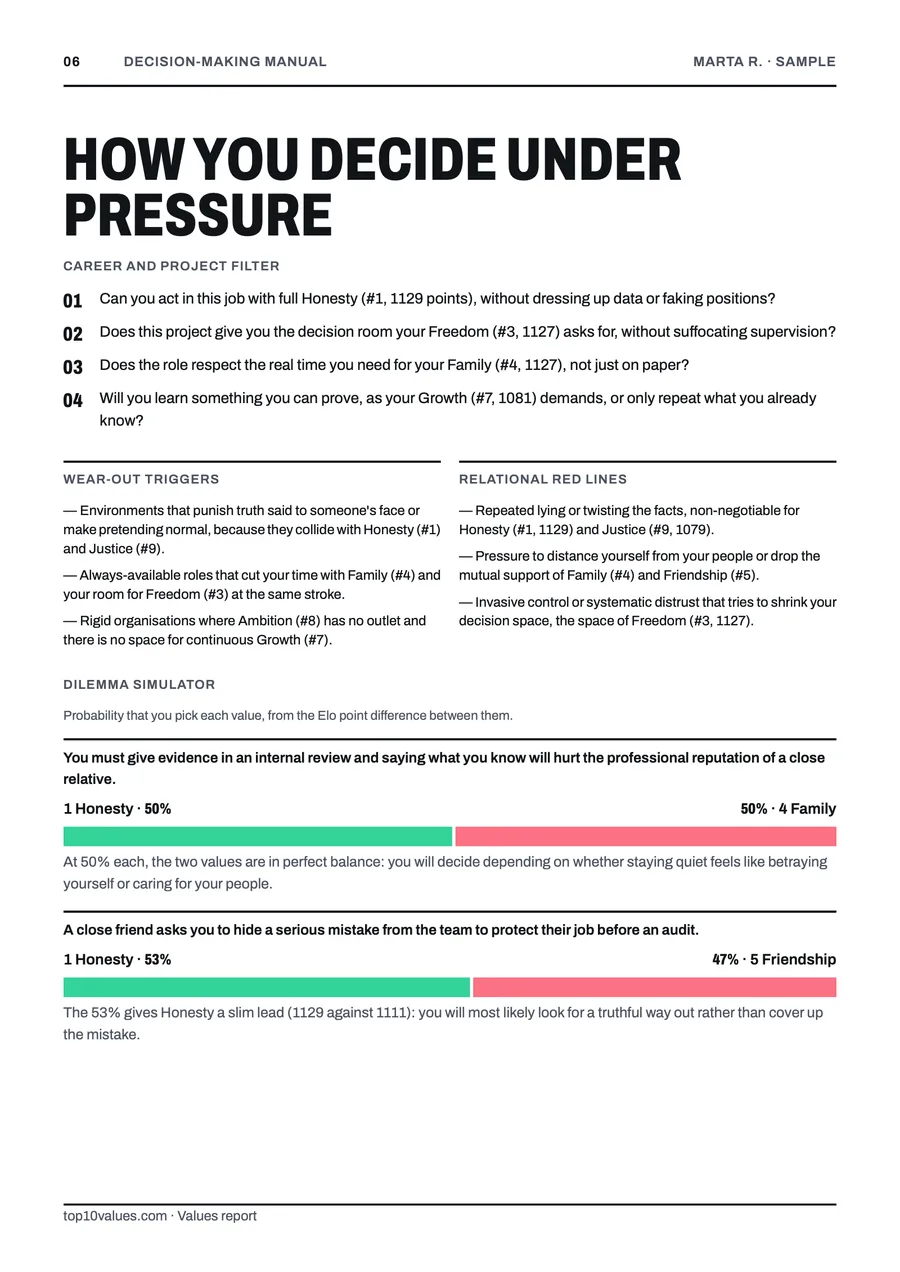
Sample page with fictional data (Marta R.), not yours. Your report is written from your own choices.
Frequently asked questions
What if I don't know what my purpose is?
That is the most common situation, and it does not mean anything is wrong. Purpose is usually built by trying things rather than discovered all at once. Start with what interests or angers you, run small experiments (a volunteering shift, a short course, a conversation with someone who works in the field) and notice what leaves you with more energy. Over time a pattern emerges.
Does my purpose have to be my job?
No. For many people work is the means that sustains what they truly care about: their family, a passion, their community. That is entirely valid. What does help is a job that does not contradict your purpose or consume all the energy you need for it.
What is the difference between purpose and goals?
A goal gets completed and crossed off: passing an exam, opening a business, running a marathon. Purpose does not finish; it is the direction that gives meaning to a series of goals. If your purpose is for people in your town to have access to affordable sport, opening a community gym is one goal, and keeping it open is another.
Can purpose change over the years?
Yes, and it usually does. What drove you at twenty-five, perhaps proving yourself or exploring, may give way to caring, teaching or leaving something for those who come after. Reviewing it from time to time is not inconsistency; it is how you keep it alive.
Is it selfish to pursue a purpose of my own?
It depends on how you go about it. Seeking meaning is not selfish, and it often benefits the people around you, who get to live with someone more motivated. It becomes selfish when you pursue it at others' expense without negotiating, for instance leaving your partner with all the housework while you give every evening to your cause.
When Purpose clashes with…
Invented scene. Irene is a nurse who has spent six years in the emergency department, and she also runs first-aid workshops in high schools, which is what truly drives her. A health consultancy offers her a coordinator role with better pay, office hours and no night shifts, but no patients and no classrooms. Success sees a clear step up: more responsibility, a bigger salary and prestige. Family brings its own weight: with a young daughter, leaving nights and holidays behind matters a great deal. Purpose does not win just because it sounds nobler; it asks whether that job will bring her closer to what matters to her or only to a life that is more comfortable on paper. Before answering she can ask to see an ordinary day, find out whether the role leaves room for the workshops, and separate what she wants to defend from what she is afraid to lose. The answer may still be yes, but with open eyes about what changes. More scenes in conflicting values.