Values hierarchy: how to rank your personal values, with a worksheet and a 20-minute exercise
By Juan Alejandre · Published · Reviewed
Industrial engineer and consultant, 25 years working with teams
A values hierarchy is a list of what matters to you in order: which value comes first, which comes second and which gives way when you cannot have everything. You build it by comparing your values two at a time, counting how often each one wins, and then checking the result against what you actually do in a normal week.
This guide assumes you already have candidates. If you do not know yet which values matter to you, start with the personal values list or the exercises in knowing your personal values, and come back with ten or fifteen words. Here you rank values, not look for them. It is not a test or a diagnosis.
What a values hierarchy is, and what it is not
A list tells you which values exist. A hierarchy tells you which ones weigh more for you. On a list, honesty, family and freedom sit at the same height. In a hierarchy one is ahead, and that is what helps on the day two of them collide.
Advertisement
It is not the hierarchy of needs. The "hierarchy of needs" is a well-known model that arranges human needs in levels, from basic ones such as food and safety towards more personal ones, in a single order meant to apply to people in general. A personal values hierarchy is a different thing: an order made by one person, for that person, and it can differ completely from your neighbour's. Nothing is wrong with a hierarchy that puts adventure above security, or the other way round. Nor is it taken from any academic theory of values.
Why bother? A single value does not help you decide. If someone is offered a better-paid job in another city, "family and ambition matter to me" does not tell them what to do, because both are true. They need to know which one comes first today. Ranking also forces uncomfortable admissions, such as that security beats adventure nearly every time. That discomfort is the useful part.
Four steps to build it
You need paper, a pen and about 20 minutes. It is the same principle as the top10values game (choosing between two values each time), done by hand.
1. Start from 10 to 15 candidates
Write down ten to fifteen values, taken from the list of 50 values or from your Top 10 in the game. The more candidates, the more pairs:
| Candidates | Pairs |
|---|---|
| 8 | 28 |
| 10 | 45 |
| 12 | 66 |
| 15 | 105 |
By hand, ten is a sensible ceiling: 45 pairs take around fifteen minutes.
Before you compare, check that every candidate is a value. A belief is not a value: "hard work always pays off" describes how you think things are, while "ambition" says what you want to protect. If a candidate can be proved wrong, turn it into the value behind it; values vs beliefs has four questions for that.
2. Compare two at a time
For every pair, ask yourself: "if I could only protect one of these two for the next year, which one would I pick?" Answer fast and about your real life, not the one you would like. Keep a column per value and make a mark each time it wins. Ties are not allowed; the point is that you give one up.
3. Count the wins and rank
Add up the marks and sort from most to least. The total must equal the number of pairs; if it does not, you skipped one. For a tie, look at who won the pair formed by the two tied values. If you still hesitate: "which of the two would I let go of first if I had to let one go?"
4. Check it against your real week
A hierarchy made in one afternoon shows what you declare. To see what you do, open your calendar and spending for the last two weeks and, for each of your top three values, write down something concrete you did. If the first appears nowhere, either it is not as high as you thought, or something stops you from living it. Move it, or write down what is in the way.
Three made-up examples
These are invented scenes. They show how the outcome changes with the person and the stage of life; they do not say which hierarchy you should have.
Scene A: Marta, 17, an assignment on "my values"
Example. Marta's tutor asks the class to hand in a one-page text about their values. She starts with eight candidates and makes 28 comparisons: learning 6, family 6, health 4, friendship 4, creativity 3, success 2, wealth 2 and adventure 1. Learning and family tie; family won their direct comparison, so it goes first.
The tutor wants evidence, not a list. For each of her top three Marta writes two sentences with facts: "Family: I have dinner with my parents four nights a week, and I skipped a school trip for my grandmother's birthday." She is surprised to see success so low, and checks it: her grades are a way of learning, not a separate value.
Scene B: Daniel, 34, a steady job and a freelance plan
Example. Daniel has had a permanent contract for six years and is tempted to go freelance. Security and freedom tie with 7 wins each, and freedom narrowly took the direct comparison, which does not convince him. He uses the tie-break question: "Which would I let go of first, the fixed contract or deciding my own year?"
It takes him a while. He would let go of the contract only if he had six months of expenses saved. That condition is what really orders his hierarchy: freedom first, with a minimum base. Courage shows up in third place, which he did not expect. The decision is still open; he now has conditions he can check. If your tie is this one, see freedom vs security.
Scene C: Lucia and Pablo, a couple who rank separately
Example. Each one builds the hierarchy without seeing the other's, using the same ten candidates. Lucia puts honesty first, love second and balance sixth. Pablo puts love first, balance second and honesty fifth.
When they compare, they do not argue about who is right: all three values are on both lists and only the order differs. Lucia sees why Pablo softens bad news; Pablo sees why Lucia is upset when someone hides even a small thing. They agree one rule: if something will hurt, they say it the same day, calmly. To do this with more structure, values in a relationship has an exercise for two.
The worksheet: a table you can copy
Copy it and fill it in with your own values. The last column is the most useful, because it makes you decide what you would do differently.
| Value | Rank | What I do in a normal week | What I would change |
|---|---|---|---|
| Family | 1 | Dinner with my parents twice; call my sister on Sundays | Keep my phone off the table |
| Learning | 2 | One hour of a course a day, Monday to Thursday | Move from watching videos to doing exercises |
| Your value |
The first two rows are invented. If "What I do" stays empty, that row is a signal: either you want to live that value and do not yet, or it is not as much yours as you thought.
Using it for a school or life-plan assignment, and common mistakes
If you must hand this in, fill in the value plus a sentence on what it means to you ("freedom" is not the same for everyone); the rank from your comparisons, even if unexpected; a justification with one fact from your life ("every Saturday I go to the market with my grandfather" says more than "I always help others"); and an action for the next few months. Follow the format your teacher asks for. This guide gives the method; it does not write your assignment.
The most common mistakes:
- Copying a list from the internet. It shows, because no value has a fact behind it.
- Listing twenty values. More than ten will not guide any decision.
- Choosing "greeting card" values. Honesty, respect and kindness sound right in any essay; include them because they won comparisons.
- Answering as the person you would like to be. Pick what would win on a bad day.
- Expecting a hierarchy without conflict. Two high values pulling in opposite directions is normal; conflicting values deals with exactly that.
When your hierarchy changes, and how often to redo it
It changes when your situation changes: a move, a child, a new job, an illness, a breakup. A different order does not mean you were wrong before. A reasonable rhythm is once a year and after a big change, keeping the previous version with its date. Comparing the two shows what rises, what falls and what stays.
Doing it with the game: from comparisons to a Top 10
The top10values game makes these comparisons across all 50 values: you pick one of two each time and, after about 100, you get an ordered Top 10. It chooses the most informative pairs, so you do not compare all 1,225 possible ones. You can start without an account; Google sign-in is only asked at the end, to save your game, share the result or buy the optional extended report. The calculation is explained on the methodology page.
That replaces step 3; steps 1 and 4 stay yours. To read the result, see the personal values test guide.
Frequently asked questions
What is a values hierarchy?
It is a list of your values ordered by importance, so you can see which one comes first when two collide. It differs from a plain list in that every value has a rank.
How do I make a values hierarchy?
Write ten to fifteen values, compare them two at a time asking which one you would protect if you could keep only one for a year, count each one's wins, and check the order against what you do in a normal week.
Is a values hierarchy the same as the hierarchy of needs?
No. The hierarchy of needs is a model that arranges human needs in levels. A values hierarchy is a personal ordering of what matters to you, made by you and open to change.
How many values should it have?
Up to ten is a practical ceiling. With more, the order stops helping you decide, because there is always a value that justifies any option.
Related guides
- Personal values list: the 50 values used in the game, in case you need more vocabulary.
- Conflicting values: what to do when two values on your hierarchy ask for different things.
- Personal values test: how a Top 10 comes out of pairwise comparisons.
- Schwartz's theory of basic values: how your ranked Top 10 maps onto the four groups of his circle.
Next step
Play the values game and compare your Top 10 with the hierarchy you built by hand; the differences are often the most interesting part. If you prefer to keep reading, the full list of values explains what each one means.
Sources
Find your top 10 values with 100 quick comparisons
What does the paid report include?
When you finish the 100 comparisons you will see your Top 10 on screen. If you want to go further, there is a PDF report on your personal values: €9.95 (VAT included), one-off payment. To buy it you need to save your game with a Google account.
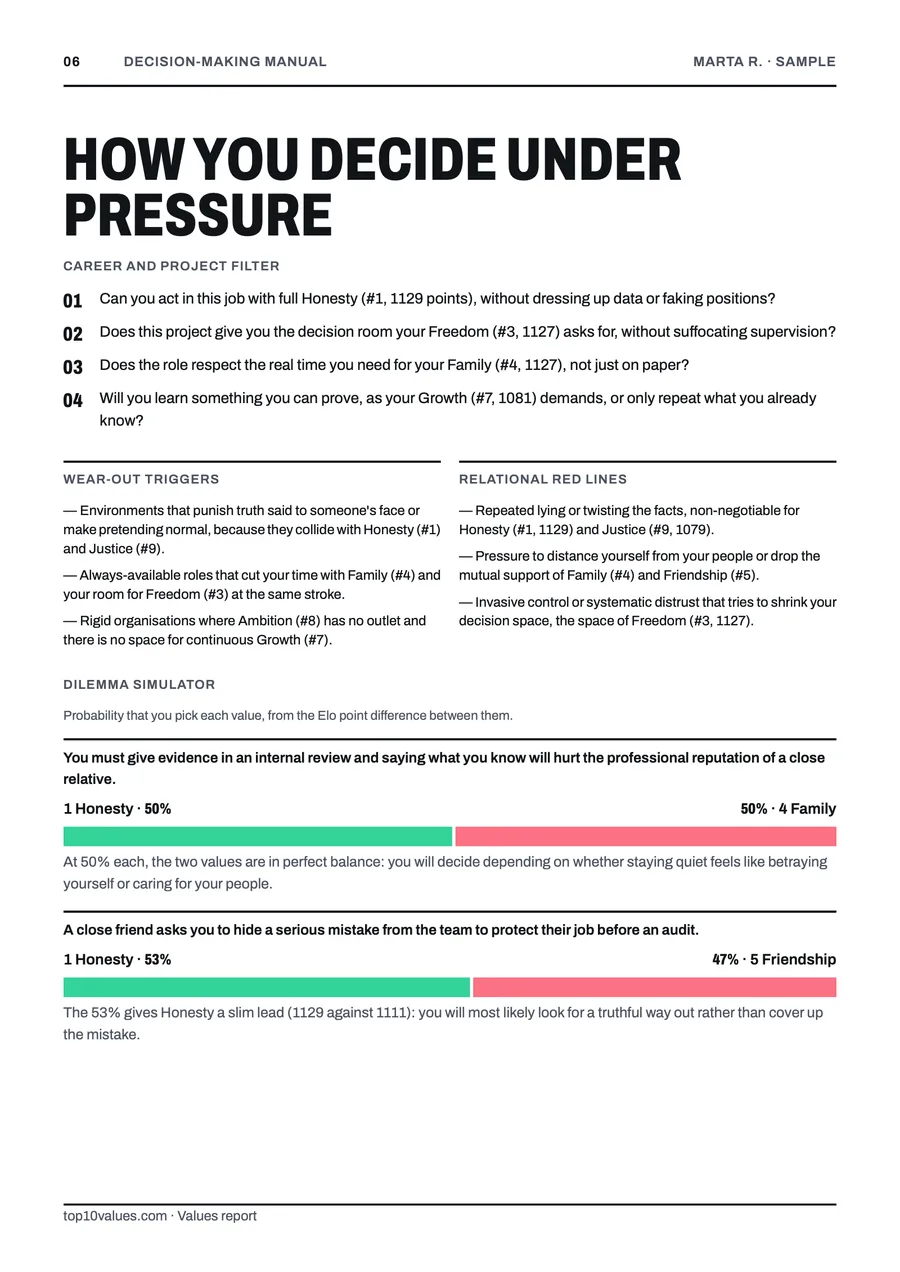
Sample page with fictional data (Marta R.), not yours. Your report is written from your own choices.