Wellbeing
Balance
Harmony between life areas.
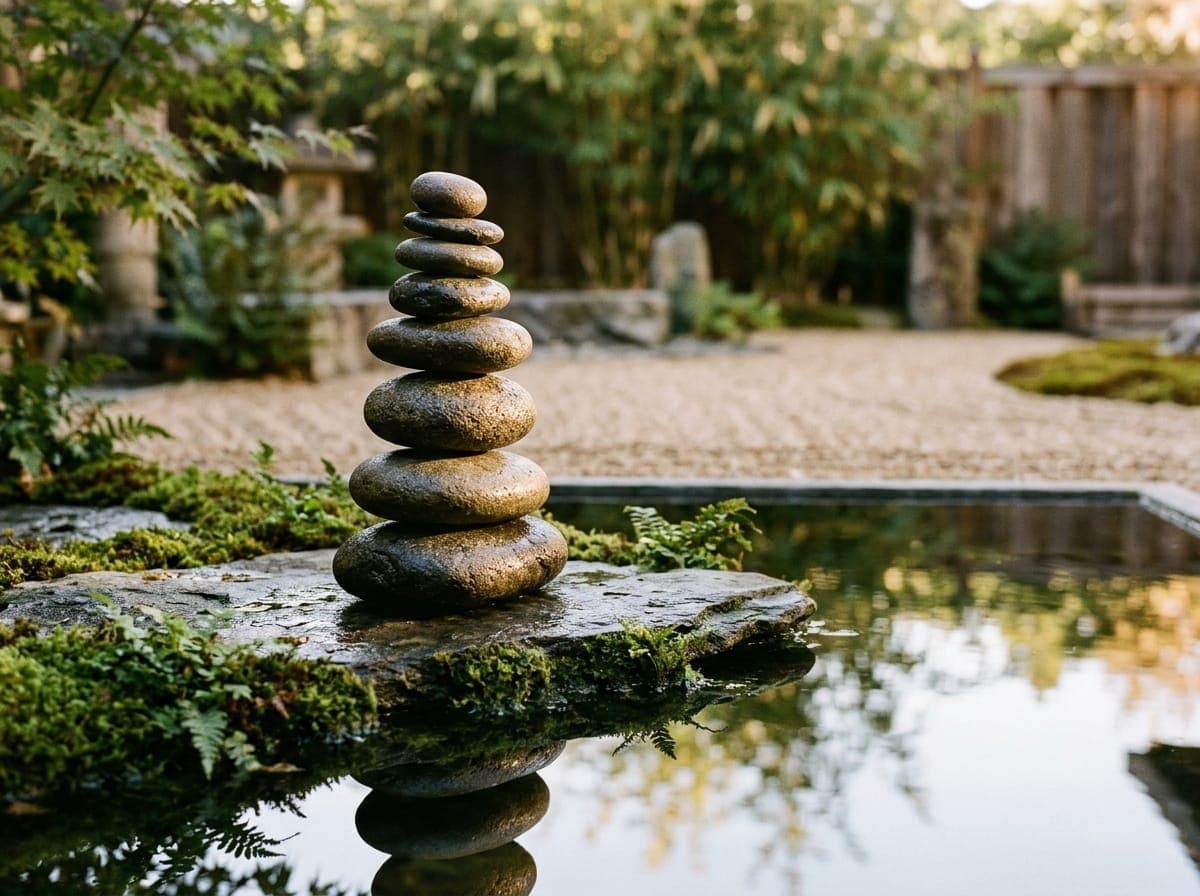
Balance is the active pursuit of harmony among the different areas of life—work, relationships, health, leisure—so that no single dimension swallows all the time and energy available. People who prioritize balance set clear limits, such as switching off from work outside working hours or reserving fixed time for rest and personal connections. This value doesn't mean giving exactly equal time to every area, but feeling that none of them is chronically sacrificed for another. Over the long run, balance prevents burnout and the regret of having invested an entire stage of life in a single front of existence.
What does this value mean?
Balance is spreading your time, energy and attention across the areas of your life so that none of them collapses to prop up another. It does not mean giving every area the same number of hours. It means the split reflects what truly matters to you, and that you can keep it going week after week without paying for it with your health, your relationships or your peace of mind. It is a continuous adjustment, more like riding a bicycle than standing still on a pair of scales.
People who put balance among their values are not chasing a symmetrical life; they want a life in which nothing important is left untended for too long. You can see it in small, concrete choices: the designer who closes her laptop at seven because at eight she is collecting her daughter from netball practice; the self-employed electrician who turns down an August job because he had already promised a family holiday; the person revising for professional exams who still keeps Thursday five-a-side, because without it they get snappier and study worse; the one who, after a week of deadlines, takes Monday morning off without guilt. Aristotle framed this in the "Nicomachean Ethics" when he wrote about the mean: virtue sits between excess and deficiency, and that point is not the same for everyone, because it is measured relative to each person. That has a practical consequence: your balance does not have to look like your neighbour's, or like the lives you see online. It also allows for seasons. With a newborn, in the week before an exam or during a product launch, your life will lean to one side, and that is not a failure if you chose it, it has an end date and you know how you will make up for it afterwards.
What it does NOT mean
Balance is not dividing your hours into equal parts: eight for work, eight for sleep and eight for everything else is a sum that hardly anyone's life fits. It is not avoiding effort or settling for less, either. You can have stretches of very intense work and still be a balanced person, provided the effort is chosen and not a way of running away. It does not mean having time for everything, which is impossible; it means deciding, with some thought, what stays out. It is not the flawless routine of social media, with meditation at dawn, a workout, reading and a home-cooked dinner, which tends to be a postcard rather than a life. And it is not a state you reach and then relax in: balance is lost and recovered several times a year, and the value lies in noticing early that you have tilted.
Related concepts
Why might it matter to you?
What is not looked after deteriorates quietly. Health, a friendship or a relationship rarely break all at once: they wear thin over months of "not now" until the cost finally shows. Balance is the habit of looking at the whole picture before that day arrives. The World Health Organization describes burnout as an occupational phenomenon, the result of chronic workplace stress that has not been successfully managed; what matters here is the underlying point, that sustaining an impossible pace eventually takes something from you. Valuing balance also gives you a way to decide. When someone offers you a promotion, a project or a plan, you stop asking only "can I?" and start asking "what will I stop doing if I say yes?". That second question protects you from piling up commitments that each looked reasonable on their own. There is a quieter advantage too: if you live in a balanced way, you cope better with bad spells, because you have not staked your whole identity on one place. If work goes sour, you still have your friends, your body, your hobbies. If a relationship ends, you still have a craft in which you feel capable. Balance does not stop the blows, but it keeps all of them from landing in the same spot.
Advertisement
How can you live this value?
- Run through your areas (work or study, health, partner, family, friendships, time for yourself, money, community) and score each from zero to ten according to how much attention it actually gets today, not how much you think it deserves. You will see more quickly where the crack is opening. Repeat it every quarter and compare it with last time.
- Pick one area that is slipping and give it a small, fixed commitment in the diary: the Sunday call to your brother, the Tuesday swim, the Friday supper with phones in a drawer. What has no slot gets beaten by the urgent; what has a slot has a fighting chance.
- Put an end date on lopsided seasons. Before starting a stretch of extreme work, say out loud how long it will last and what you will do when it is over: a few days off, a week without meetings, a weekend away. If the date moves twice, it is no longer a season but a way of living, and it is better to decide that honestly.
- Set one concrete line between work and the rest of your life and keep it with evidence, not intentions: email notifications off after a certain hour, the laptop put away in a cupboard, a finishing time you repeat. A vague limit ("I try not to work at weekends") breaks at the first emergency.
- Practise saying "yes, but not now" and "no, thank you" in one short sentence without over-explaining: "My diary is full this month, shall we look at November?" Someone who gives three reasons invites negotiation; someone who gives one friendly sentence usually gets a nod.
- Treat rest as an appointment with someone important. Enough sleep, a meal now and then with no screen, or a walk without headphones are not prizes you earn when the list is finished; they are what lets the list get done well. If you only rest when you cannot go on, your body will make the decision for you.
What happens when you don't live up to this value?
When balance disappears, one part of your life swells at the expense of the others until it is the only thing in your head. You notice it in small things: you answer work messages over dinner, you get home with no energy left to listen, you put off the doctor three times, you stop seeing a friend because "we'll catch up soon" and two years go by. You begin to live in advance, always bracing for next week, and weekends exist only to recover. There is a more treacherous effect: because whatever you neglect stops sending signals, it takes you a long time to notice. Friendships don't complain, your body warns you with aches you ignore, and your partner gets used to talking about logistics. On some ordinary day, faced with something small, you get the feeling that you are ticking every box and are not really anywhere. If balance is one of your values, that feeling hurts more: your life works on the outside, yet it drifts away from what you say matters to you.
The healthy side and the shadow
When does this value stop helping you and start limiting you?
Healthy expression
Chosen proportion
In excess
Paralysis by perfect distribution
Balance goes wrong when you turn it into bookkeeping. Some people keep a tally of the hours they give each area, feel guilty whenever one drifts, and end up more tired from managing balance than from living it. Another distortion is using it as an excuse: "I need balance" comes to mean "I won't commit to anything demanding", and it becomes a way of dodging the effort that would be worth making. It can also be a form of comfort: avoiding the risk of betting heavily on something, a project, a relationship, a move to another city, because it would endanger everything else. And there is a facade version, the balance of someone who arranges their diary carefully so as to look like a rounded person but enjoys no part of it. The healthy version is recognisable because it leaves room for intense seasons and for rest, tolerates imbalances without drama, and is judged by how you feel and how your relationships are doing, not by a table of hours.
This value at work
At work, balance shows in the fact that your performance does not depend on heroics. You end the day with a plan for tomorrow instead of carrying the worry into supper; you say how long something will really take; you flag early when a workload is unmanageable, not after you have already let people down. If you lead a team, your example outweighs any policy: there is little point telling people to switch off at six if you send emails at midnight and expect replies by morning. With remote work the challenge changes: with no commute and no door to close, the day spills over easily, so it helps to build your own shutdown rituals, such as clearing the desk, walking round the block or changing out of your work clothes. It is worth separating hard work from work without limits: the first can fit with your balance for a while; the second cannot. And remember that sometimes the imbalance is not yours to decide: some jobs, sectors and employers demand permanent availability. In that case your value pushes you to ask how long you can sustain it and whether that role fits the life you want.
This value in relationships
Friendships are the first thing to be sacrificed when balance is missing, because they almost never have a deadline or make demands. Keeping them going requires deliberately making room: a monthly dinner that does not get cancelled because you are tired, a message to someone you have not heard from in months, a trip pencilled in a year ahead. It is also worth accepting that friendships go through seasons: a friend with a small baby or a new business will have little spare time, and that is not a snub. Among people who value balance there is another subtle conflict: one person needs plenty of plans and another needs solitude to recharge, and both feel misunderstood. It helps to talk about what each of you needs instead of reading absence as lack of interest. And watch the flip side: giving all your friends the same frequency out of duty ends in empty get-togethers. The balanced thing is not to see everyone in equal measure, but to see those who matter with the regularity they deserve.
This value in love
In a couple, balance has two sides. One is the split of everyday life: who cooks, who gets up in the night, who takes each set of parents to the hospital appointment. When one of you takes on nearly everything without discussing it, resentment shows up long before any complaint. The other side is the balance between time together and time apart. Some couples suffocate from too much togetherness and others cool off from too many separate diaries. It is worth raising it with specifics ("we haven't had supper without screens for three weeks") rather than with sweeping reproaches ("you're never here"). It also depends on the season: with small children or a job change, the couple slips into second place for months, and the healthy question is not how to avoid that but how you look after each other within it: a weekly slot that is respected, a lunchtime message, a weekend away when the logistics allow. Be careful not to turn balance into an audit of the relationship; your partner is not just another area on your chart, they are also the person you are sharing out the rest with.
This value in family
In a family, balance is tested above all in the caring years. People who raise children while looking after elderly parents, a common situation in the forties and fifties, know there is no perfect split and that someone is always left waiting. What does help is sharing things out clearly between siblings, asking for outside help before you are exhausted, and accepting that the best care is sometimes the kind you can keep up for years, not the most heroic one for a few months. With children another tension appears: the guilt of not being there and the guilt of having no life of your own, which often flare up together. A child does not need you to give up everything; they need to see that you can look after yourself and your family without complaint, and they learn more from that than from any speech. Among the adults of a family, balancing means deciding how many Sunday lunches, weddings and celebrations you attend before they turn into obligations, and accepting that saying "not this year" to one of them is not abandoning anyone.
This value and yourself
Choosing balance as a value suggests you have found out, perhaps the hard way, that a life concentrated on a single front becomes fragile. You are probably uncomfortable around people who boast of never switching off, and the idea of rushing until retirement in order to rest afterwards does not convince you. It is worth checking which way you tend to fall. Some people use balance as a shield against intensity, and some demand it loudly while practising it little, because they still accept everything they are asked. Ask yourself, too, whether what you call balance is what you truly want or merely what seems sensible, because sometimes a life heavily centred on one passion is also a full life, as long as you chose it knowing what you leave out.
What are you willing to sacrifice for this value?
Balance mostly costs you visible renunciations. Would you turn down a promotion that would have you travelling half the month if you have small children and have talked it through with your partner? Would you pass up an attractive career opportunity because it demands a commitment you could not sustain? Would you accept earning less in exchange for working hours that leave you room to live? Think of an occasion when you said "no" to something important to protect another part of your life. If you did it without bitterness, balance is already steering your decisions. If you did it but remember it as a defeat, perhaps you have not yet fully decided what weighs more. And if you have never said no to anything, perhaps balance is a value you admire more than you practise.
Signs you're betraying this value
You betray balance when you promise a dinner and cancel it for a task that could have waited, when you answer work messages on a holiday you announced as a proper break, or when you call a pace "temporary" after it has lasted two years. Also when you always take the hours from sleep because it is the one item nobody chases you for, when you leave the doctor until after the project, or when you load your share of everyday chores on someone else without mentioning it. A subtler sign: boasting about how busy you are, as if exhaustion were an achievement, instead of asking what you are giving up.
Turning the value into goals
Value
Balance
Behavior
Finish the working day at a fixed time and not pick it up again in the evening unless it is a genuine emergency
Goal
Restore this quarter a weekly plan with a person or an activity you have let slide
Habit
Every Sunday, look over the coming week's diary and check that it contains some rest, some movement and some time with people you love
Questions to reflect on
- Which area of your life gets less attention today than you would like, and how long has that been the case?
- What lopsided season have you accepted in recent months, and does it have a clear end date?
- Who have you stopped seeing or ringing on the grounds that you cannot find the time?
- What do you say yes to so as not to cause friction, and what would it cost you to say no?
- At what moments do you feel most like yourself, and how much room do they have in your week?
- If you looked back in five years, which present neglect would you wish you had not allowed?
How much are you living this value?
Imagine someone who knows you well describing your last week: where you put your hours, who you spent them with, what you left undone. Would you recognise in that account what you say matters to you? From zero to ten, rate how closely your diary matches your priorities. If it is below seven, choose one adjustment for this week, such as cancelling an optional meeting to have supper in peace, and notice how you feel.
When two values clash
Balance clashes with Ambition and Success: climbing, founding something or excelling in a field often demands stretches of near-total dedication, and anyone unwilling to go through them will watch others do so. It is better to decide what share of imbalance you accept, for how long and with what compensation, than to let your surroundings decide for you. It also pulls against Discipline, which sometimes asks you to keep up a hard routine just when your body is asking to stop, and against Purpose, which can draw you into giving everything to a cause. With Health it usually goes hand in hand, although they get in each other's way when exercise becomes an obsession and leaves no time for anyone else. With Family and Friendship there is a constant diary conflict: giving to one means taking from another, and no formula avoids the guilt. With Freedom it complements something essential, which is being able to set your own pace, but a quarrel can arise when one person's freedom is paid for by the other's workload. And with Creativity there is a paradox: some work demands total immersion, while other work needs rest and distance to emerge. It allies with Peace, since a reasonable split takes some of the hurry out of your days. The useful question is rarely "which one wins?" but "what price am I prepared to pay this season, and what price am I not?"
Is “Balance” one of your top 10 values?
Find out by playing and comparing this value with the other 49
How the Elo ranking works and its limits in the methodology.
What does the paid report include?
When you finish the 100 comparisons you will see your Top 10 on screen. If you want to go further, there is a PDF report on your personal values: €9.95 (VAT included), one-off payment. To buy it you need to save your game with a Google account.
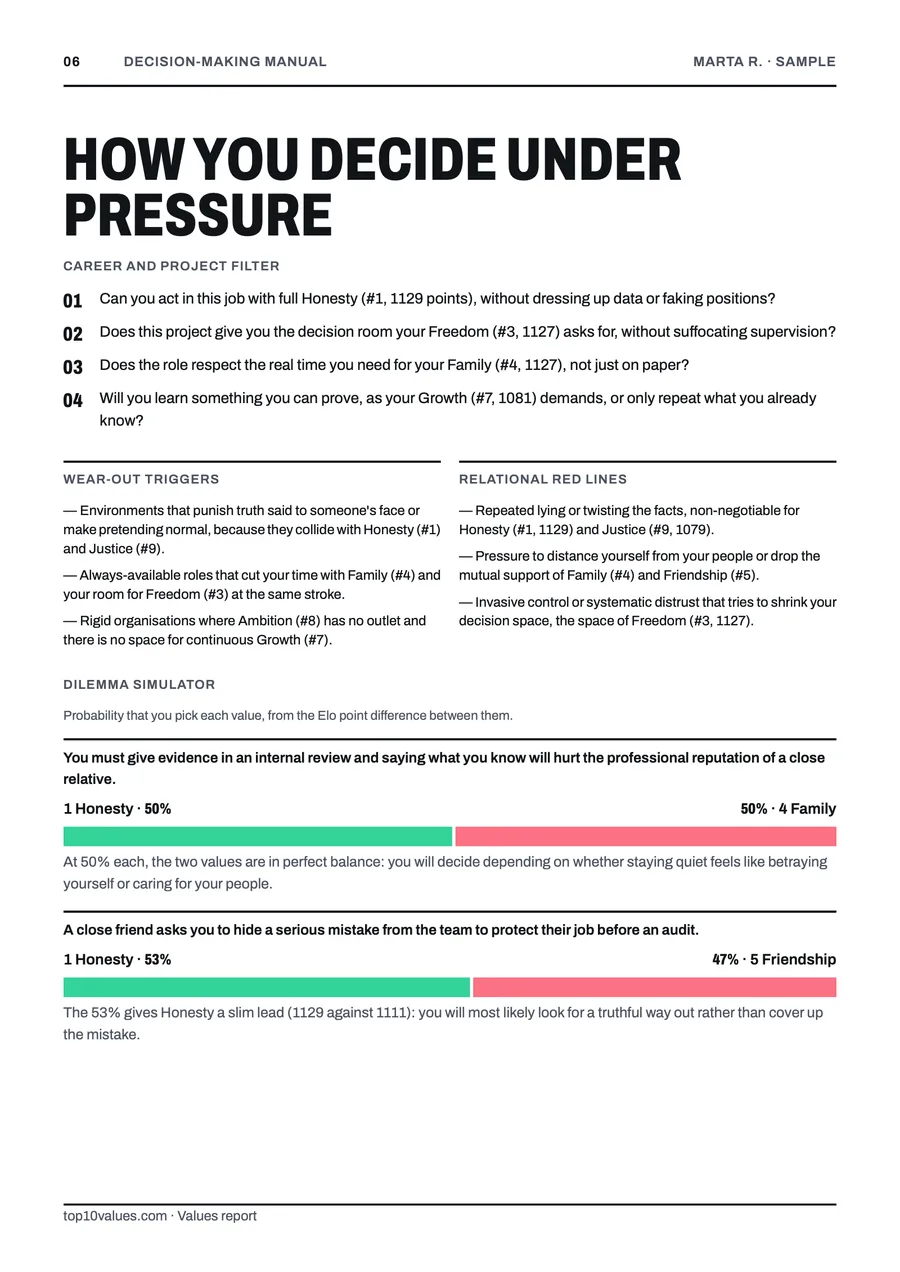
Sample page with fictional data (Marta R.), not yours. Your report is written from your own choices.
Frequently asked questions
Does work-life balance mean working less?
Not necessarily. Some people work long hours and feel balanced because they chose that effort, enjoy it and it doesn't swallow the rest; others work few hours and are overwhelmed by worries, caring duties or debts. What matters is not the number of hours but whether your current split lets you look after what you value and whether you can keep it up without going under. Sometimes the adjustment is not to work less but to work with firmer limits: clear start and finish times, real breaks, and tasks that don't stretch without reason.
Can you have it all at once?
In practice, almost never at the same moment. What is possible is to spread things over time: a year of a lot of work and little leisure, another devoted to family, another to a hobby you had abandoned. Seeing life in seasons lifts a lot of guilt, because it changes the question from "why can't I do everything?" to "what needs attention now, and what do I commit to picking up again?" The risk is that a season drags on without you deciding it, so it pays to review it against dates.
How do you tell balance from simply taking the easy route?
Taking the easy route avoids whatever is hard; balance chooses what deserves to be hard. A good sign is to look at what you turn down: if you say no to an opportunity because it clashes with something you value more and you can name it, that is balance. If you say no from fear of not measuring up or from laziness, and then keep mulling it over, it probably isn't. Another clue: balance tends to leave you with energy and clarity, while the easy route leaves a dull unease that you could have done more.
What is burnout and how does it relate to balance?
Burnout appears in the World Health Organization's International Classification of Diseases (ICD-11) as an occupational phenomenon, the result of chronic workplace stress that has not been successfully managed. In that classification it is not a medical condition, but it is a serious warning sign. It is usually described in terms of exhaustion, distance or cynicism towards the job, and reduced effectiveness. Not every imbalance ends that way, and not every kind of exhaustion is cured by a holiday, because the cause often lies in how the work is organised. If you suspect it is happening to you, it is worth talking to your GP or a mental health professional.
Is balance the same as Aristotle's idea of the mean?
They are close, but not identical. In the "Nicomachean Ethics", Aristotle describes each virtue as a midpoint between an excess and a deficiency, courage for instance sitting between recklessness and cowardice, and he adds that this point is defined in relation to each person and situation, not by a fixed figure. That fits balance today: there is no universal proportion of work, rest and relationships. The difference is one of scale: Aristotle is talking about character, whereas when we speak of balance now we usually mean how you organise time and energy among particular areas of your life.
When Balance clashes with…
Invented scene. Daniel is an architect who leaves at half past six and has not worked a weekend in three years. Now the studio is entering an important competition, and his partner, Marta, asks him for two weeks of total commitment. Balance does not mean doing the same thing every day: it means not letting one phase become your way of life. Ambition reminds him that this competition could change the studio's course. Success points out that if Daniel says no, whoever takes his place will end up better positioned. Discipline is the most ambiguous of the three: it can sustain the effort, but it can also keep the rest you promised yourself. A concrete way out is to accept the sprint with a written end date, agree what gets recovered afterwards (two free afternoons, a week of holiday) and check halfway whether the cost is still bearable. More scenes in conflicting values.