Personal Growth
Discipline
Ability to stay consistent.

Discipline is the ability to sustain a consistent behavior over time, even after the initial motivation has faded. People who value discipline trust habits and routines more than one-off willpower, because they know willpower is a limited resource. This value is behind any achievement that requires sustained repetition: training a body, mastering a technical skill, or keeping a project alive for months without immediate results. Discipline doesn't imply extreme rigidity, but the ability to return to the plan after a detour, without needing renewed enthusiasm every time to keep going.
What does this value mean?
Discipline is following through on what you decided to do after the mood that made you decide has worn off. It is the link between what you say matters and what you actually do on an unremarkable Tuesday, when nobody is watching and the sofa is closer than the task. Seen this way it is less about toughness than about consistency in service of something you chose.
Discipline is the unfashionable half of almost every achievement. The cellist who plays the same slow passage for a fortnight before speeding it up, the apprentice who sharpens his tools at the end of each day whether or not he feels like it, the nurse studying for a specialist exam on her days off, the freelancer who invoices on the first of the month without being chased, the swimmer who is in the water at six whatever the weather. It also lives in smaller habits: leaving the phone in another room while you write, packing tomorrow's lunch tonight, closing one task before you open the next. A practical point is that people who do this well rarely rely on raw willpower. They arrange their surroundings and their calendar so that the right action takes little effort.
What it does NOT mean
Discipline is not rigidity, boot-camp severity or choosing the hardest option every time. Misunderstood, it turns into cruelty towards yourself: rising at five because «suffering builds character», training on an injury to protect a streak, punishing yourself after a lapse. It is not the same as motivation, which is the surge that comes and goes; discipline is what remains when the surge is missing. It is not productivity, since you can be relentlessly consistent at something pointless. Nor is it obedience: following another person's rules without judgement is compliance, whereas real discipline comes from goals you hold as your own. And it does not oppose rest. Someone who never stops is not disciplined but stuck. The word can also carry echoes of school detention and barracks, which are worth setting aside.
Related concepts
Why might it matter to you?
Few things worth having happen in a day, and discipline is the bridge between a plan and its result. Learning a language, clearing a debt, rehabilitating a knee or building a small business all demand weeks of unapplauded work, by which point the first burst of enthusiasm has gone. People who prize discipline have usually felt the frustration of starting a lot and finishing little, and found that the difference lay less in talent than in carrying on while bored. It also has a less obvious benefit: it saves you from deciding over and over. If Monday and Thursday are training days, there is nothing to haggle over each time, and that mental energy goes elsewhere. Finally it builds a quiet confidence that slogans cannot supply, the kind that comes from having kept your word to yourself a hundred times.
How can you live this value?
- Shrink the goal until it is almost embarrassingly easy, and keep it that way for two weeks: five minutes of practice, one page, ten press-ups. At the start the thing to protect is the streak, not the volume. You can raise the volume once the habit holds up on its own.
- Anchor the habit to a trigger that already exists. «After I pour my morning coffee, I open the language app» is easier to keep than «I'll practise sometime today», because the coffee supplies the cue and you never have to remember.
- Remove friction before you need willpower. Put the running shoes by the door, log out of social media on your work laptop, charge your phone in the hallway. If something takes five steps you will do it less; if it takes one you will do it more.
- Decide in advance what you will do after a slip. A rule that works for many people is «never twice in a row». One missed day is a stumble; two start becoming a new habit. It spares you the «streak broken, forget it» reaction, which ends more resolutions than laziness does.
- Keep a visible record, such as a wall calendar or a notebook. A row of ticked days tells you what you really do, and lets you adjust the plan with evidence rather than impressions.
- Schedule rest with the same seriousness as effort. A weekly day off and a lighter week now and then make the plan sustainable, and a sustainable plan beats the heroic one that lasts three weeks.
Advertisement
What happens when you don't live up to this value?
Without discipline, life fills up with beginnings: the January gym membership, the half-finished course, the novel in the drawer, the savings plan that always starts next month. Each abandoned effort leaves a faint deposit of distrust towards yourself, and gradually you stop believing your own promises, to the point of not daring to make new ones. Deadlines get met in a last-minute scramble with a guilty conscience, and whatever is important but not urgent (your health, your accounts, a project of your own) loses to whatever shouts loudest. Other people notice: you become the friend who says «this time for real» or the colleague who needs reminding about deliverables. And inside there lingers the sense that you could have done more, which is more tiring than the effort you skipped.
The healthy side and the shadow
When does this value stop helping you and start limiting you?
Healthy expression
Flexible consistency in service of a goal
In excess
Rigidity and harsh self-demand
The excess is rigidity: following the plan becomes the aim instead of the means. It appears as an inability to skip a routine when you are ill, to improvise an evening with friends, or to accept that today you have nothing left. Discipline merges with punishment and every lapse reads as proof that you are not good enough. It can also disguise fear: some people hide in strict routines to avoid whatever is uncertain or emotional. And it often turns outward, as contempt for those who «don't try hard enough». A useful test: healthy discipline adapts to circumstances without feeling defeated, while the rigid kind snaps the moment something leaves the script.
This value at work
At work, discipline separates those who deliver only under supervision from those who deliver without it. It shows in remote work, where nobody sees whether you start at nine, and in long projects, where early enthusiasm fades and weeks of grey tasks remain. It comes down to plain practices: giving your best hours to the important task rather than the inbox, ending each day with a note for tomorrow, handing in what you promised on the date you promised, or warning early when you will miss it. For the self-employed and for founders it is decisive: with no boss, the calendar is whatever your judgement makes it. Do not confuse it with being always available, though. Discipline includes closing the working day, and people who cannot stop usually produce worse work.
This value in relationships
In friendships, discipline is keeping up what is not urgent: being the one who writes first to someone you have not heard from in months, keeping a friend's birthday in your calendar, meeting your old school group every quarter even when it takes effort to line up diaries. Many friendships fade not through conflict but through lack of upkeep. For some people a ritual helps, like dinner on the first Friday of the month or a call on Sunday evenings, because it does not depend on how you feel that day. There is a limit: keeping up a relationship from duty when it no longer gives you anything is another form of rigidity. And the other way round, arriving late, cancelling at the last minute and promising without delivering wear trust down faster than most arguments.
This value in love
In a couple, discipline means looking after the everyday with consistency, without waiting for the relationship to demand it loudly: the weekly talk about how you are both doing, the date night that survives tiredness, the household chores shared out and done without reminders. Long relationships are held together more by repeated small gestures than by grand moments. It is also discipline over your own conduct: pausing before you answer harshly, doing what you agreed, not making joint decisions alone. Strain appears when your rhythm is strict and your partner's is spontaneous. Living together then calls for negotiation: flexible timetables, time with no agenda, plans that can change without either of you taking offence.
This value in family
In the family, discipline appears in what children learn by repetition: bedtimes, homework, household jobs, clear limits that hold from one day to the next. Children soon see whether a rule depends on the adults' mood or on an agreement. Here the dilemma is that discipline can slide into heavy-handedness, and it helps to remember that a rule is accepted more readily when explained and applied consistently, not with shouting. There is a grown-up discipline too: doing what you promised your kids (the trip to the park, the bedtime story, the match you said you would attend), since those small promises build their trust in you. With ageing parents it means steadiness in caring, which is almost always more routine than heroic gesture.
This value and yourself
If discipline is among your core values, you probably like seeing results from what you do and dislike the gap between what you plan and what you achieve. It may also point to a history: someone who learned early that achievements come through work, or someone who lived with the consequences of not following through. It is worth finding out where your standard comes from. If it springs from a wish to build something, it is a sound foundation; if it springs from a fear of being lazy or of being seen to fail, it can become a burden. Look at your relationship with rest as well: if resting makes you feel guilty, your discipline may be running you instead of serving you.
What are you willing to sacrifice for this value?
Discipline costs concrete things. Would you stop going out on Thursdays to prepare for an exam? Would you turn down an invitation to keep your bedtime? Would you spend less today, even if that means missing a trip with friends, to reach a savings target? It also means accepting boredom and the feeling of getting nowhere, those plateau weeks when you do the right thing and nothing seems to move. You also give up some spontaneity and the comfort of the moment. Ask whether the goal is worth what you leave behind: discipline without a clear reason is only a tiring habit.
Signs you're betraying this value
You betray this value when you always pick the comfortable version of your commitments («I'll do it tomorrow», «I've done enough»), when your rules apply only if nothing better comes up, or when you put in a heroic effort for two days and vanish for two weeks. You also betray it through rigidity that goes nowhere: keeping up a routine out of pride after it has stopped serving your goal, or demanding of others what you do not do yourself. And when you change method every few weeks in search of the perfect system, which is an elegant way of never starting. One clear sign is the list of things you promised this year and where each one stands today; it is more honest than any January resolution.
Turning the value into goals
Value
Discipline
Behavior
Choose a single habit, give it fifteen minutes at the same time each day, mark it on a calendar you can see, and never miss two days in a row
Goal
Within ninety days, have kept the habit on at least 80 % of days and gradually extended it to half an hour
Habit
Every night, lay out what you need for tomorrow (clothes, books, tools) and note in one line whether you followed through today and what helped or got in the way
Questions to reflect on
- What have you kept up for over a year, and what did that commitment have that others lacked?
- Which promise to yourself have you been breaking for months, and what story do you tell to justify it?
- What in your surroundings makes consistency harder, and which part could you change this week?
- How do you treat yourself after a missed day: as a learner or as a culprit?
- In which area is your discipline rigid, and in which does it lack firmness?
- If you could keep only one commitment all year, which would it be and why?
How much are you living this value?
From 1 to 10, how often in the past month did you do what you had decided to do even though you did not feel like it? Pick one specific commitment and review the last thirty days: how many times you kept it, which day of the week you failed most and what triggered it. Change one thing (the time, the place, the difficulty) for two weeks and note whether you follow through more or less.
When two values clash
Discipline clashes with Freedom and Adventure when routine blocks spontaneity: skipping an impromptu trip because it breaks your study plan is a legitimate choice, yet it can also be a loss. It clashes with Inner peace and Balance if the demand hardens into permanent tension and leaves no space to rest. With kindness towards yourself there is an inner conflict: how much firmness is enough and when does it become harshness? With Creativity, which sometimes needs to wander without a timetable, it coexists well if you reserve some time for play. With Health, discipline can be an ally (training, sleeping) or an enemy (training while injured). And with Family it appears when your strict schedule leaves little room for the surprises of those you live with. One question that helps: does my discipline serve what I want, or only the image of a disciplined person?
Is “Discipline” one of your top 10 values?
Find out by playing and comparing this value with the other 49
How the Elo ranking works and its limits in the methodology.
What does the paid report include?
When you finish the 100 comparisons you will see your Top 10 on screen. If you want to go further, there is a PDF report on your personal values: €9.95 (VAT included), one-off payment. To buy it you need to save your game with a Google account.
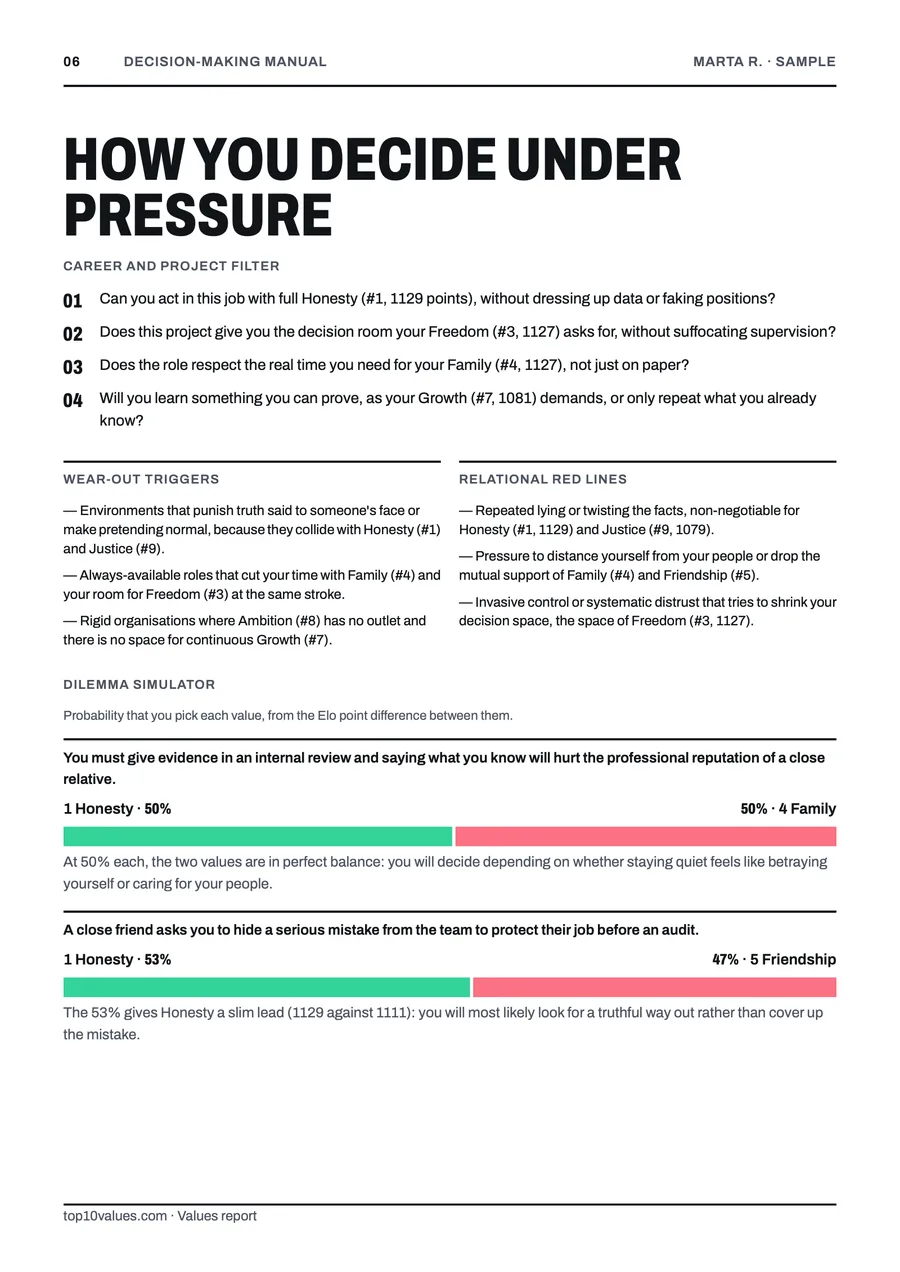
Sample page with fictional data (Marta R.), not yours. Your report is written from your own choices.
Frequently asked questions
What is the difference between discipline and motivation?
Motivation is a mood that rises and falls; discipline is what you do when it falls. Relying only on motivation tends to mean starting with plenty of energy and quitting within weeks. Discipline, backed by routines, a helpful environment and clear goals, lets you move forward even on flat days, and motivation often returns once you see results.
Can discipline be learned, or is it a matter of character?
It can be trained. Some people find it comes more naturally, but most improve by starting with small commitments, preparing their surroundings and reviewing what works. What usually helps most is stacking small, repeated wins rather than relying on a heroic start. If keeping any routine feels very hard and it affects your daily life, it may be worth discussing with a professional.
Does being disciplined mean not enjoying yourself?
No. Well-understood discipline leaves you more free time and less guilt, because the important things are already done. What it does involve is choosing: giving up some immediate pleasure for something that matters more to you. If your plan stops you enjoying almost everything, it is probably badly designed or too demanding.
What should I do if I fail several days in a row?
Restart without settling scores. Go back to the minimum level (five minutes, one page) and ask what happened: were you tired, was the goal too big, did something change in your routine? A failure is information about the plan's design, not a verdict on you. What builds discipline is how quickly you return, not the absence of falls.
How do you stay disciplined without becoming a perfectionist?
Decide beforehand what counts as «enough» and respect it, even if you could do more. Alternate demanding periods with lighter ones and leave room for surprises. If you find you cannot skip a routine when you are ill or worn out, or you punish yourself for slipping, revisit the plan. Discipline should work for you, not rule you.
When Discipline clashes with…
Invented scene. Álvaro is training for his first half marathon, and his plan calls for eight kilometres every Tuesday at seven. One Tuesday it is raining, he slept badly, and his neighbour suggests a leisurely breakfast and a chat. Discipline knows that motivation is unreliable and that the plan exists precisely for the days when you do not feel like it. Freedom replies that a plan that never bends is just another kind of cage, and that choosing today is also a way of using the ability to choose. Peace reminds him that reaching the finish line exhausted and anxious may not be what he wanted. Being kind to yourself is the hardest part to tune: it is not an excuse, but it is not about beating yourself up either. A practical way out is to decide in advance what counts as a fair reason to skip a session, such as illness or very little sleep, and to make it up rather than lose it. That way the plan decides, not the mood of the moment. More cases in conflicting values.