Wellbeing
Inner peace
Emotional calmness.

Inner peace is the state of emotional calm that lets you face life without constant agitation or chronic background anxiety. People who value inner peace prioritize calm over intense stimulation, avoid unnecessary conflicts and actively seek practices that reduce mental noise: silence, nature, serene routines or emotional management techniques. This value doesn't equal passivity or avoiding every challenge, but maintaining a stable center even when the outside environment is turbulent. People guided by inner peace are often a point of stability for those around them, precisely because they aren't easily swept up in other people's drama or urgency.
What does this value mean?
Inner peace is a steady sense of calm and of being at terms with yourself that holds even when circumstances are far from perfect. It does not depend on everything going well. It depends on how you relate to what happens: to your choices, your mistakes, your limits, and the things you cannot change. It is closer to a way of being than to a goal you reach once and keep.
It means closing the day without a head full of regrets and imagined arguments. It shows up in small, concrete ways: switching your phone off on a Sunday without guilt, accepting that a project did not turn out as you hoped and ceasing to replay it, not taking the bait when a relative needles you at the holiday dinner, or making a big decision without the feeling that you have betrayed something in yourself. The Stoics, Epictetus in his Handbook among them, kept returning to one exercise: sorting what is up to you from what is not. It is still among the most practical tools for anyone who cares about this value.
What it does NOT mean
Peace is not a problem-free life, an absence of emotion, or constant well-being. Nor is it passivity: if you mistake it for putting up with anything, you end up suppressing what bothers you, and that surface calm is paid for later in tension, resentment or physical symptoms. It is not the same as avoiding conflict: staying quiet so nobody gets annoyed buys you a calm evening and leaves the problem untouched for tomorrow. Nor can it be bought with a wellness routine. A candle, a meditation app or a weekend retreat can help, but none of them replaces the work of sorting out what keeps you awake, whether that is a debt, a draining relationship or a job you dread. And it should be told apart from apathy: inner peace means being present, not switching off from everything.
Related concepts
Why might it matter to you?
Your mind is where you spend every waking hour, so its state colours how you decide, how you talk to others and how much you enjoy what you already have. A person who cannot find calm tends to react rather than choose: firing off an angry reply, agreeing to a deal out of tiredness, making a decision at two in the morning. Many ambitions carry a hidden promise of peace («when I earn more, when this project ends, when that gets sorted») which, unexamined, gets pushed back indefinitely. People who rank this value highly have often come through turmoil, burnout or loss and concluded that no goal justifies permanent tension. It is also contagious: in a household or a team, whoever stays level at each surprise turns down the noise for everyone else.
How can you live this value?
- List what steals your calm and split it into two columns: what you can change and what you cannot. In the first, write a concrete action with a date, like calling the bank or talking to your sister. In the second, decide how much mental time it deserves, say ten minutes a day, and no more.
- Protect a demand-free space. It might be a walk after lunch without headphones, the first half hour of the morning without a screen, or one evening a week with no plans. What matters is that it is regular and that you treat it as an appointment that does not get cancelled for just anything.
- Close open loops. Many worries linger because they are half-finished: an unanswered text, an apology you owe, paperwork dragging on. Write them down and pick one to settle today; the relief of closing something small is usually bigger than you expect.
- When tension rises, name what is happening before you act: «I'm getting irritated because I feel ignored», not «these people are impossible». Breathing slowly or stepping outside for five minutes will not solve the underlying issue, but it keeps the peak of anger from writing your reply.
- Learn to say «that's my limit». Inner peace erodes through small concessions repeated: taking on one more request, meeting people who leave you drained, answering messages at all hours. A limit stated calmly costs less than the resentment that builds without it.
Advertisement
What happens when you don't live up to this value?
When peace is missing, the mind stays in alarm mode. You wake at five with the to-do list circling, eat lunch while scrolling email, and struggle to stay in a conversation because you are thinking about the next one. Small problems get magnified and big ones become unmanageable, because no energy is left to face them. At home, others pay for it: curt replies, thin patience, rows over trivia that are really about something else. Over time, many people describe the feeling of living in a waiting room, always waiting for something to happen before they are allowed to rest. And because resting feels like a luxury, it gets postponed once more.
The healthy side and the shadow
When does this value stop helping you and start limiting you?
Healthy expression
Calm that accepts and acts
In excess
Avoidance
The excess is avoidance: putting so much weight on being undisturbed that you give up any situation that might unsettle you. You stop raising what bothers you, turn down challenges that would help you grow, dodge difficult conversations, and call «peace» what is really fear of conflict. It can also harden into detachment, a coolness that protects you from hurt but stops you from getting involved. Healthy peace is not kept by sidestepping everything but by being able to recover your calm after a storm. A useful test: if your tranquillity depends on other people never asking anything of you, it is not peace, it is isolation.
This value at work
At work, inner peace becomes sustainable effort: delivering without living in permanent emergency mode, saying «this won't make Thursday, what should we prioritise?» instead of agreeing to everything and arriving burned out. You see it in the person who answers an aggressive email the next morning instead of in the heat of the moment, or who truly disconnects on holiday. It also means choosing environments: some well-paid jobs have a calm cost that is too high, and valuing this means putting a price on tranquillity when comparing offers, including the commute, the on-call rota and the Sunday-night dread. It is no excuse to dodge pressure or responsibility, though: some stress comes with things that matter and is worth carrying. The difference is whether you can recover afterwards or the unease becomes chronic.
This value in relationships
In friendships, inner peace shows in not loading your relationships with your own nerves. A calm person can listen without interrupting, does not take a cancelled plan as a personal slight, and does not get pulled into other people's dramas too easily. When this value matters to you, you also have to look at who adds calm and who takes it away. That does not mean dropping someone going through a bad patch, but recognising the ties that always end in blame or emergencies, and deciding how much room to give them. And the reverse: are you the one who usually brings the chaos? A friendship can benefit from saying plainly, «tonight I don't need advice, I just need you to listen».
This value in love
In a couple, peace is a mix of emotional safety and disagreements that get resolved without wounds. It is built with small routines (a dinner without phones, a regular moment to go over what is pending) and with agreements about how to argue: no serious topics at midnight, a twenty-minute break when things heat up, and picking the conversation up again afterwards. There is a risk, though: mistaking peace for the absence of arguments. A couple that never argues may be swallowing things for fear of losing the calm. The tranquillity that lasts belongs to people who can say something awkward and come out with the relationship intact. If your partner thrives on movement, plans and intensity, the difference in pace deserves an open conversation.
This value in family
Family is where peace gets tested: holiday gatherings, remarks about how you raise your children, dividing up the care of ageing parents. Living this value here means deciding which battles to fight and which to let go, without swallowing what truly matters. Sometimes it helps to set conditions: leaving before the long post-dinner chat, not discussing politics with a certain uncle, or asking that certain comments not be made in front of the children. With kids, it means offering a home where conflicts are talked through without shouting and where the adults' tiredness is not unloaded on them. You will not shield them from every bit of noise, but they can learn that an argument does not destroy a relationship.
This value and yourself
If inner peace ranks high for you, you may be in a turbulent stretch and miss calm, or you may have lost it once and know the price. It may also show that you are sensitive to atmosphere and need more quiet and recovery than other people, which is not a weakness. It is worth checking whether you are looking for peace or simply relief: relief comes when you get a problem off your back, while peace is the ability to live with the ones that remain. If you notice you avoid more and more things in order to stay calm, calm bought that way tends to shrink, because each avoidance reduces what you feel able to face.
What are you willing to sacrifice for this value?
Would you pass on a dazzling opportunity that promises sleepless nights? Would you accept a less exciting life in exchange for a quieter head? Would you have an uncomfortable conversation today in order to sleep better for months? This value does not ask you to withdraw, but it does lead to decisions that can look unambitious from outside: turning down a promotion with on-call duty, moving somewhere quieter, no longer going to events that wear you out. Also ask what you could let go of: the need to be right, the need to control the outcome, or the need for everyone to be happy with you. Peace almost always costs one of those three.
Signs you're betraying this value
You betray this value when you say you want calm and take on one more commitment, when you feed your restlessness with news, social media or comparisons you know unsettle you, or when you hold a grudge and call it «it's nothing». Also when you impose your calm on others by asking them not to make a fuss so as not to disturb you, which looks like serenity and is really control. And when you use peace as an excuse not to face something pending: the call to the doctor, the talk with your boss, the look at your accounts. The surest signal is bodily and daily: poor sleep, tight shoulders, a clenched jaw, an inability to stop. When it repeats, your choices are telling a different story from your words.
Turning the value into goals
Value
Inner peace
Behavior
Set aside thirty minutes every day with no screens or obligations, and finish one small pending task before bed
Goal
Within three months, settle the five open matters that most disturb your calm and set one clear limit at work or in your calendar
Habit
Every night, write down one worry you can act on tomorrow (with the first step) and one that is not up to you, then close the notebook
Questions to reflect on
- When did you last feel truly calm, what were you doing, and what did that situation have that your everyday life lacks?
- Which open matter takes most of your peace right now, and what is the smallest step you could take this week?
- In which situations do you call «peace» what is really avoiding a conflict?
- Which people, places or habits leave you calmer after you have been with them, and which leave you drained?
- What could you let go of (being right, controlling, pleasing) to have more calm?
- If your peace of mind had a price, which commitments you accept now would you stop accepting?
How much are you living this value?
From 1 to 10, on how many days a week do you end the day feeling calm rather than exhausted? If it is fewer than four, identify the situation that repeats on the bad days and change one specific variable for seven days: the time you turn your phone off, a commitment you cancel, or a conversation you offer to have. Note what changes in how you sleep and how you treat other people.
When two values clash
Inner peace clashes with Ambition and Success when the road to a goal demands pace, pressure and sacrifice: climbing professionally is rarely tranquil, and sometimes you have to choose how much of yourself to give. It clashes with Justice and Honesty when defending what is right breaks an apparent calm: reporting abuse, saying a painful truth or standing up to a relative disturbs the atmosphere, and staying silent is cheaper that night. With Adventure the clash is one of temperament: novelty, risk and change stir up emotions that are not always serene. With Authenticity, tension can appear if being yourself makes people around you uncomfortable. And with Security there is much in common, since financial or housing stability underpins calm, but it can also tie you to a situation that no longer suits you. A helpful guide is to ask whether you are buying that tranquillity with solutions or with silences.
Is “Inner peace” one of your top 10 values?
Find out by playing and comparing this value with the other 49
How the Elo ranking works and its limits in the methodology.
What does the paid report include?
When you finish the 100 comparisons you will see your Top 10 on screen. If you want to go further, there is a PDF report on your personal values: €9.95 (VAT included), one-off payment. To buy it you need to save your game with a Google account.
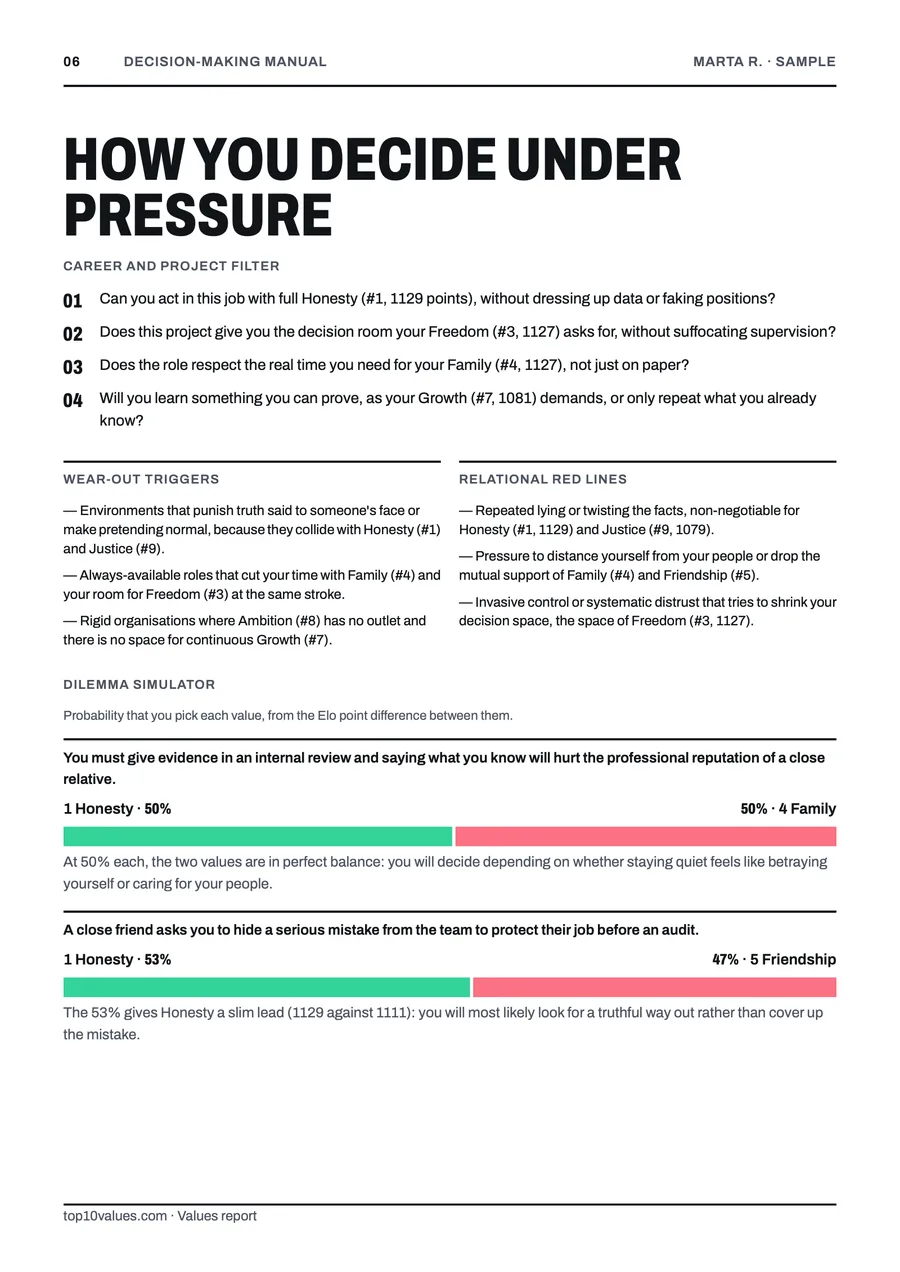
Sample page with fictional data (Marta R.), not yours. Your report is written from your own choices.
Frequently asked questions
Does inner peace mean having no conflicts?
No. It means getting through them without losing your footing. A person with inner peace argues, gets angry and makes mistakes, but recovers faster, does not stockpile resentment and can listen. Avoiding every conflict is usually a form of fear that ends up creating more inner tension.
How do you find inner peace when you have real problems?
Start by separating what you can solve from what you cannot. For the first, define concrete steps however small: calm often grows when you move from worrying to acting. For the second, practise acceptance without resignation: recognising that something is out of your hands is not the same as ceasing to care. Talking to someone you trust also lightens the load. If the unease is persistent and gets in the way of functioning, see a mental health professional.
Do I have to meditate or practise mindfulness?
No. Some people find calm in meditation, others in walking, swimming, cooking, praying, knitting or simply sitting in silence. What matters is having some regular practice that pulls you out of the noise and returns you to yourself. Try a few for several weeks and keep the one you can sustain without it turning into another chore.
Is it selfish to put my own peace first?
Not necessarily. Looking after your calm usually improves how you treat others, and an exhausted person cares badly. It would be selfish if it let you walk away from your responsibilities or load others with what is yours to do. The question is whether your peace rests on having no commitments or on being able to carry them better.
How do I stay calm when someone is provoking me?
Give your body a few seconds before you respond: breathe slowly, drink some water, ask for a moment. You do not have to answer straight away, and important replies almost always come out better after a pause. In a face-to-face conversation you can say «I need a few minutes, I'll come back to this». Afterwards you can address the essential point without adopting the other person's tone.
When Inner peace clashes with…
Invented scene. A year ago Gloria stopped arguing with her brother-in-law Rafa at family meals, and she has slept better since. This Christmas, Rafa remarks in front of everyone that her father-in-law's business "collapsed because of his bad management", and Gloria knows that is not true. Peace asks her to let it go and serve the dessert. Honesty answers that staying silent in front of something false has a cost too, and that her father-in-law is sitting at the table. Justice recalls that this is not the first such remark and that nobody has ever stopped him. Ambition turns up from the side: at work, Gloria avoids asking for a raise so as not to make her boss uncomfortable. Avoiding conflict is not always calm; sometimes it is postponement. She can correct one fact in a plain tone, without turning it into a debate, and talk to Rafa alone another day. More cases in conflicting values.