Knowing my personal values: six exercises to find out what really matters to you
By Juan Alejandre · Published · Reviewed
Industrial engineer and consultant, 25 years working with teams
Knowing your personal values means finding out which criteria you actually use when you choose, not the ones you would like to have. The most reliable way is to look at what you already do: the moments when you felt most like yourself, what makes you angry, where your time and money go and what you pick when you cannot have everything. With six simple exercises and a final check you can have a first list in an afternoon.
Many people try to find their values by reading a list and ticking the ones that sound good. The result is usually a set of noble words (honesty, family, freedom, success) that almost nobody would reject and that, for that very reason, do little to help you decide. The list is not the problem: ticking boxes measures what seems desirable to you, not what you actually put first.
In this guide you will find what personal values are and how they differ from goals and personality traits, six exercises to discover them (each one looks from a different angle), how to check that the list is really yours, the most common mistakes and what to do with your values once you know them. It is not a psychological test or a diagnosis: it is a self-knowledge method you can do on your own.
What personal values are (and what they are not)
A personal value is a stable criterion you use to decide what matters when no rule tells you. It shows in small decisions (what you do with a spare evening) and in big ones (taking a job, moving house, ending a relationship).
The psychologist Milton Rokeach defined values as enduring beliefs that some ways of acting, or some end goals, are preferable to others. Decades later, Shalom Schwartz studied values in dozens of countries and proposed an idea that helps a lot when you try to know your own: almost everyone identifies the same basic values, and what changes from one person to another is the order, that is, which ones come first when they clash. Two people can both value security and adventure; what sets them apart is which one wins when they have to choose.
That is why knowing your values is less about finding words and more about ranking them.
It helps to separate three things that are often confused:
| What it is | Example | |
|---|---|---|
| Value | A criterion that guides many decisions and is never "finished" | Learning, honesty, family |
| Goal | Something concrete you can achieve and tick off | Passing an exam, running a marathon |
| Trait | A usual way of being or reacting | Being outgoing, being tidy |
A goal usually serves a value: running a marathon can be a concrete form of discipline or health. When you reach the goal, the value is still there and looks for another path.
Why it is so hard to know which ones are yours
There are three common reasons:
- Everything seems important. If someone asks whether you value honesty, you will say yes. And family too. And freedom. Rating values one by one from 1 to 10 almost always ends with a list full of nines and tens.
- You confuse what you value with what you "should" value. Upbringing, work and the people around you hand you borrowed values. They are not fake, but they are not always the ones in charge when you decide.
- Values show best under tension. As long as you do not have to choose, you can defend security and adventure at the same time. The order appears when a job offer forces you to pick.
The exercises below are designed to get around those three problems: they look at facts, not intentions, and they force you to choose.
Six exercises to know your personal values
You need paper or a note on your phone and about 15 minutes per exercise. You do not have to do them all on the same day. At the end of each one, write down two or three values you think you see behind your answers. If you cannot find the word, look it up in the list of values or in the guide with a personal values list and examples.
1. Your moments of fulfilment
Think of three moments in your life when you felt especially in the right place: proud, calm or with the feeling that it all made sense. They do not have to be big achievements. For each one, answer: what was happening?, who were you with?, what exactly were you doing?
Example. Lucy remembers the afternoon she taught her nephew to ride a bike, the month she arranged her mother's move on her own and the day her team delivered a project she had argued for. Behind them are family, contribution and independence.
2. What makes you angry
Values also show in their negative. Write down three situations that made you genuinely angry, at work, in the street or in the news. Ask yourself what was being trampled on.
If it outrages you when someone takes credit for another person's work, you may value justice or recognition. If being told when to clock in irritates you, freedom is probably at stake. Anger marks a boundary, and boundaries usually protect a value.
3. Where your time and money go
Look at your calendar and your spending over the last four weeks. Do not judge, just observe: what fills the hours you choose yourself, outside your obligations? What do you spend on when the spending is not necessary?
This exercise is uncomfortable because it shows the gap between what you say and what you do. If you say you value learning but have not spent a single hour learning anything in a month, there are two possible readings: either it is not as high up as you thought, or something is stopping you from living it. Both are useful information.
4. The people you admire
Pick three people you admire, famous or not: a friend, a teacher, a public figure. Write down what they do that you find admirable, not what they are. "She is brave" says less than "she said out loud what everyone was thinking when it could cost her the job".
What you admire in others is often a value you see as yours, even if you do not fully live it yet. In the example above, the value could be courage or integrity.
5. The hard decision
Remember an important decision you made in recent years that was hard: taking a job, leaving a relationship, moving or staying. Write down what you lost and what you gained with the option you chose. What you were willing to give up says a lot about what you put first.
Example. Andrew turned down a promotion that would have meant travelling three weeks a month. He lost money and visible success; he gained time with his children and balance. That decision ranked his values better than any list.
6. Choosing two at a time
Take the values you have written down in the first five exercises (usually between 10 and 20) and compare them two at a time: "if I had to choose, which weighs more for me, security or freedom?". Answer quickly, thinking about your real life and not your ideal one. Count how many times each one wins and rank them.
Comparing in pairs works better than rating because it forces you to choose: you cannot give both a ten. It is the same idea behind the top10values game: it shows you pairs of values and ranks your choices with an ELO scoring system to give you your Top 10. If you want to know how it works and how to read the result, see the personal values test guide.
How to check that the list is really yours
Once you have a ranked list of five to ten values, run these four checks before you settle on it:
- The decision test. Think of a decision you still have to make. Do your values help you lean towards one option? If the list cannot help you decide anything, it is probably too general or too idealised.
- The cost test. For each of your top five, find a moment when you stood up for it even though it cost you something. If you cannot find one, it may be a value you appreciate but that is not as high up.
- The close-person test. Show the list to someone who knows you well and ask whether they see you in it. The point is not their approval, but whether what you see in yourself matches what others see in your actions.
- The time test. Put the list away and look at it again in two weeks. What still feels true is more reliable than what excited you on the first day.
Common mistakes when trying to know your values
- Choosing too many. A list of twenty values does not guide anything. Keep five to ten and single out the top three.
- Stopping at the word. "Freedom" means very different things to two people. Next to each value, write a sentence with what it means to you: "freedom: being able to plan my time without explaining myself".
- Judging yourself by your values. There are no better or worse values. Valuing wealth or recognition does not make you a worse person than valuing humility; what matters is knowing it and deciding with it in mind.
- Assuming they are forever. Values are fairly stable, but their order changes with life stages: a child, an illness or a job change can move what comes first. It is worth reviewing them once a year or after a big change.
- Mixing up values and goals. "Becoming a director before 40" is a goal. Ask yourself which value sits behind it: leadership, success, financial independence?
What to do once you know your values
Knowing your values only helps if you use them. Three simple ways to start:
- As a filter for decisions. When facing a choice, ask which option best respects your top three values. It will not give you the answer, but it structures the conversation with yourself.
- To explain your decisions. Saying "I turned down the promotion because balance comes before salary for me" is clearer, for you and for others, than talking around it. It also helps in a job interview: see the guides on values in a job interview and values at work.
- To talk with the people close to you. Many disagreements are clashes of priorities. Comparing your values helps you discuss them with examples in front of you; the guide on values in a relationship has an exercise for two, and freedom vs security looks at one of the most common clashes.
And when you feel uneasy without knowing why, check whether you are living far from one of your main values. Discomfort is often the sign that something important to you is being left out.
Frequently asked questions
How can I know my personal values?
By looking at what you already do more than at what you think: your moments of fulfilment, what makes you angry, where your time and money go, who you admire and what you gave up in hard decisions. Then compare the values that come up two at a time to rank them, and test the list against a real decision.
How many personal values should I have?
There is no right number, but a useful list usually has between five and ten, with the top three very clear. With more than ten it is hard for the list to help you decide, because almost everything ends up looking important.
Do personal values change over time?
They are fairly stable, but their order changes with life stages. A move, having children, an illness or a job change can push one value ahead of another. That is why it is worth reviewing them now and then.
What is the difference between values and goals?
A goal is concrete and can be achieved (finishing a degree, saving a sum of money); a value is a criterion that guides many decisions and is never finished (learning, security). Goals are usually concrete ways of living a value.
Is there a test to find my values?
Yes. The top10values game shows you pairs of values, ranks your choices and gives you your Top 10 in about 10 minutes. It is a self-knowledge tool, not a validated psychological test: use it as a starting point and compare it with the exercises in this guide.
What if my values clash with each other?
That is normal. Almost everyone has values that pull in opposite directions, such as security and adventure or independence and family. You do not have to drop either one: the point is to know which weighs more in each context and to look for decisions that make room for both when possible.
How your Top 10 is calculated
The game shows you pairs of values and you choose which matters more to you each time. From those choices, an ELO scoring system, a method used to rank chess players, works out an order for your 50 values. You can read the full explanation on the methodology page.
Final thoughts
Knowing your personal values does not require a retreat or a long test: it requires looking honestly at what you already do and daring to rank. If you want a shortcut for the last step, find your Top 10 in the game and compare it with what the exercises told you. If you prefer to start by reading, the list of values explains what each one means.
Sources
- Rokeach, M. (1973). The Nature of Human Values. New York.
- Schwartz, S. H. (2012). An Overview of the Schwartz Theory of Basic Values. Online Readings in Psychology and Culture, 2(1). https://doi.org/10.9707/2307-0919.1116
Sources
Find your top 10 values with 100 quick comparisons
What does the paid report include?
When you finish the 100 comparisons you will see your Top 10 on screen. If you want to go further, there is a PDF report on your personal values: €9.95 (VAT included), one-off payment. To buy it you need to save your game with a Google account.
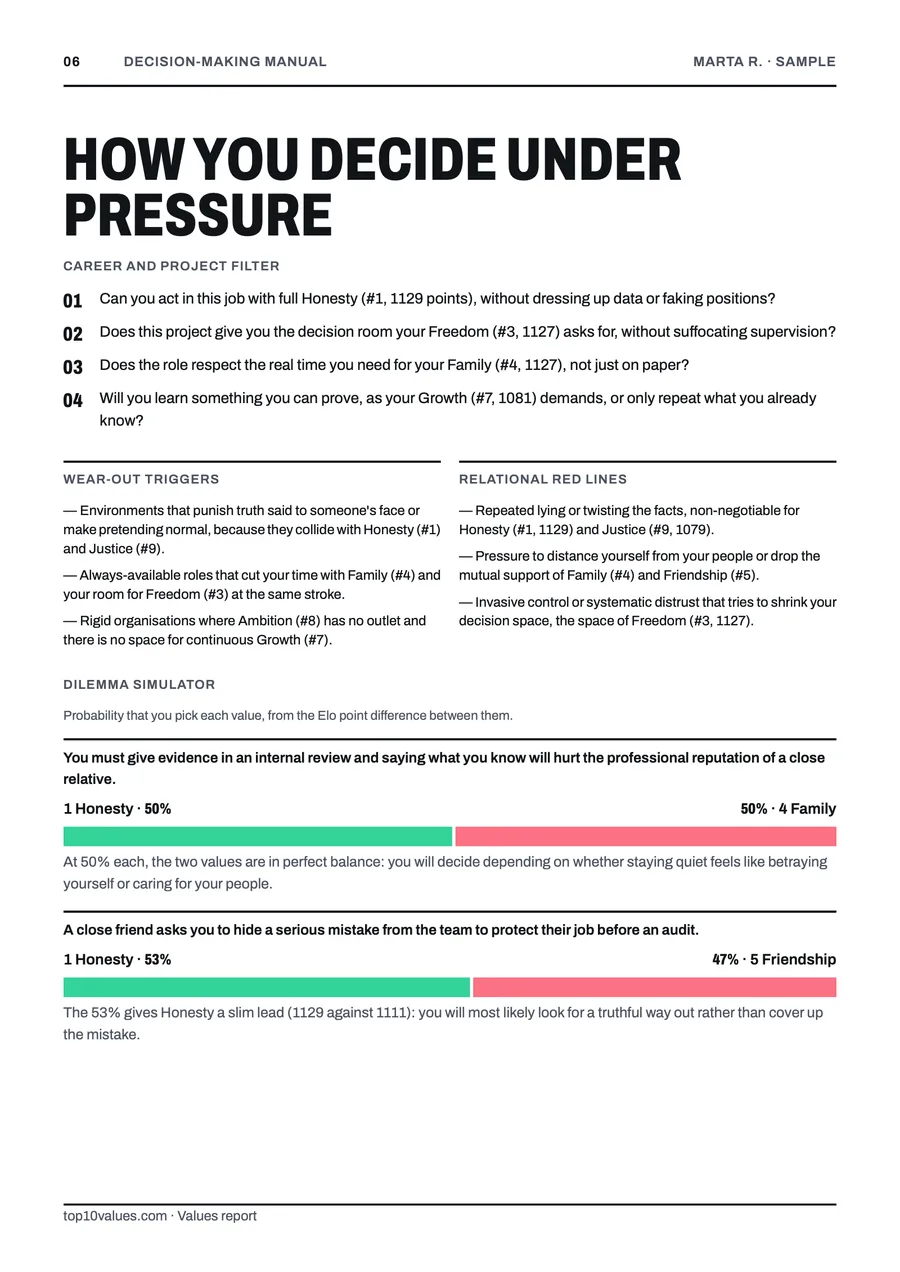
Sample page with fictional data (Marta R.), not yours. Your report is written from your own choices.