Achievement
Recognition
Being appreciated by others.

Recognition is the need for your effort, talent or contribution to be seen and explicitly valued by others. People who prioritize recognition want their work not to go unnoticed and feel more satisfied when their contribution receives public validation, whether through a promotion, a compliment or a specific mention. This isn't necessarily vanity, but the legitimate desire for the effort invested to have a tangible social reflection. This value can create frustration if the environment doesn't recognize merit fairly, and it usually differs from success in that it focuses specifically on external validation rather than on the achievement itself.
What does this value mean?
Recognition, as a value, is the importance you place on other people seeing what you contribute and naming it accurately: the report that rescued the meeting carries your name, someone at home notices who plans every meal of the week, your team knows which part of the project came from you. It is not fame and it is not applause; it is about being seen as you are, for what you actually do. People who hold it high are not satisfied just because the project went well or the household runs smoothly: they want their part to appear in the story when someone explains how it was done, so before joining a team or a group they look at whether people there get credited for what they do.
People who rank recognition high tend to see themselves in very specific scenes. The engineer who finds out her manager has presented, as his own, the fix she walked him through on Tuesday, and who lies awake that night not over the promotion she might miss, but because nobody will ever know the idea was hers. The nurse who works back-to-back shifts during a wave of sick leave and is stung less by the exhaustion than by the thank-you email from management addressed "to all staff". The six-year-old who won't touch his sandwich until somebody has looked at the drawing he brought home from school. The grandmother who is happier to hear her grandchildren say "this is Grandma's Spanish omelette" than to receive any present. And the person who quits a volunteer group they enjoyed because, after two years, the coordinator still doesn't know their name. What they share is not vanity, but a need for what they give and what others know about them to line up. The philosopher Axel Honneth, in The Struggle for Recognition, argues that many social conflicts are best understood as struggles to be recognised: what people demand is not only things, but to count.
What it does NOT mean
It is not wanting to be the centre of attention. Some people need the spotlight at every dinner; others only ask to be listened to when they talk about their work. The second is recognition; the first is something else. Nor is it collecting followers, awards or mentions: you can have a trophy on the shelf and feel that nobody around you knows what you do, or have none and know that the four people who matter to you see you perfectly well. It is not fishing for compliments either. The recognition that counts for someone who holds this value is precise ("the rota you built saved us three phone calls a day"), not generic ("you're a star"). And it is not the opposite of humility. Humility, properly understood, does not ask you to hide what you do, only not to inflate it; you can want your contribution named without wanting it exaggerated. Finally, it is not a character flaw or a sign of immaturity: wanting your effort to matter to someone is one of the most ordinary ways of wanting to belong.
Related concepts
Why might it matter to you?
Recognition matters because it is one of the ways you know that what you do lands somewhere. You can work for months on something, care for someone for years or hold a group of friends together, and if nobody ever names it, it starts to feel as though it never happened. This is not pride; it is information. When your manager tells you which part of the report was useful, you learn what to do more of; when your partner mentions noticing that you've handled the bank paperwork for weeks, you know the division of labour is visible from both sides. Abraham Maslow, in his theory of motivation, listed esteem, both self-respect and respect from others, among basic human needs, and Frederick Herzberg, in his late-1950s research on motivation at work, placed recognition among the factors that motivate people, alongside achievement and responsibility. You hardly need a study, though, to know what happens in a team where the same person always takes the credit: everyone else stops suggesting ideas. Being clear about how much this value weighs for you also protects you. If you deny it, you may end up accepting jobs, relationships or groups where your work is invisible by design, and take years to understand why you feel drained even though everything is supposedly fine. If you own it, you can pursue it directly and healthily: ask to be credited, choose environments that give feedback, say at home what you would like noticed. And you can learn to give it, one half of this value that often gets neglected.
How can you live this value?
- Record your contribution as it happens, not when you suddenly have to defend it. A short email when you close a milestone ("customer migration is done; these three cases are still open") leaves a trail of who did what without sounding like a complaint. If you wait for the annual review, you will be reconstructing from memory what everyone else has already forgotten.
- Ask for the specific recognition you need instead of hoping people will guess. "I'd like the client presentation to say the analysis is mine" or "it helps me when you tell me something I do at home makes your day easier" are clear requests. Staying quiet and resenting it is the most common route, and the one that works worst.
- Separate who you want to impress from who you want to be seen by. Write a short list, three to five people, whose opinion of your work or character genuinely matters to you. When a stranger's like or a distant colleague's silence gets to you, check it against that list and decide how much weight it deserves.
- Give the recognition you would like to receive, with details. In a meeting, name the person who pulled the data together; months after a friend helped you move, remind them which piece of furniture they carried up the stairs. Precise recognition lands far better than general praise, and practising it helps you understand what you are missing yourself.
- Make sure recognition doesn't choose your work for you. Before taking on a project, ask whether you would do it even if nobody knew it was yours. If the answer is no for almost everything you do, keep some corner of your life, a hobby, a caring role, an anonymous task, where applause is not the reason.
- Every few months, look at where you feel invisible and whether the problem is the environment or the communication. Sometimes your work goes unseen because nobody tells the story, and telling it is enough; other times the place simply never recognises anyone, and no strategy will change that. Telling the two apart can save you years of waiting in the wrong place.
Advertisement
What happens when you don't live up to this value?
When recognition matters to you and is missing for a long time, it rarely blows up all at once; it wears you down slowly. You start doing the bare minimum, because doing more changes nothing. You stop offering ideas in meetings after watching someone else repeat them two or three times and collect the nods. At home, you keep a silent tally of the jobs you do that nobody mentions, and that tally leaks into arguments that are supposedly about something else: the dishes, the car, who called whom. With friends, you catch yourself wondering whether anyone would notice if you stopped organising the get-togethers. Sometimes the symptom is the reverse: you look for recognition in places that don't deserve it, spending hours watching the reactions to a photo, or accepting a showy but empty role because at least it comes with a title. It can also happen that you have dismissed it as a value out of embarrassment, and you live in places where nobody ever says "good job", telling yourself it doesn't bother you, while being surprised by how much a stranger's kind remark affects you. The clearest sign is bitterness: when someone else's credit, even deserved credit, feels like an injustice done to you.
The healthy side and the shadow
When does this value stop helping you and start limiting you?
Healthy expression
Wanting your contribution seen for what it is
In excess
Living for applause
Recognition goes wrong when it stops being the result of what you do and becomes the reason for doing it. You start choosing projects for how visible they are rather than for what they contribute, avoiding the background work nobody sees, such as writing documentation, training a new colleague or maintaining what already works, and feeling every win by someone else as something taken from you. In relationships, the shadow shows up as a need for constant confirmation: asking people what they think of everything you do, being hurt when your partner doesn't comment on your haircut, measuring a friendship by who reacts first to your messages. Social media makes this especially easy, because metrics turn recognition into a number you can check at any hour. There is also a shadow by deficit, just as damaging: giving up on any recognition for fear of seeming vain, letting others sign your work and then resenting it in silence. A useful test is to ask what you would do with a project if you were guaranteed that nobody would ever know it was yours. If you would drop it, applause is in charge; if you would still do it but it would sting, the value is healthy and simply asking for its place.
This value at work
Work is where recognition is tested most often, because credit is shared among many hands and not always shared well. If this value ranks high for you, take it into account from the interview onwards: ask how results are presented to senior management, whether the names of the people doing the work appear in reports, and what happened the last time someone on the team had a good idea. A company that pays a little more but where everything goes out under the department head's name can wear you down more than one that pays less and habitually credits each person. Once you are in the role, recognition is earned and protected through unglamorous habits. Put your significant contributions in writing: a two- or three-line weekly summary to your manager is not showing off, it is making visible what would otherwise disappear. When you work in a team, agree at the start who will present what; that is far easier than reclaiming credit afterwards. If someone takes credit for your idea, raise it privately first and stick to facts ("I showed you this approach on Tuesday; I'd like the next meeting to note that it's mine"), and only escalate if it happens again. If you manage people, this value gives you an advantage: you know how it feels not to be named, so you can get it right. Credit the people who did the work in public, especially in front of your own bosses, and give specific feedback rather than a passing "nice work". In 1968 the sociologist Robert K. Merton described what he called the "Matthew effect" in science: credit tends to pile up on those who are already well known, even when others did the work. It happens in plenty of fields, and the person in charge is the one who can stop it.
This value in relationships
In friendship, recognition is nearly always played out in small things. It is the friend who organises the annual trip, books the house, builds the expenses spreadsheet and chases everyone to pay, and whom nobody ever thanks for "setting it up again". Or the friend who always listens and is rarely listened to, because she is so good at it that nobody notices she has things to say too. If recognition matters to you, you will spot these imbalances sooner than most, and it pays to decide what to do about them before they turn into distance. Saying something works better than quietly drifting away: "this year I'd love someone else to handle the trip" or "I realised the other day we always end up talking about your stuff" are awkward sentences, but they save friendships. It works the other way too. If this value matters to you, you have a particular radar for what others do that goes unmentioned; use it. A message like "I was thinking about how you helped me when I lost my job" costs nothing and may be what that person remembers most from their year. Be careful, though, about measuring friendship by social media reactions or by who sends birthday wishes first; those are very poor signals and will make you feel less seen than you are.
This value in love
In a couple, recognition takes a particular form: your partner seeing what you do for the relationship and the household, and also who you are beyond those roles. A frequent source of conflict for couples who live together is the work nobody sees: remembering medical appointments, knowing when the detergent is about to run out, planning dinners, keeping track of the in-laws' birthdays. Whoever does it usually feels nobody notices; whoever doesn't often has no idea it exists. If recognition is a high value for you, naming that division out loud works better than waiting for it to be discovered. Writing a list together, without blame, of everything that keeps the household running tends to surprise both people. Beyond the chores, there is recognition of who you are: your partner knowing what the project you just finished cost you, mentioning to their friends something you do well, remembering what you told them about your childhood. Ask for it clearly if it's missing, and ask what the other person needs to see, because it doesn't always match; for one person it may be a comment, for another, being allowed to choose the holiday without an argument. The risk, in its excessive form, is turning the relationship into a merit tribunal where every gesture is logged and something is expected back. Recognition in a couple works better as a habit of noticing than as bookkeeping.
This value in family
In families, recognition is learned very early. A small child who shouts "look!" forty times in an afternoon at the park is not being tiresome; they are checking that what they do exists for someone. How adults respond to that call teaches lessons that last. Praising effort and detail ("you used three colours for the sky") tends to tell a child more than generic praise ("how lovely") or a comparison with a sibling. With teenagers the picture shifts: recognition from peers starts to matter more than recognition from home, and that is normal; what helps is that home keeps noticing what they do, even if the reply is a grunt. In adulthood other scenes appear. The daughter who looks after her ill mother while her brother, who lives far away, collects all the praise each time he visits. The retired father who feels nobody asks about his trade any more, though he knew it better than anyone. The person who leaves work to raise children and finds that at family dinners nobody asks "and how are you doing?" any longer. In all of these, recognition is a matter of fairness at home, not vanity. If it is a high value for you, you can do a lot as a bridge: saying out loud, in front of everyone, who has been holding something together for months, or asking your elders to teach you what they used to do. And if you are the one who feels invisible at home, saying so with one concrete example usually opens more doors than a general complaint.
This value and yourself
If recognition weighs heavily on your list, you are likely to remember in detail the times someone took credit for something of yours, and also the times someone named you when you didn't expect it. You may well work better with a manager who gives frequent feedback than with one who leaves you to it and says nothing, even if the latter gives you more freedom. You might find it hard to admit this value out loud, because it is associated with vanity, and prefer to say that what matters to you is "respect" or "having your work valued"; deep down, that is this value said more modestly. It helps to know what kind of recognition fills you up: some people need it in public, in front of the team; some prefer a private conversation; some are content with an objective fact, such as their proposal being adopted; and some only need one particular person to know. If you're not sure, think of the compliment you remember best from the last few years and look at its shape: who said it, where, and exactly what they said. That is usually where the clue lies. And watch one thing: if you rely on recognition to know whether something is well done, you will struggle to make unpopular or risky decisions, because at first they are almost never applauded.
What are you willing to sacrifice for this value?
Protecting recognition sometimes costs you comfort and goodwill. Would you tell a colleague you get on well with that the idea she presented yesterday was yours, knowing the conversation will be tense? Would you leave a stable, well-paid job where for years nobody has mentioned what you do? Would you ask, at a family dinner, for recognition of the person who has been caring for Grandad for months, even if it makes others look bad? Living this value in a healthy way also means giving something up. Would you do important work that won't carry your name, because the project needs it? Would you let your teenage child shine at something you taught them without reminding anyone? Could you go a week without posting anything online, just to see how much it affects you? Notice which of those scenes makes you most uncomfortable: that is where the line falls between standing up for recognition as a value and depending on it as a need.
Signs you're betraying this value
The first way of letting recognition down is the quiet one: you let someone else sign your work and then complain to third parties instead of talking to them. The second is the opposite: presenting as yours something that came out of a team, or leaving out the name of whoever gave you the idea because it made you look better. You betray it when you demand that your contribution be noticed but never name what others do, at home or at work. When you inflate an achievement on your CV or in an interview, because the recognition you seek no longer matches what you did. And when you choose a task, a friendship or a partner mainly for how good they make you look to other people, rather than for what they bring you. A quiet sign: if it has been a while since you told anyone "you did this really well", with specifics, the value has turned purely inward.
Turning the value into goals
Value
Recognition
Behavior
When you finish any significant task, send a two-line note to the relevant person explaining what you did and what is still open
Goal
Within the next three months, your manager, your partner or your group can describe at least three of your contributions in detail, and you can describe theirs
Habit
Every Friday, name one specific contribution from someone else, in writing or out loud, and log one of your own in a private document
Questions to reflect on
- Which contribution of yours from the last few months do you think nobody has seen, and what could you do this week to make it known without it sounding like a complaint?
- Whose recognition, among three or four people, genuinely matters to you, and how much time do you spend worrying about the opinions of people who are not on that list?
- When was the last time someone took credit for something of yours, what did you do, and what do you wish you had done?
- Who around you, at home or at work, have you not recognised for a while for something they do every day?
- Would you do your current job just as well if you knew nobody would ever learn which part was yours? What does your answer tell you?
- What kind of recognition fills you up most: public, private, an objective result, or the word of one person? Are you getting it in that form?
How much are you living this value?
Go back over the last four weeks and find two scenes: one in which someone saw and named something you did, and one in which you named what someone else did. Score from one to ten how well your contribution is known in the places that matter to you, without your needing applause to keep doing it. Below seven, settle on just one step for this week: clearly tell someone about something you did, or credit someone's work in public.
When two values clash
Recognition clashes with Humility when talking about what you have done feels like bragging. The way out is usually precision: "I prepared the cost analysis" is a fact, not a performance; what humility rejects is exaggeration, not information. With Contribution, the tension appears when serving the common good means anonymous work: volunteering nobody sees, a donation without a name, code you maintain in an open-source project without anyone saying thanks. If both values matter to you, you can set aside part of your contribution for anonymity and part for visibility, and know which is which. With Authenticity, the clash comes when what gets applauded isn't who you are: the joke that makes the table laugh but doesn't represent you, the professional profile that wins congratulations but doesn't resemble you. There it is worth asking which recognition you actually want, because the kind you get by pretending doesn't nourish. With Honesty and Integrity, the risk is inflating achievements or leaving out others' part so you shine brighter; recognition gained that way is fragile, because you know it doesn't fit. With Loyalty, the tension is concrete: claiming credit for an idea may embarrass a manager who has backed you for years, and you might choose to talk to them privately rather than in a meeting. Finally, with Inner peace, it clashes when the search for approval keeps you glued to your phone, to performance reviews and to other people's faces. One question works for almost all of these clashes: is what you are asking people to see exactly what you did, no more and no less? If the answer is yes, asking for it rarely betrays another value; what usually betrays it is exaggeration or silence.
Is “Recognition” one of your top 10 values?
Find out by playing and comparing this value with the other 49
How the Elo ranking works and its limits in the methodology.
What does the paid report include?
When you finish the 100 comparisons you will see your Top 10 on screen. If you want to go further, there is a PDF report on your personal values: €9.95 (VAT included), one-off payment. To buy it you need to save your game with a Google account.
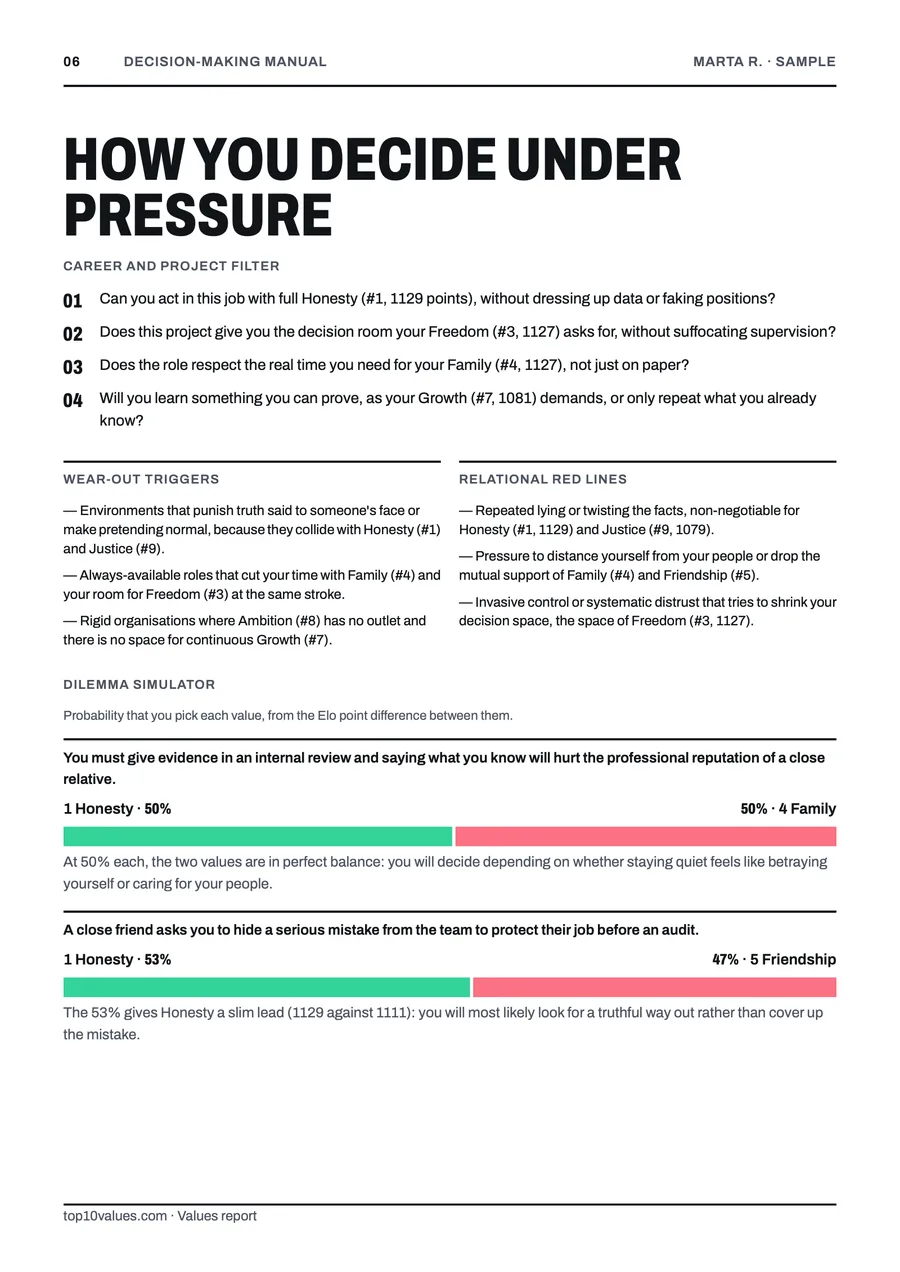
Sample page with fictional data (Marta R.), not yours. Your report is written from your own choices.
Frequently asked questions
What is recognition as a personal value, and what does it look like in everyday life?
It is the importance you place on other people seeing and accurately naming what you contribute. Everyday examples: asking for the report you prepared to carry your name; noticing that "thanks for organising dinner" affects you more than the dinner itself; choosing a job partly because people there get credited for what they do; or feeling that a project going well isn't enough if nobody knows you made it happen. It also includes the other side: paying attention to what others do and saying so.
Is wanting recognition the same as being vain?
Not necessarily. Vanity seeks admiration beyond what you have done; recognition as a value seeks to have what you have done seen, no more and no less. One way to tell them apart is to notice what bothers you: if it hurts that nobody knows the idea was yours, that is recognition; if it hurts that someone else is praised even when they deserve it, vanity or envy is taking over. Wanting your effort to count for someone is a very ordinary human need.
What is the difference between recognition, success and ambition?
Success focuses on achieving the results you set out to achieve; ambition, on wanting to go further than where you are. Recognition looks in another direction: at whether others see and name what you do. You can have success without recognition, for example when you deliver a project someone else signs, and recognition without success, as when your team values your effort on a project that failed. Knowing which of the three drives you most helps you choose jobs and understand why some achievements leave you cold.
What should I do if a colleague or my boss takes credit for my work?
First, gather facts: emails, document versions, dates. Then talk privately and without accusing: "the approach presented yesterday is the one I showed you on Tuesday; I'd like the next meeting to note that it's mine." Many people correct course when it's put to them calmly. For the future, record your contributions as they happen and agree at the start of each project who will present what. If it keeps happening anyway, take it to the right person with the evidence, or consider whether that environment suits you.
How do you ask for recognition without sounding like you're complaining?
Ask for something specific and positive, and pick your moment. Instead of "nobody values what I do", try "I'd like the client meeting to mention that the analysis is mine" or, at home, "it really helps when you tell me you've noticed I organised something". It works better in a calm conversation than in the middle of an argument. And it helps if you do it for others too: people who recognise others often have more standing to ask for it.
How do I stop depending on likes and other people's approval?
The aim is not to stop wanting recognition, but to choose whose recognition counts. Make a short list of the people whose opinion genuinely matters to you and check against it whenever a reaction, or the lack of one, gets to you. Try going a few days without checking the metrics on what you post and notice what changes. Keep one activity you do only for yourself, without showing it to anyone. And if the need for approval causes you a lot of distress or stops you from making decisions, it can help to talk it through with a psychologist.
How do you give someone good recognition?
Make it specific, timely and about something the person actually did. "Thanks for staying late on Thursday to check the data; because of that the client never saw the error" is worth more than "you're a great team". Where possible, do it in front of people who matter to them, such as their manager or their family. Don't fold it into a criticism in the same sentence, because the praise gets erased. And if you know them well, ask how they like to be recognised: some people appreciate public applause and others prefer a private note.
When Recognition clashes with…
Having your work seen, versus not showing off, contributing without your name on it or being who you are when the applause goes elsewhere.