What are your values? How to choose and explain them in a job interview
By Juan Alejandre · Published · Reviewed
Industrial engineer and consultant, 25 years working with teams
"What are your values?" sounds easy until it is asked across a desk. If you say "integrity, teamwork and hard work", you sound like every other candidate. If you improvise, you may name three words you cannot back up when the interviewer says, "Can you give me an example?"
This guide suggests another route: choose a few values that are really yours, prove each one with a concrete fact and link it to the job. You will find a three-sentence method, six sample answers for different roles, ideas for the "What are your weaknesses?" question that usually follows, a short section on resumes and a 10-minute exercise to do before the interview. No answer guarantees anything, but an honest answer with examples is remembered longer than a list of adjectives.
How values play out once you have the job is a topic for another guide. This page is about the conversation before you get there.
What the interviewer really wants to know
Whoever asks this is not grading you on morals. In a behavioral interview, questions about values are a shortcut to three things, and it helps to keep them in mind when you prepare:
- Whether you know yourself. A person who knows what matters to them can explain why they choose what they choose, and that makes it easier to picture working with them.
- Whether what you say matches what you have done. The interviewer has your resume in front of them. If you say you care about learning and you have spent eight years in one role without any training, the answer rings hollow. If you back it up with a fact (a course, something you picked up and then applied), it holds.
- Whether you fit how the team works. A team with tight deadlines and a lot of autonomy needs people who are comfortable with that. This is what people mean by "cultural fit", and it is not about having the "right" values, only about not clashing with how work really happens there.
That is why the question almost never has a perfect answer in the abstract. It has an answer that is true for you and relevant to that particular job.
How to choose your three values before the interview
Start from your real values, not the ones that sound good
It is tempting to open a list and tick whatever looks best in an interview. The problem arrives at the second question: "Can you give me an example?" A value that is not yours has no examples, and it shows.
To start from what matters to you, go through the list of personal values and notice which ones you recognize in past decisions, not which ones you would like to have. Think about a time you turned something down, stayed late for a reason you could explain, or were bothered by how something was handled. Those moments usually point at a value.
If you would rather let the order come from choices than from gut feeling, the top10values comparison game makes you pick between two values each time, so you cannot keep them all. The methodology page explains how the order is calculated. Arriving at the interview with your Top 10 in hand gives you an honest starting point. If you want to know what the test does and does not tell you before you try it, read the guide to the personal values test.
Cross-check your list with the job post and the company
Read the job post and the company's website looking for clues about how people work. Do they talk about autonomy, customers, quality, growing fast, looking after the team? Then compare that with your list. Keep the honest overlap: the values that are yours and that also make sense in that setting.
If the overlap is small, do not force it. Two real values with good examples are worth more than three where one is filler. And if the overlap is close to zero, that is useful information for you about whether the job suits you.
Be careful with company values pages in particular. A list on a careers page is what the company says about itself. What you can really learn from it is which words they use, not how daily work feels. If you can, ask a question in the interview that tests it, for example: "What does a good week look like for someone in this role?"
Why three and not five
Every value you name obliges you to support it with an example. With three, you can spend about twenty seconds on each without the answer dragging on. With five, you either rush through each in one sentence and it sounds like a list, or you take too long. Five values with no examples carry less weight than three with one.
If you are asked for five, you have room: give your three with a story, then add two more in passing, saying they come next.
The answer structure: value, story, link to the role
You may already know the STAR method (situation, task, action, result), which is widely used for questions like "Tell me about a time when...". It works very well when the question is about a specific situation. When the question is about you, a shorter structure is easier to carry into the room. It has three sentences:
Value: "What matters to me is X." Story: "For example, when Y happened, I did Z." Link: "That is why, in this role, I would look for W."
- Value. Name it in your own words and, if needed, define it in half a sentence. "Honesty" can mean many things; "saying things even when they are uncomfortable" is already a definition.
- Story. A real, concrete episode: where it happened, what happened, what you did. Skip the grand adjectives. If you can add a result that someone could check, good, but do not invent one.
- Link. One sentence tying the value to the work you are being offered. It is the part almost everyone forgets, and it is what turns an anecdote into an answer.
Repeat the pattern for each value. Three values, nine sentences, under two minutes. That is shorter than a full STAR answer and leaves you less to remember on the day.
A note on the story: it does not have to be a work story. If you are new to the job market, a school project, volunteering, caring for a relative or a side project all count, as long as there is something you did yourself.
Sample answers by role
The examples that follow are fictional: they invent plausible facts to show the structure. Your answers have to come from your own stories. Each one uses a different value and the three-sentence method.
Customer service: kindness
"Kindness matters a lot to me, meaning treating a person well even when they are angry. For example, in the electronics department of a big-box store, a customer came in very upset because his washing machine delivery was late. Instead of reciting the delivery policy, I apologized for the wait, called the carrier myself while he stood there and gave him an approximate time window. He left without raising his voice, and he came back to buy again. In this job I would want the customer to feel there is a person on the other side and not a script."
A useful detail: kindness here is not "being nice", it is a specific behavior under pressure. If your kindness has a limit (you do not accept abuse), you can say so. It adds realism.
A role that handles money: honesty
"A value that matters a great deal to me is honesty, above all when saying it makes me look bad. For example, when I was closing out the register at the accounting firm where I worked, I noticed I had charged a client twice for the same invoice. Nobody had spotted it. I told my supervisor that same day, we refunded the amount and I suggested adding a check at the end of each shift, which we still use. In a job where you handle other people's accounts, I would rather be known for flagging my mistakes early than for never making any."
Notice that the story is the candidate's own mistake, not a heroic deed. A story where you admit an error and fix it shows honesty better than any definition.
Startup or sales role: ambition
"If I had to keep one value, it would be ambition: I like setting goals that stretch me a little beyond comfortable. For example, in my last job as a sales rep for a sporting goods distributor, the target was one new account per month and I set myself three. I built a list of small shops near my territory, visited one a week and closed four in the first quarter. I know this needs judgment: I am not interested in growing at any price, but without losing the relationship with the customer. In a young company, I like a pace where each win opens the next challenge."
Ambition often raises eyebrows. Anchoring it in behaviors (prepare, visit, close) and limiting it ("without losing the relationship") keeps it from sounding opportunistic.
Remote or goal-based work: freedom and trust
"Two values that go together for me are freedom and trust. I do my best work when I decide how to organize my day, and in return I commit to delivering on time. For example, as a freelance copywriter, my client gave me weekly deadlines with no set hours. I never missed one, and when I saw I was not going to make a delivery, I said so three days ahead instead of waiting until the last moment. In a remote role, that is the combination I look for: autonomy on my side and clear communication, so nobody has to check on me."
The key is reciprocity. Freedom without follow-through sounds like indifference, and trust without examples sounds like a slogan.
First job with little experience: learning
"The value that shows most in my track record is learning. In college I volunteered at an after-school tutoring program, and in the second month I realized I was explaining fractions badly. I asked a retired teacher, also a volunteer, to watch one afternoon and tell me what she would change. I tried two of her suggestions and the kids started finishing the exercises without asking for help. I have no office experience, but I do have the habit of asking for feedback, applying it and checking whether it worked. That is what I want to keep doing in this role."
With no work history, coursework, volunteering, a personal project or a summer job all work as facts. What matters is that there is something you did.
A team role: respect or loyalty
"For me respect is the basis of a good team, and I practice it even when I disagree. In the restaurant kitchen where I worked, a veteran line cook had a way of prepping the sauces that looked slower to me. Instead of correcting him in front of everyone, I asked him afterward why he did it that way, and I learned it avoided a problem I had not seen. Even so, I suggested trying my method on a small batch and we compared times. We ended up with a mix of both. In this job I would like to keep debating ideas without anyone feeling questioned as a person."
If you prefer loyalty, the pattern is similar: a fact in which you stood by your team or your manager in a hard moment (a very heavy season, a reorganization) and a sentence making clear that loyalty does not mean staying quiet, but saying things inside the team.
Values worth framing carefully
No value is off limits, but some are easily misunderstood if you state them without context. The idea is not to hide them, but to explain what they mean to you.
- Perfectionism or excellence. Said on its own, an interviewer may hear "slow". It works better if you talk about caring about detail where it matters and knowing when something is good enough: "I double-check anything that goes to a customer and I deliver on time what does not need it."
- Independence. It can sound like not wanting to collaborate. Make the distinction: "I like to solve what I can on my own and ask for help early when I cannot."
- Work-life balance. It is a legitimate value, but in an interview it can be heard as lack of commitment. Present it as sustainability: "I perform better over the long run if I rest, so I protect my time when there is no urgency."
- Financial security. It is honest, but said bare it can sound as if only the paycheck matters. Tie it to the stability that lets you do the job well: "A stable situation lets me focus on learning and stay with a project for the long term."
The common rule: name the value, say what it means in behavior and make clear how it helps the work.
Values and weaknesses in the same interview
The question "What are your weaknesses?" often comes close to the one about values, and you can handle both together: almost every value has an excessive side. This is the idea behind the "bright side and shadow side" section on each value page: what you carry too far becomes a weakness, and that makes it an honest weakness, not a strength in disguise.
Some pairs to think about:
- Trust and credulity. "I trust people quickly, and a few times I have accepted a piece of information without checking. Now I ask for the source when something matters."
- Honesty and bluntness. "I say what I think, and sometimes with little filter. I am learning to pick the moment and the way."
- Ambition and impatience. "I find slow rhythms hard to accept. I have learned to ask for realistic deadlines instead of overpromising."
- Kindness and difficulty saying no. "I take on tasks so as not to inconvenience anyone and I overload myself. Now I ask what priority each request has before I answer."
Avoid the humble-brag weakness ("I work too hard", "I am a perfectionist") without any explanation: interviewers have heard them all. A real, limited weakness with a change you are already making is more believable.
Values on a resume (or CV)
Should you put personal values on a resume? It is not required, and if they take up space that your achievements could use, it does not pay off. In the US the document is a resume and in the UK a CV, and in both a loose list of "reliable, proactive, honest" adds nothing. Include values only if there is room and they come with a fact.
A useful line in a summary might be: "Customer support with a focus on honesty: six years resolving issues in retail and banking, preferring to explain clearly rather than promise what cannot be delivered." It combines value, context and behavior. It is better to keep values for the interview, where you can explain them with a story.
Related questions you may be asked
- "What do you value in a manager?" Pick a value that is yours and project it: "I value clarity: knowing what is expected of me and getting feedback in time." Do not criticize former managers.
- "What would make you leave a job?" Answer with a reasonable limit, not a complaint: "It would be hard for me to stay somewhere that asked me to hide mistakes from a customer." It connects to your value and does not sound like an ultimatum.
- "What does integrity mean to you?" Define the term in one sentence with a behavior and add a short example, such as correcting your own mistake before anyone notices it. You can lean on the pages for integrity and honesty to sharpen the definition.
- "What do you do when a request clashes with your values?" Describe how you raise it first, calmly, and what alternative you propose. A real example is worth more than a statement of principles.
Frequently asked questions
What values should I say in a job interview?
The ones that are yours and have an example behind them. The word matters less than being able to tell a fact in which the value shows. Then cross-check your list with what the job post says about how people work and keep the ones that fit honestly.
Should I give 3 or 5 values?
Three is a good number: it lets you give an example for each without running long. If you are asked for five, develop three and name two more in passing. Five values with no examples carry less weight than three with one.
Can I say family is one of my values?
Yes, if it is true. So that it does not sound like lack of interest in the work, explain what it gives you: "My family gives me stability, which is why I am consistent and plan my time well." Avoid presenting it as something that competes with the job.
What if I do not share the company's values?
Say so constructively, without pretending. You can agree on part and nuance another part, or stick to the ones you do share. Faking agreement with values you do not feel tends to cost you later, and the interview is also your chance to decide whether the setting suits you.
Should I memorize my answer?
Not word for word. Memorize the pattern (value, story, link) and the three stories you will tell, not the sentences. A read-out answer sounds rehearsed; one recalled in your own words sounds like you.
What values and weaknesses can I mention?
Choose three values that are yours and, for each, think of its excessive side: trust can lead to credulity, honesty to bluntness and ambition to impatience. Present it as something you are already working on, not as an excuse.
Do personal values go on a resume?
Only if you have spare space and they come with a concrete fact. It is usually more effective to keep them for the interview, where you can explain them with a story.
A 10-minute exercise before the interview
- Minutes 1 to 3. Write down five values you recognize in your decisions. If you are unsure, lean on your Top 10 from the values game.
- Minutes 4 to 5. Cross out the ones with no real story behind them and the ones that do not fit the job. Keep three.
- Minutes 6 to 9. For each one, write one line for the story (where, what you did) and one for the link to the role.
- Minute 10. Say the answer out loud, without notes. If it runs over two minutes, cut the story, not the link.
If you are still not sure what your values are, start the comparison game: 100 quick choices, and you do not need an account to begin. You will go into the interview with your Top 10 as a starting point and your own examples ready. It is not a validated psychological test and it does not predict how you will perform in a job.
Sources
Find your top 10 values with 100 quick comparisons
What does the paid report include?
When you finish the 100 comparisons you will see your Top 10 on screen. If you want to go further, there is a PDF report on your personal values: €9.95 (VAT included), one-off payment. To buy it you need to save your game with a Google account.
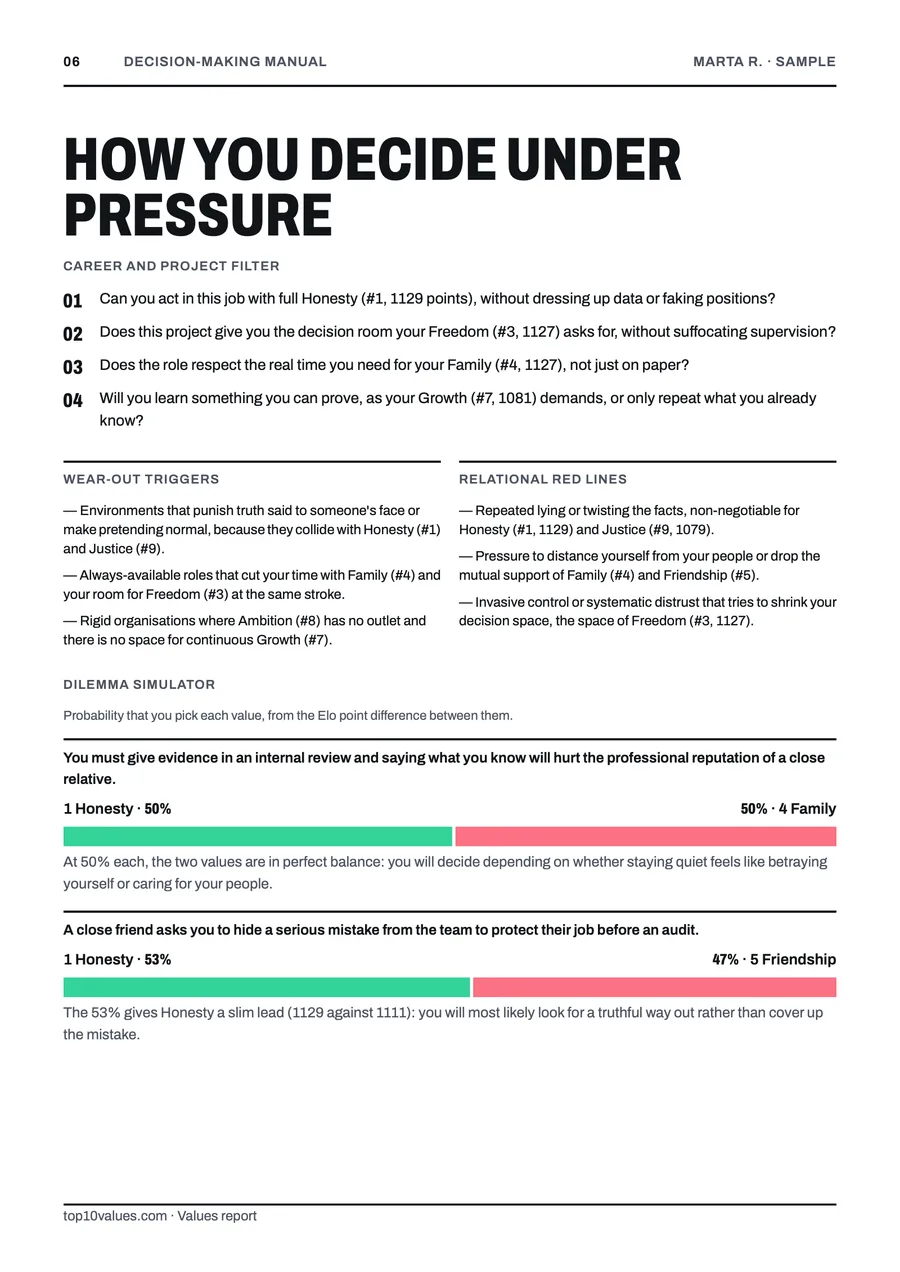
Sample page with fictional data (Marta R.), not yours. Your report is written from your own choices.