Personal Growth
Learning
Continuous desire to acquire knowledge.

Learning is the constant desire to acquire new knowledge and to better understand the world, other people or yourself. People who value learning enjoy the process of not knowing and gradually closing that gap, whether by reading, studying formally or experimenting on their own. This value usually translates into active curiosity: asking, researching and questioning easy answers. Unlike pure curiosity, learning emphasizes the accumulation and consolidation of knowledge over time. People who prioritize it rarely stagnate professionally, because they see every stage of their life as an opportunity to keep developing.
What does this value mean?
Learning, as a value, is the decision to turn what happens to you and what you do not yet know into ability: to understand something that slipped past you yesterday, to do well something you used to do badly, to read a situation more accurately than you did before. It differs from simply taking in information because it demands a change you can check: after learning, you can explain or do something you could not before. Putting it among your values means that when you choose a job, a project, a conversation or a way of spending Sunday, you also ask “what will I be able to do or understand when this is over?”, and that question carries weight in the decision.
People who rank learning high tend to recognise themselves in very concrete scenes. The accounts clerk whose company switches invoicing software and who signs up first for the trial sessions, even if it means staying late, because she would rather understand the system before it is imposed on her. The retired man who, at seventy-two, enrols in a community music class and accepts playing the piano badly in front of people twenty years younger. The chef whose dish comes back from the dining room and who, instead of defending it, asks the waiting staff to tell him exactly what the table said. The person who, after a row with a partner, writes down which sentence lit the fuse so they can spot it next time. The teenager who is not satisfied with watching a skateboarding tutorial and keeps trying the trick until it lands. The common thread is not a degree or a count of courses but a practical attitude towards experience: every mistake, every project and every new person is study material. It helps to separate two things that are easily confused: being exposed to something, and actually learning it, which takes attention, effort and going back to practise. Learning as a value lives in that second part, the less glamorous one. That is why it shows less in what you say than in what piles up at home: notebooks full of notes, tools half-mastered, lists headed “what did I understand this week?”.
What it does NOT mean
It is not collecting certificates. Some people accumulate diplomas to feel secure or to get through a selection process and never use them; that is a CV strategy, which can be perfectly reasonable, but it is not a value. Nor does it mean studying in an institution: people learn in a workshop, in a kitchen, in a badly run meeting or while looking after a sick relative. It does not equal reading a great deal or knowing a little about everything: someone who reads five books a month and changes nothing about what they do learns less than someone who reads one and applies it. It does not mean you are already competent at everything, or have to be: people who truly learn spend a lot of time as beginners and put up with it. And it is not a synonym for personal growth or for curiosity. Growth is the change you notice in who you are over the years; curiosity is the pull that draws you to explore something just because. Learning is the deliberate work in between: choosing what to do with that pull, practising, getting it wrong, checking whether you understood, and still remembering it six months later. You can learn a lot while feeling hardly any curiosity (a workplace safety test, the boiler manual), and you can feel curiosity without learning anything.
Related concepts
Why might it matter to you?
Almost everything you can do today, from tying your shoelaces to holding a difficult conversation, you learned at some point, and almost everything holding you back today is something you have not yet learned to do: negotiate a salary, say no without guilt, cook for eight, use the tool your colleagues have mastered. That is why treating learning as a value changes how you live problems. A hard situation stops being a verdict on you (“I am no good at this”) and becomes a specific gap in skill that can be worked on. That distinction protects your self-esteem without falsifying it, because it does not tell you that you are good at everything, only that what you cannot do today can be fixed. It has a practical effect on working life too: trades change faster than careers, and anyone who keeps learning keeps room to manoeuvre when their sector shifts. It has an effect on relationships: people who are willing to be corrected, to ask someone who knows more and to admit a mistake without drama are easier to work with, to manage and to love. And there is a quieter benefit: learning gives you a source of satisfaction that does not depend on anyone applauding. Noticing that you now solve in ten minutes what took an afternoon a year ago is a silent kind of pride that goes through neither social media nor payroll.
Advertisement
How can you live this value?
- Turn each experience into a two-line note. When a meeting, a trip, an argument or a project ends, write what you would do the same and what you would do differently. Without that step, the experience merely passes; with it, something stays. A notebook and five minutes are enough, and after a few months you will be able to reread patterns you cannot see now.
- Pick one active learning goal per quarter and give it an end date. “Learn Spanish” has no finish line; “follow a one-hour meeting in Spanish without asking anyone to repeat themselves” does. A bounded project stops learning from turning into an endless list of courses begun.
- Practise by recalling, not rereading. When you study something, close the material and try to explain it aloud or on paper before looking again. What you cannot reconstruct is precisely what you have not yet learned. Then review at widening intervals: after two days, after a week, after a month. It is uncomfortable, and that is exactly why it works.
- Ask for specific criticism from someone who knows more than you, and ask before everything is finished. “What would you change here?” gives more than “what do you think?”. Be ready not to defend yourself for the first thirty seconds: that pause is where most of the learning happens.
- Teach what you have just learned, even to one person. Explaining it to a colleague, a child or a neighbour forces you to order what you know and exposes gaps you had not noticed. If there is nobody to tell, write an explanation for someone starting from zero.
- Protect practice time the way you protect a medical appointment. Half an hour three times a week is worth more than one heroic afternoon a month. Put the slot in your diary, leave the material ready the night before, and decide in advance what you will do when you are tired, for example cut the session to ten minutes rather than skip the day.
What happens when you don't live up to this value?
When learning is neglected there is rarely a visible crisis, only a plateau. You do the job with what you already know, your answers become predictable, and developments in your field reach you as noise rather than opportunity. You notice you explain things with the same examples as ten years ago. A new tool brings a tiredness out of proportion to the real effort, and you dress it up as good sense: “that is a fad”. At home, the domestic version is letting others handle what you do not understand, from the tax return to your parents’ phone. In time your mood shifts as well: a dull irritation with people who learn fast, or a feeling that the world has become too complicated. If learning is one of your values, that plateau feels like a boredom that is hard to explain, because nothing is wrong yet nothing is moving. A good indicator is to ask when you were last a beginner at something, hated it, and carried on until it stopped costing you so much.
The healthy side and the shadow
When does this value stop helping you and start limiting you?
Healthy expression
Learning in order to act better
In excess
Studying in order not to act
The most common shadow of learning is using it as a refuge. Signing up for one more course, reading one more book or waiting until you “know a bit more” is an elegant way of postponing the moment you show what you do and risk it going badly. Someone living in that phase can spend years preparing for a project that never starts. A second shadow is comparison: measuring what you know against what others know turns every conversation into an exam and makes learning a source of anxiety instead of energy. A third is contempt for those who know little: if you prize learning so highly, you may struggle to be patient with people who lack the time, the appetite or the means, and your enthusiasm hardens into superiority. The healthy version has three recognisable traits: what you learn is put to use soon, even if clumsily; you are glad when others know more than you, because it gives you someone to ask; and you know when to stop studying and start doing.
This value at work
At work, learning as a value makes you choose differently. Between two similar offers, you look at which puts you next to people who know more than you, which gives you responsibilities slightly above your current level, and which has a culture where asking questions does not cost you. A somewhat lower salary in a team that teaches can be a better investment than a higher one in a post where you have spent three years repeating the usual tasks. Inside a company it shows in details: you accept the awkward task nobody wants because it means learning the whole system; you ask to shadow a colleague from another department for a day; after a failure you propose a review without blame and run it with facts. If you manage people, learning leads you to ask your team what they have learned this month and to let someone get it wrong within safe limits instead of fixing it yourself. The counterweight is delivery: a team in which everyone explores tools and nobody closes tasks is not learning, it is scattering. An arrangement that often works is to set aside explicit, visible time for training and to ask, at the end of each project, for a short note on what was learned and what will be done with it. Watch the other side too: if training in your organisation consists only of compulsory courses nobody applies, your value will ask you to change the format, not drop the idea. And if you are the most experienced person in the group, the sign that the value is still alive is that you still ask the younger people how they do what you no longer know how to do.
This value in relationships
In friendship, learning shows in the fact that you change your mind now and then and say so aloud. “You were right about what you told me last year” is a short sentence with a large effect. You value friends you learn something from, and those who learn from you without your turning it into a lesson. A good exercise is to ask a trusted friend to tell you something they have noticed about you that you have not told yourself. That demands setting defensiveness aside and listening. There is also a less comfortable version: learning from conflicts. After a falling-out with a friend, asking what part was yours, even if it is only 20 per cent, and what you would do differently next time gives you more than winning the argument. And among friends with different trades, learning works as an exchange: the friend who is a surgeon explains how she thinks under uncertainty, the friend who is a joiner teaches you to measure before you cut, and you teach them your own craft. The risk is turning every relationship into a school and valuing people for what they teach you. A friend is not a resource. It helps to have bonds where you learn nothing in particular and are simply at ease.
This value in love
In a couple, learning means accepting that getting along is a skill, not a stroke of luck. You learn how the other person argues, what they need when they are tired, what counts as care for them and what counts for you, and that knowledge needs updating because both of you change. It can be very practical: finding out that one of you does not want solutions on getting home exhausted but ten minutes of quiet, and that the other needs to talk the next day, not right then. Many couples stall because each keeps applying the manual from five years ago. Learning together is also a form of intimacy: a language your partner’s family speaks, a cookery class, one partner’s craft explained patiently. And there is a delicate kind of learning, the kind that comes from recurring disagreements: when a row keeps coming back, the useful question is not who is right but what we still have not learned about this subject. Beware of turning the relationship into a permanent improvement project: if every gesture is analysed and every talk ends in “what we should work on”, spontaneity goes and the person across from you feels assessed. Learning to love better must not replace loving.
This value in family
In the family, learning crosses the generations in both directions. With small children, what carries most is example rather than lessons: a father who says “I don’t know how to fix this, let’s watch a video” teaches his daughter that not knowing is a starting point, not a shame. With teenagers, the key is to tolerate their doing it their own way and to comment on the result without humiliating them; a failed exam can be treated as information about their study method rather than a judgement on their worth. With grandparents, the direction reverses easily: in some families a grandson shows his grandmother how to make a video call and she, in return, teaches him a stew or how to tell edible mushrooms from the others on the hillside. That exchange keeps the bond alive and stops older relatives from feeling like a burden. There are also hard lessons that arrive unchosen: caring for a parent with dementia, decoding the language of healthcare paperwork, learning to ask siblings for help. People who hold this value do not experience these only as a load but as an involuntary school of patience and organisation. Watch one specific risk: the parent who, out of enthusiasm, fills their children’s diary with after-school activities until they have no time to be bored. Children’s learning needs empty gaps as well.
This value and yourself
If learning is among your highest values, you probably find it hard to tolerate a stage in which everything repeats, and you prize above all the people and places that make you better at something. You may well have spent a while working out what you are missing each time something goes wrong. You may notice it in small gestures too: you save links you mean to read, you ask “how is it done?” before “who does it?”. It is worth checking the reverse. How much of what you learn do you use? How many courses have you begun in the last two years and how many have you finished? Do you also learn things that make you uncomfortable, such as your own patterns at work or in a relationship, or only subjects that leave you unchallenged? If you rank it middle or low, that is no defect: it may mean you currently value stability, experience already gathered, or depth in what you have mastered. But do it knowingly, because circumstances change, and a value put on hold for comfort tends to reclaim its place late and badly.
What are you willing to sacrifice for this value?
Learning costs time, comfort and, above all, image. Would you accept a less prestigious post for a year to change sector and learn a trade from scratch? Would you say in a meeting “I didn’t follow that” knowing everyone else seems to have followed it? Would you stop being the expert on your team in order to be the one who knows least on another? Would you put part of the money you had earmarked for a treat into training? Would you go back to the basics of a discipline where people already consider you good, because you spotted a flaw in your technique? Recall the last time you gave up something like that. If it was recent and you do not regret it, learning already weighs in your decisions. If you always choose to stay where you are competent and promise yourself you will change “when there is a moment”, the value may be more of an aspiration than a practice.
Signs you're betraying this value
You betray learning when you answer an error with an excuse instead of a question, when you avoid situations in which you could look like a beginner, or when you repeat a method for years without checking whether a better one exists. Also when you pile up courses and reading but change nothing about what you do, or when you drop something hard just before it begins to bear fruit. Dismissing a criticism because it comes from someone younger or lower in rank is a clear signal. And there is a betrayal hidden behind good sense: calling it “a waste of time” to learn something with no immediate use, and keeping only what pays off this week.
Turning the value into goals
Value
Learning
Behavior
After every important project, write for five minutes what worked, what failed and what you would change next time
Goal
Complete one concrete learning goal this quarter with a verifiable result, for example holding a ten-minute conversation in a new language or delivering a piece of work with a tool you do not command today
Habit
Three thirty-minute sessions a week at a fixed time, starting by trying to recall the previous session before opening the material
Questions to reflect on
- What can you do today that you could not do five years ago, and how did you really learn it: through courses, through mistakes or with someone beside you?
- Which situation makes you feel like a beginner so that you avoid it, and what would you lose by not avoiding it for a month?
- When did you last change how you do something because someone corrected you, and how did it feel?
- What are you learning now that you actually use this week, and what are you merely accumulating?
- Who do you learn from without their knowing, and have you ever told them what you have learned from them?
- If your learning over the last twelve months were a book, what would its title be, and would you like the title of the next twelve?
How much are you living this value?
Think about the past month and find one thing you now do better, or understand better, than when it began, and one occasion when you made a mistake and took something concrete from it. On a scale of one to ten, rate how far your weeks include real practice, not just consuming content. If it falls below seven, choose one skill, define how you will know you have progressed, and book the first three sessions in your diary.
When two values clash
Learning clashes with Financial Security when the best chance to learn means earning less, leaving a permanent contract or paying for training with no guaranteed return. There is no single right answer: at fifty with a mortgage the decision looks nothing like it would at twenty-five, and it is better to agree a plan with a cushion than to jump blind. With Simplicity the friction is about space in your life: learning expands it, and anyone seeking an existence with fewer things may find that every new interest adds materials, timetables and expectations. With Mastery the relationship is close but tense: mastery rewards staying with one subject for years, while learning pushes you to change subject once the basics are secure, and it often pays to alternate periods of depth with periods of exploration. With Inner Peace and Balance the clash is tiredness: too many self-improvement plans turn leisure into another obligation. With Discipline they help each other, because real learning demands repetition when you do not feel like it, but discipline can turn rigid where learning needs to stay flexible. With Loyalty it appears when learning leads you to outgrow your group, your boss or your family and leave them behind, or to question how things are done “here”. With Family, when study time comes out of hours that used to be shared. Growth and Curiosity are close allies but different, as explained above, and Humility is the indispensable ally: without admitting that you do not know, there is nothing to learn. It also complements Wisdom, which decides what is worth learning and when enough is enough.
Is “Learning” one of your top 10 values?
Find out by playing and comparing this value with the other 49
How the Elo ranking works and its limits in the methodology.
What does the paid report include?
When you finish the 100 comparisons you will see your Top 10 on screen. If you want to go further, there is a PDF report on your personal values: €9.95 (VAT included), one-off payment. To buy it you need to save your game with a Google account.
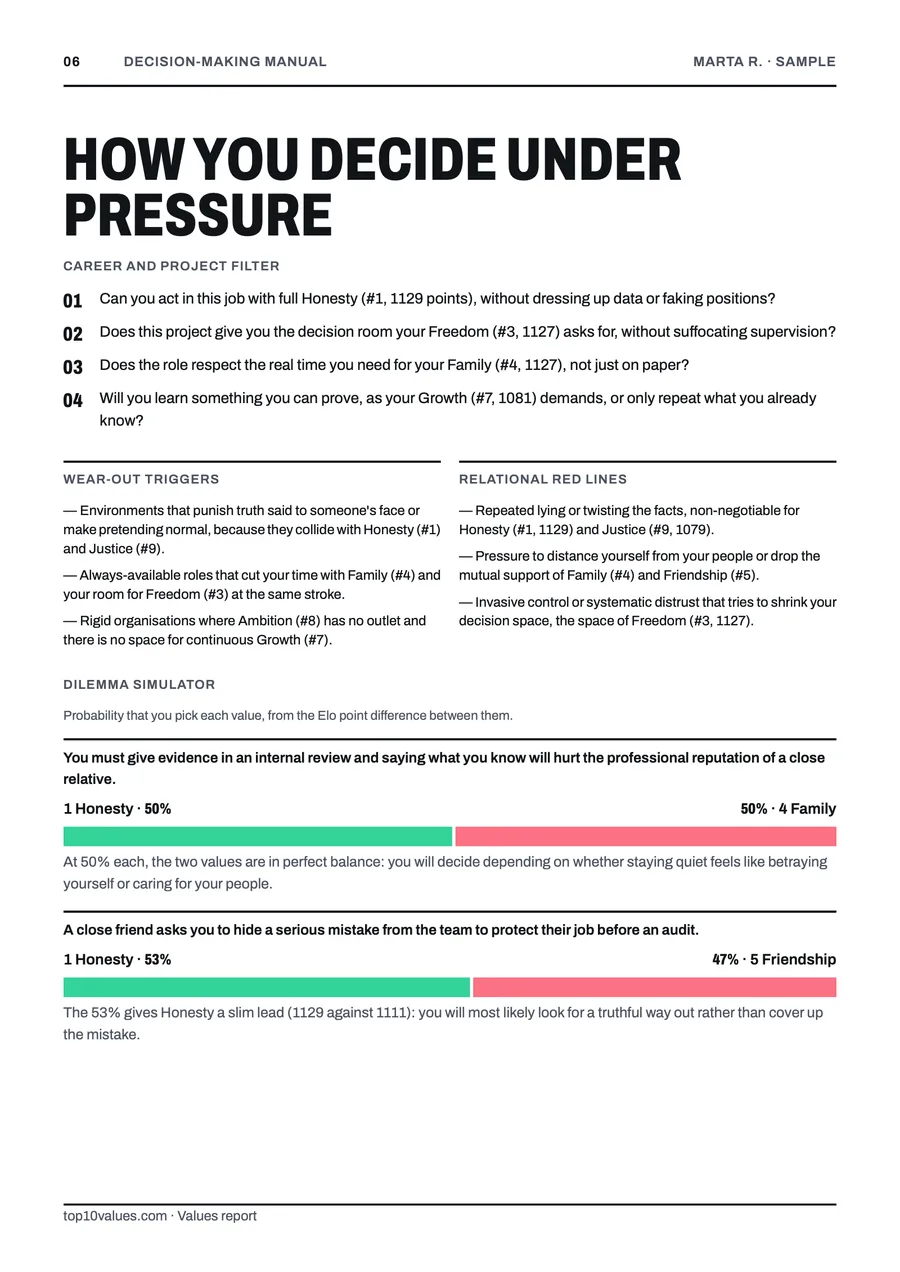
Sample page with fictional data (Marta R.), not yours. Your report is written from your own choices.
Frequently asked questions
What is the value of learning, and what are examples of it in everyday life?
The value of learning is the importance you give to improving your understanding and your ability from what you live through, not merely to piling up facts. Everyday examples: asking a colleague to show you the spreadsheet they use instead of repeating your slow method; cooking one dish three weeks running and adjusting something each time; typing into your phone what you got wrong in a presentation before you forget it; learning to make a video call so you can see your granddaughter; or asking the doctor what each term in a report means. The common thread is that you take something from each situation and use it afterwards.
What is the difference between learning, growth and curiosity?
They are three neighbouring values with different jobs. Curiosity is the impulse that leads you to explore something nobody asked you to. Learning is the deliberate work of turning that exploration, or any experience, into an ability: practising, getting it wrong, checking and remembering. Growth is the long-term outcome, the change in who you are and in how you relate to your life. You can feel a lot of curiosity and learn nothing if you jump from topic to topic; you can learn a great deal under compulsion without your life changing; and you can want to grow without knowing how, because you lack the concrete practice that learning supplies.
How do I know whether learning is really one of my core values and not just something I think sounds good?
Look at the decisions where it costs you. It is a value when you have turned down or changed something comfortable because it taught you nothing, when you put time and money into training without anyone requiring it, and when you put up with feeling clumsy for weeks. If it appears only when it is easy or when it looks good on a professional profile, it is a preference or an image. A simple exercise is to review the last twelve months and count the things you started learning, the ones you kept up for more than three months and the ones you use today. The third number is the most revealing.
Can you learn at any age, or is there an age after which it is not worth it?
You can learn at any age, although conditions change. Some older people find it harder to memorise quickly, but they can compensate with prior experience that lets them connect the new to what they already know. What weighs most in practice is not age but beliefs (“I’m past all that”), available time and the lack of places where mistakes carry no consequences. For anyone starting late, it helps to choose modest goals, find a group where the others are also beginners, and measure progress in weeks, not years.
What is the best way to learn: reading, watching videos or doing?
No single method suits everything, but some guidelines are well established. Reading or watching a tutorial gives you a first understanding; doing it yourself, mistakes included, is what fixes it. Checking what you can recall without looking at the material pays off more than rereading, and spacing out your reviews works better than cramming everything into one night. A classic reference here is the “forgetting curve” described by Hermann Ebbinghaus in the nineteenth century: what you do not review is lost quickly. Combine all three: a first pass with a text or video, practice of your own straight away, and staggered reviews.
What should I do if I study a lot but never apply it?
It is a frequent sign that studying has become a refuge. Try a simple rule: for each hour of study, schedule one of real use, however imperfect, such as an exercise, a small project, an explanation to a colleague or a visible change in your work. Set a date by which you will teach or deliver something, because a date forces you to decide what you have really learned. And ask yourself what your mind fears will happen once you start applying it; usually it is the fear of doing it badly in public, and that fear shrinks with small rehearsals.
Does learning a lot make me a better person?
Not automatically. Learning gives you more tools, but what you do with them depends on other values such as respect, humility and kindness. Some very cultured people look down on those who know less, and some people with little schooling teach everyone around them patiently. What can happen is that learning well, with the attitude of someone who admits what they do not know, makes you more tolerant of other people’s mistakes and harder to fool. That is the valuable part: not the quantity of knowledge, but how it changes the way you treat what you do not understand.
When Learning clashes with…
Opening a new front to learn, versus delivering what you already have, performing in the short term or giving time to your people.