Personal Growth
Growth
Drive to evolve and improve yourself.
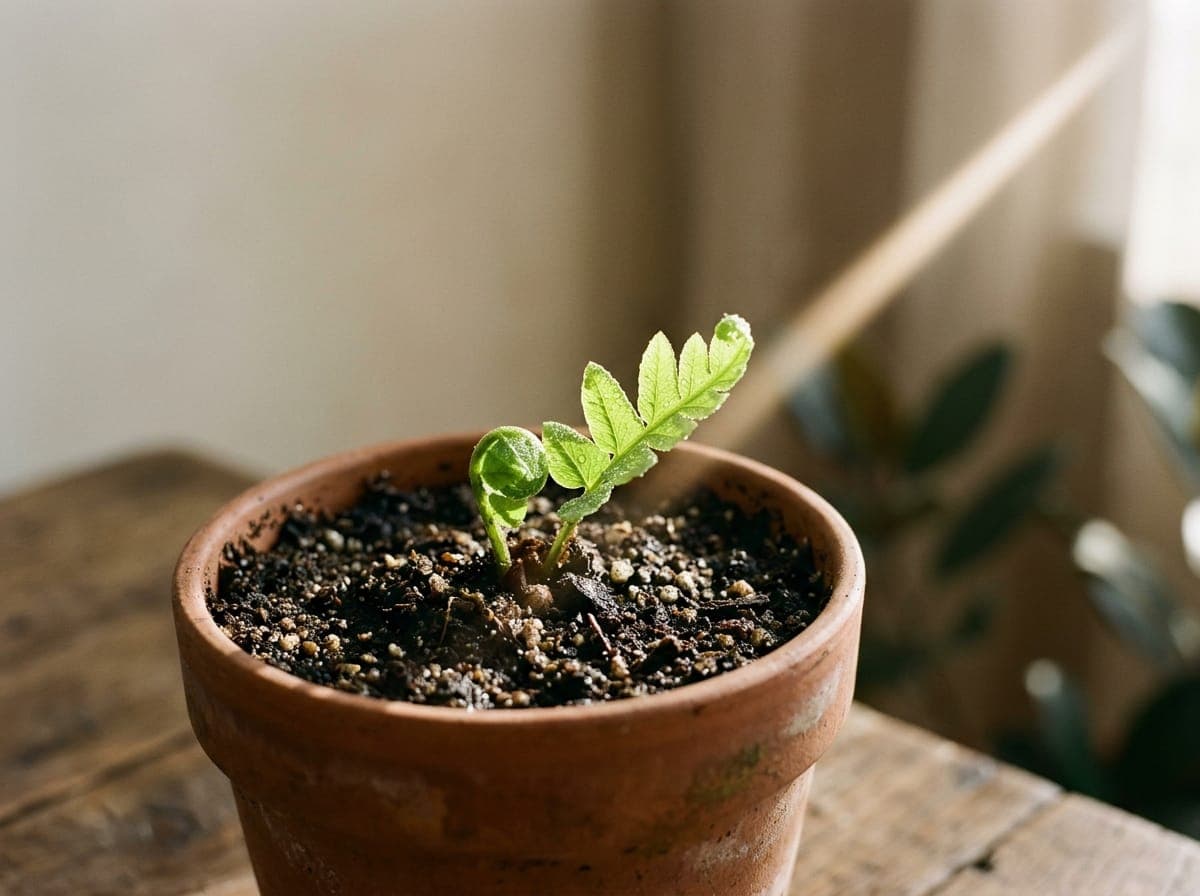
Personal growth is the continuous drive to evolve, learn from experience and become a more capable or more aware version of yourself. People who value growth see setbacks and mistakes as useful information rather than final failures, and actively seek out situations that take them out of their comfort zone. This value is rarely content with a stable state: even after reaching a goal, the question of what comes next appears. Unlike purely intellectual learning, growth also covers emotional maturation, overcoming fears and the gradual building of a life more aligned with who you want to be.
What does this value mean?
Growth as a value is a commitment to keep becoming more capable, more perceptive and more fully yourself, rather than treating who you are today as finished. It is not about collecting credentials or changing for the sake of change. It is about leaving each stretch of life with something learned, corrected or widened. The only fair comparison is with your own earlier self.
Growth is the useful discomfort of being a beginner again. You can see it in the electrician who spends a winter learning solar installation while his old trade still pays the bills, in the manager who asks her team what she does that makes their week harder and writes the answers down without arguing, and in the retired teacher who takes up the cello at sixty-eight and is happy to sound dreadful for a year. It also lives in small things: reading the manual instead of handing the problem to someone else, or treating a tense phone call with a parent as something to learn from, not just something to get over. The phrase «growth mindset», associated with the psychologist Carol Dweck, points at this attitude of treating ability as something that develops. It makes a good starting idea, though not a slogan that fixes everything.
What it does NOT mean
Growth does not mean being dissatisfied with who you are or living in a state of permanent self-improvement. If you confuse growing with endless correction, your life becomes a project with no delivery date, and every win tastes thin because you are already eyeing the next one. It is not consuming courses, productivity books or podcasts while your behaviour stays put: reading about habits is not having habits. It does not equal climbing a career ladder (you can grow without a promotion, and be promoted without growing), and it is not a race against people who seem faster. It is not the same as success, either. You can hit a target and learn nothing, or fail at a venture and come out changed. Finally, growing does not require discarding what you already are. Sometimes it means going deeper into something you have done for years.
Related concepts
Why might it matter to you?
People change anyway. What differs is whether you steer the change or just undergo it. Someone who cares about growth tends to read mistakes as information rather than a verdict, and that alters how a layoff, a breakup or a failed launch is lived: they ask what they can take from it before asking whose fault it was. It also guards against a quiet kind of stagnation, where ten years pass and you realise you lived the first year ten times. When this value ranks high, it is often because some moment (a job you outgrew, a stretch of boredom, a blow) taught you that feeling alive and feeling comfortable are not the same thing. And it shows from outside: people like working, living and learning alongside someone who can say «I don't know that yet».
Advertisement
How can you live this value?
- Pick one area to grow in this quarter and decide how you will know you moved. «Get better with money» is fuzzy; «track every expense for three months and open a savings account with an automatic monthly transfer» can be checked.
- Seek out friction on purpose, in manageable doses. If you dread public speaking, give a two-minute toast at the next family birthday. If you have never lived alone, spend a week alone in a flat you rent for the purpose. Growth happens right at the edge of what you already handle.
- Ask for one specific opinion from someone who will be frank: «what is the one thing you would change about how I run this?». Listen without defending, say thanks, and note what you will do with it, even if the answer is to set it aside for a stated reason.
- Run a thirty-minute review once a month with three questions: what did I learn, what did I repeat although I knew it was not working, and what do I want to try next month? Writing it down stops memory from handing you a kinder version of events.
- Learn from people who are ahead without measuring yourself against those who seem to have arrived sooner. A mentor, a practice group or a book by someone who walked your road shortens the trip; someone else's clock only adds hurry.
- Let what you learn settle. After an intense stretch, a calm period with no new targets lets it sink in. Growing without pauses often ends in exhaustion, and exhaustion stops growth.
What happens when you don't live up to this value?
Without growth, life turns into repetition with minor variations. Sundays look alike, conversations circle the same topics, and complaints from three years ago are still current because nothing you do touches them. «That's just how I am» starts closing debates where there was something to learn. After a while a vague boredom can set in, or a pang of envy toward people who are moving forward, and envy is often a signpost: it points at exactly what you miss. At work, the risk is ending up with skills the market no longer asks for; in private life, that the people around you change and you cannot keep pace with them. It is a comfortable life with the blinds half down.
The healthy side and the shadow
When does this value stop helping you and start limiting you?
Healthy expression
Patient curiosity about getting better
In excess
Chronic dissatisfaction
The excess is chronic dissatisfaction: nothing you achieve counts because there is always something left to polish. It appears as perfectionism, as a pile of courses never put into practice, as an inability to enjoy a result before setting the next challenge. It can also become an escape route: someone who is always «working on themselves» has a perfect reason not to commit to anything yet, whether a partner, a project or a decision. Healthy growth includes stopping to acknowledge how far you have come. A useful test: if the first thought after each win is «so what's next?», you may not be growing at all, only running from the feeling of having done enough.
This value at work
At work, growth means choosing assignments for what they teach you and not only for what they pay, asking for feedback before the annual review rather than after, and writing down what you learn so it does not depend on memory. It shows when you compare offers: two similar salaries are not worth the same if one comes with a manager who coaches you and the other with the same task for three years. One caveat is that growing does not always mean moving up. A baker can keep improving her bread for thirty years without ever managing anyone, while another person collects four job titles in six years and masters none of the work behind them. And in teams under heavy delivery pressure, it helps to negotiate learning time, since few companies offer it unless asked.
This value in relationships
In friendships, growth means accepting that people, you included, change, and that a bond sometimes has to be renegotiated. You can be very fond of a friend and notice that you no longer share the same interests, or that the old jokes have stopped landing. Someone who values growth tends to keep company with people who challenge them kindly, who say «I think you're making a mistake» and who celebrate progress without envy. You owe the same back: ask what the other person is learning, not just what happened to them. The risk is turning friends into improvement projects, handing out advice nobody asked for or judging their pace by your own yardstick.
This value in love
In a couple, growth gets tested when one partner changes faster than the other: starting a new career, adopting a different lifestyle, or taking up a pursuit that eats up evenings. Couples who get through this well talk about it early and in specifics («I want to study at night this year, how do we organise that?») instead of letting distance settle in. How you handle arguments counts too: using a conflict to understand your own pattern teaches more than winning it. Beware of turning the relationship into a renovation site, where each of you spots the other's flaws with the aim of helping. People tend to grow better with someone who accepts them as they are and trusts they can go further than with someone who keeps them under permanent construction.
This value in family
In the family, growth shows mostly in what you decide not to repeat. Perhaps you grew up in a home where nobody apologised, and you now make a point of saying sorry to your eight-year-old when you snap at her. Or you notice that the sulking you swore you would never copy from your mother is turning up in your own marriage. Noticing it and changing it is growth, and the next generation feels the difference. It also means shifting your relationship with ageing parents, from the child who is looked after to the one who accompanies them. With your children, it means letting them grow their own way, without projecting onto them the goals you never reached, and showing by example that getting it wrong and trying again is normal.
This value and yourself
If growth ranks among your core values, a stage of your life may feel too small, or you may already know what stagnation is like. Ask yourself whether you want to advance or to be seen advancing, because they can call for different choices: the first is content to learn in silence, the second needs a shop window. Look at where the drive comes from, too. If it springs from curiosity, growing feels light; if it springs from a sense of not being enough, each goal met only postpones that feeling. Both sources can coexist, but it helps to know which one leads. And watch the pace: some changes take years, and impatience for results makes people quit just before things settle.
What are you willing to sacrifice for this value?
Growing costs specific things. Would you accept a lower salary for a year to learn a new trade? Would you give up being the expert on your team to become the newcomer on another? Would you spend winter evenings studying rather than seeing friends? People who prize growth often trade comfort for learning: the role where they already know everything, the routine that runs itself, the identity of the one who is always right. There is the price to your image as well: admitting in front of others that you do not know something, looking silly in a dance class, showing a clumsy first draft. Ask which of these losses stings most, because it often points to the growth you most need.
Signs you're betraying this value
You betray this value when you say you want to learn and dodge every situation where you might fail, when you answer criticism by explaining why the other person is wrong before considering whether they have a point, or when you have been putting off the same course, the same conversation or the same change for years. Also when you stockpile training as a substitute for action, or when you compare yourself with someone who started ten years earlier and decide it is not worth trying. And when you talk others out of changing so that you do not feel pressed to. A reliable check is your calendar: if nothing in the last three months has cost you effort, challenged you or surprised you, your choices are pointing elsewhere.
Turning the value into goals
Value
Growth
Behavior
Spend one hour, three evenings a week, practising a single skill you find hard, and ask for feedback on your progress every two weeks
Goal
Within six months, be able to show something concrete (a finished project, a talk, a conversation in another language) that proves a real step forward in that skill
Habit
Every Sunday, write three lines: what I learned this week, which mistake I repeated, and what I will try differently next week
Questions to reflect on
- What can you do today that you could not do five years ago, and what did it cost you to learn it?
- Which area of your life has stayed the same longest, and what do you tell yourself to justify that?
- When someone criticises you, what is your first reaction, and what would happen if you waited a day before replying?
- Which activity do you avoid because you would hate to look like a beginner?
- Which people teach you the most, and how much time do you spend with them?
- If a year from now you had truly grown, what would look different in an ordinary week?
How much are you living this value?
From 1 to 10, how much of what you did last month forced you to learn something new? If the score is under five, pick an activity you already do (a meeting, a recipe, a chat with your kids) and change one element for two weeks: how you prepare for it, whom you ask for advice, or what you measure. Then note what you learned and whether you want to do it again.
When two values clash
Growth clashes with Financial security when learning means leaving a stable job or earning less for a while. It clashes with Inner peace and Balance if every week has a new target and no gap is left for rest. With Loyalty it appears when you outgrow a group, a company or a community that would prefer you stayed as you were, and leaving feels like betrayal. It sits well with Humility, because learning requires admitting what you do not know, though an arrogant version of growth (always improving and reminding everyone) wears Humility down. With Success the friction is subtle: success rewards what you already do well, while growth sometimes demands being worse for a while at something new. A question that helps you decide is whether you want to arrive somewhere or become someone capable of arriving.
Is “Growth” one of your top 10 values?
Find out by playing and comparing this value with the other 49
How the Elo ranking works and its limits in the methodology.
What does the paid report include?
When you finish the 100 comparisons you will see your Top 10 on screen. If you want to go further, there is a PDF report on your personal values: €9.95 (VAT included), one-off payment. To buy it you need to save your game with a Google account.
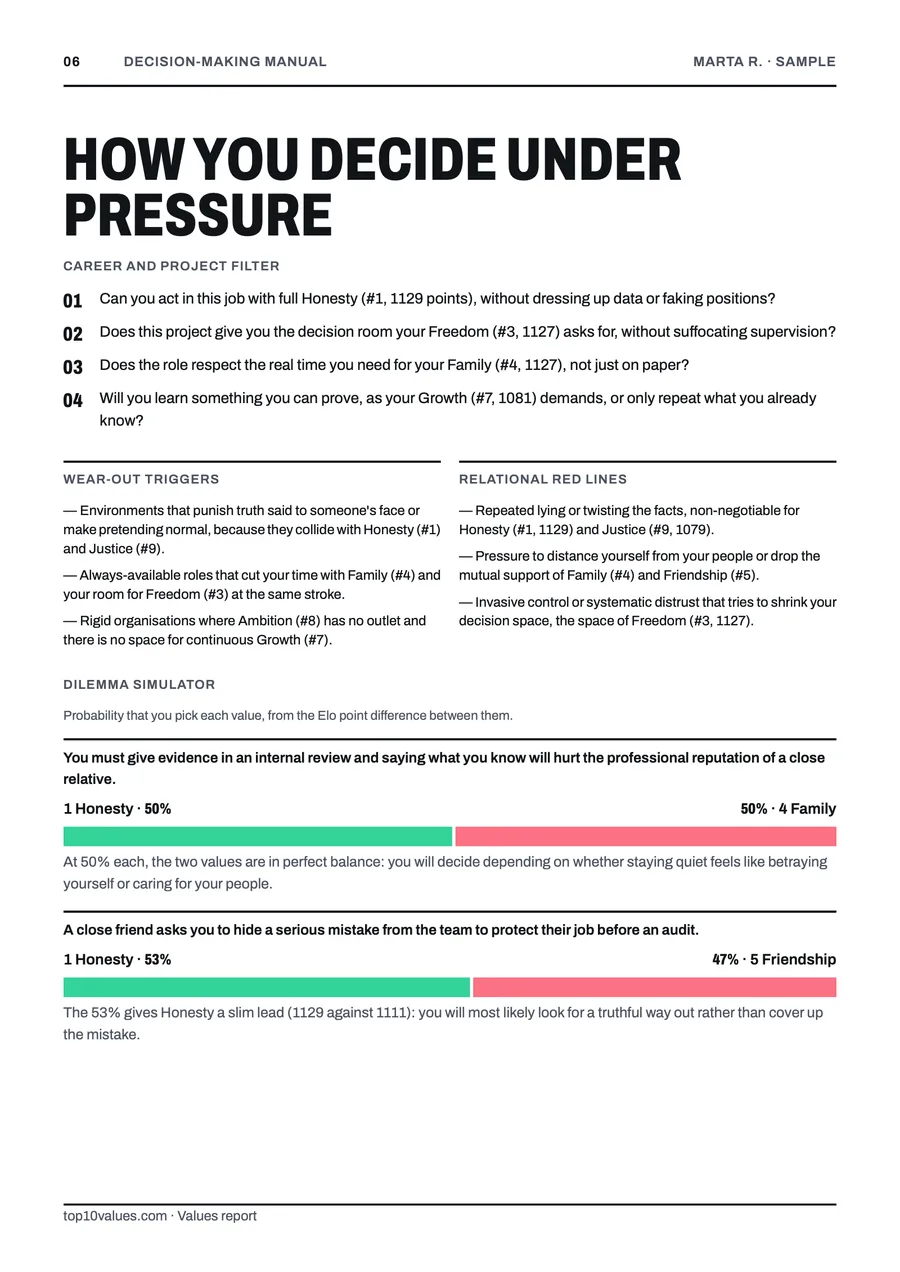
Sample page with fictional data (Marta R.), not yours. Your report is written from your own choices.
Frequently asked questions
What is the difference between personal growth and self-improvement?
They overlap, but they are not identical. Self-improvement is usually measured against a target or against other people: finishing the marathon, passing the exam. Growth is broader and often invisible: changing how you react to conflict or learning to ask for help earns no medal and may be the most important change of the year. A person can improve without growing if they repeat the same pattern, and can grow without breaking any record.
Is it selfish to spend time on my own development?
Not unless you use it to dodge what is yours to do. In most cases, people who know themselves better and build their abilities look after others better: they argue with fewer accusations, train to help with more judgement and bring curiosity home. The balance lies in negotiating the time with the people affected, rather than taking it at their expense.
How can I tell if I am growing or just busy?
Look at whether your mistakes change. If you make the same ones every year, you are doing a lot but not necessarily growing. Another clue is comfort: growth usually includes an awkward phase when you do not fully control what you are doing. If everything comes easily and you are exhausted, you are probably repeating yourself harder.
Can you grow at any age?
Yes, though the pace and the paths differ. At twenty you may learn by exploring; at fifty you can lean on what you already know to make sense of something new; at seventy a study habit can give you structure and company. What rarely helps is saying «it's too late» before you have tried. If the change you are considering has health or financial implications, talk to a professional before deciding.
What if I grow and the people around me do not?
Start by saying it plainly without demanding that they change: explain what you are doing and why it matters. Some will join in, some will respect it without understanding it, and some will drift away. You do not need to cut anyone off, but it is wise to look beyond your usual circle (groups, courses, communities) for people who share your direction, so that you do not depend on everyone moving at your speed.
When Growth clashes with…
Invented scene. Valeria has been an administrative assistant at the same accountancy firm for five years, and she has signed up for an evening data-analysis course. She loves learning, but she is starting to leave late and miss the Thursday dinners with her oldest friends. Growth tells her that staying comfortable is a slow way of standing still. Peace asks whether she has to measure herself all the time and whether she could be fine as the person she already is. Her friends' loyalty does not complain, but it shows: Valeria missed two birthdays, and someone remarked that "you have more important things now." Growing does not require leaving anyone behind, although it sometimes requires explaining yourself. She could pick one challenge per quarter, tell her friends when the course ends, and protect one dinner a month. More examples in conflicting values.