Creativity
Creativity
Generating new ideas.
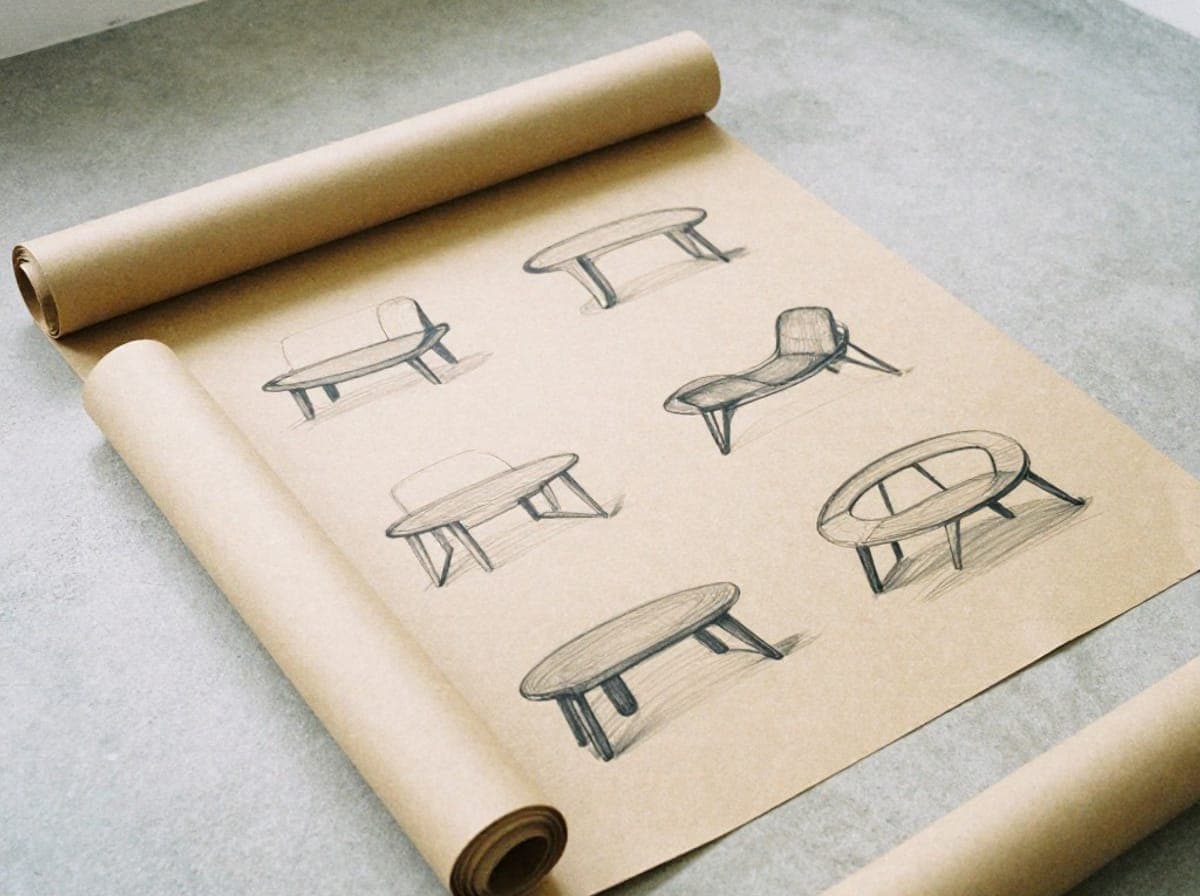
Creativity is the ability to generate ideas, solutions or expressions that are original and didn't previously exist in that form. People who value creativity refuse to always apply the known formula and enjoy exploring new combinations, whether in art, solving technical problems or everyday life. This value requires tolerance for uncertainty and for imperfect first attempts, because creating something new means accepting the risk of getting it wrong. Beyond artistic talent, creativity is a way of thinking that transfers to any field: those who prioritize it constantly look for different angles on the challenges they face.
What does this value mean?
Creativity is the ability and the wish to make something that did not exist before, or to combine what already exists in a way that feels new and is useful or meaningful to someone: a recipe, a program, a painting, a new way of explaining a lesson, a fix for a household problem. As a value it is not about having talent. It is about wanting to make things of your own rather than only repeating what is known.
It is the pleasure, and the need, of giving an idea a shape. Look for it in the person who reorganises a kitchen with what they already own, in someone who writes songs nobody will hear, in the teacher who invents a game so her class finally gets fractions, in the engineer who finds an elegant shortcut where everyone else sees a wall, or in the person who turns an ordinary notebook into an illustrated journal. None of it needs an audience; much of the reward is the process itself, the stretch where you try something, bin it and try again. For many people making is also how they work out what they feel, since shaping something with your hands or with words sorts out what was tangled inside.
What it does NOT mean
You do not need to be a professional artist or to have been born with a gift. People equate it with art, yet it also turns up in a well-built spreadsheet, in a hard conversation rescued by the right analogy, or in a dinner saved with whatever was left in the fridge. It is not the same as originality either: you can be creative working inside a known genre, technique or template, and people obsessed with being different from everyone else often produce little. It is close to imagination but not the same: imagining is conceiving, creating is carrying it to a result that others can see, hear, use or argue about. And it is not innovation, which adds the demand that the novelty work in a real setting such as a business or a market.
Related concepts
Why might it matter to you?
Some people feel oddly hollow after a day in which they made nothing at all, however small. For them creativity is no hobby but a way of being in the world, a way of turning time into something that belongs to them. It also has a practical value, because most real problems do not come with instructions. Someone used to trying alternatives gets stuck less when something unexpected lands, whether it is a budget that falls through or a disagreement at home that the usual arguments will not settle. Emotionally, making things is the antidote to feeling like a pure consumer who reads, watches, listens and buys. Creating returns a sense of authorship over your own time that few other activities offer.
Advertisement
How can you live this value?
- Book a short, regular appointment with your craft, even twenty minutes three times a week, and treat it like any other commitment. Waiting for inspiration leads to making very little. Inspiration tends to show up once you are already working.
- Allow yourself a bad first version. Almost everything that ends up good started out clumsy. Write the ugly paragraph, sketch the lopsided drawing, record the out-of-tune demo, and only then edit. Separating the moment of producing from the moment of judging removes a lot of blockage.
- Set limits on what you do. A palette of three colours, a fourteen-line poem, a meal with five ingredients or a prototype built in one afternoon force you to make decisions, and decisions drive making. Total freedom paralyses more than it seems.
- Feed the raw material. Read outside your field, visit a workshop, talk to someone from a different trade, keep a notebook of phrases or images that catch your eye. Ideas are almost always built from other people's pieces put together differently.
- Share what you make before it is perfect, with one trusted person and one specific question: «what do you get from this?», «where do you lose the thread?». Hearing opinions about what you create is uncomfortable, but without them the work only ever circles around you.
What happens when you don't live up to this value?
With no outlet for creativity, a vague discontent often sets in: productive but colourless days, the sense of reading from someone else's script, a pang of envy towards people who do make things. Many people keep a novel, a project or an instrument in a drawer for years «until there's time», and the postponement becomes a small grief. Relationships suffer too, because someone with nowhere to put their energy often discharges it in criticism or boredom. The culprit is often not a shortage of ideas but perfectionism that kills each attempt at birth, plus a schedule too packed to leave room for play.
The healthy side and the shadow
When does this value stop helping you and start limiting you?
Healthy expression
Creativity that gets finished
In excess
Scattering
The excess is scattering: starting projects without finishing them because novelty hooks you more than the persistence they demand. The person piles up half-filled notebooks, unfinished courses and ventures that never launch, and mistakes the thrill of a beginning for progress. There is also creativity that despises rules on principle, ignores people who depend on the result, or cannot stand any repetitive task. The healthy version alternates phases: explore, pick one idea, and carry it to a form others can use. Finishing is rarely fun, and it is what separates an idea from a piece of work.
This value at work
At work, creativity appears in how you handle problems that have no recipe: redesigning a process nobody questioned, explaining complex data with an everyday example, proposing a different format for a meeting that is always dull. What marks a creative team is not brilliant ideas but the freedom to float several and discard most without fuss. A manager who punishes every failed experiment gets exactly what they ask for: people who suggest nothing. Not every role allows it, though. If your job is very routine and creativity is a personal priority, you may need a project outside work so the value does not fade. And if your role is creative, watch that commercial pressure does not turn making into an assembly line.
This value in relationships
Among friends, creativity is a shared activity: planning something other than the usual pub night, giving a handmade present that shows you thought of the person, starting a book club, a garage band, a cooking group or a tabletop game night. Creative people often get close to others through what they make. It meets friction too: someone who needs time alone to create can seem distant, and someone who shares every half-formed idea can wear others out. It pays to take care over how opinions are given and received: asking for critique is not the same as asking for applause, and a friend is no good to you if they always say everything is brilliant.
This value in love
With a partner, creativity keeps things fresh once routine sets in: changing how you spend Saturdays, leaving a handwritten note instead of sending a text, planning a trip with invented rules or cooking something neither of you has tried. It has a less romantic, more practical use as well: finding original solutions to recurring arguments instead of repeating the same complaint. The risks are two. One is that someone gives so much time to a project that the partner feels pushed aside; talking about schedules and mutual support heads off resentment. The other is turning the partner into a muse or compulsory audience: a relationship is not there to validate every piece of work, and it is kinder to ask first whether they feel like seeing it.
This value in family
At home, creativity shows in how daily problems get solved and in how children are brought up. Inventing a bedtime story, turning recycling into a game, letting kids design their own birthday party or using a rainy day to build a fort from blankets are ways of living this value. With children, the most useful thing you can do is leave room for boredom and mistakes, and value the process over the pretty drawing. Be careful about correcting every stroke or making comparisons. A child who is told what it should look like learns to wait for approval instead of exploring. And if in your family making things was seen as «a waste of time», you may still be carrying that judgement.
This value and yourself
If creativity ranks high for you, it suggests you need to make things rather than just comment on them or consume them. It may mean your current job does not offer it, or that an old project is waiting for you. Look at how you judge it, too: if only what gets published, sold or liked counts, you probably give yourself little permission to create for its own sake. If you start many things and finish almost none, it is worth asking what you feel as the moment to show them approaches. And if you tell yourself «I'm not a creative person» yet this value showed up on your list, you may have learned to define creativity too narrowly.
What are you willing to sacrifice for this value?
Would you spend a winter of evenings on a project that perhaps nobody will see? Would you accept earning less in order to have a job where you can propose things, or spend money on materials, classes or tools with no direct return? Could you put up with people laughing at a first attempt? Making things costs time you take from other activities, headspace and, now and then, a public flop. Think about what you would stop doing each week to free three hours of real practice. If the answer is «nothing», this value lives more in your wishes than in your calendar. There is another, less visible cost: ceasing to treat the result as proof of your worth.
Signs you're betraying this value
You betray creativity when you copy to avoid the risk that something of your own will not land, when you present someone else's work as yours, or when you drop an idea not because it is no good but because it is no longer new. Also when you let comparison paralyse you, scrolling through what others post every day instead of doing your own thing. And when you use tiredness as a permanent alibi while finding hours for streaming or social media. There is a subtler version: only making what you know will be applauded. If everything you make is something you have already made, you may be manufacturing rather than creating.
Turning the value into goals
Value
Creativity
Behavior
Make something, however small, for twenty minutes three days a week, without showing it or judging it while you do
Goal
Within three months, finish and share with someone you trust one concrete project (a story, a piece of furniture, an app, an annotated photo album) rather than leaving it as a draft
Habit
Every day, jot in a notebook one idea, image or phrase that caught your attention, without evaluating it; once a month, reread and underline what deserves developing
Questions to reflect on
- What did you do as a child that absorbed you completely and that you stopped doing, and why did you stop?
- Which project have you kept for years «for when there's time», and what would it take to start with the smallest possible version?
- Under what conditions do you make your best work: clear limits or total freedom, alone or with company, morning or night?
- Which comment about your creative work hurt you some time ago, and does it still shape what you do?
- What do you always finish and what do you always abandon, and what does that difference tell you?
- Where could you bring your creativity to something not usually called creative, such as your job, your home or a relationship?
How much are you living this value?
From 1 to 10, how much of what you did last month came from an idea of your own rather than an obligation or a repetition? If it is under 5, pick a twenty-minute activity this week that does not have to be good for anything, put it in your diary with a day and time, and make something without thinking about the result. Then note whether it absorbed you, made you uneasy, or made you want to do it again.
When two values clash
Creativity clashes with Discipline and Productivity in daily life: the first needs time with no fixed direction, the others ask for measurable output. A day of play can look like wasted time to someone who counts every hour. It clashes with Security when living from creative work means irregular income; many people handle this by keeping a steady job and reserving fixed hours for making things. With Efficiency, because creative work is slow and messy, and people who dislike mess find it hard to tolerate. With Excellence, when the wish for everything to come out perfect stops you showing anything. And with Recognition, when you create to be liked: you begin trimming the strange and personal, which is exactly what gave the work its value. There is no formula. It often helps to separate what you make on commission from what you make because you want to, and to protect some room for the second.
Is “Creativity” one of your top 10 values?
Find out by playing and comparing this value with the other 49
How the Elo ranking works and its limits in the methodology.
What does the paid report include?
When you finish the 100 comparisons you will see your Top 10 on screen. If you want to go further, there is a PDF report on your personal values: €9.95 (VAT included), one-off payment. To buy it you need to save your game with a Google account.
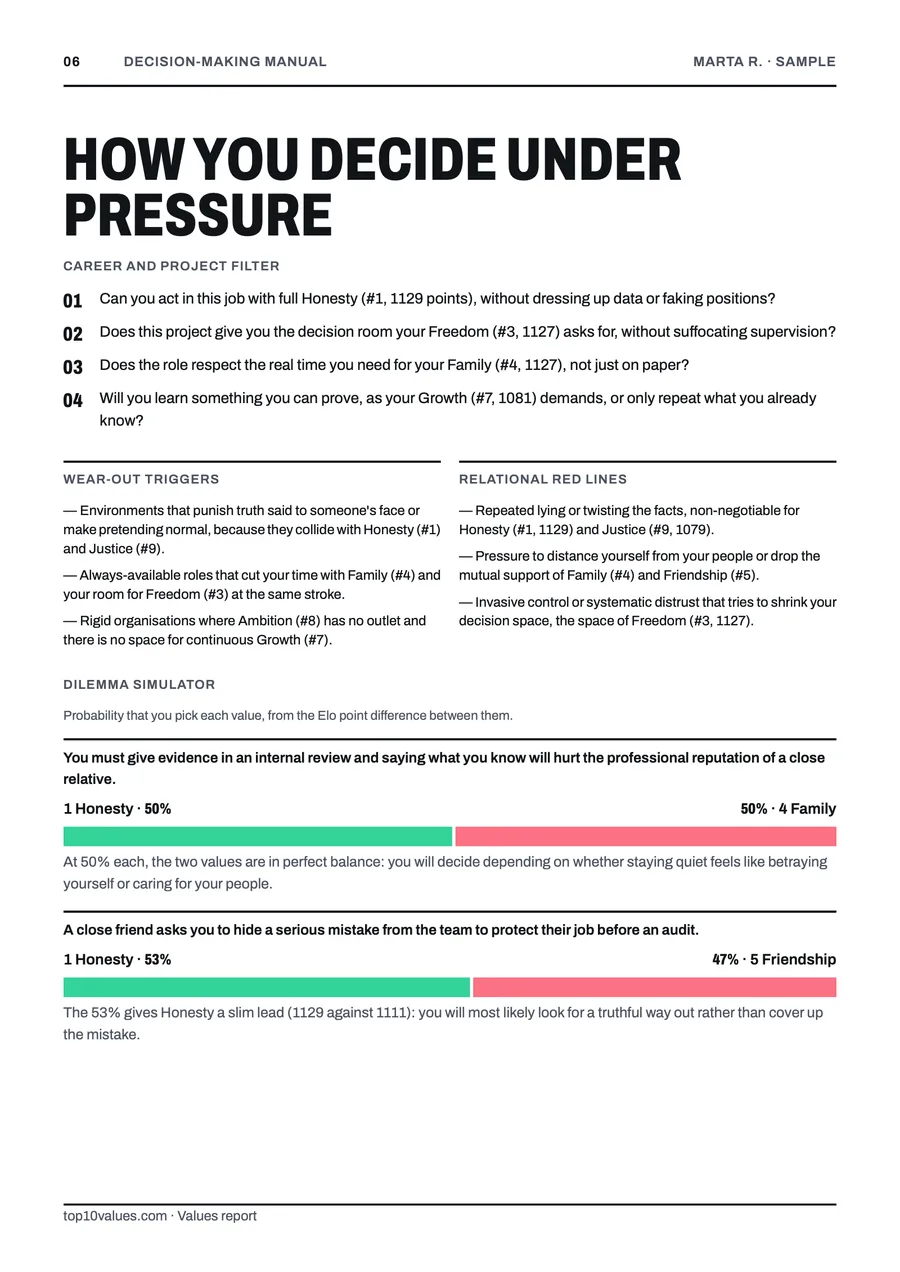
Sample page with fictional data (Marta R.), not yours. Your report is written from your own choices.
Frequently asked questions
Is creativity a talent or can it be trained?
It can be developed like any other skill. Some people start with more ease, but regular practice, exposure to varied ideas and the habit of finishing things improve the result in nearly everyone. As a value, what matters is not the level but the wish to make things of your own, even if they start out clumsy.
How can I be more creative if my job is very routine?
Look for a space of your own outside work with simple rules: a notebook, a hands-on hobby, a small project with a deadline. You can also introduce variations inside the job, like trying a different order of tasks or suggesting a fix for an awkward process. What matters is having a stretch of time when you decide what gets done and how.
What should I do when I am blocked and nothing comes?
Lower the bar and shrink the task: five minutes, one sentence, one sketch. Change the place, the tool or the format, for instance writing by hand instead of on a laptop. Check also whether the block is fear of it turning out badly; separating producing from judging usually helps. And if you have been exhausted for days, sometimes rest is the best technique.
Do I have to earn a living from creative work for it to be a real value?
No. Many people live creativity as part of their free time and it is just as genuine. Turning it into a profession adds income and recognition, but also deadlines, clients and pressure, which can take some of the enjoyment away. Before making the jump, try what it feels like to do it on commission.
How do I encourage my children's creativity?
Offer simple materials (paper, cardboard, tape, music, pots and pans), screen-free time and few instructions. Ask about the process («how did you come up with this?») rather than judging the result. Show them that you also make imperfect things, and do not fix anyone's drawing so that it looks «right».
When Creativity clashes with…
Creating for the joy of it, versus standing out or meeting your commitments to your people.