Creativity
Imagination
Creating new possibilities.

Imagination is the ability to conceive scenarios, ideas or possibilities that don't yet exist in present reality. People who value imagination enjoy thinking about hypothetical alternatives, designing possible futures or building worlds—literal or conceptual—beyond what is immediately observable. This value differs from applied creativity in that it centers on the mental process of generating possibilities, even before they are turned into something concrete. Imagination feeds both artistic storytelling and strategic planning: every significant innovation began as an imagined idea before becoming a real project that could be carried out in the physical world.
What does this value mean?
Imagination, as a value, means taking seriously what is not yet in front of you: other ways of doing something, what your life could look like five years from now, what someone feels in a situation you have never been in, what would happen if you changed a single piece of a plan. It is the ability to picture possibilities and play with them before you decide. Holding it among your values means you do not settle for the first version of things (“this is how it’s done”, “that’s just who I am”, “there’s no other way”), and that you set aside time, attention and some patience to ask “what if…?”, even though the answer will not always lead anywhere visible.
Imagination as a value is easier to see in everyday scenes than in definitions. The mechanic who, faced with a rattle nobody can trace, closes his eyes and walks through the engine part by part in his head until he lands on where it might be coming from. The night nurse who, before going into the room of a patient who cannot sleep, wonders what the ward looks like from that bed, with the corridor lights and the beeping machines, and changes the way she speaks to him. The father stuck in a forty-minute traffic jam who invents, with his kids, the story of a lorry that carries clouds. The seventy-one-year-old widow, alone now in the village house, who lets herself picture a life she had never considered, in another town or with another routine, before deciding whether she wants it. The teenager who draws, in a notebook, the full map of a world that exists only for him. And the project lead who, before launching a plan, asks her team to imagine it has already failed and explain why. What they share is not artistic talent but a habit: treating reality as a starting point rather than the only possible scenario. It surfaces in questions like “what else could be going on here?” and in what you never quite believe: that a hard situation has only one way out, or that a person is only what they show in a meeting.
What it does NOT mean
It is not creativity, though the two are neighbours. Creativity carries an idea through to something others can see, use or criticise; imagination can stay inside your head and still do its job, for instance when it helps you understand someone or see a problem coming. Nor is it fantasy in the sense of escape: picturing a difficult conversation in order to prepare for it has little in common with spending an afternoon daydreaming about a life you will never attempt. In “Biographia Literaria” (1817), Samuel Taylor Coleridge separated “fancy”, which shuffles memories without changing them, from “imagination”, which reshapes them into something new; you do not need his whole theory to find the distinction useful: not every daydream is imagination. It is not lying or embellishing: imagining how things could be gives no licence to claim they already are. It does not mean having your head in the clouds or lacking practical sense; plenty of engineers, cooks, lawyers and carers are highly imaginative and use that ability mostly to anticipate. It is not originality, which is chiefly about standing apart, nor innovation, which only counts once the new idea is applied and delivers results in a company, a service or a neighbourhood. And it is not a childhood privilege that fades with age: it changes shape, from playing pirates to sketching a plan B, but it stays if you use it.
Related concepts
Why might it matter to you?
Nearly every important decision is made about something that does not exist yet: a job you have not started, a house you have not lived in, a child not yet born, a conversation that has not happened. All you have to choose with is the version you imagine, which is why the quality of that imagining matters so much. Someone who imagines little picks between the two options the situation hands them; someone who imagines carefully often finds a third: negotiating part-time hours instead of quitting, renting in the new city for six months instead of selling the flat, asking a neighbour for help instead of cancelling the plan. Imagination also holds shared life together. Understanding someone whose life is very different from yours, a colleague caring for a disabled child or a neighbour who has just arrived from another country, requires picturing one of their days in detail, and that picture changes how you speak to them. This is why some people talk about “moral imagination”: the capacity to see what your actions do to people who are out of sight. It matters in the bad moments too. When something breaks, a redundancy, a separation, a diagnosis, imagination is what lets you conceive of a life afterwards before you have any proof that one exists. It guarantees nothing, but without it hopelessness fills all the space. Finally, it guards against a common trap: mistaking the usual for the inevitable. A great many things are done the way they are done only because nobody stopped to picture another way, and the people who keep the habit of imagining are usually the ones who ask that question out loud.
How can you live this value?
- Before deciding, ask your imagination for at least three options. When a choice looks binary (accept or decline, stay or go), write down a third, even if it seems absurd. Sometimes the third is useless, but it shifts your view enough for a fourth to appear that works.
- Rehearse difficult conversations, and rehearse the other person’s side as well. Before asking for a raise or talking to your brother about your mother’s care, picture the scene from where they sit: what worries them, what they have already heard, which sentence would put them on the defensive. Preparing only your own lines is a monologue; imagining theirs turns preparation into a real rehearsal.
- Run a premortem on your plans. The technique, put forward by the psychologist Gary Klein, means imagining the project has already failed and asking why. It works for a product launch and for a holiday with small children alike: imagination becomes useful when you point it at problems before they arrive.
- Feed your imagination with material that is not yours. Novels, history, conversations with people of another age or trade, a neighbourhood you do not know explored on foot. What you imagine is built from what you have seen, heard and read; if everything you take in is similar, your scenarios end up resembling one another.
- Leave gaps with no input. A walk without headphones, the wait at the doctor’s without your phone, ten minutes in the shower without a podcast. In those stretches the mind wanders on its own, and many people find that this is where the ideas turn up that never came while staring at a screen.
- Put a date on one idea in ten. Imagination as a value does not require you to carry out everything you dream up, but it does ask that something make it from your head into the world now and then. Pick the smallest idea that excites you and give it a first step with a day and a time: try the recipe, sketch the floor plan, call someone who has already done it.
Advertisement
What happens when you don't live up to this value?
When imagination goes quiet, life does not get worse overnight: it narrows. Decisions are made between whatever options someone presents, and you accept the first reading of events (“that was a curt reply, they must be annoyed with me”) without weighing others (“maybe they had a bad day, maybe they were typing in the car”). At work you reuse last year’s format because “that’s how we’ve always done it”. At home, weekends blur together so much that it is hard to recall a single one. A kind of impatience with people who do imagine creeps in as well: you call the long after-dinner chat where someone floats a wild idea “a waste of time”, or label anyone who suggests changing something “a dreamer”. Over the years, a lack of imagination shows most in how you look at the future: you see it as an extension of today, which brings a calm that can be misleading, because when a big change does come you have no scenario ready. If you hold imagination as a value and have let it slide, you will feel it as a low ceiling: you get on with what needs doing, but you no longer catch yourself thinking “what if…?” on the bus, and that bothers you more than you let on.
The healthy side and the shadow
When does this value stop helping you and start limiting you?
Healthy expression
Imagining to understand and choose better
In excess
Living in scenarios that do not exist
Imagination has three recognisable shadows. The first is escape: the invented future is so pleasant that it replaces the present, and you spend years picturing the business, the trip or the novel without taking a step, because the imagined version never disappoints and the real one might. The second is imagination working for fear: the faculty that lets you anticipate solutions also builds disasters in full detail, and at three in the morning you can see the redundancy, the illness or the break-up with a sharpness no evidence supports. The third is mind-reading: imagining what someone else thinks and treating it as fact, so that you argue with the version of your partner or your manager you have made up instead of asking them. The healthy form is recognisable because it comes back down to earth and knows the difference between a possible scenario and a likely one: what you imagine gets checked against facts or against the other person, and sometimes becomes a concrete step. If your imagination leaves you with more anxiety than ideas, the problem is not that you have too much of it but that it is working without direction; giving it a task, such as picturing three ways out rather than three catastrophes, tends to help more than trying to switch it off. And if night-time worry becomes constant and will not ease, it is worth talking to your doctor or a psychologist.
This value at work
At work, imagination rarely appears in the job description and almost always makes the difference in the moments that are not routine. The salesperson who pictures her client’s day, who is leaning on him, what he dreads having to explain to his boss, puts together a proposal that solves a real problem instead of reciting the catalogue. The developer who imagines an older person using the app with a phone in one hand and a shopping bag in the other catches flaws no technical test will flag. The teacher who imagines the lesson from the back row changes the font size on her slides. If you lead a team, this value pushes you to make room for “what if we tried it the other way round?” without it sounding like a waste of time: ten minutes of the weekly meeting given to a single open question, or a premortem before every launch. The friction comes with deadlines and with tightly regulated roles. In accounting, in an operating theatre or in health and safety, improvising procedures outside the proper channels is reckless, not admirable. There imagination goes elsewhere: anticipating what could go wrong, working out how to explain a rule so it is understood, picturing what happens to someone who breaks it without realising. Watch out, too, for a classic mistake of imaginative people: bringing ten ideas at once to a team that needs one. Imagining a lot does not oblige you to propose it all; choosing the idea that fits the moment is part of the job. And if your role leaves hardly any room, the quiet uses remain: anticipating the awkward question the client will ask, or going over a presentation while picturing yourself in the seat of whoever will hear it. If even that is not enough and imagination sits high on your list, give it a project outside work where it can be put to the test, such as writing the story you have been telling yourself for years or planning a vegetable patch in the garden, before frustration hardens into cynicism.
This value in relationships
In friendship, imagination does something unshowy and very valuable: it lets you stand alongside experiences you have never had. When a friend tells you her son is spending the night in A&E, you can answer with a stock phrase, or you can picture that waiting room at two in the morning, cold, with a dead phone, and turn up with a charger and a sandwich. That difference is imagination applied to another person. It also stops you freezing the picture you have of your friends: the one who was always “the funny one” in the group may be going through a stretch where he needs someone to ask him about something else. And shared imagination is one of the oldest glues of friendship: the ridiculous plans that never happen, the characters invented at school that still turn up twenty years later, the cottage you are all going to rent together “when we retire”. They do not need to come true to bind you. The risk is the opposite of what people usually assume: not imagining too little, but imagining too much about what the other person thinks. A message left unanswered for three days can turn, in your head, into anger, betrayal or contempt, when the likeliest explanation is a difficult week. If you notice yourself building stories about your friends out of silences, ask before you believe your own version.
This value in love
In a couple, imagination works in two directions, and it helps to tell them apart. The first is good: picturing the other person’s day, how the meeting they are dreading tomorrow might go or how their mother’s phone call landed, and acting on it without being asked. Inventing plans that break the routine is imagination too, like carrying the dining table out to the balcony for dinner or recreating your first date in another city, and so is holding a shared future together: talking about how you would like to live at sixty, or what you would do if one of you changed jobs. Couples who picture themselves in the long run at least have a map to argue over. The second direction is dangerous: comparing your real partner with an imagined one who is more attentive, more fun, closer to what you expected. That figure does not exist, never gets tired and never has a bad day, which is why it wins every comparison. Something similar happens early in a relationship, when you fill in everything you do not yet know about the other person with imagination and are then disappointed when the real version does not match. A useful question during arguments is “am I reacting to what they did, or to what I have imagined it means?”. And one practical point: if you have a lot of imagination and your partner has little, do not turn every idea into a compulsory plan; sometimes it is enough to share it and let them decide whether to join in.
This value in family
In families, imagination shows up first in play. A four-year-old who turns the washing-machine box into a ship does not need a more expensive toy: they need an adult who does not throw the box away and agrees to be the pirate for ten minutes. That gesture tells them that what they imagine matters. With older children, imagination grows through questions (“what would happen if the whole city lost power tomorrow?”) and through books read aloud well past the age when they can read alone. With teenagers the register changes: they imagine futures that frighten their parents, becoming a musician, moving abroad, studying something with no obvious career at the end, and the temptation is to correct them straight away with realism. It usually works better to take the scenario seriously and explore it together: what an ordinary day in that life would look like, what it would take to try it for a summer. Imagination serves the adults of the house as well. Caring for an elderly parent means picturing how someone lives when they no longer hear well or get disoriented, and adapting the home to that experience rather than to yours: more light in the hallway, familiar things kept where they have always been. Between siblings, in disputes over inheritance or caring rotas, imagining the other’s position (the one who lives far away, the one with less money, the one who carried more for longer) tends to unblock more than handing out blame. And grandparents are often the best allies of a child’s imagination: they have time, they have stories and they are in no hurry for the game to end.
This value and yourself
If imagination came out high in your ranking, you are unlikely to accept “it can’t be done” without first checking whether that is really true. You may enjoy planning a trip more than taking it, get bored in conversations that only go over facts, and catch yourself inventing life stories for strangers on the train. You may also recognise the uncomfortable side: nights spent turning scenarios over, projects that exist in full detail in your head and nowhere else, or a sense that everyone else moves more slowly. A few check-up questions are worth asking. How many of the things you imagined last year reached a first step? Does your imagination help you understand people more, or build stories about them? Does it leave you with ideas or with anxiety? If, instead, it ended up well away from the top places, you may be going through a phase where the urgent thing is to deal with what is in front of you, and that is reasonable. Do watch for two signs, though: finding it hard to put yourself in the position of someone very different from you, or taking it for granted that your life five years from now will look just like it does today. Bear in mind that imagination is not decoration but the tool you use to picture other ways out, and it is better not to let it waste away just before you need it.
What are you willing to sacrifice for this value?
Making room for imagination costs unproductive time, a certain image of seriousness and, sometimes, security. Would you defend an unconventional idea in a meeting knowing that someone will smile patronisingly? Would you leave an afternoon’s chores undone to let your daughter drag you into a long game, phone out of sight? Would you spend a year of weekends on a project that exists only in your head, knowing there is a real chance nothing comes of it? Would you accept that a plan imagined for years, a move to another city or a change of trade, might turn out worse in reality, and try it anyway? Would you set aside the version you have invented about someone in order to hear theirs, even if yours was more comfortable? Search your memory for the most recent time imagining something different cost you. If it was not long ago and you have no regrets, the value is still active. If your imagination has never cost you anything, it may be working more as entertainment than as a value.
Signs you're betraying this value
You betray imagination when you dismiss an idea before hearing it out because it comes from someone without experience, when you always take the first option that turns up because thinking of another feels like too much effort, or when you tell a child to stop making things up because keeping up with them is inconvenient. Also when you turn it against yourself: when you let worst-case scenarios decide for you without checking them against any facts, or when you treat what you have assumed about someone as the truth. Reducing it to consumption is a quieter betrayal: series, video games and feeds that do your imagining for you in every spare hour, leaving no stretch in which your own mind produces anything. And, finally, so is picturing the life you want again and again without ever taking the small first step that would bring it closer.
Turning the value into goals
Value
Imagination
Behavior
Before every important decision, write down at least three options and a one-line premortem for the one you favour
Goal
This quarter, take one imagined idea as far as a first real test, such as a prototype, a trial weekend or a conversation with someone who already does it
Habit
A thirty-minute walk once a week with no headphones and the phone out of sight, then noting down one idea or question that came up
Questions to reflect on
- Which part of your life today did you once imagine before it existed, and what helped you get from the idea to the fact?
- Which decision are you currently treating as if it had only two ways out, and what could a third look like?
- About which person close to you have you built a story that you have never checked with them?
- Does your imagination work harder for your fears or for your plans, and at what time of day is that most noticeable?
- When did you last play at something, with a child, with friends or alone, without looking for any result?
- If ten years from now your life were simply this year stretched out, what would you wish you had imagined in time?
How much are you living this value?
Go back over the past month and pick out two moments: one where you imagined an alternative, a solution or someone else’s point of view and it changed what you did, and one where your imagination only served to make you worry or to help you escape. Score yourself out of ten on how much of what you imagine turns into something useful or shared: a better decision, a more understanding conversation, a first step. With a score under seven, choose an idea you have been turning over for a while and decide today what its smallest test would be.
When two values clash
Imagination clashes with Financial security when what you picture, a business, a change of career, a year abroad, means putting a steady income at risk; many people handle this by testing the idea on a small scale before giving anything up. Friction with Productivity and Efficiency shows up every day: imagining needs stretches of time that produce nothing measurable, and in a diary optimised to the minute those stretches are the first to go. With Honesty there is a subtler friction: people who imagine easily tend to round off the stories they tell, adding a detail or polishing a line of dialogue, and it pays to know where the story ends and the facts begin, especially at work and in disputes. With Inner peace the clash comes from anxious imagination, the kind that produces scenarios at the worst hours. With Simplicity it clashes because every idea opens new possibilities, and someone who wants less in the diary and at home can hear that abundance of possibilities as noise. With Discipline the relationship is ambiguous: discipline without imagination becomes routine without meaning, and imagination without discipline stays at the level of promises. With Loyalty and Family it surfaces when you imagine a life different from the one those around you expect, and there is no way to explore it without someone feeling questioned. Among its allies, Creativity is what turns the imagined into something others can see; Empathy leans on imagination to understand what you have not lived through; Curiosity supplies new material; Courage is what takes you from the idea to a first attempt; and Innovation demands that what you imagine works outside your head. With Wisdom the alliance is quieter: it helps you decide which scenario deserves your attention and which is just noise.
Is “Imagination” one of your top 10 values?
Find out by playing and comparing this value with the other 49
How the Elo ranking works and its limits in the methodology.
What does the paid report include?
When you finish the 100 comparisons you will see your Top 10 on screen. If you want to go further, there is a PDF report on your personal values: €9.95 (VAT included), one-off payment. To buy it you need to save your game with a Google account.
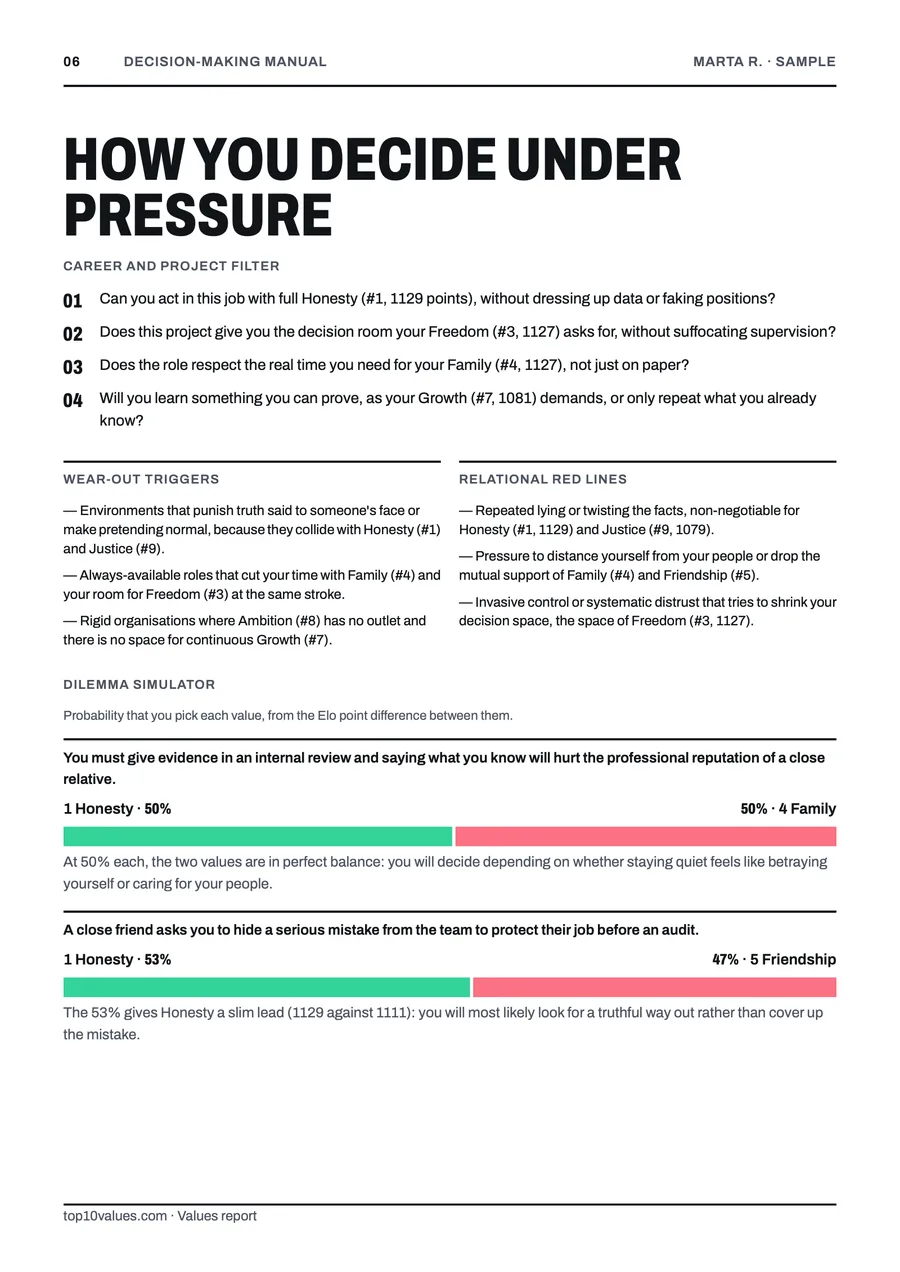
Sample page with fictional data (Marta R.), not yours. Your report is written from your own choices.
Frequently asked questions
What does it mean to have imagination as a personal value? Examples
You give real weight to picturing what does not exist yet or is not in front of you, and using that to decide, to understand other people and to open up alternatives. Everyday examples: coming up with a third option when a decision looks like a yes-or-no; imagining how your mother will experience a move to a flat with no lift before you suggest it; inventing a game with your kids out of whatever is in the kitchen; rehearsing a job interview in your head from the interviewer’s side; or imagining your project has failed so you find out in time where it might go wrong. What turns it into a value, rather than just a trait, is that you set time aside for it and defend it when it looks impractical.
What is the difference between imagination and creativity?
Imagination is the ability to conceive what is not present: possibilities, scenes, other people’s points of view. Creativity is bringing some of that through to a result others can see, hear or use: a dish, a piece of writing, a solution. You can imagine a great deal without creating anything, for instance when you picture a friend’s situation so you can support them better, and you can create with little imagination by skilfully improving something that already exists. People who hold imagination as a value mostly enjoy the conceiving and understanding stage; people who hold creativity, the making stage. Many have both, and they work well together as long as one does not smother the other.
Did Einstein really say that imagination is more important than knowledge?
Yes, although the line usually circulates without its context. It comes from an interview with the journalist George Sylvester Viereck, published in 1929 in the American magazine The Saturday Evening Post under the title “What Life Means to Einstein”. There Einstein says that imagination is more important than knowledge because knowledge is limited, whereas imagination encircles the world. He said it while explaining how his ideas arrive: in that interview he describes himself as enough of an artist to draw freely upon his imagination. He was not suggesting that study is unnecessary. Read that way, the line does not set imagining against knowing: it says that the knowledge already available is not enough to discover what is still unknown.
Do people lose their imagination as they grow up?
It is a widespread belief, but what tends to disappear is the opportunity rather than the ability. Children play every day and nobody asks that play to be useful; adults fill their days with purposeful tasks and leave little room for a “what if…?” with no consequences. Adult imagination also changes shape: it shows less in dragons and more in plans, in fixes for problems at home, or in the ability to put yourself in someone else’s position. If you feel you have lost yours, try bringing back some of those opportunities: read fiction, play with children without running the game, spend some time away from screens, or make yourself come up with several solutions to a small problem before choosing one.
How can I tell imagining apart from worrying or escaping?
All three draw on the ability to imagine, but they leave different results. Useful imagining leaves you with something: a new option, a better question, a clearer sense of what someone else feels. Worrying leaves you with the feared scene replayed over and over with no possible action, and it usually gets worse at night. Escaping leaves you with a pleasant spell and the feeling afterwards that nothing has changed. A simple test is to ask when you finish: “what can I do now with this?”. If the answer is nothing and the scenario comes back every day, it is worth steering your imagination towards concrete ways out, or talking it over with someone you trust or with a professional.
What should I do if my family or partner sees my imagination as unrealistic?
First, separate two criticisms that often come bundled together: that your ideas are unrealistic, and that you hand them to people who then have to carry them. Often the other person is not rejecting the idea but the feeling that every brainwave becomes a change of plans for everyone. It helps to present what you imagine as a scenario rather than a decision (“I’ve been thinking about something, can you help me see what’s wrong with it?”) and to try it on a small scale before asking for a big commitment. And listen to the useful part of their scepticism: someone who imagines less is often quick to spot the costs you miss. Imagination and realism work better as working partners than as opposing camps.
Can you train your imagination if you think of yourself as unimaginative?
Yes, and you do not have to start with art. Imagination works with material, so the first step is to give it more: read fiction or history, talk to people very different from you, travel, even if only to a nearby neighbourhood you do not know. Then exercise it on concrete tasks: before each decision, write three alternatives; before a difficult conversation, describe the scene from the other person’s side; before a plan, imagine how it could fail. Many people who call themselves unimaginative are in fact very good at imagining problems and risks; it is one tool pointed somewhere else, and it can be pointed at solutions as well.
When Imagination clashes with…
Letting ideas run free, versus a stable income, getting through the day's list or sticking to what is practical.