Creativity
Innovation
Creating new solutions.

Innovation is the practical application of new ideas to solve real problems or improve existing processes in a tangible way. Unlike imagination, which stays in the conceptual realm, people who value innovation want to take their ideas into concrete execution: redesigning a system, questioning a traditional method that no longer works, or creating a solution where none existed before. This value requires tolerance for failure, because not every new idea works on the first attempt. People guided by innovation tend to feel uneasy with "it's always been done this way" and constantly look for more effective ways of tackling everyday challenges.
What does this value mean?
Innovation, as a value, is the willingness to change the way something is done when you have good reason to think it could be done better, and to take on the work of making that change succeed in the place where you actually live or work. Having the idea is not enough: innovating includes testing it, checking whether it solves the problem, adjusting it and getting other people to use it. Holding it as a priority means that a routine, a process or a habit prompts two questions in you: “why is it done this way?” and “what would change if we tried it differently?”, and that you accept the cost of finding out instead of leaving it as a complaint.
Innovation is easier to see in people than in definitions. Picture the nurse who, tired of a medication trolley that forces three trips per shift, sketches a new drawer layout, tries it for a week on her ward and comes back with what she observed before asking for it to be rolled out across the hospital. Or the owner of a neighbourhood hardware shop who starts taking orders by voice message because his older customers do not type, but they do talk. Or the teacher who replaces the end-of-unit exam with a group project, checks whether students retain more and uses that evidence to decide whether to repeat it. The farmer who gives a single plot to a different irrigation system before betting the whole harvest on it. The retired woman who notices that nobody in her building knows whom to ask for help and puts up a rota so that neighbours who cannot manage the stairs get their rubbish taken down. And the teenager who sets up a shared list so the family stops buying the same bottle of oil three times over. None of these people relies on technology or cleverness; what they have in common is a particular relationship with the established way of doing things: they respect it enough to understand why it exists, and they question it enough to improve it. Innovation lives in the least glamorous stretch of change, the one that runs from “I have had an idea” to “now everyone uses it and nobody remembers how it was before”.
What it does NOT mean
It should not be confused with creativity, although the two get on well. Creativity produces something new: an idea, a design, a possible solution. Innovation adds two demands: that the novelty works where it will actually be used, with its limits on money, time and people, and that someone adopts it. You can have plenty of creativity and never innovate, if your ideas stay in the notebook, and you can innovate with someone else’s idea, if you are the one who puts it into practice. Nor is it a synonym for technology: changing the order of a weekly meeting or the way household chores are split can be more innovative than buying an app. It does not mean being up to date or buying every new release; adopting the new without asking what problem it solves is consumption, not innovation. It is not rebellion against every rule: many rules exist because someone learned something the hard way, and good innovators find out what that was before breaking them. And it differs from originality, which aims to be different; innovation aims to be better, and sometimes better means intelligently copying what already works somewhere else.
Related concepts
Why might it matter to you?
Almost everything that seems normal to you today was once a novelty that somebody had to fight for: washing hands before delivering a baby, the seat belt, the single queue at the bank, the school-run rota that parents in a class organise among themselves. Treating innovation as a value matters because things do not improve on their own. Processes stay as they are until someone accepts the cost of changing them, and that cost includes extra work, discomfort and, often, the suspicion of people who were perfectly happy before. If you hold it highly, it protects you against a particular kind of resignation: spending years complaining about something you could have tried to change in a week. At work, the advantage shows when your industry shifts: if you are used to trying new ways of working, you adapt sooner when change arrives from outside. It shows at home too, because many recurring domestic rows are really design problems (who does what, when, with which tools) and are solved faster by changing the system than by having the same argument again. And it changes how you look at problems: instead of asking who is to blame, you ask which part of the system makes the mistake keep happening. That question is less comfortable than finding a culprit, but it usually gets you further.
How can you live this value?
- Start with the problem, not the idea. Before proposing anything, describe in one sentence what is going wrong, who it affects and how often it happens. “The Monday meeting runs for ninety minutes and half the team never speaks” is a starting point; “we should use a different tool” is not. If you cannot state the problem, you do not yet know whether your idea solves it.
- Test small and set an end date. Change a single thing for two weeks in a limited area: one hospital ward, one class, Tuesday dinners. Decide beforehand what you will look at to know whether it worked. A contained trial costs little if it fails and gives you evidence if it succeeds.
- Talk to the people who will live with the change before you make it. Those who use the current system every day know things you cannot see: why it is done that way, what happened the last time someone touched it, which part must not break. Ask them what annoys them about the current way and what worries them about the new one. Plenty of innovations fail because nobody listened to the people who had to use them.
- Learn to kill your own ideas. If the trial does not improve what you set out to improve, drop it and say so out loud. Keeping a novelty alive out of pride is the quickest way to make sure nobody wants to try anything with you next time. Share the failures too: what did not work saves other people time.
- Look for solutions that already exist elsewhere. Before inventing, ask how another department, another industry or another family handles the same problem. Carefully transferring something that works elsewhere usually gives better results than starting from scratch, even if it earns you less applause.
- Own the aftermath. Once a change is adopted, the dull part begins: documenting it, teaching it to newcomers, fixing the problems of the first few months. If you always move on to the next idea and leave the upkeep to others, you are not innovating, you are handing out work.
Advertisement
What happens when you don't live up to this value?
When innovation is neglected in your life, the first thing to appear is not stagnation but chronic complaint. You have been saying for years that the shift system at work makes no sense, that planning the family holiday always ends in a row, that the residents’ association is hopeless, and you have not tried to change any of it. Over time, “we have always done it this way” stops irritating you and you start saying it yourself. You notice that other people’s new proposals tire you out before you have heard them through, and that you turn them down with reasonable-sounding arguments (“we tried that”, “there is no budget”, “now is not the time”) without checking whether those arguments still hold. At work, you may discover that a newcomer solves in a month something you had written off as impossible, and that all they had was a willingness to try. When innovation is among your values, that neglect feels like a frustration that is hard to name: you see clearly what could be better, and at the same time you feel you have neither the energy nor the permission to try. To see where you stand, recall the last fix you made to something that was not working, however small, and whether you went back weeks later to see if it had helped.
The healthy side and the shadow
When does this value stop helping you and start limiting you?
Healthy expression
Changing what does not work
In excess
Change for its own sake
Innovation goes wrong first when novelty becomes the goal. You switch the team’s tool every six months, reorganise the department before the previous structure has had time to show results, redesign the family routine whenever it bores you. For the people who depend on you, this is expensive: every change forces them to relearn, and the sense that nothing lasts erodes their trust. A second shadow is contempt for what already works and for the people who built it: talking about “the old way” with condescension, without acknowledging that it solved problems for years. A third is the person who proposes and vanishes, launching the idea, collecting the credit for the start and leaving others to handle the hard months of adjustment. And there is a quieter fourth: treating people as test subjects without asking them, at work or at home. The healthy version shows three traits: you can explain what problem each change solves, you accept that some things stay as they are because they work, and you stick around long enough for the new thing to settle.
This value at work
At work, innovation as a value changes how you choose and how you behave. Between two similar job offers, you look at which one leaves room to try things, how the manager reacts when something goes wrong, and whether people’s suggestions lead anywhere or die in a suggestion box. Inside an organisation it shows in concrete details: you bring a proposal along with a small-scale trial you have already run, rather than a slide deck; you ask people who have worked a process for years why it is the way it is before proposing to change it; and when one of your ideas fails, you are the first to say so. If you manage people, innovation asks you to create the conditions for others to propose: a small, protected space to experiment, explicit permission to get things wrong within limits, and the habit of asking “what have you tried this month?”. It helps to know that proposing change carries a political cost. Niccolò Machiavelli warned, in chapter VI of “The Prince”, that introducing a new order of things is among the hardest and most dangerous undertakings, because those who did well under the old order oppose it fiercely while those who would do well under the new one defend it only half-heartedly. That five-hundred-year-old observation still describes many meetings rather well. The practical answer is to find allies before you present the idea and to offer a way back if the trial fails. A specific risk in jobs where mistakes have serious consequences, such as healthcare, aviation or accounting, is confusing innovation with improvisation: in those fields, innovating means testing under stricter protocols, not skipping them. And if your company puts the word “innovation” on every poster but punishes every failure, your value will ask you to choose between changing the environment, finding a corner where testing is possible, or finding another job.
This value in relationships
In friendship, innovation shows up as the person who suggests changing the usual plan: instead of the monthly dinner at the same old pub, a day out, a workshop, a game nobody knows. That role is valuable, because long friendships tend to repeat their routines until they become obligations, and someone has to suggest something else. It also shows in how you tackle group problems: the group chat where nobody can agree on a date, the shared kitty that always ends in misunderstandings, the friend who is gradually left out because they moved away and nobody has thought of a format that includes them. People with this value tend to see those as design problems and to offer concrete fixes. The risk lies in misreading the group. Some friendships draw their value precisely from repetition: the Thursday coffee that has been going for twelve years, the Sunday phone call, the summer trip back to the same village. Suggesting a change there can sound as though what you share is no longer enough for you. Before proposing something new, ask yourself whether you are solving a problem the group actually feels or just your own boredom. And when a friend tells you about a problem, be careful not to leap into redesigning their life: sometimes what they want is to be heard, not an improvement plan.
This value in love
In a couple, innovation has a very useful side: treating recurring conflicts as faults in the system rather than flaws in the other person. If every Sunday night you argue about the week ahead, you may not need another conversation about who does more, but a different arrangement: going through the diary on Saturday morning, splitting chores by blocks instead of by days, writing down what used to be taken for granted. Trying it for three weeks and reviewing together how it went is a way of caring for the relationship that saves you many rows. There is also a more intimate kind of innovation: not letting the relationship run on the habits of its first year when life has changed, with children, new shift patterns or a move to another city. Couples who adapt are often the ones who allow themselves to ask which of their habits no longer serves them. The risk is that your partner feels they are living in a laboratory. If every month you propose a new method for getting organised, for talking or for resting, the message you send is that nothing as it stands is good enough. And there is an important difference between changing the system and wanting to change the person: the first is negotiated between two people; the second is not innovation but pressure. If your partner values stability more than you do, the goal is not to win them over but to choose together what can be changed and what stays fixed.
This value in family
In families, innovation moves between generations with a lot of friction. With children, the most valuable thing you can pass on is not a taste for gadgets but an attitude: when something at home is not working, you can try another way. A nine-year-old who proposes a sticker chart for chores and sees it actually used for a month learns that their ideas count and that ideas get tested. With teenagers, they are often the ones bringing in the new things, and the temptation is to dismiss them because of who they come from; listening and trying one of them under clear conditions teaches more than any lecture. With older relatives, innovation calls for real tact. A grandfather who has kept the household accounts in a notebook for fifty years does not need an app imposed on him; he needs someone to understand why the notebook reassures him and to look for a change that respects it, such as photographing the pages each month so nothing is lost. Family traditions are another delicate area: suggesting a different way to celebrate Christmas Eve, once the family has grown or scattered, can save the gathering or break it, depending on how it is done. It usually helps to frame it as a one-year trial and to ask first which part of the tradition is untouchable for each person. Watch out for a common mistake: reorganising the whole house because you have read about a new method, without asking the people who live in it.
This value and yourself
When innovation ranks high in your top 10, you probably find it hard to put up with a procedure you do not understand or that you know could be better, and you feel energised when someone lets you try a solution. You may be the one at work who spots the bottlenecks, and the one at home who ends up redesigning the wardrobe, the school run or the way bills are split. It is worth looking honestly at the other side. How many of the changes you have proposed in the last two years are still standing? How many did you drop as soon as they stopped being new? Do you really listen to people who prefer the previous system, or do you file them under “resistance”? Can you stay with something that works even when it bores you? A modest place on your list is not a flaw either: at this stage of your life, stability, mastery of what you already do well or the calm of a predictable routine may simply weigh more, and every team needs people who look after what works. But it is better as a choice than as a habit, because when your surroundings change suddenly, someone who has never practised change experiences it as a threat rather than a problem that can be solved.
What are you willing to sacrifice for this value?
Innovating costs time, reputation and comfort. Would you spend hours outside your working day preparing a trial nobody asked for and that might not work? Would you present a proposal knowing your manager or colleagues will receive it sceptically, and that if it fails it is your name people will remember? Would you give up the security of a method you have mastered to try one that will slow you down for a few weeks? Would you accept an idea of yours being implemented under someone else’s name, if what matters is that it works? Would you drop a novelty you defended in public because the data say it has not improved anything? Try to name one specific occasion when you did. If one comes to mind easily and you would do it again, innovation already guides your choices more than you think. If you always wait for someone else to move first, or only propose changes when they cost you nothing, the value may be more a taste for novelty than a practice.
Signs you're betraying this value
You betray innovation when you reject a proposal before hearing it through, when you say “we tried that” without knowing when or how it was tried, or when you defend a method simply because it is yours. Also when you complain for months about a problem you could try to fix in a week and never do. But there are betrayals on the other side too: changing something without checking afterwards whether it improved, keeping a novelty that does not work because it was your idea, or launching ideas and walking away from putting them into practice. Calling every objection “resistance to change”, without asking whether the person objecting might be right, is a clear warning sign. And another, quieter one: copying whatever is fashionable in your industry without asking which of your problems it solves.
Turning the value into goals
Value
Innovation
Behavior
Every time something irritates you for the third time at work or at home, write one line on what is going wrong, who it affects and what small change you could try
Goal
Complete a two-week trial this quarter on a specific problem, with a success criterion decided in advance, and use the result to decide whether the change stays, gets adjusted or is dropped
Habit
A fifteen-minute weekly review on a fixed day to go through your notes, pick one idea to test and check how the current trial is going
Questions to reflect on
- Which problem at work or at home have you put up with longest without trying to change anything, and what has really held you back?
- What is the last change you proposed that is still in place today, and what did you do to make it stick?
- Which routine or tradition in your life would you never touch, and could you explain why it works?
- When someone near you suggests a new idea, what is your first reaction: looking for reasons it will fail, or looking for a way to test it?
- Which novelty have you adopted in recent years without asking what problem it solved for you, and what has it cost you to keep it up?
- If you had to abandon one of your current ideas because it is not working, which would it be, and what is stopping you from doing it now?
How much are you living this value?
Think about the last three months and look for one concrete change you tried in order to fix something that was not working, however small, and whether you checked afterwards that it had helped. Score yourself from one to ten on how often you turn your complaints into trials and your trials into decisions. If you fall short of seven, pick the problem that comes up most often in your week, write down what you would change and give a two-week trial a start and an end date.
When two values clash
Against Financial security, the tension surfaces when trying something new means leaving a stable contract to start your own project, putting savings into an idea with no customers yet, or giving a trial hours you could otherwise bill; there is no single answer, and moving in stages with a defined cushion and an exit point agreed in advance tends to work. With Loyalty the tension is direct: improving a process can sound like criticising the people who designed it, your team or your boss, and sometimes innovating means questioning how things are done in a group you care about. With Efficiency the relationship is ambiguous: efficiency squeezes the most out of what exists, innovation replaces it, and during the trial period the new way usually performs worse than the old one. With Mastery the conflict is about timing: mastery rewards staying for years to perfect a technique, while innovation may push you to abandon it just as you get good at it. With Simplicity and Inner peace the risk is fatigue: every change adds learning, decisions and conversations, and a life under permanent renovation wears you out. With Respect, conflict arises when your proposal ignores the experience of people who have been there for years. Family, with its customs and fixed dates, asks for continuity, and not everything that repeats is wrong. Innovation has clear allies too: Creativity supplies the ideas, Curiosity asks the questions, Learning turns each trial into knowledge, Courage helps you speak up, and Humility lets you accept that your idea was not as good as you thought. Discipline is what keeps a change going once it stops being exciting.
Is “Innovation” one of your top 10 values?
Find out by playing and comparing this value with the other 49
How the Elo ranking works and its limits in the methodology.
What does the paid report include?
When you finish the 100 comparisons you will see your Top 10 on screen. If you want to go further, there is a PDF report on your personal values: €9.95 (VAT included), one-off payment. To buy it you need to save your game with a Google account.
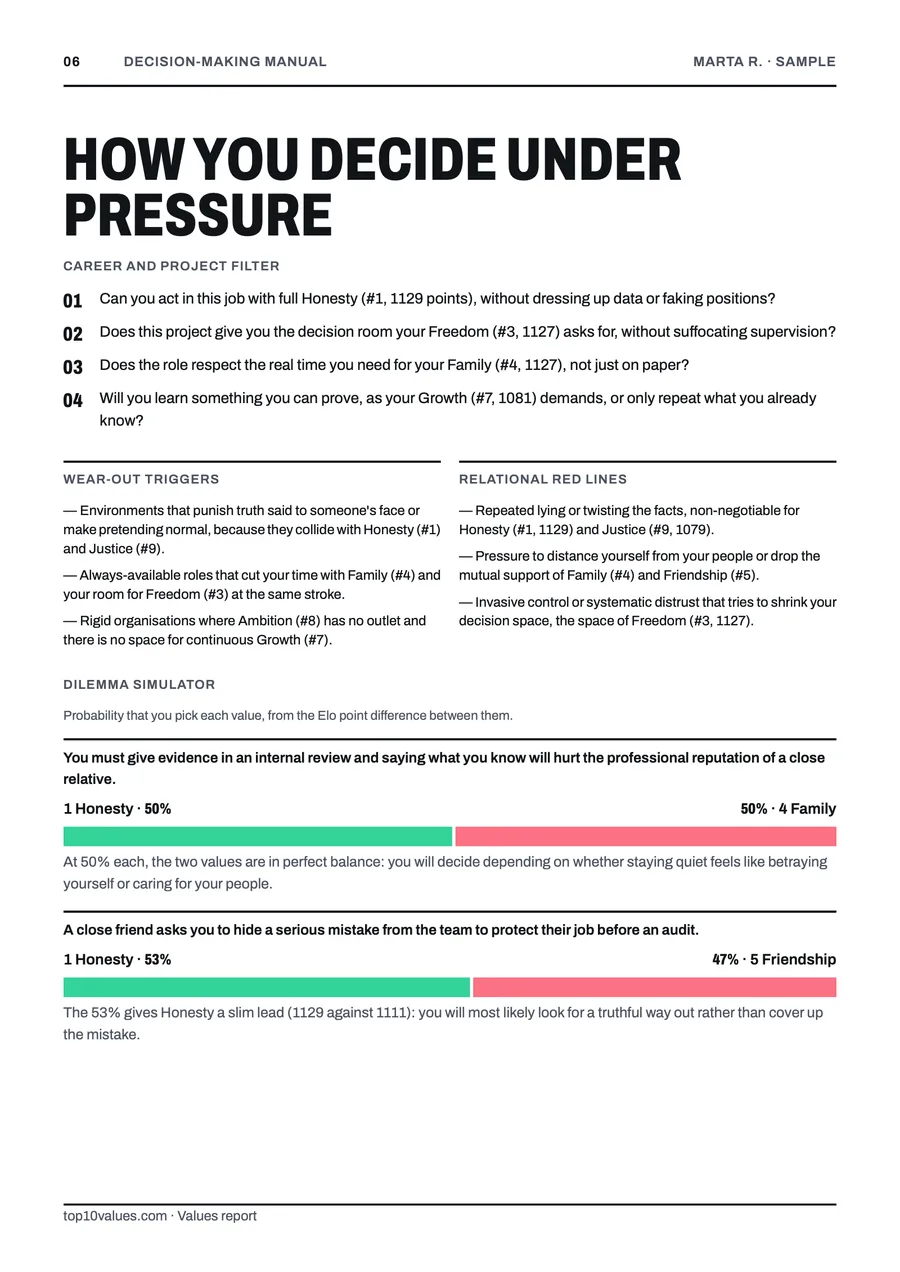
Sample page with fictional data (Marta R.), not yours. Your report is written from your own choices.
Frequently asked questions
What does innovation mean as a personal value, and what are some everyday examples?
It means caring about improving the way things are done and taking responsibility for making that improvement work, not just having ideas. Everyday examples: changing the school-run rota with other families because the current one always leaves someone stranded; trying a fifteen-minute stand-up meeting for two weeks instead of the usual hour; organising the shopping with a shared list so you stop buying things twice; adapting an older relative’s home with simple fixes so they can keep living there without help. In every case you identify a problem, test a change and check whether it makes things better.
What is the difference between innovation and creativity?
Creativity means producing something new: an idea, a design, a possible solution. Innovation means taking a novelty, your own or someone else’s, all the way to the point where it works in a real setting and other people use it. You can have brilliant ideas that never leave the notebook, which is creativity without innovation; and you can innovate by carefully applying an idea someone else came up with. That is why innovation demands skills creativity does not always need: listening to the people who will use the change, testing small, measuring the result and keeping the effort going once the novelty stops being exciting.
Do I need to work in tech or at a start-up for innovation to be a real value?
No. Innovation turns up anywhere something could be done better: a restaurant kitchen, a classroom, a GP surgery, a farming cooperative, a residents’ association or a family. Many of the changes with the biggest effect are organisational rather than technological: changing the order of a process, how a task is shared out or the format of a meeting. What makes it a value is not the sector but the fact that you spend time and effort testing changes and checking whether they work, including when nobody has asked you to.
Why do people resist new ideas even when they are good?
Because being right is not enough. A widely cited historical example is the Hungarian doctor Ignaz Semmelweis, who in Vienna in the mid-nineteenth century argued that doctors should disinfect their hands before attending births to reduce childbed fever, and whose proposal was rejected by many of his colleagues for years. The reasons for resistance are usually recognisable: change forces people to relearn, it can call into question the competence of those who did things the old way, and its benefits are not always visible straight away. That is why it pays to bring evidence, involve the people who will use the change and respect what the old system did well.
How can I innovate if almost everything in my job is set and I barely decide anything?
Start with what you do control: how you organise your own tasks, your templates, the order in which you do things. When you find an improvement that works, record it with a simple measure, such as the time it saves or the mistakes it prevents, and share it with a colleague before taking it to management. A proven improvement that others want to copy is more persuasive than any abstract proposal. And if, after several attempts, your environment leaves no room at all, that is useful information about whether the job fits your values.
What is the diffusion of innovations, and how is it useful in personal life?
It is a theory that the sociologist Everett Rogers developed in his book “Diffusion of Innovations”, first published in 1962, about how new ideas spread through a group. Rogers described how people do not all adopt a change at the same time: some try it straight away, some wait to see how the first ones get on, and some only accept it once it has become the norm. In personal life, it helps you not to take it personally when your family or team are not enthusiastic about your idea on day one. It is usually more effective to win over one or two open-minded people first and let their experience persuade the rest.
How do I know whether I am innovating or just changing things for the sake of it?
Ask yourself three questions before proposing anything. Can I describe in one sentence the problem this solves? How will I know, a month from now, whether it worked? What do the people who used the old system lose, and have I talked to them? If you cannot answer any of them, you are probably being driven by boredom or a taste for the new. It also helps to look at your track record: if you change method, tool or organisation every few months without evaluating the previous one, what you have is restlessness, not innovation. Sometimes the most innovative decision is to leave something as it is.
When Innovation clashes with…
Changing how things are done, versus the safe option, staying faithful to what already works or the shortest path.