Achievement
Financial security
Economic stability.

Financial security is the pursuit of enough economic stability to face the unexpected without it seriously compromising the rest of your life. People who value financial security prioritize saving, avoid unnecessary financial risks and tend to prefer income stability over more lucrative but uncertain alternatives. This value isn't synonymous with accumulating unlimited wealth, but with building a cushion that reduces anxiety about the future and lets you make other decisions—about career, relationships, lifestyle—from a calmer footing. For these people, real freedom begins precisely when money stops being a constant source of daily worry.
What does this value mean?
Valuing financial security means giving priority to the certainty that your basic needs, and those of anyone who depends on you, are covered today and reasonably protected against the unexpected: a car breakdown, a redundancy, a spell of sick leave, a rent increase. It does not measure how much money you have, but how much room you have: how long you could keep going if your income stopped tomorrow, and how calmly you can open an unexpected bill. When it makes your top ten, before you sign a contract, change jobs, make a big purchase or lend money, you ask yourself a concrete question: “if this goes wrong, what cushion do I have left and how long will it last?” And that answer weighs as heavily in the decision as your enthusiasm does.
This value shows up in everyday habits far more than in big statements. It is the self-employed plumber who moves part of every paid invoice into a separate account, because August and January are always thin months. It is the nurse on rolling six-month contracts who spends her weekends studying for a permanent post, because a stable contract would finally let her plan beyond the next renewal. It is the couple who, before applying for a mortgage, set aside the monthly repayment they would face for half a year, to see whether they can carry it and still have a life. It is the nineteen-year-old student who logs every purchase from her grant on her phone and discovers that her morning coffees add up to more than her bus pass. It is the father who takes out life insurance the week his second daughter is born, and the woman who, at sixty and newly divorced, requests a pension forecast for the first time and goes through it with a pencil. What they share is not their salary but their relationship with the future: money is treated as a tool that stops a stroke of bad luck from turning into a crisis. The idea has a long history in psychology. In his paper “A Theory of Human Motivation” (1943), Abraham Maslow listed among the safety needs the common preference for a job with tenure, the wish for a savings account and for insurance of various kinds. What varies from person to person is how heavily that need weighs when it competes with others.
What it does NOT mean
It is not wealth. People who value wealth want to accumulate and grow, and often want it to show; people who value security want sufficiency and predictability, and their goal has a ceiling: once the cushion is full and the debts are under control, extra money loses much of its pull. Nor is it stinginess: you can spend happily on a dinner with friends while knowing exactly what you can afford, and very often it is the cushion that lets you spend without guilt. It does not mean avoiding all risk: buying insurance, spreading your savings or learning a new trade while keeping your job are ways of managing risk, not of running from it. It is not simply having a steady job either: someone in a permanent post with three maxed-out credit cards has less room than a freelance translator with an irregular income and six months of expenses put aside. And it is not control: deciding what your partner or children spend on, or checking every purchase other people make, protects nobody; it only passes your anxiety on to them.
Related concepts
Why might it matter to you?
Without a margin, every setback arrives in a hurry, and hurry makes poor decisions. If the washing machine breaks on the 20th and the account is empty, the question is no longer which machine to buy but who to borrow from or which payment to push back. Bigger decisions work the same way: without a cushion you take the first job that comes along even if it is wrong for you, you stay in a job that is wearing you down because you cannot afford a single month of searching, or you stretch out a shared home that no longer works because you could not cover the rent on your own. That is why financial security is neither a cold value nor a purely material one: what it buys, above all, is the ability to say no. It also shapes how you perceive risk. In their prospect theory (1979), Daniel Kahneman and Amos Tversky described how losses tend to weigh more heavily on us than gains of the same size; people who hold this value high often feel that imbalance with particular force, and it helps to know it so that fear is not mistaken for prudence. Lived well, financial security lowers the background noise: you stop doing sums in your head at the supermarket, you sleep better the night before a meeting with HR, and you can think about the future in terms of plans rather than alarms. Lived badly, it becomes a watchfulness that never rests. The difference lies in having a clear number for what you need and a plan for getting there.
How can you live this value?
- Work out your bare-minimum monthly figure. Add up what you would have to pay even if your income stopped tomorrow: housing, utilities, food, transport, insurance and debt repayments. That number, not your salary, is the unit your cushion is measured in. Many people are surprised when they first see it: sometimes it is higher than they thought, sometimes a good deal lower.
- Build the cushion in stages. First, one month of that minimum figure, which already turns a breakdown into an inconvenience. Then several months: a common rule of thumb in personal finance is three to six, closer to the top end if your income is irregular or other people rely on you. Keep it in a separate account you do not see every day, so it does not look like spending money.
- Make saving happen before spending. Set up an automatic transfer for the day you get paid, however small. Saving “whatever is left over” by month’s end depends on your willpower every single evening; a standing order only depends on you not cancelling it.
- Rank your debts by what they cost. List every loan, card and buy-now-pay-later plan with its interest rate and outstanding balance. The most expensive ones, usually store cards, revolving credit and payday-style loans, are the first to clear, and while they exist it is wise not to finance new treats in instalments.
- Protect what you could not replace. Once a year, check what your home, health or life cover actually includes, whether it still fits your situation, and whether someone you trust knows where the important documents and passwords are. A household’s security also depends on someone else being able to manage the accounts if you cannot.
- Book one hour a quarter to review your numbers. Look at how much you have saved, which costs have crept up without you deciding, which subscriptions you no longer use and whether your target is still sensible. If you share expenses with someone, doing the review together over a coffee, rather than in the wake of an argument, heads off a lot of misunderstandings.
Advertisement
What happens when you don't live up to this value?
When you care about financial security but neglect it, the discomfort rarely arrives all at once: it settles in as background noise. You avoid opening your banking app in the last days of the month. Every payment notification gives you a small jolt. You use the credit card to reach payday and tell yourself next month will be different. Breakdowns stop being setbacks and become small disasters that reorganise the whole week. At work, you notice you do not dare ask for a raise or move to another company, not because you do not want to, but because you could not survive a gap in between. At home, conversations about money become short and tense, and arguments about one particular purchase are really about a bigger fear nobody names. There is also a quiet version: earning a reasonable income without knowing where it goes, and feeling it is never enough when, on paper, it should be. The most reliable signal is physical: a knot in your stomach on Sunday night as you think about the week ahead, or lying awake the night before a large payment is due.
The healthy side and the shadow
When does this value stop helping you and start limiting you?
Healthy expression
Having enough margin to decide calmly
In excess
Hoarding out of fear and forgetting to live
The shadow of financial security appears when the figure that would let you relax moves every time you reach it. You get to six months of savings and think twelve would be better; you get to twelve and start worrying about a crisis that lasts two years. Saving stops being a tool and becomes an end in itself, and every expense, even the ones that would do you good, feels like a loss. Some people go years without a holiday, a celebration or dental work they genuinely needed, and some stay in a job that is crushing them because the permanent contract outweighs everything else. A second shadow is control over other people: checking every purchase your partner makes, refusing a teenager any room to make mistakes with their own money, or turning the household budget into a courtroom. A third is suspicion: distrusting every request for help, every gift, every proposal that involves sharing. The healthy version has recognisable features: a target figure with a ceiling, decided in writing; a budget line set aside for enjoyment and spent without remorse; and the ability to help someone when the cushion allows it, because that is also what security is for.
This value at work
At work, this value shows most clearly in decisions about change. Faced with a better-paid offer from a young start-up and a slightly lower one from an established organisation, someone who ranks financial security high does not automatically pick the second, but does ask questions others skip: how much runway the company has, what share of the pay is variable, what happens if the project is cancelled within a year. A useful practical rule is never to leave a job without calculating how many months you could live with no income, and never to accept a risky proposal without a written plan B. For the self-employed, the value turns into concrete habits: setting aside the tax money the day an invoice is paid, keeping a reserve for slow months, not relying on a single client for most of your turnover, and sending invoices on time. It is also worth questioning an inherited idea. For decades, security meant spending a whole career in one company. Today, for many people, it depends more on having skills other employers want, an active network and a cushion of your own than on the promise of a contract. Within a team, someone with this value brings something useful: the person who asks about the budget before committing, who spots that depending on one supplier is dangerous, or who insists on sensible payment terms. The risk is that this caution blocks every reasonable investment; if you recognise yourself there, try proposing a maximum amount the team could lose without real harm instead of opposing the whole idea. And when you negotiate pay, the value works in your favour if you know your numbers: people who know their figures negotiate with data rather than nerves.
This value in relationships
In friendship, money is usually a topic people dodge until it causes trouble. If you value financial security, two tests come up again and again. The first is group plans: the stag or hen weekend away, the summer trip booked at speed in a group chat, the dinners at restaurants beyond your budget. Saying “I’ll sit this one out, but count me in for Sunday lunch” without a long explanation is a skill that protects your finances and the friendship alike; good friends understand, and someone else in the group is often quietly grateful. The second test is lending. A guideline many people find useful is to lend only an amount you could lose without it changing your life or the relationship, and to decide in advance whether you treat it as a loan or a gift. Guaranteeing a friend’s loan is a different matter: you are signing up to a debt you do not control, and it deserves a cool head however fond of them you are. Income gaps strain friendships too: whoever earns more may suggest plans without noticing what they cost, and whoever earns less may feel permanently in debt. Talking about it openly, alternating expensive plans with cheap ones and not keeping score of every coffee works better than pretending the gap is not there. And there is a small gesture that says a lot about this value lived well: when a friend is going through a rough patch financially, offering concrete, discreet help because your cushion allows it, without making them feel they owe you.
This value in love
In a couple, financial security tests trust more than almost any other value, because it forces you to talk about fears, debts and what each of you learned about money growing up. It is common for one partner to experience saving as protection and the other to experience spending as a way of enjoying life, and for both to be partly right. Before moving in together, or signing anything jointly, an unhurried conversation is worth having: what each of you earns, what debts you carry, what size of cushion would let you relax, and what you would refuse to cut back on. Many couples settle on a mixed system: a joint account for shared costs, into which each person pays in proportion to their income, and separate accounts for everything else, so nobody has to justify a treat. One point is often forgotten: when one partner goes part-time or stops working to care for a child or a relative, their long-term financial security shrinks, even if the household’s does not. Discussing how to make up for it, for instance with contributions to savings or a pension in their name, is a form of care. The warning signs are equally clear: hiding purchases, lying about a debt, deciding on a large shared expense without consulting, or using money as a means of control. Financial security lived well in a relationship does not mean nobody spends; it means neither of you is afraid of what would follow if the relationship ended or one of you lost a job.
This value in family
In families, this value passes down more through what children see than through what they are told. A seven-year-old who gets a little weekly pocket money and learns to wait three weeks to buy something understands saving better than after any lecture. With teenagers, the test is letting them make mistakes with small sums: if they spend a month’s allowance in a week, waiting for the next one teaches more than an instant bailout. Their first pay packet, from a summer job or an internship, is the ideal time to get them into the habit of putting a slice aside the moment they are paid. With ageing parents, financial security calls for conversations almost everyone puts off: what pension they receive, whether they could pay for a care home or help at home, who would manage their accounts if they no longer could, whether they have made a will. Having that talk before there is any urgency prevents rushed decisions and fallings-out between siblings. Inheritances and help between generations are delicate ground too: many parents want to help their children with a deposit on a flat, which is generous, but if it compromises their own retirement the problem is simply postponed by a generation. The aeroplane safety briefing, put on your own oxygen mask before helping the person beside you, applies here with some precision. And in families that went through hard times, this value is often inherited along with a load of fear; recognising that lets you keep the prudence and let go of the dread.
This value and yourself
When financial security ranks high for you, chances are you know your bank balance without checking, feel uneasy owing money even in small amounts, and find it hard to enjoy a big purchase until it is fully paid off. You may take news of layoffs or downturns more calmly than your friends because you have already done your sums, or less calmly because you keep redoing them. Many people with this value high can point to an experience that explains it: a childhood with lean months, a parent made redundant, a business of their own that closed, or the opposite, having watched someone close get through a hard time thanks to their savings. Now look at the flip side. Does your comfort figure have a concrete number, or does it shift each time you reach it? When did you last spend on something you were excited about without feeling guilty? Have you turned down opportunities that, looking back, you could have afforded? Do you talk about money with the people you share your life with, or handle it in silence? The answers show whether the value gives you room or takes it away.
What are you willing to sacrifice for this value?
Protecting your financial security costs, above all, immediate pleasures and a little image. Would you skip the summer trip your whole group is planning so you can finish building your cushion? Would you drive the same old car for another two years while everyone else upgrades? Would you turn down an exciting offer from a project with no clear funding? Would you say at a dinner that you would rather pay for what you ordered than split the bill evenly? Would you take a few months of less stimulating work while preparing a move with a safety net? Would you cook at home on weekdays to keep a savings target nobody else can see? Recall the last financial trade-off you made by choice. If it was recent and left you satisfied, the value is already shaping your decisions. If you have never made one and security still seems important to you, you may be holding it as an aspiration rather than living by it.
Signs you're betraying this value
You betray your financial security when you buy something you do not need on instalments so as not to fall behind, when you leave bank letters or card alerts unopened, or when you dip into the cushion for a treat and promise to top it up with no date in mind. Also when you sign a contract, a loan or a guarantee without reading it because asking feels awkward. Putting off, year after year, the decision to start saving for retirement is a clear sign, as is not knowing how much you pay each month in subscriptions. There is also a reverse betrayal, harder to spot: using prudence as an excuse never to do anything that matters to you, or refusing to help someone close when you could do so at no real risk.
Turning the value into goals
Value
Financial security
Behavior
Setting up an automatic transfer to a separate savings account on the day you get paid
Goal
Building, this year, a cushion worth three months of your bare-minimum expenses and clearing your most expensive debt
Habit
A fifteen-minute look at your accounts every Sunday and a full one-hour review every quarter
Questions to reflect on
- If your income stopped tomorrow, how many months could you keep your current life going, and how do you feel knowing the answer?
- What amount of savings would genuinely let you relax, and what would you do differently once you got there?
- What big step did you take, or hold back from, for financial reasons, and how does it look to you now?
- What did you learn about money at home without anyone spelling it out, and what would you like to hold on to?
- Who could you show your real accounts to without tidying them up first, and which money conversation have you been putting off?
- What do you spend on gladly and without guilt, and where are you saving out of fear rather than for a goal?
How much are you living this value?
Think about the last three months. Do you know your bare-minimum monthly figure and how many months of it you have saved? Was there an unexpected expense, and how did you handle it? Score from one to ten the breathing room your current situation gives you to decide calmly, without money forcing you to accept the first thing that comes along. If you score below seven, start small: work out your minimum figure this week and set up a first savings transfer, however modest.
When two values clash
Financial security clashes with Freedom when the option that would give you the most room day to day, going self-employed, cutting your hours or moving abroad, means giving up predictable income. Seen from security’s side, the answer is not to give up but to prepare the jump: work out how many months the transition needs and do not leap until you have them. With Adventure the tension is similar but more emotional: someone drawn to the unknown experiences the cushion as an anchor, and someone who seeks security experiences adventure as a threat; a pot of money set aside for experiences, which can be spent in full without touching the essentials, is often a good compromise. With Family there is a conflict few people expect: helping a child with a flat or a sibling with a debt is a form of care, but it can drain the cushion that protects you and, in the long run, them. With Contribution and Service, friction appears when deciding how much to donate, or how much time to give a cause, when that reduces your income; fixing an annual share in advance saves you deciding each time under guilt. With Health the relationship cuts both ways: money buys rest and care, but working endless overtime or putting up with a job that makes you ill to keep the salary erodes the very thing security was meant to protect. With Enjoyment the tension is daily: every dinner, every concert, every treat passes through the savings filter, and a life in which nothing is ever spent on pleasure ends up not worth so much protection. With Wealth and Ambition it pays not to blur the lines: all three are about money, but security is content with enough, while the other two push you to grow, and growth usually means taking risks. With Learning, paying for training or accepting a lower salary for a role that teaches you can look reckless, although over time skills are one of the best protections there are. And with Honesty there is an alliance that sometimes hurts: telling the truth about a debt, about what you earn or about what you cannot afford is uncomfortable, but without that truth no plan is possible.
Is “Financial security” one of your top 10 values?
Find out by playing and comparing this value with the other 49
How the Elo ranking works and its limits in the methodology.
What does the paid report include?
When you finish the 100 comparisons you will see your Top 10 on screen. If you want to go further, there is a PDF report on your personal values: €9.95 (VAT included), one-off payment. To buy it you need to save your game with a Google account.
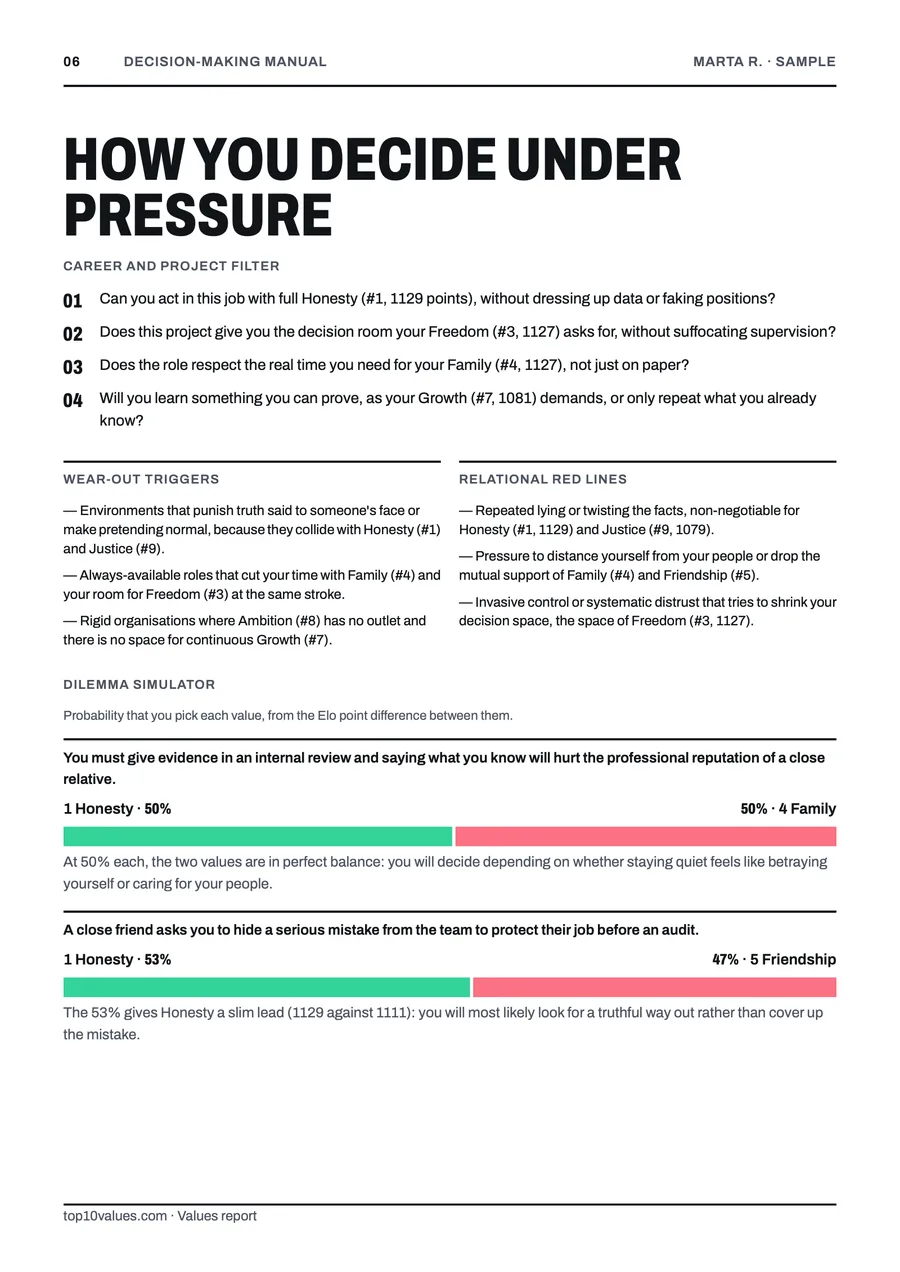
Sample page with fictional data (Marta R.), not yours. Your report is written from your own choices.
Frequently asked questions
What does it mean to have financial security as a personal value?
It means that knowing your essential costs, and those of the people who depend on you, are covered, and that you could withstand a setback, carries real weight when you decide. You can see it in concrete habits: knowing your bare-minimum monthly figure, keeping an emergency fund, avoiding expensive debt, reading contracts before you sign them and asking what would happen if a plan went wrong. It does not depend on how much you earn, but on how you manage what you have and how much margin you give yourself.
What is the difference between financial security and wealth?
Wealth points towards accumulating and growing; financial security points towards sufficiency and predictability. Someone can have large assets and little security, if their income hangs on a single investment or they borrow to sustain a high level of spending, while someone on a modest income can have a great deal of it, if they spend less than they earn and have several months saved. That is why the values game lists them separately: choosing one or the other reveals something different about what you want money to do for you.
How much money do you need to feel financially secure?
There is no universal figure, because it depends on your costs, on how many people rely on you and on how stable your income is. What helps is to calculate your bare-minimum monthly figure and express the target in months rather than in a currency: a common rule of thumb in personal finance is three to six months of essential expenses, more if you are self-employed or work in an unstable sector. Writing that number down has another advantage: it gives you a finishing line and stops the target moving every time you get close. This page deals with the value itself; for specific decisions on investments, tax or retirement, it is wise to consult an independent professional.
Is it materialistic to choose financial security as one of your values?
Not necessarily. For most people who choose it, money is not the goal but what lets them protect other things: their health, their family, the chance to change jobs or to leave a relationship that is not working. It becomes materialistic when the protection loses its ceiling and starts crowding out everything else, or when you measure your own worth, or other people’s, by what they own. If you choose it alongside values such as family, freedom or health, you will most likely use it as a foundation for them.
How can couples talk about money without arguing?
It helps to pick a calm moment, not straight after a purchase that caused friction, and to start with each person’s fears and history before the figures: what money was like at home, what worries you, what would make you feel protected. Then come the numbers: income, debts, fixed costs and a shared savings goal. Agreeing a threshold above which any purchase is discussed, and leaving each partner a monthly sum to spend with no questions asked, removes many small arguments. Repeating the conversation every few months stops misunderstandings piling up.
How can you tell if fear about money is holding you back?
Some signs: your savings target rises every time you hit it; you struggle to spend even on necessities such as the dentist or a pair of glasses; you have turned down several opportunities that your numbers could have absorbed; or you watch other people’s spending anxiously. Try writing down what you would do if you already had the cushion you want, then check whether, with what you have now, you could do at least part of it. If worry about money keeps you awake persistently, seeking psychological support is as sensible as seeking financial advice.
What does classic literature say about financial security?
One of the most quoted summaries comes from Charles Dickens’s novel “David Copperfield” (1850). Mr Micawber, a character forever pursued by debt, advises the young hero: “Annual income twenty pounds, annual expenditure nineteen nineteen and six, result happiness. Annual income twenty pounds, annual expenditure twenty pounds ought and six, result misery.” The irony is that Micawber never follows his own advice. The underlying idea still holds: security depends less on how much comes in than on the gap between income and outgoings.
When Financial security clashes with…
Invented scene. Raquel has saved the equivalent of six months of expenses and sleeps well because of it. In the same week her brother asks her for 4,000 euros to start a food truck, and she is offered the chance to quit her job and go freelance. It is the same money for three uses. Security wants it untouched: it is what turns a bad month into just a bad month. Freedom sees it as the way out, although a cushion that is never touched lets nobody leave either. Family asks whether those savings are worth more than helping someone you love. It can help to set a floor you would not go below and to lend only what you could afford not to get back. A method for deciding is in conflicting values.