Achievement
Wealth
Financial prosperity.

Wealth, understood as economic prosperity, is the pursuit of enough stability and material abundance to sustain the lifestyle you want and widen the options available to you. People who value wealth make career, investment or saving decisions with an eye to building solid assets over time, not just covering immediate expenses. This value isn't necessarily superficial materialism: for many people, wealth is above all a tool that buys time, security and freedom of choice in the face of the unexpected. The usual challenge for those who prioritize this value is keeping accumulation from becoming an end in itself, disconnected from what that prosperity is really being sought for.
What does this value mean?
Wealth, as a value, is the importance you place on building abundant financial resources: earning well, growing what you have and eventually holding more than you need to cover the basics. It is not satisfied with making the numbers work at the end of the month; it looks up and ahead, to the assets you could gather over ten or twenty years and to what those assets would let you do. Putting it among your values means that when you choose a job, negotiate a salary, decide what to do with a bonus or weigh up starting a business, you also ask “does this add to what I am building?”, and that question genuinely counts, even if it is not the only one.
People who rank wealth high tend to recognise themselves in very specific scenes. It is the electrician who, at thirty-four, leaves the firm where he has worked for a decade to start his own, and uses the first profits to buy a second van and take on an apprentice instead of upgrading his car. It is the nurse who picks up night shifts and, on the day they are paid, moves that money into an investment account she does not check every week. It is the new graduate who, with her first offer on the table, asks about the salary band and makes a counteroffer while her classmates sign whatever they are handed. It is the woman who grew up in a home where the electricity was sometimes cut off and who promised herself that her children would never see anyone counting coins at the kitchen table. It is the bar owner who, after years of paying rent, saves until he can buy the premises, because he knows the business might close one day but the building will still be his. And it is the couple in their sixties running the numbers so they can leave each child enough to start out with less of an uphill climb than they had. What these people share is not a bank balance but a way of looking at money: not only as something to spend or protect, but as something you build, put to work and turn into options. There is also a less solemn side worth admitting: many people with this value simply enjoy what money makes possible, from a good house to a dinner where nobody checks the right-hand column of the menu, and they do not feel they owe anyone an apology for it.
What it does NOT mean
It is not greed. Greed hoards for the sake of hoarding and experiences every expense as a wound; someone who values wealth can spend with pleasure, invest with risk and give generously. Nor is it showing off: displaying what you have so others will admire you sits closer to Recognition than to wealth, and plenty of people with substantial assets drive a twelve-year-old car. It is not the same as Financial security, although the two are cousins: security looks for sufficiency and predictability, enough margin to absorb a blow; wealth looks for abundance and growth, and so it accepts risks that would keep security awake at night. It does not require you to be rich already: you can hold this value on a modest salary, and it shows in how you use that salary. It is also distinct from Ambition, which can aim at a body of work, a record or a title with no interest in money at all. And it is not just about figures. Aristotle, in the Politics, already distinguished between household management, which gathers the goods needed to live well and has a natural limit, and the art of making money for its own sake, which has none. Wealth held as a healthy value looks more like the first: it accumulates with a purpose and knows what the money is for.
Related concepts
Why might it matter to you?
Money on its own gives meaning to nothing, but it converts easily into things that do: time with the people you love, quicker access to medical care, an education for your children, the chance to walk away from a job that is harming you or to help a friend without throwing your own life off balance. Treating wealth as a value, rather than as something slightly shameful you pursue in private, has a practical advantage: what you name, you can plan for. Many people say money does not matter to them and in practice live with constant money worries, because they never negotiate, never look at where their money goes and never decide what to do with what they save. Admitting that you want to prosper forces you to learn how it works: what an asset is, what a debt really costs, why time makes invested money grow when the returns are reinvested. It also widens your room to choose: someone who has built up some capital can take a sabbatical, switch industries, care for a sick parent or start a risky project without betting everything on it. And there is an effect that is often forgotten: wealth handled well increases your capacity to contribute. Plenty of foundations, scholarships, local shops and jobs exist because someone set out to make money and then decided what to do with it. Finally, wealth is one of the values where starting early matters most: small, repeated decisions made at thirty have far more runway than big decisions made at fifty.
How can you live this value?
- Write down what you want wealth for and how much would be enough for each thing. “Being rich” does not guide a single decision; “being able to work part-time at fifty-five” or “paying for two children’s university without a loan” does. Giving each goal a purpose and a number turns a vague wish into a plan and protects you from chasing a target that keeps moving on its own.
- Work out your net worth and repeat the exercise every quarter. Add up what you own (accounts, investments, the part of your home that is already yours, a business) and subtract what you owe. The figure may be small or even negative at first; what matters is the direction. Looking only at your payslip is misleading: there are high salaries with zero net worth and average salaries that, year after year, build a great deal.
- Treat your income as something you work on, not something that happens to you. Prepare a pay conversation every year with evidence: what you have achieved, what your role pays in the market, what new responsibility you are taking on. Explore a second income stream linked to what you already know how to do, such as teaching, consulting or selling a small product, before looking for one that has nothing to do with you.
- Decide what you will do with your next pay rise before it arrives. The moments when the most wealth is won or lost are not the ordinary days but each increase in income: a promotion, a new client, a bonus, the last payment on a loan. If half of every increase goes straight into investments in the month it arrives, your standard of living still improves, but no new fixed cost can swallow the whole rise: whatever you add to your spending, you add the same to your investments. If you wait to see what is left over, within three months the rise will have turned into a nicer car or a pricier flat without you ever having chosen it.
- Only invest in what you understand, and distrust anything in a hurry. If you cannot explain in two sentences how something you are about to put your savings into makes money, you are not ready to invest in it yet. Spread your risk, look closely at fees, which quietly eat part of what you earn, and walk away from any promise of returns that are high, fast and safe all at once. This page is about the value and is no substitute for advice from an independent professional on your particular situation.
- Set aside, in advance, one share for enjoying and another for giving. If everything that comes in goes towards growth, wealth becomes a number you never touch; if everything is spent, it never grows. Fixing a percentage for treats without guilt and another for helping someone or supporting a cause makes your money serve your life rather than the other way round.
Advertisement
What happens when you don't live up to this value?
When wealth is one of your values and you neglect it, the warning sign is rarely poverty. It is more often a mix of frustration and resentment that is hard to put into words. You work hard and, when you take stock of the year, you notice you have nothing more than you had the year before. You took the first offer, did not ask for the raise you were due, left your money sitting in an account that earns nothing and told yourself you would “look into it”. A bitter comparison creeps in with former colleagues who now earn twice as much, along with the suspicion that you are working so that other people can prosper. Sometimes it hides behind inherited guilt: in many homes people said that wanting money was for bad people, and that idea can lead you to sabotage opportunities without noticing, or to spend as soon as you are paid so you do not have to think about it. It also shows up as fear of looking at the numbers: you avoid opening your statements, you do not know what you have or what you owe, and every financial decision gets made late and in a rush. If wealth sits low among your values, this neglect barely bothers you; if it sits high, it feels like betraying something you wanted for yourself and the people you care about. One question cuts through it: what have you done, deliberately, in the last twelve months so that in ten years you will have more than you have today?
The healthy side and the shadow
When does this value stop helping you and start limiting you?
Healthy expression
Building wealth with a clear purpose
In excess
No figure is ever enough
The most recognisable shadow of wealth is the moving target. You set yourself a figure and, once you reach it, it no longer feels like enough, because you compare yourself with someone who has twice as much or because your spending has risen in step with your income. With money this has a very concrete mechanism: every step up in lifestyle creates a new fixed cost (the bigger house needs more furniture, higher bills and more heating; the better car, more expensive insurance), and the wealth you thought you were building goes into keeping up what you already have. Seneca put it in one of his Letters to Lucilius: it is not the person who has too little who is poor, but the one who craves more. A second shadow is measuring people by what they earn, yourself included: if a bad financial year makes you feel like less of a person, money has stopped being a resource and become your identity. A third is the shortcut: padding an invoice, hiding income, exploiting someone’s need in a negotiation, or piling into fashionable bets and investments that promise to make you rich in months. And a fourth, quieter one, is the price paid by your other values: health that suffers from the extra hours, a family that gets used to your absence, friends you only see to talk business. Wealth lived in a healthy way can be recognised by four things: you know what you want the money for, you have decided in writing how much is enough for each goal, you would not do anything to earn more that you would be ashamed to tell, and you enjoy what you already have.
This value at work
At work, wealth plays out above all at two moments: when you choose a role and when you negotiate what you are paid. Between two offers, you compare not just the gross salary but the whole package: bonus, equity, pension contributions, paid training and, above all, where the role will take you in five years. A slightly lower salary in a growing sector, or at a firm that offers a stake in the business, can pay off more than a high one in a role with nowhere to go. You want to understand how your company makes money, which part of the business has the best margins and how to get closer to it, because that is usually where promotions and bonuses live. If you work for yourself, the value shows in pricing your time with judgement, raising your rates when your calendar fills up, and turning down clients who cost you money rather than taking them out of fear of having no work. If you manage people, wealth properly understood leads you to pay fairly and transparently, because you know what a good professional costs and what it costs to lose one. The tensions are real. Some jobs light you up and pay little; others pay a lot and hollow you out. There is no formula, but there is a useful question: how many years could you do this without it changing you for the worse? Then there are golden handcuffs: bonuses, share options or deferred pay that tie you to a job you no longer want. Before accepting them, work out what leaving would cost you at each point and decide whether that price seems reasonable. And watch the ethical line: the day a commission pushes you to sell someone something that is not in their interest, wealth has started charging you in a different currency.
This value in relationships
Among friends, money is one of the least discussed subjects and one of the heaviest. When wealth ranks high for you and your friends earn a lot less than you, or a lot more, small scenes arise that need care: who picks the restaurant, how the bill gets split, which trip gets suggested for the long weekend. Suggesting plans everyone can afford without strain, or picking up the bill now and then without keeping score, keeps the friendship above the difference. Another common scene is the friend who asks to borrow money or invites you to invest in their business. A simple rule protects you both: never lend a friend more than you could afford to lose without asking for it back, and if you invest, do it with a signed agreement, as you would with a stranger. Friendships cope badly with debts nobody dares to mention. Watch your tone, too. Talking constantly about returns, what your house cost or your latest deal pushes away people who do not share that priority, and it can come across as superiority even when you do not mean it. The reverse also matters: if you surround yourself only with people who value money as you do, your sense of what is normal can drift upwards without you noticing. Having friends who live well on much less is one of the most effective antidotes to the moving target.
This value in love
In a couple, wealth raises a question many couples avoid: what do we want money to do for us? It is common for one person to enjoy saving and investing while the other prefers to spend on travel, dinners or the home, and neither stance is a flaw. Conflict arises when nobody talks about it and every purchase becomes a small verdict. It helps to agree shared goals with figures and deadlines, for example a deposit on a home or a year of runway so one of you can change careers, and to agree how much of what comes in is invested jointly and how much each of you manages in your own way. Income gaps need particular care: if one person earns considerably more, splitting costs fifty-fifty can look fair and feel unfair, and splitting them in proportion to what each earns tends to breed less resentment. Wealth has a specific shadow here: using money as power, making decisions alone because you contribute the most, or making the other person feel they are living on borrowed means. It is also worth discussing, however awkward it feels, how you will hold property, what happens to what each of you owned before, and what would happen if the relationship ended. Doing this calmly, at the start rather than in a crisis, is not a lack of romance; it is a way of protecting you both. When wealth is a shared project rather than one person’s obsession, it can bring you very close: few things feel as much like a team as looking back together, ten years on, at what you have built.
This value in family
In families, wealth is passed on as an attitude long before it is passed on as an inheritance. Children learn what to think about money from what they hear at the dinner table: whether every bill becomes an argument, whether rich people are spoken of with contempt or envy, whether saving is presented as sacrifice or as a project. With young children, concrete things work best: a see-through money box where they can watch the coins pile up, weekly pocket money they are allowed to waste on something they later regret, the idea of waiting two weeks for something more expensive. With teenagers the conversation can be more grown-up: what take-home pay is, why a credit card is not extra money, how invested money grows over the years. A child’s first pay packet is a chance to go one step beyond saving: open a small investment account together and look back, a few years on, at how much it has grown without anyone touching it. Some family scenes are more delicate. People who are the first in their family to earn well often feel a mix of pride and guilt, and receive requests for help they do not know how to ration; setting clear limits from the start prevents resentment on both sides. Inheritances, for their part, are a frequent source of conflict between siblings: talking while everyone is still alive about how a house or a business will be divided, with all the children present, often saves years of silence between siblings. And in family businesses it pays to separate carefully what is decided as a family from what is decided as a business. A common risk for people who value wealth is wanting to spare their children any hardship at all; handing them everything ready-made can take away the very thing that helped you prosper.
This value and yourself
If wealth is among your top values, you probably think about money more often than you say out loud, notice how other people have built their wealth and enjoy making financial decisions that others put off. It is worth asking what money buys for you, because other values often hide behind the word wealth: security, if what you want is never to be short again; freedom, if you want to choose without depending on anyone; recognition, if it matters that people see it; family, if you think mainly of the people you love; or simply the pleasure of the game of growing something, which is real too. Knowing which weighs most helps you choose better, because each calls for a different strategy. Check the other side as well. Is there anything you would not do for money, and are you clear about it before anyone makes you the offer? Does your mood rise and fall with the markets or your balance? Do you enjoy what you already have, or do you see it only as a step towards the next thing? If wealth sits in the middle or near the bottom of your list, there is nothing to fix: it may mean that time, people or the meaning of your work matter more to you right now. Even so, it is wise not to abandon money matters altogether, because a basic level of order with money protects exactly those other values.
What are you willing to sacrifice for this value?
Building wealth costs time, comfort and, often, instant gratification. Would you accept a less appealing job for a few years because it pays considerably more and moves you towards a specific goal? Would you keep the old car while your friends buy new ones, so you can invest the difference? Would you move to another city for a better salary, knowing it takes you away from your people? Would you put your savings into a business of your own, with a real chance of losing them? Would you give up your weekends to a side project for a year? And the reverse question, just as revealing: would you turn down a big raise if it meant losing your evenings with your children or your health? Think back to the last time you chose money over something else you cared about, or the other way round. If you did it calmly and do not regret it, you already know how much wealth weighs in your decisions. If you always name it as a priority but it has never changed what you do with your salary, your time or your weekends, it is probably still a wish and not yet a value.
Signs you're betraying this value
Wealth is usually betrayed in everyday habits, long before any big decision: when you say you want to prosper but do not know what you own or what you owe, when you spend every raise before it reaches your account, or when you avoid negotiating a salary or a rate for fear of looking money-minded. Also when you buy things to keep up appearances and call consumption an investment, or when you pile into an investment you do not understand because everyone is talking about it. And there is a betrayal in the other direction: when, to earn more, you cross a line you promised yourself you would not cross, hide income from your partner, cut corners you should not with your staff or the tax office, or let money decide for you on things you used to consider non-negotiable. At that point you are no longer living wealth as a value; wealth is living you.
Turning the value into goals
Value
Wealth
Behavior
Whenever you receive extra income or a pay rise, invest half of the increase in the month it arrives, before changing any of your spending
Goal
Within twelve months, know your exact net worth, have cleared your most expensive debts and have three financial goals written down, each with its figure, its deadline and its purpose
Habit
At the close of each month, thirty minutes with your statements and your net-worth sheet in front of you to update the figures, check you are heading in the intended direction and decide on a single adjustment
Questions to reflect on
- If you had twice your current net worth tomorrow, what would you change in your life, and is any of it something you could start now with what you have?
- What did you hear about money at home as a child, and which of those phrases are still making decisions for you without your noticing?
- How much would be enough for each of your goals, and what would you do on the day you reached it?
- Is there anything you would not do for any amount of money? Have you ever had that tested?
- Which of your spending leaves you with something lasting, and which disappears within a week without your remembering it?
- Who could you tell, without discomfort, how much you earn and how much you own, and what stops you from doing so with the people closest to you?
How much are you living this value?
Think about the last twelve months and find one decision you made deliberately so that your wealth would grow, and one time money led you to set aside something that mattered to you. On a scale of one to ten, rate how closely the way you earn, spend and invest matches what you say you want to build. If it comes out below seven, start by working out your net worth this week and decide now what share of your next pay rise or bonus will go straight into investments.
When two values clash
Wealth collides with Simplicity almost head-on: one asks for more and the other for less, and people who hold both usually resolve it by distinguishing between accumulating assets, which can sit comfortably with a simple life, and accumulating things, which cannot. With Financial security the relationship is that of cousins with different temperaments: both look after money, but security prefers not to lose and wealth accepts the occasional loss in order to grow; before a risky investment or a business of your own, it helps to decide in advance which part of your assets is untouchable and which can be put at stake. With Family and Balance the clash is about time: the hours that build wealth usually come out of dinners, weekends and rest, and setting a limit before you start, such as an intense stretch of work with an end date, stops the temporary from becoming permanent. Health works in a similar way, except that the damage takes longer to show. With Honesty and Integrity it appears in the shortcuts: the undeclared invoice, the sale that does not serve the customer, the massaged figure; money earned that way tends to cost more than it seems. With Contribution and Service the tension is about how much you give and how much you keep; fixing an annual percentage for causes you care about saves you from deciding each time with guilt. With Justice, it surfaces when your prosperity depends on conditions you consider unfair to others. With Recognition it can tip into ostentation. On the other hand, wealth gets on well with Ambition and Discipline, which supply direction and persistence, and with Freedom and Independence, which are often the deeper reason people want money in the first place.
Is “Wealth” one of your top 10 values?
Find out by playing and comparing this value with the other 49
How the Elo ranking works and its limits in the methodology.
What does the paid report include?
When you finish the 100 comparisons you will see your Top 10 on screen. If you want to go further, there is a PDF report on your personal values: €9.95 (VAT included), one-off payment. To buy it you need to save your game with a Google account.
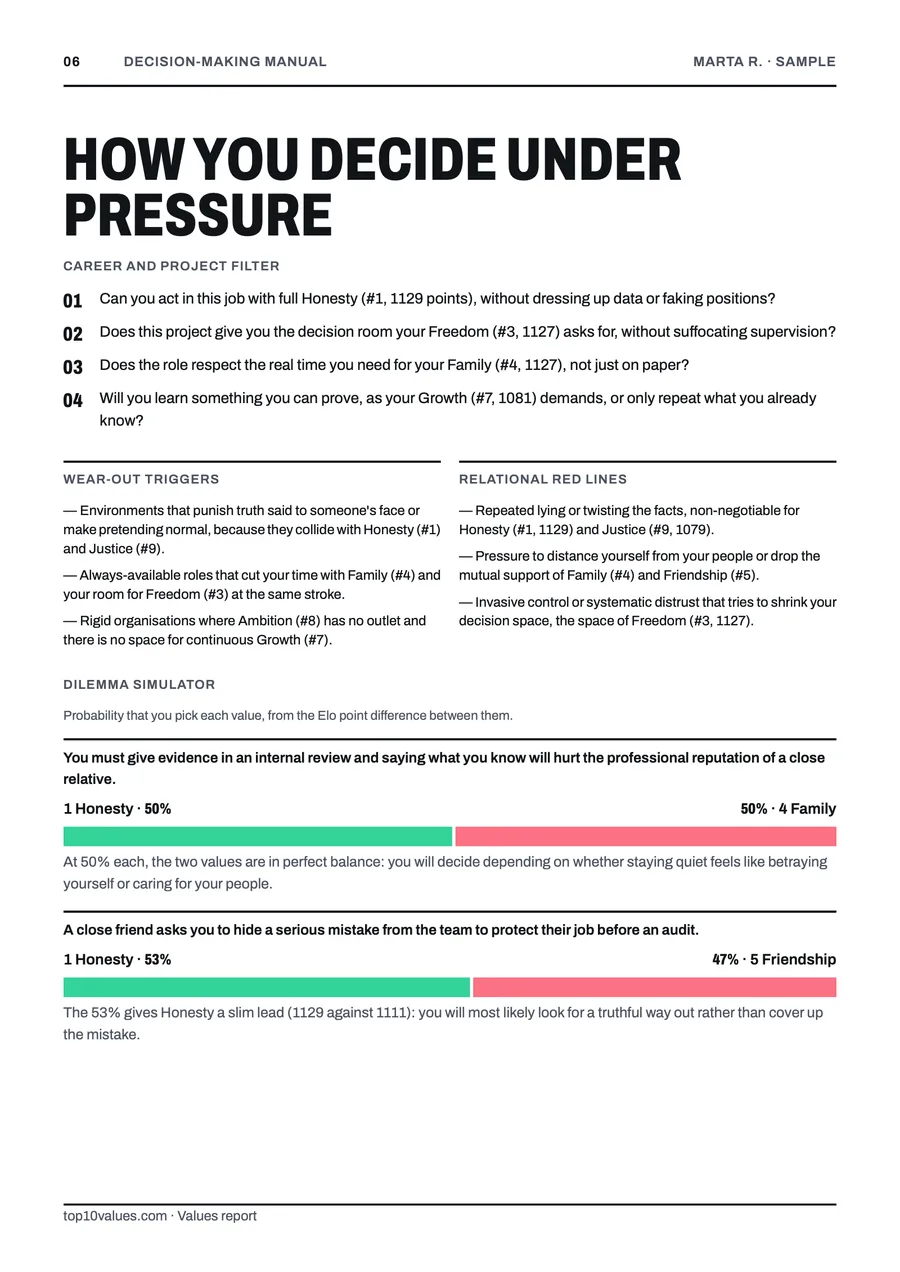
Sample page with fictional data (Marta R.), not yours. Your report is written from your own choices.
Frequently asked questions
What does it mean to have wealth as a personal value, and what does it look like in everyday life?
It means that building abundant financial resources, beyond covering the basics, is a priority that shapes your decisions. It shows in concrete habits: negotiating your salary instead of accepting the first figure, deciding in advance where each pay rise will go, calculating your net worth from time to time, learning how investments work before putting money into them, considering a business of your own or reinvesting profits instead of spending them. What sets it apart from a passing wish is consistency: it is not about dreaming of being rich, but about making decisions, month after month, that move you closer to it.
Is it wrong or materialistic to want to be rich?
Wanting to prosper is not wrong in itself; what matters is what for and at what cost. Wealth lets you look after the people you love, buy time, choose your work and help others, and many people choose it for exactly those reasons. It becomes a problem when it has no ceiling and no purpose, when it crowds out health, family or friendship, or when it is gained at other people’s expense. Aristotle drew this line in the Politics: he considered it reasonable to gather the goods needed to live well, and criticised the pursuit of money without limit as an end in itself. A simple test is to ask whether you could explain with pride, to someone you respect, how you earn your money and what you use it for.
How are wealth, financial security and ambition different?
They are three neighbouring values that are easily confused. Financial security seeks sufficiency and stability: having your needs covered and a cushion for the unexpected. Wealth seeks abundance and growth: having more than you need, which is why it tolerates more risk. Ambition is the drive to go far in something that matters to you, which might be money but might equally be an artistic career, a sporting record or a senior post. A highly ambitious person can be indifferent to money; someone who values security may have no professional ambition at all. Choosing one or another in the values game says different things about what you are looking for.
Does money buy happiness?
It depends on what you mean by happiness and on how much money you already have. In 2010, Daniel Kahneman and Angus Deaton published a study using US data in which people’s overall evaluation of their lives kept rising with income, while day-to-day emotional well-being appeared to level off above a certain point. In 2021, Matthew Killingsworth published data that showed no such plateau, and in 2023 Killingsworth and Kahneman, together with Barbara Mellers, co-authored a paper to reconcile the findings: for most people, well-being keeps improving as income rises, while among the unhappiest group the improvement levels off beyond a certain income. What many studies agree on is that money brings great relief when it is lacking and that, beyond a certain point, how it is used matters more.
How much money is enough?
There is no universal figure, but there is a way to find yours: write down your concrete goals, put a price on each and add them up. Without that exercise, the target tends to rise every time you get close. Kurt Vonnegut recounted, in a poem published in The New Yorker in 2005, a conversation with the novelist Joseph Heller at a billionaire’s party: when Vonnegut remarked that their host might have made more in a single day than Catch-22 had earned in its entire history, Heller replied that he had something the host could never have, the knowledge that he had enough. Valuing wealth is not at odds with that knowledge: you can keep growing your assets while knowing which part already covers what you wanted and which part is simply margin, or play.
How do you start building wealth on an ordinary salary?
Through small, repeated steps rather than big strokes. The foundation belongs to Financial security: knowing what comes in and what goes out, clearing expensive debts and having a cushion for emergencies. Beyond that, the part that belongs to wealth begins: investing what you can set aside regularly and in a diversified way, even if it is not much, without trying to guess when the market will rise or fall, and letting time work on reinvested returns. Alongside this, the lever that usually moves results most in the early years is income: building skills that are better paid, negotiating and, if it suits you, opening a second stream. For specific products, tax or retirement decisions, consult an independent adviser who is not paid commission for selling you anything.
What should you spend money on so it adds most to your well-being?
Research on spending and well-being offers some pointers. Elizabeth Dunn, Lara Aknin and Michael Norton published a paper in Science in 2008 in which spending money on other people was associated with greater happiness than spending it on yourself; Dunn and Norton developed these ideas in the book Happy Money (2013), where they also argue for buying experiences rather than objects and for paying to buy back time, for example by outsourcing chores you hate. For someone who values wealth, the practical conclusion is useful: it is not only about how much you accumulate, but about deliberately directing part of it towards what genuinely improves your life and the lives of those around you.
When Wealth clashes with…
Growing your wealth, versus living with less, risking what you already have safe or giving time to your people.