Wellbeing
Simplicity
Valuing a simple life.
Simplicity is the preference for reducing unnecessary complexity in everyday life, choosing fewer possessions, fewer commitments and more direct processes over overloaded alternatives. People who value simplicity feel more comfortable with tidy spaces, less crowded schedules and clear decisions, avoiding the accumulation of options or things that create noise without adding real value. This value doesn't mean giving up ambition or quality, but constantly questioning what is truly necessary and discarding the rest. Simplicity usually translates into greater mental clarity, because it reduces the number of trivial decisions that consume energy throughout the day.
What does this value mean?
Simplicity, as a value, is a preference for a life with fewer things, fewer commitments and less noise, so that what really matters stays in view and has room. It is not measured by how little you own, but by the ratio between what you have and what you use, between what you agree to and what you can genuinely attend to. Putting it among your values means that before you buy something, join a group, accept a role or install yet another app, you also ask “what will this ask of me in return for what it gives?”, and that sometimes the answer is no even when the offer is a good one.
People who rank simplicity high tend to recognise themselves in decisions that look like sacrifices from the outside. It is the nurse who, moving flats, sells half the furniture and finds she can now clean the whole place in an hour instead of a morning. It is the father who agrees with his nine-year-old on a single after-school activity, the one she chooses, so that weekday afternoons do not turn into a relay of car journeys. It is the project lead who replaces a twenty-slide weekly report with one page and three questions: what moved, what is stuck, what we need. It is the retired woman who leaves the family house for a small flat and, out of forty years of belongings, keeps what fits on two bookshelves and a glass cabinet. It is the student who deletes the apps he opens without noticing and keeps only the ones he uses on purpose. And it is the couple who marry with thirty guests over one long lunch, because they would rather talk to everyone than wave at two hundred people. The common thread is not scarcity but selection: choosing a few things so that you can look after them. The idea is old. In “Walden” (1854), Henry David Thoreau, who spent a little over two years in a cabin by a pond in Massachusetts, summed up his experiment with a repeated plea, “Simplicity, simplicity, simplicity!”, and urged readers to let their affairs be as two or three rather than a hundred or a thousand. You do not need to move to the woods to share the intuition; it is enough to notice that everything you add to your life also asks something of you.
What it does NOT mean
Simplicity is not poverty or stinginess. Living on little because the money does not stretch is hardship, not a choice, and people who value simplicity sometimes spend more: one good coat rather than three that fall apart. Nor is it an aesthetic. White walls, Scandinavian furniture and photos of wardrobes with twelve hangers are a decorating trend that can be lived in a very complicated way, replacing everything so that it looks as if there is less. It is not oversimplification: reducing a hard problem, such as an illness, a feud between siblings or a crisis at work, to a slogan or a culprit does not make it simpler, it only distorts it. It is not laziness or a dodge from effort; many simple solutions take more thought up front than complicated ones. It is not isolation: you can have a busy social life built on plain plans. And it is not the same as efficiency. Efficiency aims for the least waste and can sit comfortably with very sophisticated systems; simplicity would rather remove the part, even if everything worked fine with it, when the price of keeping it is having to watch over it.
Related concepts
Why might it matter to you?
Almost nothing enters your life on its own. An object has to be stored, cleaned, insured, repaired and, eventually, got rid of. A subscription has to be remembered, reviewed and cancelled. A seat on the residents’ committee, a group chat or a new hobby brings meetings, notifications and expectations. None of those costs shows up at the moment you say yes, which is why they pile up without your ever choosing them. Simplicity as a value is a way of making them visible before you agree, not afterwards. The effects are very practical. With money, low fixed costs give you room to turn down a job that is wrong for you or to ride out a few months of uneven income. With attention, fewer open fronts mean you can actually be in the conversation in front of you instead of running through your to-do list. With decisions, having fewer options in small matters leaves energy for the big ones: the psychologist Barry Schwartz argued in “The Paradox of Choice” (2004) that beyond a certain point, adding alternatives increases doubt and lowers satisfaction with whatever you pick. And in terms of what your life is for, simplicity helps you answer a question that excess tends to bury: if you could keep only a few things, which would they be? People who can answer it also know what to defend when everything starts asking for space at once.
How can you live this value?
- Work out the upkeep before you add anything. Faced with a purchase, a subscription or a new commitment, ask four questions: where will it live, how much time a month will it take, who will deal with it when you drop the ball, and how do you get out of it? If you cannot answer the last one, think twice: whatever is hard to leave is what complicates life most.
- Declutter by zone, not all at once. One drawer, one folder on your laptop, the bathroom shelf, the list of group chats on your phone. A whole afternoon spent emptying the house is exhausting and often ends with a trip to buy storage boxes. For anything you are unsure about, use a box with a date on it: if three months pass without you opening it to look for something, its contents can go.
- Apply a one-in, one-out rule to recurring commitments. List everything that takes a slot every week: training sessions, meetings, classes, visits you feel obliged to make. If there is no evening left without plans, add nothing new until something else has gone. Simplicity is lost far more often through an accumulation of good things than through bad ones.
- Simplify the decisions you keep repeating. A basic weekly meal plan you vary, clothes in a few colours that go together, one usual supermarket, a set route to work. The point is not to live in a uniform but to save deliberation for what deserves it: where to live, who with, what work to do.
- Bring simplicity to your devices. Keep notifications only for messages from people, not from apps; mute the groups you read out of duty; move everything you open out of habit off your home screen. Once a year, list the subscriptions you pay for and mark the ones you used last month: the result is usually a surprise.
- Simplify what is yours and negotiate what is shared. Your wardrobe and your diary are up to you; your children’s toys, your partner’s books or your team’s filing system are not. Suggest, explain what everyone would gain and accept areas where the other person decides. Throwing out someone else’s things in the name of simplicity breaks more than it tidies.
Advertisement
What happens when you don't live up to this value?
When simplicity ranks high for you and your life is heading the other way, the discomfort is rarely dramatic; it is diffuse. You pay for a storage unit full of things you cannot remember. Your Sunday goes on tidying up what the week messed up. Your calendar is packed with commitments you accepted one at a time, each of them reasonable, none of them truly chosen. You get a hundred notifications a day and answer the urgent ones rather than the important ones. You open a full wardrobe and find nothing to wear; you open a streaming service and spend twenty minutes choosing without watching anything. Then a very specific feeling sets in: that you are administering your life rather than living it, as if you were its manager and not the person who lives in it. It often comes with irritation you cannot pin down, with fantasies of escaping somewhere with nothing in it (a cottage with no signal, a trip with a single backpack) and with purchases that promise order: another planner, another organiser, another app. If that sounds familiar, the problem is seldom a lack of method; it is that you have stopped deciding what gets in.
The healthy side and the shadow
When does this value stop helping you and start limiting you?
Healthy expression
Clearing what is surplus to see what matters
In excess
Cutting what matters as well
The first shadow of simplicity is using it as an excuse not to commit. A friend going through a bad patch complicates your week, a teenager complicates the house, chairing the neighbourhood association complicates your Thursdays; if simplicity becomes the supreme rule, every bond that takes effort starts to look like clutter, and what remains is a tidy, empty life. The second is moral superiority: looking down on your mother-in-law’s living room crammed with photos, on birthday parties with piñatas or on the neighbour’s big car, as if your way of living were the right one. It helps to remember that chosen simplicity is a luxury compared with imposed scarcity, and that boasting about owning little in front of someone who cannot own more is hurtful. The third is shop-window minimalism: swapping everything you own for pricier, more austere versions, competing to have less than anyone else, or watching for surplus so closely that order becomes one more source of anxiety. The fourth is oversimplification: applying the logic of clearing a drawer to problems that are not solved by removing things, such as grief, a chronic illness or a rough patch in a relationship. The healthy version is recognisable because it leaves room for what does matter, even when that is hard work; because it does not judge how other people live; and because it knows that some valuable things are complicated by nature.
This value at work
At work, simplicity shows first in what you do not do. You decline the meeting with no agenda, ask for a four-paragraph email to become one concrete question, suggest dropping a step in the process that nobody can explain. People who value it are often the ones who ask “what would happen if we stopped doing this?” and, when nobody knows, propose trying it for a month. In jobs that involve designing something, whether a form, a manual, an app or a restaurant menu, simplicity is close to a professional discipline: the hard part is not adding features but deciding which ones to leave out. Antoine de Saint-Exupéry, an airline pilot as well as a writer, put it this way in “Wind, Sand and Stars” (“Terre des hommes”, 1939), writing about aircraft design: perfection seems to be reached not when there is nothing left to add, but when there is nothing left to take away. The line has a flip side worth keeping in mind. What is simple for the user usually costs the designer a great deal, and simplifying your part can complicate someone else’s, as when you stop documenting a task and the colleague covering your holiday has to guess. The most common tensions come with promotions and with heavily regulated organisations. A better-paid role usually brings more meetings, more direct reports and more email, and if you value simplicity you have to decide whether the salary makes up for that complexity or whether you would rather stay in a more hands-on role. In companies with many controls, proposing to simplify can sound like wanting to bend the rules; it helps a lot to arrive with the cost of the step measured, in hours or in errors, and with a concrete alternative.
This value in relationships
In friendship, simplicity tends to mean plain plans and a few deep ties. You would rather have coffee in the kitchen than dinner with a booking, a walk than an activity that requires buying gear, a small group than a chain of meet-ups. Your friends may find that a relief: with you there is nothing to organise and nothing to live up to. Friction appears with friends who like to do things big. The three-day stag or hen weekend in another city, the expensive group present, the anniversary trip, or the chat with forty members and two hundred messages a day can ask more of you than you want to give. Saying no without judging is a skill worth practising: “I’ll come to the dinner, but I can’t do the whole weekend” lands far better than a remark about how absurd the plan is. There is also a quieter trap. Trimming your circle can help you let go of relationships that only take and never give, but it can also become a way of drifting away from someone who is struggling and, precisely for that reason, is hard work. Before you let a friendship fade, ask yourself whether it really is surplus or simply going through a difficult season. In return, simplicity gives your friends something they will notice: meeting up with you takes very little. There is nothing to book weeks ahead, no ten calendars to line up and nothing to buy, so you see each other more often and not only on special occasions.
This value in love
In a couple, simplicity is tested above all by living together. Two people rarely agree on how many things are enough: one keeps the ticket from every gig and the other would bin the box unopened; one wants a clear living room and the other loves being surrounded by plants, books and souvenirs. What works is not persuasion but division: shared areas with agreed rules and personal areas where each person decides, no comments allowed. Throwing out something of your partner’s without asking, even if it has sat in a box for years, usually feels like disrespect rather than a favour. Simplicity also shows in how you celebrate. Some couples find a kind of intimacy in it: a small wedding, few and thoughtful presents, a trip without a fixed itinerary, dinner at home instead of a fashionable restaurant. In others, one partner values Adventure or Beauty and experiences that restraint as a lack of enthusiasm. There it helps to talk about what a purchase or a plan means to each of you, not what it costs. Finally, simplicity in communication is a gift to any relationship: saying “I need an evening with no plans” or “that upset me” instead of hinting, circling or hoping the other person will guess saves arguments that come from misunderstanding more than from disagreement.
This value in family
Family life is where simplicity is hardest to sustain, because every person adds things, schedules and expectations. With young children, the challenge arrives as toys, clothes outgrown every season, birthday parties with presents from the whole class and after-school activities that multiply. Some families rotate toys in boxes so there are only ever a few out, ask grandparents for a single present or a shared outing, or agree with each child on one activity per school year. At Christmas, a Secret Santa among the adults shrinks the mountain of parcels and the spending without taking away the fun of opening something. With teenagers, simplicity plays out on the phone and in the pressure to have what everyone else has; lectures tend to work worse than the example of adults who are not glued to a screen. At the other end of life, simplicity comes up when ageing parents move somewhere smaller or when their house has to be cleared. It is one of the most delicate moments: every object carries a story, and what looks like junk to you may be, to a sibling, the only mug left from their childhood. Go slowly, share things out before throwing anything away and let each person keep what matters to them, even when it fits no rule. Teaching simplicity at home is not about banning things but about showing that a good afternoon needs very little: a picnic in the park, a game of cards, a walk that requires no tickets.
This value and yourself
Inwardly, simplicity has to do with how many demands you place on yourself at once. You can have an uncluttered home and a head crammed with resolutions: learn a language, run a half marathon, read fifty books a year, change jobs, meditate every morning and call your mother more often. Valuing simplicity also means choosing a few fronts and letting the rest wait without treating that as failure. It helps to ask why you keep what you keep. Sometimes it is fear of needing something and not having it, a trace of leaner times. Sometimes it is nostalgia: university notes or clothes in a size you no longer wear hold an earlier version of you. Sometimes it is identity: the bookcase, the camera kit or the record collection say who you are, or who you would like to be. Naming the reason lets you decide more calmly what to keep. And there is a simplicity in how you talk to yourself: describing what is going on in short, true sentences, such as “I need sleep” or “I don’t want to go”, instead of building long explanations to justify what you already know.
What are you willing to sacrifice for this value?
Choosing simplicity has a price worth knowing in advance. You turn down opportunities that really were good, simply because they did not fit: the interesting master’s degree, the well-paid side job, the trip with friends that came at the wrong moment. You give up some convenience, because you will not always have the exact tool, the perfect outfit for every occasion or the app that does everything, and sometimes you will have to borrow or rent. You may lose standing with people who measure success by what is visible: the older car, the small home, the quiet wedding. Some people will drift away because your way of living feels to them like a reproach, even if you say nothing. And financially, buying less but better sometimes means spending more in one go. What you get in return is time, attention and a life you recognise as chosen.
Signs you're betraying this value
There are concrete signs that you are betraying simplicity. You buy something to soothe a bad day and put it away unused. You take on a new commitment because you did not know how to refuse, and you are already carrying three others that started the same way. You pay to store things you never use. The afternoon you set aside to sort things out has been pending for months and gets postponed every week for lack of time. You pick up your phone to do one thing and put it down twenty minutes later without having done it. You notice that your home, your calendar or your inbox asks more of you than it gives. And perhaps the clearest sign: when someone asks what you would like to do this weekend, there is no gap in which to answer.
Turning the value into goals
Value
Simplicity
Behavior
Before any purchase that is not an everyday item, wait forty-eight hours and decide where it will be kept and what will leave the house in exchange
Goal
Win back one fixed evening a week with no commitments this quarter and fully clear one specific area of your home, such as the loft, the storage cupboard or the drawer of old cables
Habit
Ten minutes every Sunday to look over the coming week’s calendar and drop, delegate or postpone at least one thing
Questions to reflect on
- If you had to move tomorrow into a home half the size, what would you take without hesitating and what would you leave without regret?
- Which commitment in your week did you accept because you could not say no, and what would really happen if you dropped it?
- When did you last enjoy yourself a great deal with very little, and what did that moment have that your everyday life lacks?
- What do you keep just in case, and when did that case last actually happen?
- In which part of your life could simplicity become an excuse for avoiding something that does matter to you?
- Which decisions do you make again every week that you could settle once and forget?
How much are you living this value?
Think about last week and check three things: how many hours you had with no plans at all, how many times you looked for something and could not find it, and how many commitments you attended without wanting to. On a scale of one to ten, rate how far your life is the size you choose rather than the size it has grown into. If it comes out below seven, pick a single area (a drawer, a group chat, a weekly activity) and simplify it before next Sunday.
When two values clash
Simplicity clashes with Adventure and Curiosity, because every new experience tends to bring gear, travel, schedules and people, and someone who wants a life with few things can feel each plan as a mess. It clashes with Learning too: learning widens your life, and each new interest adds books, tools and commitments; the usual way out is to learn one thing at a time, not to stop learning. With Ambition, Success and Recognition the tension is built in: almost every promotion multiplies meetings, direct reports and exposure, so it is worth deciding how much complexity you will take on and in exchange for what. With Beauty the relationship is ambivalent: both enjoy stripping away what is surplus, but beauty sometimes asks for objects, colours and ornaments that simplicity would discard. With Family and Contribution the clash is more delicate, because caring for others and committing to a cause complicate life by definition; here simplicity should shape how you help, not whether you help. With Wealth it can pull in opposite directions, since building assets usually means managing more accounts, properties or investments. On the other hand, simplicity is a natural ally of Freedom, because lower costs and fewer ties give you more room to decide; of Inner Peace, because fewer open fronts mean less noise; of Balance, because time is easier to share out when there is less to share; and of Excellence, because a lot of excellent work consists precisely in taking things away. It usually gets on well with Efficiency, though the two part ways when a complex system saves time but needs constant supervision.
Is “Simplicity” one of your top 10 values?
Find out by playing and comparing this value with the other 49
How the Elo ranking works and its limits in the methodology.
What does the paid report include?
When you finish the 100 comparisons you will see your Top 10 on screen. If you want to go further, there is a PDF report on your personal values: €9.95 (VAT included), one-off payment. To buy it you need to save your game with a Google account.
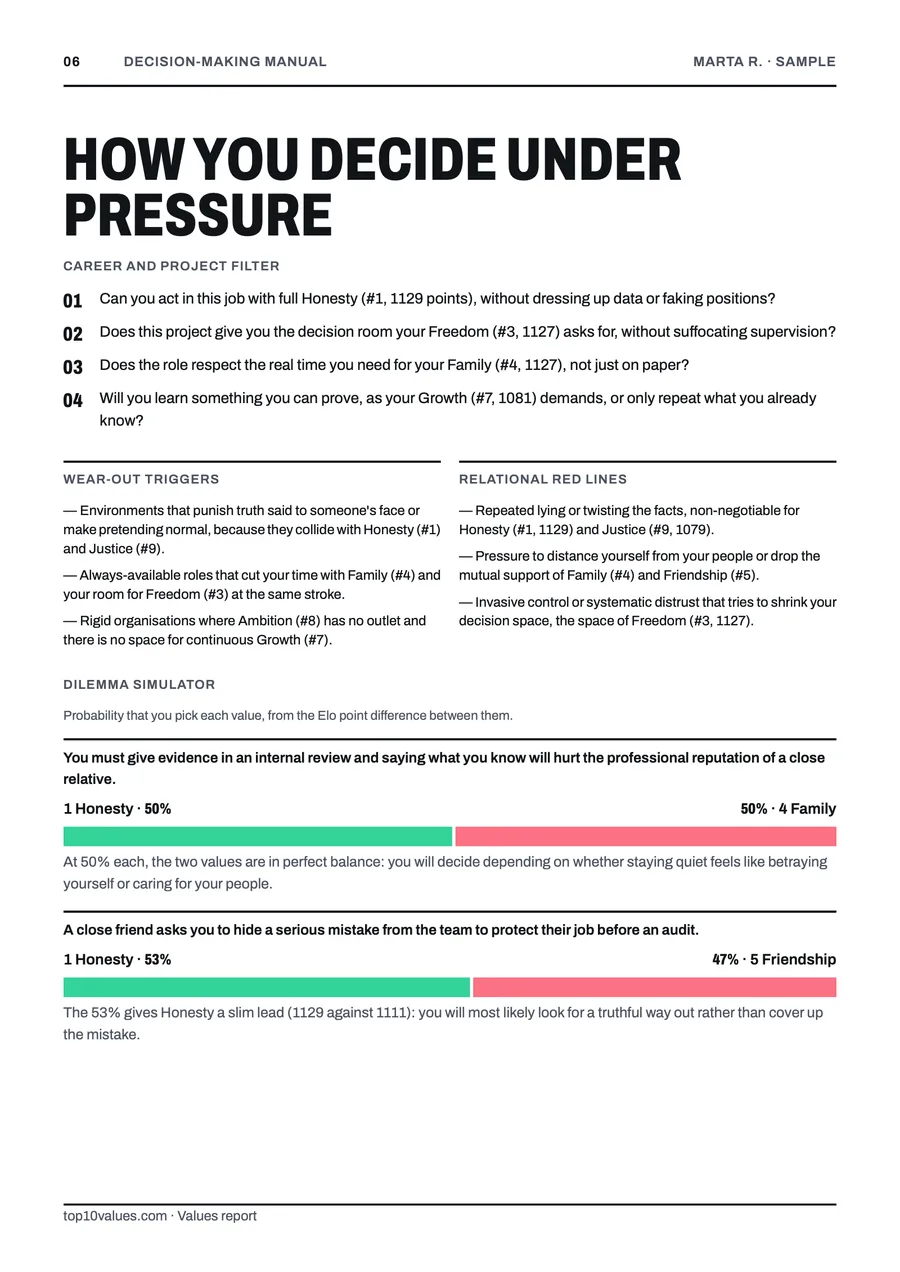
Sample page with fictional data (Marta R.), not yours. Your report is written from your own choices.
Frequently asked questions
What is simplicity as a personal value, and what does it look like day to day?
Simplicity as a personal value is the importance you give to living with fewer things, fewer commitments and less noise, so that you have time and attention for what matters to you. Everyday examples: waiting two days before buying something you do not need today; having one card and one bank account instead of five; cooking a handful of recipes with few ingredients that you make well; agreeing as a family on one present per person at Christmas; muting the group chats you never read; or meeting a friend for a walk instead of organising an elaborate dinner. The common thread is choosing a few things so that you can take care of them.
What is the difference between simplicity, minimalism and frugality?
They are close neighbours and often get mixed up. Frugality is about money: spending little and making the most of what you have. Minimalism, as it has been popularised in recent years, is mainly an aesthetic and a practice around possessions: owning few things and keeping spaces clear. Simplicity is broader, because it also covers time, commitments, technology and the way you think. You can be frugal and have a house crammed with things kept just in case; you can be minimalist in the living room and run an impossible calendar; and you can value simplicity and spend more than expected on one good item that replaces several poor ones.
Does valuing simplicity mean settling for less?
Not necessarily. Settling means accepting less than you want because you see no alternative; valuing simplicity means wanting less of some things in order to have more of others. Someone who chooses a job with less responsibility so they can be home in the afternoons is not settling: they are trading salary for time and know what they are doing. Simplicity does demand ambition somewhere: in the quality of what you keep, the depth of your relationships or how well you do the few things you do. If you notice that you talk about simplicity to avoid admitting you are afraid of trying something, it is worth looking at, because the word may be covering for something else.
Is simple living just a recent trend?
No. The idea that life is better with little runs through the history of thought. Epicurus, in his “Letter to Menoeceus”, held that, when the point is to ease hunger, plain food gives as much pleasure as a lavish meal, and that getting used to simple fare protects you against the blows of fortune. Thoreau turned that intuition into an experiment in “Walden” (1854). In 1981 Duane Elgin published “Voluntary Simplicity”, the book that popularised the phrase and tied it to a movement of people who cut back their consumption by choice. What is recent is the commercial version: books, shows and products that sell simplicity as a lifestyle, sometimes with a great deal to buy.
Why can having lots of options make it harder to decide?
Because every extra alternative asks to be compared, and comparing is tiring. Barry Schwartz, a psychology professor at Swarthmore College, popularised this idea in “The Paradox of Choice” (2004): beyond a certain point, more options do not bring more freedom but more doubt before choosing and more regret afterwards, because there is always a suspicion that another option was better. People who value simplicity tend to protect themselves in practical ways: they limit in advance how many options they will look at, take the first one that meets their requirements for small decisions, and save detailed comparison for the choices that really have consequences.
How can you simplify your life when you live with someone who hoards?
Start with your own things and leave the other person’s alone, at least at first. Sorting out your clothes, your desk or your phone shows the effect better than any argument. Then agree on zones: shared spaces with a few basic rules, such as keeping the dining table clear, and personal spaces where each of you decides. Ask why they keep what they keep; behind boxes of magazines or duplicate tools there are usually memories, a fear of needing them or an unfinished project, and each reason calls for a different conversation. If the accumulation stops the home from being usable or causes a lot of distress, it may be more than a difference in taste, and it is worth consulting a professional.
Where do I start simplifying without throwing everything away?
With whatever weighs on you most every day, not with whatever is most visible. For some people it is the phone; for others, the children’s schedule, the wardrobe or work email. Pick one area, give it a short session and decide on each item: it stays, it goes, or it moves into a dated box of doubts. Before throwing something out, think about whether someone else could use it: giving, selling or donating makes the decision easier. And do not buy anything to organise with until you have removed what is surplus, because many storage boxes only serve to hide what you do not dare let go of. If after a month you miss nothing, you know you could live with less.
When Simplicity clashes with…
Living with few things and few commitments, versus exploring something new, taking up another hobby or accepting a more complex role.