Personal Growth
Curiosity
Desire to explore and discover.

Curiosity is the genuine desire to explore, ask questions and understand how things, people or ideas work, without needing an immediate use for it. People who prioritize this value enjoy researching topics outside their specialty, asking uncomfortable questions or trying something just to see what happens. This attitude keeps the mind active and usually translates into more flexible thinking, able to connect information from different fields. Curiosity differs from formal learning in that it doesn't necessarily aim to accumulate structured knowledge, but to satisfy the urge to discover; many historic innovations were born precisely from curious questions with no practical goal defined in advance.
What does this value mean?
Curiosity is the urge to know, understand or try something you do not yet know, without anyone requiring it of you and without it having an immediate use. It is the question you cannot leave unasked, the detour you take just to see where it leads, the "how does this work?" you say to a machine, a person or an idea. As a value, it means giving that urge a place in your life: making room to explore, ask and learn, even when the safe and familiar option is more comfortable.
People who put curiosity among their values recognise themselves in very ordinary scenes: the person who stops to read the blue plaque on a building they have walked past for years; the engineer who, instead of binning the broken kettle, takes it apart on the kitchen table to see what failed; the passenger who asks the cabbie why he chose that route and ends up learning how the traffic in their own city flows; the parent who, faced with the fifth "why?" in a row, answers "I don't know, let's find out". It also shows in how you talk: asking real questions, not just waiting for your turn, and taking an interest in the lives of people who think differently. Psychologists have been trying to describe it for decades. George Loewenstein, in a 1994 paper in "Psychological Bulletin", presented it as an "information gap": it is awakened when you notice the distance between what you know and what you want to know, which is why it tends to start once you already know something, not from zero. Daniel Berlyne distinguished long ago between curiosity that simply seeks novelty and curiosity that pursues a specific answer. And Todd Kashdan, who has devoted much of his work to this trait, argues that it is not one thing but several dimensions, among them joyful exploration and a tolerance for the discomfort of not knowing.
What it does NOT mean
It is not the same as gossip. Curiosity about people rests on respect: you are interested in how someone thinks, but you accept that there are things they do not want to share. Nor is it endless content consumption: scrolling through short videos gives constant novelty, but rarely leaves you wanting to go deeper or with anything learned. It is not hoarding stray facts or collecting hobbies you drop after three weeks; it can become that, but then it is closer to scattering yourself. It does not mean being cleverer, and it is not limited to childhood or to science: you find it in the person who repairs bicycles, in the one who cooks, in the one who reads poetry and in the one who asks their gran what the neighbourhood was like sixty years ago. And it is not a trait you either have or lack: it can be trained, just as it withers when you stop using it.
Related concepts
Why might it matter to you?
Curiosity is what keeps learning alive once nobody is marking your work. People who learn only out of obligation stop as soon as the course ends; people who feel curious keep reading, trying and asking long after the certificate is framed. It also widens your world in ways that are hard to predict: a documentary about tides leads to a chat about fishing with your neighbour, and that chat ends up opening a trade, a trip or a friendship. It is, besides, a good defence against boredom and against rigidity. Curious people tend to cope better with change, because their first reaction to something new is to look with interest rather than shut down. There is a social benefit that gets little mention: showing curiosity about someone is one of the most effective ways of making them feel they matter. Someone who asks with real interest and listens to the answer builds trust without trying to. And it works as an antidote to premature certainty: if you ask yourself what you still have to understand, it is harder to stay anchored to an opinion that no longer holds up.
Advertisement
How can you live this value?
- When you run into something you don't understand, jot it down on your phone or in a notebook instead of ignoring it: "how is cheese made", "why are there disused railway lines in my town". Set aside time each week to look into one of those questions. Many come to nothing, but now and then one takes you a long way.
- Ask one more question in every conversation. After someone tells you something, add "how did that go?" or "what surprised you most?" You will find that chats run longer and that you learn things you would never have imagined from people you thought you knew.
- Set aside regular time for something with no practical use: an astronomy course, learning to knit, working out the names of the trees in your local park. Curiosity weakens when everything has to be justified by usefulness or by what it adds to your CV.
- Read or listen to someone who thinks differently, aiming to understand how they got there rather than to rebut them. A useful question is "what would have to be true for this person to be right?" You don't have to change your mind; it is enough to discover that the reasons on the other side are more interesting than you assumed.
- Step off your usual route once a week: walk to work by another street, go into a shop you have never entered, try a dish from a cuisine you don't know. These are small risks, but they keep your attention awake and remind you that your area holds more than it seems.
- When something truly interests you, stay with it a little longer before jumping to the next thing. Deep curiosity rarely shows up on the first page of search results; it appears in the third hour of a book, the tenth question to a specialist, or the second time you go back to an exercise that went wrong.
What happens when you don't live up to this value?
Without curiosity, life takes on a tone of repetition. Conversations circle the same subjects, your reading shrinks to whatever confirms what you already think, holidays look like last year's, and weekends fill up with screens that entertain without stirring anything. You get used to saying "I know what that's like" without having checked, and that phrase closes more doors than it seems to. In time it shows socially, too: your questions stop being questions and turn into formalities, and people can tell whether you are truly interested. A certain stiffness appears in the face of change, because the new is felt as a threat before it is seen as an opportunity. If curiosity is one of your values, that stagnation is felt inside as a kind of dull thirst: you know you could be learning something and you aren't, and often that is down to tiredness, or because you have talked yourself into believing you have no time for it.
The healthy side and the shadow
When does this value stop helping you and start limiting you?
Healthy expression
Deep, respectful interest
In excess
Scattering and prying
Curiosity without a brake turns into scatter: you start ten things, leave them half done and are left feeling you know a little about everything and have mastered nothing. It can also be an elegant way of putting things off: you disappear down a rabbit hole of reading about a side issue while the task that matters stays untouched. Another shadow is prying: asking about other people's lives without gauging whether it bothers them, or using "I'm just curious" to justify invading their privacy. And there is a subtler version, curiosity as consumption: an appetite for novelty that is never satisfied and stops you from settling with what you already have. The healthy version can be told apart because it leaves you with something: a skill that improves, a finer understanding of someone, a better question than the one you started with. It is also recognisable by its respect: you know when to stop asking.
This value at work
At work, curiosity makes you the person who asks why a process is done that way and what would happen if it were done differently, and who takes an interest in other departments' work instead of staying in your own. That tends to produce good ideas and, above all, to anticipate problems. In an interview, curiosity shows in the questions you ask: someone who only asks about hours and pay gives a different impression from someone who asks how decisions are made or what the team has learned over the past year. If you manage people, protect the team's curiosity: if every question is met with "we've tried that already" or a sigh, people stop asking. In technical roles, curiosity is often what separates the person who fixes a fault from the one who papers over it. The flip side is focus: if every novelty pulls you away from what you are meant to be doing, your curiosity becomes a cost to the team. A good compromise is to set aside explicit time for exploring, whether an hour a week or a day a quarter, and keep the rest for delivering what you promised.
This value in relationships
Curiosity is one of the foundations of a good friendship: someone who asks genuinely and remembers the answers makes others feel seen. It shows in details like asking about last week's job interview, how a friend's grandfather is doing or the book someone said they were reading. It also helps to keep long friendships going: people change, and anyone who assumes they already know how their friend thinks stops finding out who that friend is today. Beware of the curiosity that cross-examines: some questions open a door and some corner a person, and the difference usually lies in the tone and in accepting an "I'd rather not talk about that". Among friends with different pastimes, curiosity lets each show the other their world, from the fells to chess, without needing to share it. And in groups it is worth being the one who asks the quietest person a question, because they nearly always have something interesting that nobody has invited them to say.
This value in love
In a couple, curiosity is what prevents autopilot. After years together it is easy to believe you know everything about the other person, and so you stop asking; yet they keep changing, just as you do. Asking "what's been on your mind lately?" or "what would you like to do this year that you've never done?" opens conversations that routine had closed. It helps in conflict too: when an argument heats up, asking yourself "what's going on for them to react like this?" before replying often stops the escalation. And it keeps attraction alive, which feeds partly on mystery: finding that your partner has sides you didn't know, a new interest, an unexpected opinion, a childhood memory. Mind you, curiosity is not surveillance. Checking your partner's phone or quizzing them about every plan is not interest in them but insecurity in another guise, and it wears away the trust you say you want to protect.
This value in family
In a family, curiosity works in both directions. With small children, the endless question can be tiring, but answering with patience, or with "I don't know, let's find out together", is one of the most effective ways of showing them that asking is fine. With teenagers, curiosity means taking an interest in their world without turning it into an interrogation: asking about their music, the game that absorbs them or what they think of a news story, and listening to the answer even if you don't share it. With older relatives, curiosity is almost an act of affection and memory: asking a grandmother about her childhood, how she met her husband or why she left her village, before those stories are lost. Many families find out too late that nobody wrote down how that stew was made or where that surname came from. And among adult siblings, a little curiosity stops the roles of childhood from being fixed for ever.
This value and yourself
Choosing curiosity as a value suggests you find ready-made answers hard to swallow and prefer a good question to a lazy explanation. You probably feel more energised when you are learning something new and get bored easily in settings where everything repeats. It is worth checking how much of that curiosity stays at the level of intention. Plenty of people say they are interested in everything and in practice repeat the same reading, the same routes and the same opinions. It is also worth looking at the other side: if you start many things and almost never finish any, perhaps novelty moves you more than interest does. And if you avoid certain questions about yourself or your relationships with others, notice whether your curiosity is selective and only points at what doesn't make you uncomfortable.
What are you willing to sacrifice for this value?
Curiosity costs time, certainties and sometimes comfort. Would you leave a stable job with no learning for one that teaches you more, even if it pays a little less? Would you admit in a meeting that you don't understand a concept everyone else seems to have mastered, at the risk of being thought out of your depth? Would you spend your winter Sundays learning something that will bring no visible benefit? Would you listen closely to someone who challenges a belief important to you, without interrupting? Recall a time you gave up something certain in order to explore. If you remember it with satisfaction, even if it turned out so-so, curiosity is already steering your decisions. If you always pick the predictable and promise yourself you'll explore "when there's time", perhaps you value it more as an idea than as a practice.
Signs you're betraying this value
You betray curiosity when you answer "I know" without having checked, when you write off a whole subject out of prejudice, or when you stop asking so as not to admit ignorance. Also when you look up the answer to everything online within a minute and never think about it again, or when you spend the day among stimuli that leave you nothing. A subtler sign appears when your curiosity points only at what confirms your ideas: you read, follow and listen only to those who already agree with you. On the other side, you also betray the respect that should go with it if you keep pressing someone who has said they don't want to talk about something.
Turning the value into goals
Value
Curiosity
Behavior
Ask one real question in every important conversation, instead of assuming what the other person thinks
Goal
Learn a skill or subject with no immediate use this quarter, with a weekly commitment of two hours
Habit
Each evening, write down one thing that sparked your interest that day and decide when you will look into it
Questions to reflect on
- Which subject has drawn you for a long time that you still haven't explored, and what has held you back?
- In which conversations do you ask real questions, and in which do you just wait for your turn?
- Which belief of yours have you gone years without questioning, and what might you find if you did?
- Which people around you do you find dull, and what do you actually know about them?
- Do you spend time on something purely because it interests you, with no thought of performance or result?
- Which question about yourself or your life are you avoiding asking?
How much are you living this value?
Think back over the last week and what you learned without anyone making you: a fact, a recipe, the history of a place, something about someone close to you. From one to ten, rate how much room that exploring took up in your diary and how much in your head. If it falls below seven, pick one question you have been putting off and book it a specific slot before Sunday.
When two values clash
Curiosity clashes with Discipline: the first invites you to follow an interesting thread, the second to finish what you began. Living with both means keeping one zone for exploring and another for delivering, rather than letting either swallow the other. It also strains against Loyalty and Family, when novelty pushes you to abandon a project, a group or a shared routine the moment it stops surprising you. With Purpose the relationship is ambiguous: a clear purpose gives your curiosity a direction, but it can also close you to whatever lies outside it. With Peace there is real friction: curiosity is restless, and someone seeking calm may at times need not to know, or not to open one more subject. With Respect and Trust, boundaries need care: asking about someone's private life without their permission breaks what curiosity ought to reinforce. With Honesty it allies itself uncomfortably, because the most interesting questions are often the ones someone would rather not hear, including those you ask about yourself. And with Health dilemmas can arise when curiosity pushes you to try physical risks or substances that harm you. By contrast it fits naturally with Growth, Creativity, Wisdom and Humility, since only someone who admits they don't know everything keeps learning. It also leans on Courage, because saying "I don't follow" in front of others costs more than it looks.
Is “Curiosity” one of your top 10 values?
Find out by playing and comparing this value with the other 49
How the Elo ranking works and its limits in the methodology.
What does the paid report include?
When you finish the 100 comparisons you will see your Top 10 on screen. If you want to go further, there is a PDF report on your personal values: €9.95 (VAT included), one-off payment. To buy it you need to save your game with a Google account.
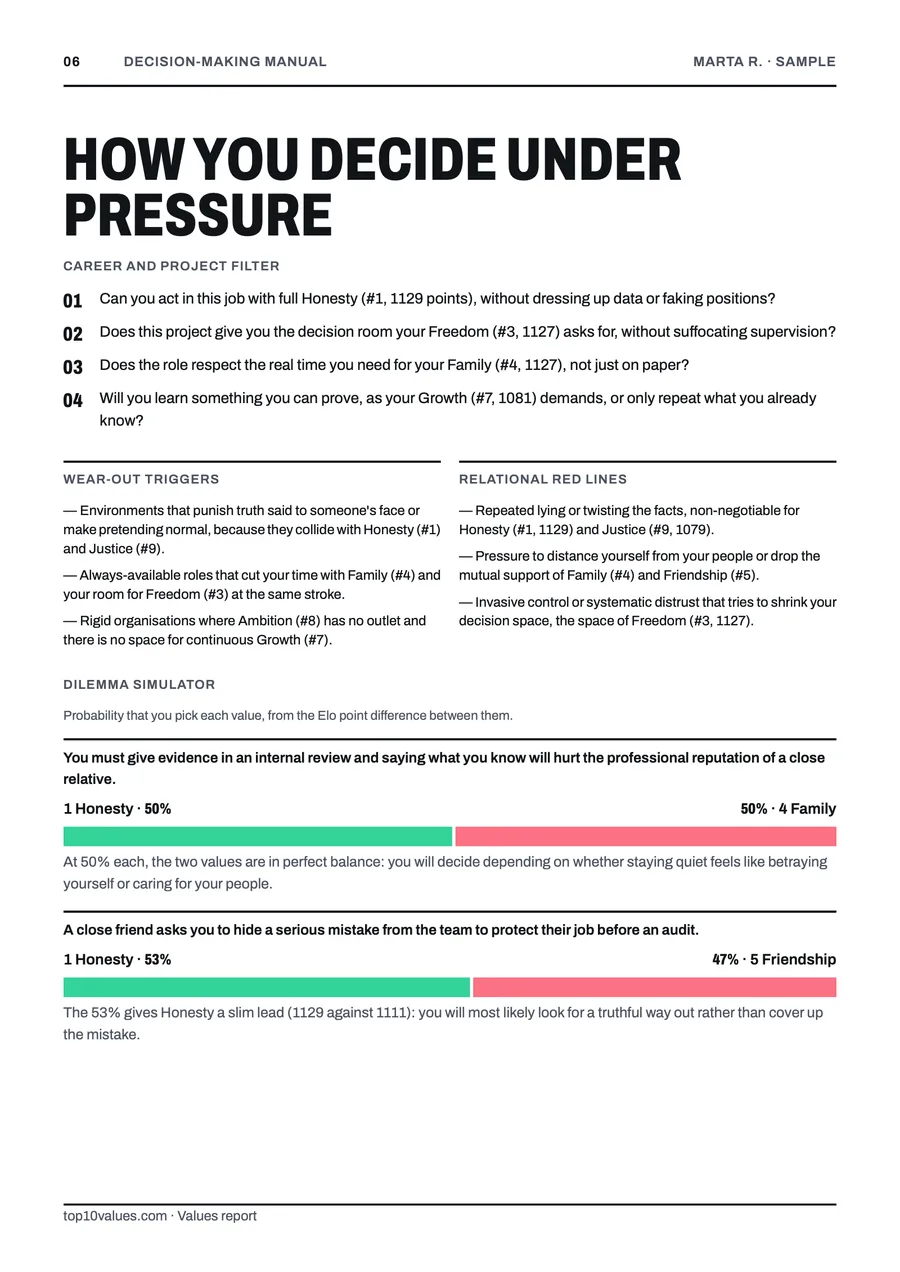
Sample page with fictional data (Marta R.), not yours. Your report is written from your own choices.
Frequently asked questions
Can curiosity be trained, or are you born with it?
It can be trained. There are differences of temperament between people, but curiosity responds to habits: if you allow yourself to ask questions, try new things and stay a little longer with what intrigues you, it is sustained and grows; if you silence it with "I know already" or "I haven't got time", it fades. A useful approach is to begin with what already interests you a little, because, on Loewenstein's model, curiosity arises when you perceive a gap between what you know and what you would like to know. Learning the basics of a subject is often what makes you want to go further.
What is the difference between curiosity and scatter?
Curiosity goes deeper; scatter skips. One clear sign is what you are left with: with curiosity you come away with a richer understanding, an improving skill or a link between ideas; with scatter you come away feeling you have seen a lot without grasping anything. You don't have to give up exploring many things, but now and then it pays to pick one and stay with it long enough for it to bear fruit. Another clue: if you start something new just as the previous thing gets difficult, you may be driven by escape rather than interest.
Where does the saying "curiosity killed the cat" come from?
According to students of English proverbs, the oldest form was not about curiosity but about worry: "care killed the cat", meaning that anxiety can finish anyone off. In time the word was swapped for "curiosity", and the saying came to be used as a warning against poking your nose into other people's business. It is a good illustration of how society has long been wary of curiosity. Some complete the proverb with "but satisfaction brought it back", a later addition. What is true is that asking without weighing the consequences can be unwise, and that is what the shadow side of this value is about.
Is curiosity bad when it is aimed at other people's lives?
It depends on how and why. Taking an interest in how someone lives, thinks or feels, and listening attentively, is a form of care. Hunting for gossip, pressing someone about what they don't want to tell, or looking into their life behind their back is another matter. A good test is to ask yourself whether you would put the same question to that person's face and whether you would accept an "I'd rather not say" without annoyance. If the answer is yes, your curiosity is probably travelling with respect.
What does philosophy say about curiosity?
Aristotle opens his "Metaphysics" by saying that all human beings by nature desire to know, and he links the origin of philosophy to wonder at what we do not understand. Centuries later, Montaigne made the question "what do I know?" the motto of his essays. What is interesting is that in both cases curiosity is presented not as a luxury but as part of what it means to think. There is also a critical tradition: some ancient Christian thinkers, such as Saint Augustine, distrusted curiosity when it was reduced to a hunger to see things for the sake of seeing them, an intuition that connects with today's scatter.
When Curiosity clashes with…
Invented scene. Marcos has spent three weeks on one idea: understanding how mechanical watches work. He has taken apart an old one, bought tools and watches videos until two in the morning. Meanwhile the reading for his master's module sits unopened and the deadline is Friday. Curiosity cannot be scheduled, which is exactly why it is valuable, but it also jumps to the next thing when the hard part begins. Discipline asks him to finish what he committed to before opening another door. Loyalty shows up through his project partner, Aina, who is counting on him and covered his share last week. And peace complains about the short nights and the feeling of having ten things open at once. A useful way out is to set aside a fixed slot for the new thread, write down questions instead of chasing every one, and finish first what someone else is waiting for. More cases in conflicting values.