Freedom
Adventure
Seeking exciting new experiences.
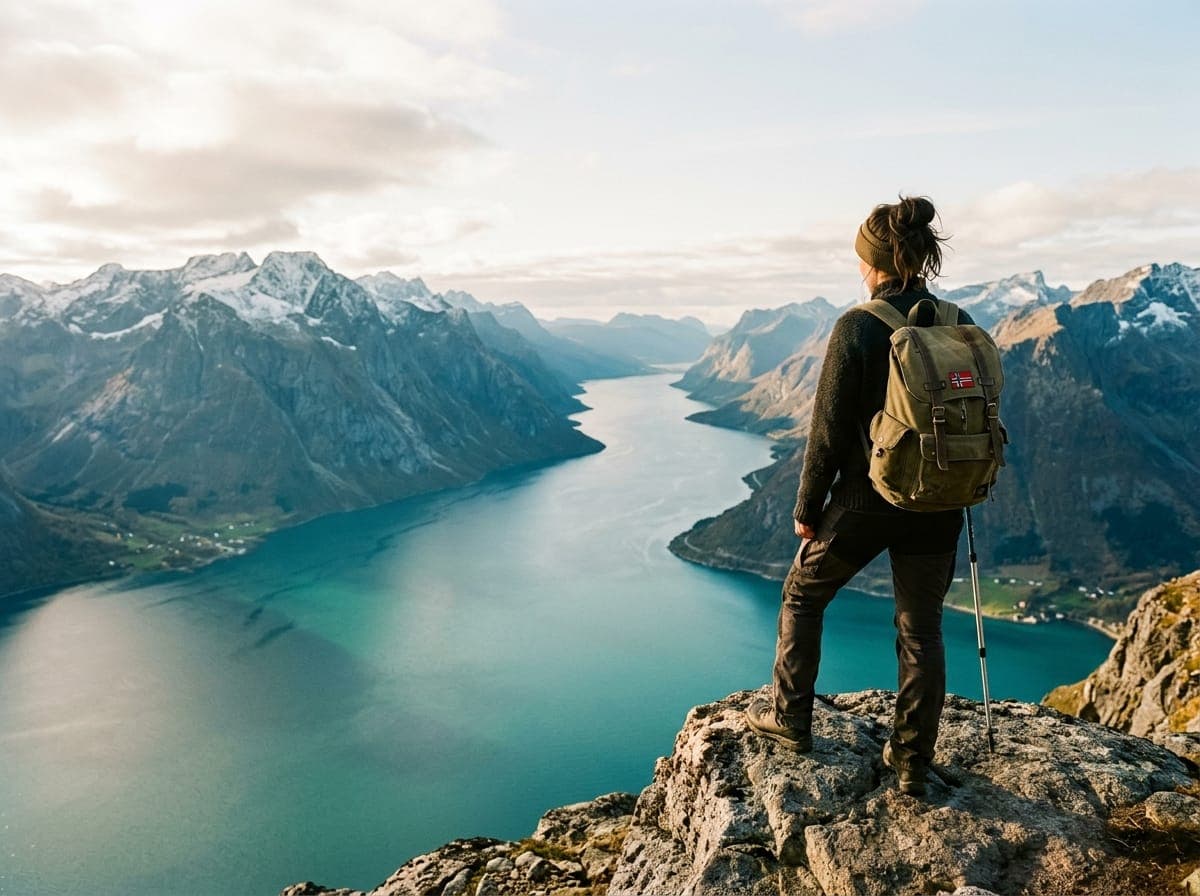
Adventure is the active willingness to step out of the familiar and expose yourself to new, uncertain or stimulating experiences. People who prioritize this value don't look for the safe routine; they look for the charge that comes from exploring territory—physical, cultural or professional—that they haven't yet mastered. It can show up as travel, controlled-risk sports, or accepting projects with an unpredictable outcome. Unlike simple intellectual curiosity, adventure also involves action and a consciously accepted degree of risk. For these people, the possibility of regretting not having tried weighs more than the fear that something might go wrong along the way.
What does this value mean?
Adventure, as a value, is the inclination to choose the unfamiliar every now and then, even when the familiar is right there: an unmarked path, a city with no booking, a project nobody around you has attempted. Three ingredients set it apart from mere novelty. First, the outcome is genuinely uncertain: it could go well, so-so or badly, and you will not know until you are in it. Second, you take part with your body and your decisions, not as a spectator. Third, part of what you are after is that uncertainty itself, not only the reward at the end. Ranking it high means that when life offers you the known option and the unknown one at a similar price, the unknown one weighs more for you than it would for someone else.
You spot adventure as a value less in what people say than in what they sign up for. The nurse in her early thirties who applies for a six-month contract at a hospital on an island she knows only from the map, because she wants to see what it is like to work where the only ambulance is a helicopter. The father who, on a Saturday with no plans, turns up at the station with his two kids and buys tickets for the first regional train out, with one rule: back home to sleep. The sixty-eight-year-old woman walking the Camino de Santiago for the first time without booking hostels, who accepts that some night she may end up on a mat in a sports hall. The developer who puts a hand up for the project built on technology nobody on the team knows, aware that for a month she will look like the slowest person in the room. What they share is not physical risk or distance but a preference: between the closed version of a plan and the open one, they often pick the open one, and the improvising it demands is part of the appeal. The idea is old. In The Hero with a Thousand Faces (1949), Joseph Campbell called it “the call to adventure”: the moment when the hero of many traditional stories is invited to leave the known world, and he noted that the first reaction is often to refuse. A domestic version of that scene plays out every time you hesitate between the usual plan and the one whose ending you cannot predict.
What it does NOT mean
It is not chasing adrenaline or doing extreme sports. Some people skydive every month and run the rest of their lives on a fixed script; others have never climbed anything yet change country, trade and language with an ease that alarms their families. Nor does it simply mean travelling a lot: a package tour with every transfer and meal sorted in advance can be very pleasant and contain no adventure at all, while entering a neighbourhood cooking contest when you have never cooked for strangers does. It is not recklessness: healthy adventure works out what could be lost before setting off, and recklessness finds out along the way. It is not collecting experiences to post about; if the photo matters more than what happens to you, the real value at work is a different one. And it helps to separate it from three neighbours it is often confused with. Freedom is the room to make decisions about your life; adventure is one of the things you can do with that room, and one of the ways you spend it. Curiosity is wanting to know what something is like; adventure is stepping inside it, with the chance that it goes wrong. Courage is acting despite fear for something that matters to you; in adventure, the unknown is not the obstacle you get past on the way to something else, it is a large part of what you came for.
Related concepts
Why might it matter to you?
A life with no dose of the unknown can be comfortable and still slowly shrink. Not because anything goes wrong, but because the list of things you believe you can handle gets shorter each year. If you have never had to find your way with no signal, ask for help in a language you barely speak or deal with a breakdown sixty miles from home, you do not know whether you could, and what you do not know tends to look impossible. Adventure corrects that list with evidence. After getting yourself out of a situation you did not control, your confidence rests not on what you tell yourself but on something you have tested. It also changes how you remember your life: plenty of people notice that whole months of identical weeks collapse into a single block in memory, while three days somewhere new leave dozens of sharp scenes. There is a benefit for relationships too: shared adventures, especially the ones that went slightly wrong, turn into stories that hold a group together for decades. And there is a practical one. People used to moving through uncertainty can cope better with the changes they did not choose, such as a redundancy, a forced move or a diagnosis, because they already know the feeling of having no map and carrying on anyway. Adventure does not protect you from those blows, but it gives you some practice with not knowing.
How can you live this value?
- Book a dose of the unknown into your calendar every month. It does not have to be a trip: a walk through a part of your town you have never set foot in, a sport you have never tried, a class in a language you do not speak, a meal at a restaurant where you recognise nothing on the menu. What matters is that it is something you cannot do yet, or cannot predict, and that it has a date.
- Set your limits before you leave, not halfway through. Decide three things in advance: how much money you can lose without it really hurting, which health risk you will not accept, and how you get back if everything goes sideways. With those three lines drawn, you can improvise inside them calmly. Without them, the improvising is done by tiredness or by the excitement of the moment. If the plan involves mountains, the sea or a country you do not know, add the basics: tell someone where you are going and when you expect to be back, check the weather forecast, take out insurance, and do not take on any physically risky activity without the training, the equipment and, where needed, the guide it calls for.
- Plan less on purpose. If you usually have everything nailed down, try booking only the first night of a trip, leaving a whole afternoon unplanned, or going to a local group's meeting without looking up its members first. Adventure does not need distance; it needs gaps where something you did not foresee can happen.
- Say yes to an invitation you would normally turn down. The colleague's wedding in a village you have never heard of, the hiking club's outing with people of a different generation, the work trip nobody wants. Many adventures are not sought out: they arrive as an awkward proposal and get lost to a “maybe next year”. Before answering, ask yourself whether you are declining for a real reason or out of habit.
- Match the dose to the people with you. If you are travelling with a six-year-old, with your mother or with a friend who has never slept in a tent, everyone's adventure cannot be yours. Offer a version that is a fair stretch for them, and save your tougher version for when you go alone or with people at your level.
- Tell the story, including the parts that went badly. When you get back, write down or tell someone three things: what you did not expect, what you decided on the spot and what you would do differently. That way each outing becomes usable experience for the next, not just a nice memory, and you start telling apart the risks that were worth it from the ones that only worked out by luck.
Advertisement
What happens when you don't live up to this value?
When adventure is missing from the life of someone who values it, the sign is rarely a dramatic crisis. It is more a sense of narrowness that is hard to explain. Everything works, but the weeks are so alike that you struggle to tell them apart afterwards. Holidays are always at the usual apartment, the usual restaurants, the usual route to work. You start talking about what you will do “when the kids are older”, “when I retire” or “when there is more money”, and the list grows while the calendar fills with more of the usual. Another sign is a quiet envy of people who talk about trips, changes or risky projects, sometimes dressed up as criticism: “that's irresponsible”, “they'll be back”. Substitutes appear as well: documentaries about explorers, videos of people crossing continents in a van, travel plans that never get booked. Enjoying other people's adventures can be a perfectly good pleasure, but when it takes the place of your own, it is usually a sign the value has been parked. To check your own pulse, think of your last day with no script: if you have to go back years to find one, the value has been on hold for a while.
The healthy side and the shadow
When does this value stop helping you and start limiting you?
Healthy expression
Grounded exploration
In excess
Running towards the new
The most recognisable shadow of adventure is using novelty to avoid staying anywhere. When a job, a relationship or a city stops surprising you, you feel the urge to move on, and you call it an adventurous spirit when it is often difficulty sitting through the dull stretch that everything worthwhile has. People who live like this collect beginnings and very few second years. A second shadow is passing the risk on to others: the adventure you choose is sometimes paid for by people who did not choose it, like a partner left holding the mortgage, children who change schools every two years or colleagues who rescue the project you walked away from. A third is escalation: what thrilled you last year now feels tame, and to get that thrill again you need more distance, more height or more risk, until the risk is no longer calculated. The healthy version has clear features: you know your limits before setting off, you can stay put when something deserves it, you ask the people who depend on you before risking what is also theirs, and you enjoy the adventure even if nobody will ever hear about it.
This value at work
At work, adventure shows in career decisions and in the kind of tasks you ask for. Between two similar offers, you are drawn to the one that involves opening something up: an office in another country, a product that does not exist yet, a client nobody has managed to win. You volunteer for the pilot, the trade fair in a new city, the temporary posting. Some jobs have adventure built in, such as international aid work, film crews, street reporting, mountain guiding, field research or work at sea, and people who choose them usually accept irregular hours, uneven pay or long spells away from home in exchange. In a stable office role, adventure looks for other outlets: offering to trial a tool before anyone else, joining a cross-team project, or spending a week on the shop floor, in a store or with customer support to see the work from another angle. If you manage people, the value gives you an advantage and a danger. The advantage is that you spread a taste for trying things and make sure a reasonable mistake is not punished. The danger is changing direction every quarter because last quarter's strategy no longer excites you, while your team, which needs stability to deliver, wears out from one reorganisation after another. One workable rule is to separate clearly what gets explored from what gets maintained: a small share of time and budget for experiments with a review date, and the rest protected from your enthusiasm.
This value in relationships
In friendship, adventure tends to play a specific role. There are friends you share the sofa with and friends you share uncertain outings with, and people who rank this value highly are usually the ones who suggest, organise and drag the group along. That role deserves real credit. Many of the stories a group of friends still tells twenty years later began because someone insisted on driving off on a Friday night to a beach nobody knew, or on signing everyone up for an obstacle race without training. Shared adventure builds a particular kind of trust: you have seen the other person tired, lost or scared, and you know how they react. But it has its friction points. The first is the rhythm of life: at twenty-five almost the whole group is available, and at forty some have small children, others are caring for their parents and others cannot afford the cost. If every plan you suggest needs spare time and spare money, you will lose company without noticing. The second is pressure: pushing until someone says yes to something that genuinely frightens them is not encouragement; it takes the decision away from them. A “no” to a via ferrata or a trip with no bookings deserves as much respect as a “yes”. It is also worth keeping friendships where nothing extraordinary happens, where the biggest adventure is trying the new bar on the corner.
This value in love
In a couple, one thing is worth clearing up first: novelty sought behind your partner's back has nothing to do with this value. Within a relationship, adventure plays out on different ground, mostly once the beginning is over. Early on almost everything is new, and someone who values adventure can live that stage with special intensity. The challenge comes later, when living together, bills and routine take the place of surprise. It is easy then to mistake a lack of novelty for a lack of love, and to look elsewhere for what has stopped being cultivated at home. The more useful question is which adventures you can have together: learning to sail, moving to another city for a year, taking a trip each summer where the destination is drawn out of a hat, or something as small as a monthly dinner at a place the other person picks without telling you where. When the two of you hold this value at different levels, it takes careful negotiation. For the partner who does not share it, a trip with nothing booked can be a source of real anxiety, not a lack of spirit; for the one who holds it highly, identical holidays every year can feel like a slow suffocation. Explicit agreements work well: one open trip and one fully planned, an adventure you take with friends while your partner does something else, or an agreed margin for improvising decided in advance. And some big decisions, such as moving abroad, only go well if both people choose them, not if one drags the other along.
This value in family
In family life, adventure changes shape with every age. With small children it rarely means big trips. It looks more like letting them climb a little higher up the tree than you are comfortable with, always somewhere you can keep an eye on them, a night camping in the grandparents' garden, or a walk where they choose the way at every fork. Many people with this value find that what they pass on is not the destination but the attitude towards the unexpected: if your kids watch you handle a missed train with humour, they learn that surprises can be dealt with. With teenagers, adventure carries more weight: a school exchange, a first trip with friends, a summer of volunteering. For many parents the challenge is letting go, preparing the departure well and accepting that there will not be news every two hours. It also runs the other way. In some families the seventy-five-year-old mother announces she is off to Peru with a group of retirees, and the adult children who always urged her to get out more suddenly want to forbid it. Respecting the adventures of older relatives is part of the value. And there is a risk worth facing squarely: the children of very adventurous parents sometimes needed the opposite. Frequent moves, new schools and interrupted friendships can be a great education for some kids and a source of insecurity for others. Asking each child, in a way that suits their age, what they find hard and what they enjoy about the life you lead keeps your value from becoming their burden.
This value and yourself
If adventure is among your top values, the word “routine” probably makes you slightly uneasy, you likely remember your life by its changes more than by its stable periods, and repeating a holiday destination is hard for you. You may notice it in small habits: taking the wrong exit on purpose to see where it goes, ordering the dish you cannot decipher, or proposing last-minute plans that throw people who had their weekend sorted. That taste for the open option has a less comfortable side. How many of your changes were choices, and how many were escapes from something that had become difficult? Have you ever made it through the dull stretch of a project, a job or a relationship, or do you tend to leave just as it starts? Who pays for the less visible part of your adventures? Finding it halfway down your ranking, or lower, is not a shortcoming either: it may mean you value depth, stability or looking after what you already have, and that you find novelty inside the familiar, for instance in getting to know a person or a craft ever more closely. The only question worth asking is whether you have placed it there by choice or out of fear, because from the outside the two look alike and from the inside they feel very different.
What are you willing to sacrifice for this value?
Adventure costs comfort, security and sometimes the approval of the people around you. Would you accept lower pay for a year to work somewhere that makes you start from scratch? Would you spend your savings on a trip without knowing exactly what you will find, knowing you could have played it safe? Could you bear your family calling what you are doing madness, and do it anyway after hearing them out calmly? Would you sleep badly, eat strange food and get lost now and then in exchange for what can only be lived outside your home ground? Would you give up a restful afternoon to try something that makes your stomach turn just thinking about it? And, turning it around, would you let go of an adventure you long for because someone who depends on you cannot take on the risk right now? Think of the last bad night's sleep, lost pay or family argument you accepted in exchange for something uncertain. If the date is recent and you would do it again, adventure genuinely steers your life. If every answer starts with “once things settle down”, it may be more nostalgia than practice.
Signs you're betraying this value
You betray adventure when you turn down a tempting proposal out of habit, when you let the fear of looking foolish decide for you, or when you turn every trip into a list of locked-in bookings that leaves no room for anything unplanned. Also when you have spent years saying “some day” about a project without taking the first concrete step, such as asking for information, setting money aside or picking a date. There is a subtler betrayal in the opposite direction: taking risks without preparation and calling it adventure, endangering people who did not choose that risk, or abandoning something just when it demands persistence while claiming you need novelty. And a very common one: living only other people's adventures, on screen or in conversation, while your own weeks never change.
Turning the value into goals
Value
Adventure
Behavior
Once a week, pick one small thing you have never done, such as a route, a dish or an activity, and do it without researching it too much beforehand
Goal
Take one trip this year of at least two days without everything planned, with limits on money, safety and the way back set in advance, and write down what you learned when you return
Habit
On the first Sunday of each month, spend fifteen minutes noting your next unfamiliar experience, giving it a date and deciding who you will share it with
Questions to reflect on
- What is the adventure from your life you remember most, and which part of it would you like to feel again now, at your current age and in your current situation?
- Which uncertain proposal have you turned down out of habit in the past year, and what would it have taken for you to say yes?
- When did you last not know how the day would end and feel fine about it?
- Which of your recent changes were choices, and which were ways of escaping something that had become difficult?
- Who around you pays part of the cost of your adventures without having chosen them, and have you talked to them about it?
- If you had to have an adventure without leaving your town, what would it be, and what would it take to do it before the month is out?
How much are you living this value?
Look back over the last month and find at least one moment when you chose something unfamiliar while the familiar was available, and one when you said no to something that tempted you. Then score your recent weeks from one to ten by how much room they left for something unplanned to happen. If you score below seven, write down now one small experience you have never had, give it a date within the next two weeks and decide which limit you will respect.
When two values clash
Adventure clashes with Financial Security almost by definition: the unknown usually costs money, and many career adventures mean giving up a steady salary or investing in something with no guaranteed return. How much that matters depends on your stage of life. At twenty-five with no dependants, the risk does not weigh what it does at fifty with a mortgage, and the sensible move is usually to venture out with a cushion and a date to reassess. With Health the tension cuts both ways: physical adventure can strengthen you or injure you, so it pays to let the challenge grow with your preparation rather than your enthusiasm. With Family and Loyalty, the conflict shows up when your wish to explore runs into the needs of people who count on you: a move abroad that separates your children from their grandparents, or a switch of project that leaves your business partner with the unfinished work. With Discipline the friction is about the calendar, because the routine a training plan, a degree or a career requires leaves little room for improvised plans; yet they often help each other, since discipline is what saves the money and prepares the body for the adventure. With Inner Peace and Simplicity, the clash is one of pace: someone seeking calm or a life with fewer things may experience every outing as disorder. With Freedom, Curiosity and Courage the relationship is an alliance, although they are distinct values, as explained above. And with Learning and Vitality there is usually mutual reinforcement: every outing you make the most of teaches you something and gives you energy back, as long as it does not leave you drained for ordinary life.
Is “Adventure” one of your top 10 values?
Find out by playing and comparing this value with the other 49
How the Elo ranking works and its limits in the methodology.
What does the paid report include?
When you finish the 100 comparisons you will see your Top 10 on screen. If you want to go further, there is a PDF report on your personal values: €9.95 (VAT included), one-off payment. To buy it you need to save your game with a Google account.
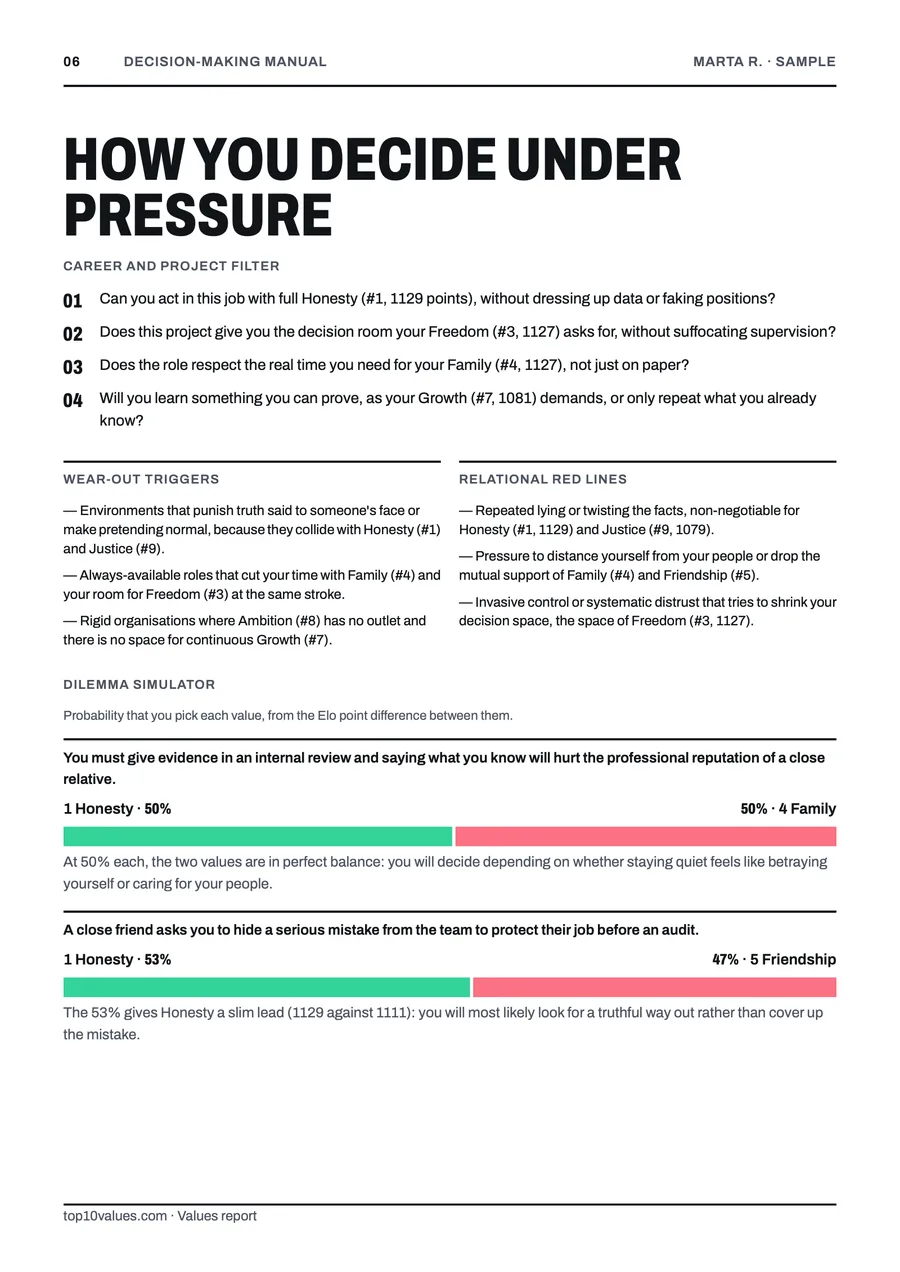
Sample page with fictional data (Marta R.), not yours. Your report is written from your own choices.
Frequently asked questions
What does it mean to have adventure as a value, and what are everyday examples?
Having adventure as a value means giving importance to living, now and then, through new situations whose outcome you do not know, and choosing them even when the safe option is available. Everyday examples: walking home by a route you do not know; accepting an invitation to a wedding in a village where you know nobody; signing up for a climbing, dance or pottery class with no experience; ordering the dish whose name you cannot make out; spending a weekend away with only the first night booked; or joining a work project that uses a tool you have not mastered. The common thread is that you choose the uncertain and take part in it rather than just watching.
How are adventure, freedom and curiosity different?
They overlap, but each answers a different question. Freedom answers “can I decide?”: it is having room to shape your life without needing anyone's permission. Curiosity answers “what is out there?”: it is the wish to know or understand something you do not yet know. Adventure answers “shall I go in?”: it is throwing yourself into a new and uncertain situation, with your body and your decisions, and accepting that it may go wrong. You can value freedom highly and use it to lead a quiet, predictable life; you can be deeply curious and satisfy that curiosity by reading at home; and adventure usually needs a bit of both, because it requires room to go out and the wish to find out what is there.
Is adventure just another word for seeking adrenaline?
No. The appetite for intense experiences is a trait psychology has studied for decades: the psychologist Marvin Zuckerman called it “sensation seeking” and developed scales to measure it, set out in his book Sensation Seeking: Beyond the Optimal Level of Arousal (1979). That trait is about the intensity of what you feel. Adventure as a value is more about the unknown than about intensity: learning a language in the country where it is spoken, changing careers at forty or walking a quiet route without a map can be great adventures without a single rush of adrenaline.
Do you need money to have adventures?
Money widens the options, but it is not what makes something an adventure. Many of the most valuable ones are close to home and cheap: walking across a neighbouring county, sleeping in a mountain hut, doing a house swap or a language exchange, volunteering for something you know nothing about, or learning a manual craft at a local workshop. What turns an experience into an adventure is the uncertainty and your active part in it, not the distance or the price. If your budget is tight, it helps to set a clear spending limit and to look for novelty in what you do rather than where you go.
How do you live with a partner or family who do not share this value?
Start by not treating their caution as a flaw: for many people, a lack of planning causes real anxiety. Negotiating formats works better than arguing about the value. For example, alternate a planned trip with an open one, agree in advance which part of the plan will be improvised, have some adventures with friends who enjoy them as much as you do, and share gentler ones with your partner or your children. And listen closely to their objections: sometimes they point to a risk your enthusiasm hides from you.
Where does the word “adventure” come from?
It comes, through Old French “aventure”, from the Latin verb “advenire”, meaning “to arrive”. Its original sense is roughly “what is about to arrive”, that is, what is going to happen and you do not yet know. In older English the word could simply mean chance or fortune, and its shortened form survives in the old phrase “at a venture”, meaning at random. The idea fits the value well: adventure is less about the extraordinary than about what has not happened yet and could turn out in many ways.
Can you value adventure with small children or past a certain age?
Yes, although it changes shape. With small children, adventure usually means shorter, closer plans with room for the unexpected: a night in a cabin, a Saturday train with no fixed destination, a walk where they choose the way. With age, what you lose in physical stamina you often gain in time, judgement and calm in the face of surprises, and many adventures do not require fitness at all: a course abroad, a volunteering stint, a new hobby or a group trip. The point is to adjust the challenge to your situation, not to give up on the unknown altogether.
When Adventure clashes with…
Invented scene. Jorge has saved 6,000 euros and found a one-way ticket to New Zealand with a working holiday visa. He is 31, had knee surgery two years ago, and his brother has just become a father. Adventure wants to say yes before fear drafts a list of objections. Security does the sums: that money is his cushion, and coming back without a job in a weak market could cost months. Health asks whether the knee will hold up through weeks of farm work and long hikes. Family points out that the baby will arrive just when he is on the other side of the world. He does not have to give up the trip: he could go for six months instead of twelve, set aside a minimum that stays untouched, and see a physiotherapist first. A well-prepared adventure is still an adventure. More scenes in conflicting values.