Personal Growth
Courage
Acting despite fear.

Courage is the willingness to act in line with your own principles or goals despite the fear that is present, rather than waiting for it to disappear entirely. People who value courage face difficult conversations, make risky decisions or defend unpopular positions when they consider it necessary, accepting discomfort as part of the process. This value doesn't mean the absence of fear, but the ability to act anyway when something important is at stake. Courage usually shows up in specific moments—asking for a change, setting a boundary, starting something new without guarantees—rather than as a constant, visible trait in everyday life.
What does this value mean?
Courage is the willingness to act for something that matters to you even when you feel afraid and know it may cost you something: a reputation, a comfortable relationship, an income, other people's approval. It is not the absence of fear. It means fear does not get to make the decision when what is at stake is worth it.
Courage lives in the space between what you think and what you actually do when acting is uncomfortable. Think of telling your manager that the client deadline cannot be met, apologising first after an argument in which you were partly right, leaving a steady job that is wearing you down, finally booking the medical check-up you have put off for months, or telling your family you are changing direction. Few of these moments look cinematic; usually the whole thing comes down to a ten-minute talk you have dodged for weeks. Aristotle placed courage midway between two faults, cowardice (too little) and recklessness (too much). The framing still holds: the point is not to leap every time but to judge which risks deserve it.
What it does NOT mean
Courage is not recklessness or a taste for danger. A person who puts their savings on an unexamined bet is being rash, and is often running from something else, like boredom or an unmade decision. Nor is it the same as aggression. Shouting in a meeting, or saying «I just tell it like it is» as an excuse to hurt people, usually takes less nerve than hearing criticism without getting defensive. It is not the absence of doubt either: a person who feels no fear before something serious has probably not grasped what they are risking. And it should be kept apart from boldness that chases applause. Genuine courage is usually low-key and has no need of spectators.
Related concepts
Why might it matter to you?
The choices that shape a life are seldom comfortable: changing career, leaving or staying, ending a relationship that no longer works, reporting wrongdoing, asking for what you deserve. If fear always gets the final say, what you avoided ends up authoring your life, and the years turn that into «I wish I had dared». It is also the value that puts weight behind the others. There is little point valuing honesty if you will not say an uncomfortable truth, or fairness if you stay quiet while someone is treated unjustly in front of you. That is why many people find that their courage is not an isolated quality but the part that turns the rest of their values into actions.
How can you live this value?
- Name the fear precisely before deciding. «I'm scared of the conversation» is vague; «I'm scared she'll say no and I'll have to rethink the whole project» is something you can work with. Once it is specific, the fear often turns out to match a small risk, or points to something you can prepare for.
- Work out the worst realistic outcome, not the catastrophic one. If you ask for a raise, the worst realistic result is a «not right now» and a slightly tense chat, not being fired. Ask yourself what you would do then and how you would repair it. Once you have an answer, the leap stops being a leap into the dark.
- Break the big thing into steps you can take this week. Someone who wants to leave a job that is hurting them can start by finding out what is on the market, talking to a person who already made that move, and building a cushion of a few months' expenses. Small steps are not cowardice in disguise as long as they have dates and you keep them.
- Do the thing you dread most first, while you still have energy, instead of leaving it for the end of the day. What is postponed gains weight: an awkward phone call that takes five minutes today can become a weeks-long problem.
- Find someone who will tell you the truth before you act and ask them to challenge you, not just cheer you on. Courage improves with an outside pair of eyes that can tell a risk worth taking from running away forwards.
Advertisement
What happens when you don't live up to this value?
When courage is missing, you get very good at finding reasons to wait: «once this busy patch is over», «once the kids are older», «when the time is right». You accept tasks you do not want because saying no is awkward, stay silent in the meeting and then resent that it was decided without you, and spend weeks rehearsing a conversation that never happens. Sometimes the cost is not dramatic but cumulative: a friendship cooling over what was never said, a personal project that never leaves the drawer, a version of you that looks less like the one you wanted to be each year. Avoiding a fear brings quick relief, which feeds it: each time you give way, the next step looks taller.
The healthy side and the shadow
When does this value stop helping you and start limiting you?
Healthy expression
Courage with judgement
In excess
Recklessness
The excess is recklessness: taking risks you have not measured, mistaking impulse for conviction, or using «courage» to avoid the hard work of preparing. You will recognise it in decisions made to prove something to someone, in bets that put at risk what other people rely on you to protect, or in the habit of quitting whenever things get complicated and calling it «leaving your comfort zone». The healthy version asks what you are defending and what you can afford to lose. There is also a less visible shadow: courage misread as an obligation to put up with everything. Staying in a situation that harms you is not always strength, and sometimes the brave thing is to leave or to ask for help.
This value at work
At work, courage usually takes the form of an uncomfortable sentence said in time: «this plan won't make the date», «I think I got the calculation wrong», «I disagree, and here is why». On teams where nobody risks saying these things, small problems stack up and go off together. It also shows in the opposite direction: owning up to your own mistake before someone else finds it, defending a colleague who is being blamed for no reason, or putting forward an idea that might be turned down. Leaders have their own version: making an unpopular decision and explaining it, or saying «I don't know». Be careful not to mistake it for bluntness. You can disagree firmly and respectfully at once, and people who manage that tend to be listened to for longer.
This value in relationships
In friendship, courage is saying what the other person needs to hear even though they may be upset: that their partner treats them badly, that you have felt unheard for months, or that their drinking worries you. Friendships cool as much through what is left unsaid as through what is said. It also means making the first move: texting someone you lost touch with after a silly row, inviting someone new, admitting you miss a person. And it means tolerating disagreement without ending the relationship. Someone who needs everyone to agree with them is not feeling friendship, they are feeling fear of rejection. Sometimes the greatest show of care is a hard conversation handled with tact, without lecturing and without trying to win.
This value in love
With a partner, courage mostly means letting yourself be seen. Saying «I love you» before the other person does, admitting something hurt instead of pretending nothing happened, asking for what you need without waiting to be guessed. It also covers the big decisions: moving in together, having children or not, saying that something is not working and suggesting couples counselling. And at the other end, accepting that a relationship has ended when staying is only habit or fear of being alone. That ending is not always a failure; sometimes it is the most honest decision for both people. In a healthy relationship, courage is asked for gently: you do not demand that the other person expose more than they are ready to.
This value in family
Most families have a conversation that has been waiting for decades: dividing an inheritance, caring for ageing parents, an old grievance between siblings, a life decision you know they will not understand. The courage needed is not for picking a fight but for accepting some short-term upset in return for more honest ties. With children it appears differently: setting limits that will not make you popular, saying no to what you consider harmful, or letting them take age-appropriate risks rather than shielding them from everything. Children learn more from watching how you handle your own fears, apologise when you are wrong, or talk frankly about something hard, than from hearing you talk about bravery.
This value and yourself
If courage sits near the top of your list, you may find it unbearable to spend a life sidestepping what matters, or perhaps something you went through showed you how costly silence can be. It may also reveal that you demand too much of yourself: if every decision has to prove your strength, you may find it hard to accept that it is fine to doubt, to rest, or to admit you cannot cope with something. If your courage switches on mainly in physical or professional risk and disappears in intimate conversations, that is worth noticing. And if you see yourself as brave but always on other people's causes, ask what matter of your own you are leaving pending.
What are you willing to sacrifice for this value?
Could you live with someone being angry at you if that is the price of staying true to what you think? Or losing an opportunity, a circle of friends or a familiar stability for something that may not work out? Think of one decision from recent years that you made out of fear and one you made despite it, and compare how you feel about each today. Courage means tolerating uncertainty, being judged and sometimes being wrong in front of others. If those losses seem unbearable, this value may be on your list more as an aspiration than as a practice, and there is nothing wrong with admitting that: it is a good starting point.
Signs you're betraying this value
You betray courage when you know what you should do and invent a justification for not doing it, when you let someone else carry blame that is yours because owning it is embarrassing, or when you boast of being frank with people who cannot answer back but go quiet around those who have power over you. Also when you confuse courage with demanding it of others: asking a colleague to report something while you stay out of it. Another sign is group courage: saying aloud what everyone already thinks when it is safe, and keeping quiet when there is real risk. Above all, this value breaks down when the distance between what you say you admire and what your diary shows never closes.
Turning the value into goals
Value
Courage
Behavior
Have the conversation you have been putting off this week, prepared with what you want to say, what you will ask for and what you will do if the answer is no
Goal
Resolve within three months one important matter you are avoiding today (a job change, a family conversation, a personal project) through dated steps
Habit
Every Sunday, write down which uncomfortable decision is pending, the smallest next step and the exact day you will take it; at the end of the week, note whether you did
Questions to reflect on
- Which conversation have you been avoiding for months, and what do you think will happen if you have it? And if you do not have it for another year?
- When did you last do something despite being afraid, and what helped you take the step?
- In which area are you brave with ease (work, sport, travel) and in which do you freeze (relationships, family, money)?
- Which decision are you presenting as «being prudent» when it is really fear?
- Who do you admire for their courage, and what exactly do they do that you could do on a small scale?
- What risk have you taken out of pride or to prove something, and what might have happened if you had thought it through calmly?
How much are you living this value?
From 1 to 10, how much of what you decide each month is decided by fear instead of by your values? If it is above 5, pick one small thing you have been putting off and do it within 48 hours: send the message, book the appointment, say the no. Then note how long the discomfort really lasted and compare it with what you had imagined.
When two values clash
Courage clashes with Security when the step you want to take puts at risk the income or stability of people who depend on you: leaving a job with young children does not weigh the same as doing it at twenty-five with no commitments. Here the brave thing may be to take the risk with a plan, and not necessarily right away. It clashes with Inner peace when telling the truth breaks an apparent calm: keeping quiet about an injustice to avoid an argument is the comfortable exit, though sometimes silence is the right call. With Loyalty the conflict is fine-grained: do you defend a friend who is wrong, or tell them they are wrong? With Humility, courage can look like arrogance; the difference is whether you are willing to hear objections. And with Honesty they reinforce each other without being the same thing: you can be truthful at no risk, and courage begins where truthfulness costs something. There is no single rule. It often helps to ask who benefits from your silence and who is harmed by it.
Is “Courage” one of your top 10 values?
Find out by playing and comparing this value with the other 49
How the Elo ranking works and its limits in the methodology.
What does the paid report include?
When you finish the 100 comparisons you will see your Top 10 on screen. If you want to go further, there is a PDF report on your personal values: €9.95 (VAT included), one-off payment. To buy it you need to save your game with a Google account.
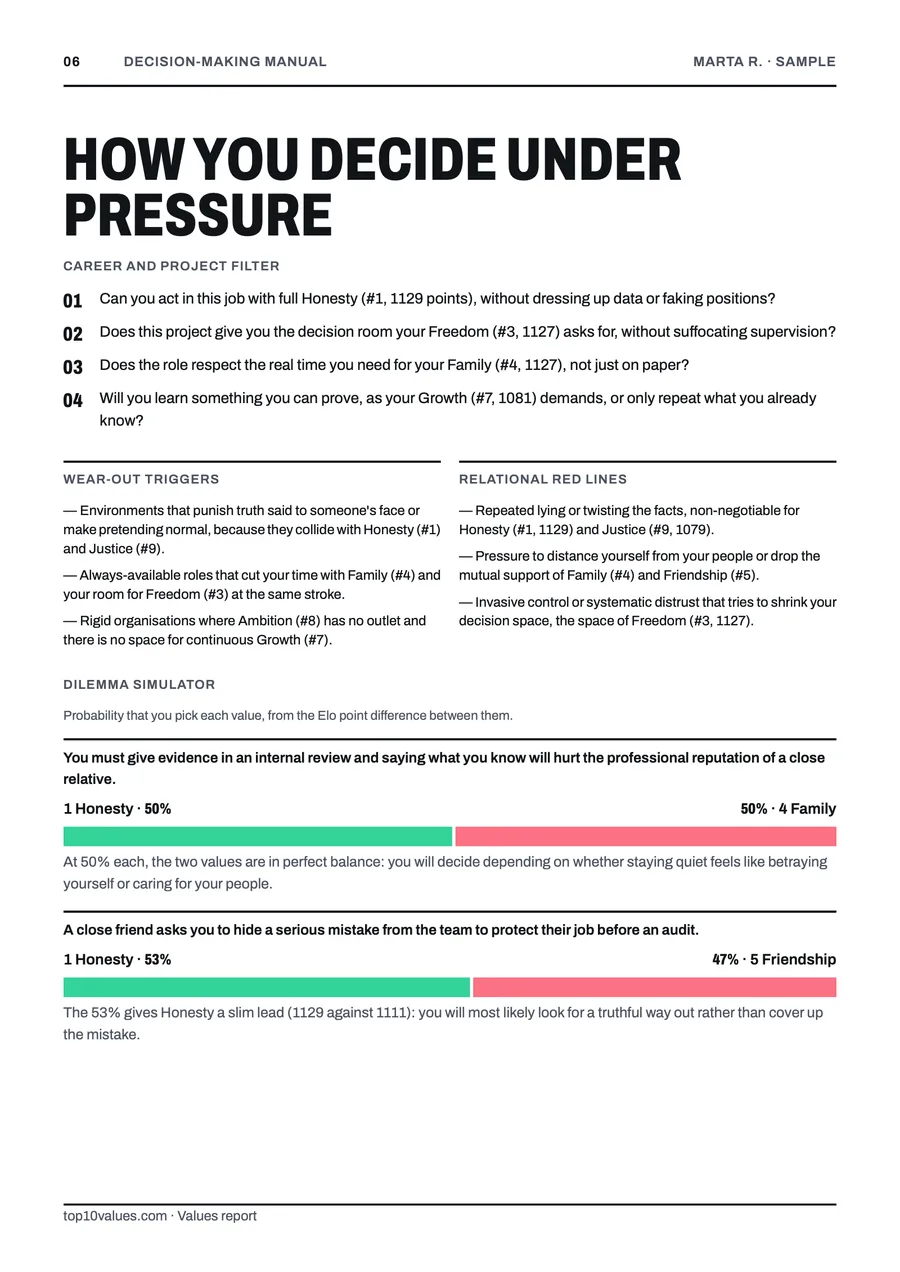
Sample page with fictional data (Marta R.), not yours. Your report is written from your own choices.
Frequently asked questions
How can I be braver if fear blocks me?
Start with small, repeated actions rather than one big leap. Choose something low-cost (asking a question in a meeting, sending back a wrong order at a restaurant, saying no to a plan you do not want) and build up gradually. Fear eases more by watching the worst fail to happen than by talking yourself out of it. If the fear is so intense that it affects your daily life, talking to a mental health professional is a sensible form of courage.
What is the difference between courage and recklessness?
Recklessness ignores the risk or does not know it; courage sees it and decides to take it for something that matters. A practical test: can you explain what you could lose, what you would do if it goes wrong and why it is worth it? If not, you are probably improvising. Look at the motive too: risking something to stay true to a value is courage, risking it to impress someone or to avoid feeling something is usually something else.
Can you be brave and afraid at the same time?
Yes, and that is the usual case. Courage only makes sense if there is something to fear. What changes is what you do with the fear: you can keep it in view, acknowledge it and act anyway. People who say they feel nothing are often underestimating the risk or denying what they feel.
Is saying no also an act of courage?
Often it is. Turning down a request you cannot take on, dropping a plan you do not want, or setting a limit with a relative means putting up with other people's disappointment. It is not always: if you say no for comfort or to avoid a reasonable effort, it is something else. The key is whether your refusal protects something you value or simply saves you some bother.
How do I teach courage to my children without forcing them?
Give them graded chances to face what scares them, without mocking them or pushing them in all at once: ordering for themselves at a café, talking to a teacher, trying a new sport. Praise the effort of trying more than the result. And tell them sometimes about something that scared you and how you handled it: they will see you as someone who also doubts, and learn that fear is not a sign that something is wrong.
When Courage clashes with…
Taking the step that scares you, versus keeping the peace, standing by a friend or hearing objections.