Creativity
Self-expression
Expressing who you are.

Self-expression is the need to communicate outwardly who you really are, whether through style, words, art or any other form of individual manifestation. People who prioritize this value want the way they dress, speak, create or even decorate their space to faithfully reflect their inner identity, rather than fitting a generic mold. Suppressing this need usually creates frustration, while being able to express yourself freely brings a sense of coherence between your inner and outer worlds. This value is closely tied to authenticity, but focuses specifically on the visible, communicable manifestation of that identity toward others.
What does this value mean?
To value self-expression is to make a priority of bringing out what you think, feel and are, in a voice and a form that others can recognise as yours: voicing an opinion, writing, dressing a certain way, singing, cooking, arranging your home, or telling someone you trust what is going on with you. It is not measured by how much you say or how many people listen, but by the gap between what you carry inside and what makes it to the outside. Having it high among your values means that staying quiet as a habit weighs on you, that you look for places where your way of seeing things has room, and that when something matters to you, you need to give it a shape so that it exists for other people too.
Away from theory, this value has very recognisable faces. It is the engineer who barely speaks in project meetings but goes home and writes three pages about what he would have said, until one day he prints those notes and brings them to the next meeting. It is the teenager who cuts her hair in a way her parents dislike and, when asked why, answers “because that is how I see myself”. It is the nurse who, after a hard shift, needs to talk it through out loud before she can sleep, and who notices something is off in the weeks when there is nobody to tell. It is the grandfather who starts recording voice notes for his grandchildren about the village he grew up in, because he does not want his version of that life to disappear with him. It is the person who moves abroad, learns the language and discovers that what they miss most is not the food but being able to make jokes with their own sense of humour. The common thread is not extroversion: plenty of very private people find expression essential and practise it in a notebook, on a guitar, in a garden or in the way they dress. What they share is that thinking or feeling something is not enough; it has to take a concrete form, with their mark on it, that can be seen or heard.
What it does NOT mean
Self-expression does not mean talking a lot, having an opinion on everything or telling everyone everything. Nor is it the same as authenticity: authenticity asks that what you show be true; self-expression asks that what is true actually gets shown, and authenticity can live perfectly well in silence. It is not creativity either, because expressing yourself does not require inventing anything: describing in your own words how a farewell felt is expression even if there is nothing original about it. It is not the right to freedom of expression, which is a legal protection against those in power; this is about a personal priority, about how much having a voice of your own matters in your life. And it does not mean showing off or chasing applause: expressing yourself to be seen and expressing yourself so that what is inside gets understood are different things, even if they sometimes overlap.
Related concepts
Why might it matter to you?
What goes unsaid does not vanish: it keeps circling, turns into resentment or bursts out at the worst possible moment. That is why self-expression has a practical job, not just an aesthetic one. When you put into words what bothers you about how chores are split at home, the other person can respond to something specific; when you do not, they respond to your sullen face and to their own guesses. Work runs the same way: ideas that are never proposed cannot be weighed, and someone who never speaks up ends up in a role that others have defined. Expressing yourself also helps you find out what you think. Many people discover their view on something while writing it down or explaining it, not before. In the 1980s the psychologist James W. Pennebaker began a line of research on expressive writing, in which participants were asked to write for several days about difficult experiences; his work and the studies that followed suggest benefits for the wellbeing of many people, though not everyone and not in every circumstance. There is no need to make it a therapy exercise to borrow the underlying idea: giving shape to what you feel usually makes it easier to handle. And there is one last, more personal reason. A life in which you never show how you see things can be pleasant and orderly, but it makes it hard for anyone to learn what you are like inside, and hard to feel loved for who you are rather than for the part you play.
How can you live this value?
- Say one more sentence in the moment. When you catch yourself holding back an opinion in a meeting, at dinner or in a conversation with your partner, add just one sentence that starts with “I see it differently” or “that did not sit well with me”. No speech required. The practice is to close the gap between what you think and what you say little by little, starting with low-stakes situations before you get to the hard ones.
- Keep an outlet that does not depend on an audience. A notebook, voice memos, an instrument, sketching on the train. Having somewhere to express yourself without anyone grading it lets you work out what you want to say before you say it to others, and stops all your expression from hanging on other people's reactions, which is what happens when social media is your only outlet.
- Choose which part of you shows up in everyday life. Expression is not only about art: it is in how you dress, how you set up your desk, what music you play in the car, how you write an email, what dish you bring to a lunch. Go through those details and ask which ones you actually chose and which are habit or a fear of standing out. Changing one small thing is an easy way to regain some presence without asking anyone's permission.
- Name emotions precisely. “I'm not great” says little; “I was disappointed you didn't let me know” or “I'm worried the move to the new team will go badly” says far more and gives the other person something to answer. Building your emotional vocabulary is one of the most useful ways to express yourself, because it turns a vague unease into something you can actually talk about.
- Ask for the format that suits you. Some people express themselves better in writing than out loud, walking side by side than sitting face to face, with time to think than in the heat of the moment. If you know which one is yours, ask for it: “can I write it down tonight and we'll talk tomorrow?” is a legitimate way to express yourself, not a way of dodging the conversation.
- Finish something and show it now and then. Half-written songs, the blog you never publish and the toast you only rehearse in the shower never reach anyone. Every so often, complete something and share it with one person you trust: a recipe, a short story, a set of photos, a letter. What you learn from seeing how it lands is something you cannot learn while it sits in a drawer.
Advertisement
What happens when you don't live up to this value?
When self-expression matters to you and you are not living it, the signs show up in specific scenes long before any conscious reflection. You leave meetings with the speech you never gave still running through your head. You have the feeling that people know a flattened version of you, polite and correct, but not the one who laughs out loud, gets angry or is moved. You struggle to answer “and what do you think?” because you have gone so long without saying it that you are no longer sure. Sometimes envy shows up towards those who dare: the colleague who paints and exhibits in a local café, the friend who says what he thinks at family dinners. And over time the outburst may come: after months of silence, some minor detail triggers a reaction so out of proportion that it surprises everyone, you first of all. This is rarely a lack of character. More often it is the mark left by places where speaking up had a price: a home where children's opinions did not count, a job where disagreeing was punished, an accent or a mother tongue you were made to feel ashamed of.
The healthy side and the shadow
When does this value stop helping you and start limiting you?
Healthy expression
Expressing yourself to be understood
In excess
Expressing yourself to fill all the space
The shadow side of self-expression appears when saying what you think becomes more important than what happens to the person listening. The first form is the monologue: every conversation reminds you of a story of your own, and everyone else ends up as an audience. The second is honesty as an excuse: “I just say what I think”, used to drop hurtful remarks without taking responsibility for their effect. The third is oversharing: posting intimate details online or at work, yours or other people's, such as your partner's or your children's, without considering who will read them in a few years. The fourth is subtler: expressing yourself only according to the response, polishing every post and every opinion for approval, until the voice is no longer yours but your audience's. Healthy expression, by contrast, leaves room for the other person: you say your piece and then you listen; you choose your moment; you care that what you show is true, not just that it gets attention; and you accept that not everything you feel has to be public.
This value at work
At work, self-expression plays out on three fronts: meetings, style and the substance of what you do. In meetings, the question is whether you put forward ideas and push back when you are not convinced, or whether you wait to mention it afterwards in the corridor. A simple tactic is to prepare one contribution per meeting and make it early, before the discussion settles into a direction that is hard to shift. On style, many workplaces have dress codes or rules about tone and format that leave little room; people who value expression usually look for the room that does exist (how you present a report, how you write to clients, which details you take care of when dealing with people) rather than fighting every rule. On substance, some jobs run on a personal voice, such as teaching, design, journalism, cooking or sales, while others expect you to leave it at the door, like scripted phone support or certain audit and compliance roles. If this value is in your top three and you spend eight hours a day reading from a script, it is worth bearing in mind when you think about your next move, even if it is no reason to quit tomorrow. There is also a specific risk: mistaking self-expression for speaking first or loudest. A team quickly notices the person who turns every meeting into a showcase. And if you manage people, the value has another side: creating space for others to express themselves, for instance by collecting views in writing before a meeting so that those who need time to think are not shut out.
This value in relationships
In friendship, self-expression decides whether your friends know your opinions, your odd tastes and your bad days, or only the version of you that shows up in the group. It is common to have friendships going back years in which you have never said that you dislike the usual plan, that a comment hurt, or that you are going through a rough patch. Expressing yourself here does not mean pouring everything into the group chat; it means choosing one or two people with whom you can show more, and then doing it. A healthy friendship can handle “I'm not up for this, shall we do something else?” and also “it hurt that you didn't come to my book launch”. If you tend to be the one who fills the conversation, friendship asks the opposite of you: ask questions and stay with the answer instead of steering it back to your own story. At your next dinner with friends you could notice how often you talk about yourself and how many questions you ask; not to beat yourself up, but to see whether the balance is the one you want. And one kind of friendship is especially valuable for this value: the one that lets you try things out. Showing the first chapter, singing at karaoke, rehearsing the difficult conversation with your boss. Someone who listens without judging during those trial runs helps you find your voice before you use it where it costs the most.
This value in love
In a couple, self-expression often runs into a widely held belief: that if the other person loves you, they should be able to guess what you need. That almost never happens. Saying “I need you to hold me when I get home from the hospital, even if I don't tell you anything” or “I like it when you text me mid-afternoon” does not make the relationship less romantic; it gives your partner a concrete way to get it right. Style matters too: in many couples one partner speaks in words and the other in deeds, such as fixing the tap or having dinner ready, and each can feel that the other expresses nothing at all. Talking about those different languages heads off a lot of arguments. Early in a relationship it is normal to show only your most agreeable side; over the years, this value asks you to reveal the rest: the tastes you kept hidden, the political views you avoided, the sadness that comes on some Sundays. It also asks the reverse: letting your partner have outlets for expression that are not meant for you, such as a journal, a theatre group or a friend they talk to about other things, without treating them as secrets kept against the relationship.
This value in family
Family is where you learn, or fail to learn, that expressing yourself is safe. Some households argue at full volume and have forgotten it ten minutes later; in others nobody ever raises their voice, but nobody names what is going on either. Someone raised in the second kind may reach adulthood with no words for anger, and someone raised in the first may not know how to say anything important without turning up the volume. With young children, this value grows when you let them choose some visible things (their Saturday clothes, the colour of one wall in their room, which drawing goes on the fridge) and ask “what do you think?” at dinner, including when you do not like the answer. With teenagers the test is harder: the hair, the music, the opinions that strike you as over the top. Separating what affects their health or safety from what only offends your taste helps you pick which battles are worth fighting. With ageing parents, expression changes direction: many people want to tell their life story as they grow older, and listening patiently, or helping them record or write it, is a way of honouring their voice. And at family gatherings where everyone is assumed to think alike, stating a different view calmly, without trying to win anyone over, usually does more for the relationship than years of polite silence.
This value and yourself
Self-expression starts on the inside: you cannot show what you have not identified. Before you say what you think, you often need to know it, and that takes a moment to ask yourself what you really feel about a proposal, a piece of news or a change, rather than adopting the group's first reaction. It is also worth checking how you talk to yourself. Some people allow themselves to speak up with others but keep correcting themselves internally (“what a stupid thing to say”, “who cares”). That critical voice works as a censor in advance and makes every sentence cost twice as much. A simple exercise is to write by hand for ten minutes, without correcting anything, whatever is going through your head, and reread it the next day; the idea resembles the “morning pages” Julia Cameron proposes in The Artist's Way, though you do not need to follow her method. What usually turns up is that you have more opinions, wishes and nuances than you thought. Finally, accepting that expressing yourself sometimes means getting it wrong in public, saying something clumsy or not being understood the first time is part of the value: nobody finds their voice without having used it badly a few times.
What are you willing to sacrifice for this value?
Living this value has costs. The first is approval: when you say what you think, some people will find out they do not think as you do, and one or two may stop inviting you. The second is the comfort of going unnoticed: people who express themselves are exposed to criticism, mockery and misunderstandings that silence avoids. The third can be professional: there are companies, industries and countries where certain opinions or certain styles cost you promotions or opportunities, and it is worth weighing when the price is worth it and when you would rather take that voice to an outlet outside work. The fourth is time: writing, rehearsing, painting or preparing what you want to say takes hours that come from somewhere else. And sometimes the cost is giving up expressing yourself at a particular moment to protect someone: not posting the photo, not telling the story that involves your brother, waiting until someone else's grief has eased before talking about your own.
Signs you're betraying this value
You let this value down whenever “I don't mind” comes out of habit rather than because you genuinely do not mind. When an expressive pastime has been parked for years, like the instrument in the cupboard or the unopened notebook, and the excuse is always lack of time. When you change your opinion halfway through a sentence because of the look on your listener's face. When you let someone else tell your story, at a dinner or in a meeting, and do not correct what is untrue. And you also betray it from the other side: when you talk without listening, when you use frankness to wound, or when you expose other people's private lives just to have something to tell.
Turning the value into goals
Value
Self-expression
Behavior
Voice at least one opinion of your own in every important meeting or conversation this week, even a brief one
Goal
Finish one piece this quarter that expresses something of yours, such as a thousand-word essay, three recorded songs or a series of ten photos, and show it to three people you trust
Habit
Ten minutes a day of uncorrected writing or expressive practice at a fixed time, and once a week pick one fragment to revise carefully
Questions to reflect on
- In which situations does “I don't mind” come out of your mouth when you actually have a preference, and what are you afraid will happen if you say it?
- Which part of you do your colleagues know, which part does your family know, and which part does nobody know? Are you happy with that split?
- How did you express yourself as a child (drawing, making up stories, dressing up, singing), and what became of it?
- Think of something that was hard to say recently: what actually happened afterwards, as opposed to what you feared?
- Is there someone who tends to get crowded out of the conversation when you are around, and what would change if you gave them more room?
- If you had to explain who you are to a stranger without mentioning your job, what would you tell them and what would you show them?
How much are you living this value?
Think about the last two weeks. Find one moment when you said or showed something of yours even though it was hard, and another when you kept it to yourself. Then score, from one to ten, how closely what others see of you matches what you think and feel. Under six? Pick one outlet (a conversation you have been putting off, a notebook, a pastime you dropped) and decide what you will do with it this week. Nine or ten? Then look at the other side: ask someone close whether they feel they have room to express themselves when they are with you.
When two values clash
The tension with Inner peace appears when speaking up opens an argument it would have been calmer to avoid; at a family lunch or in a team under strain, it helps to ask whether speaking up will change anything or just let off steam, and sometimes the answer is to find another time and another format. With Humility the tension is about space: humility invites you not to put yourself at the centre, while expression needs your voice to be heard; the two fit together when you say your piece without believing it is worth more than anyone else's. With Financial security and Ambition it shows up at work: certain opinions, styles or side projects can cost you a promotion or a client, and you have to decide how much leeway you are willing to risk and where you would rather hold back. With Loyalty it surfaces when expressing yourself means telling stories about your family or your circle, or disagreeing in public with the people who back you. With Empathy it is a question of turns: someone who values speaking up needs to learn to listen with equal attention, or the conversation becomes a one-way street. With Respect, when your way of expressing yourself (jokes, clothes, opinions) clashes with the norms of a setting, such as a funeral, a client meeting or someone else's home. Authenticity is a close but different ally: one makes sure that what you show is true; the other, that it gets shown at all. Creativity gives it tools, Courage lends it the drive to speak when it is frightening, and Freedom gives it the frame: without the freedom to express yourself, the value stays a wish.
Is “Self-expression” one of your top 10 values?
Find out by playing and comparing this value with the other 49
How the Elo ranking works and its limits in the methodology.
What does the paid report include?
When you finish the 100 comparisons you will see your Top 10 on screen. If you want to go further, there is a PDF report on your personal values: €9.95 (VAT included), one-off payment. To buy it you need to save your game with a Google account.
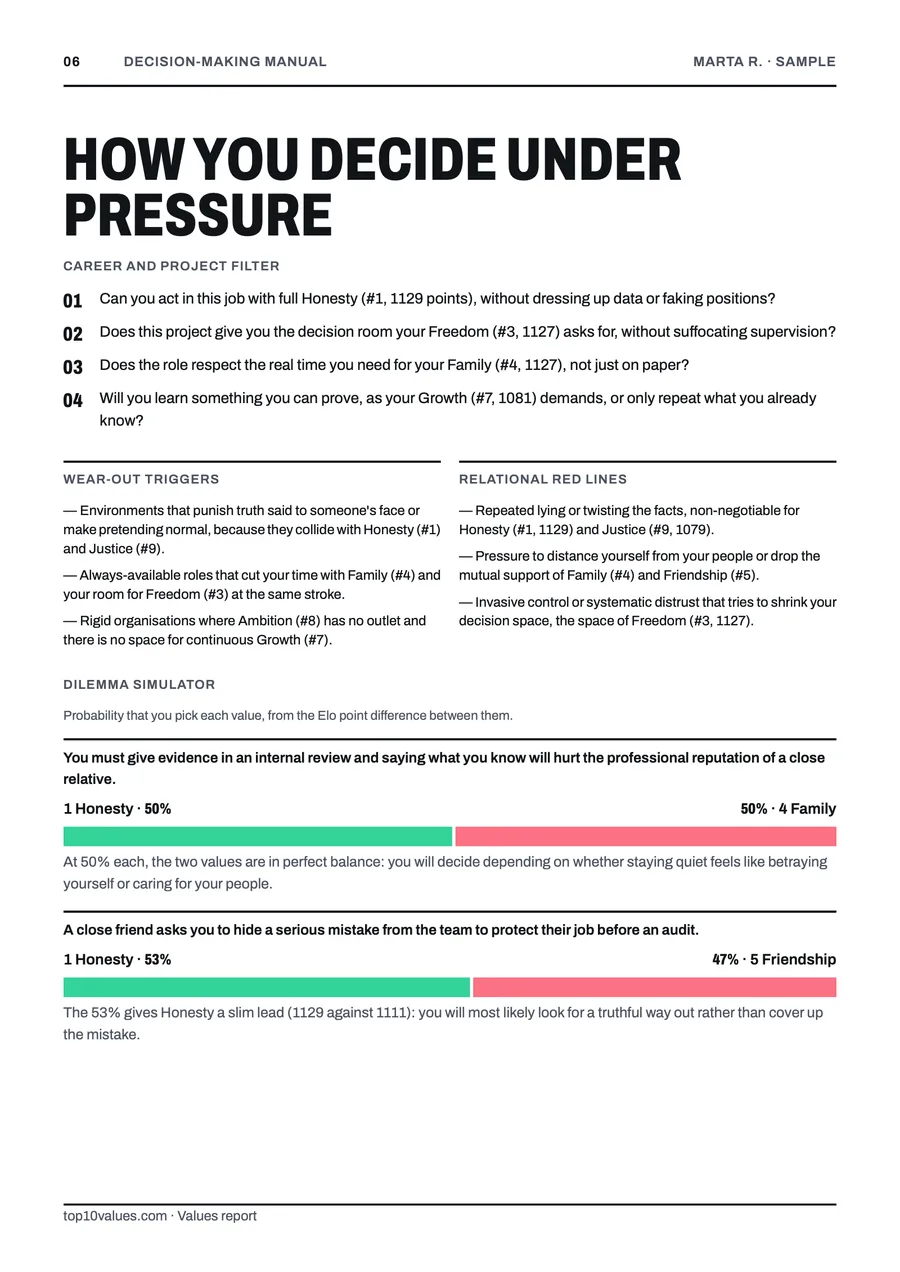
Sample page with fictional data (Marta R.), not yours. Your report is written from your own choices.
Frequently asked questions
What is self-expression? Everyday examples
To value self-expression is to give weight to showing outwardly what you think, feel and are, in a way that is recognisably yours. Everyday examples: saying in a meeting that you disagree with a deadline and explaining why; choosing your weekend clothes based on how you see yourself rather than on what is expected; writing someone a letter instead of sending an emoji; telling your partner that work is wearing you down before it starts showing in your mood; singing in a choir, keeping a journal, decorating your room, or cooking a dish from home for your friends. The common thread is that something inside takes a concrete form and reaches another person.
How is self-expression different from authenticity and creativity?
They are close values that often get mixed up. Authenticity is about consistency: what you show matches what you think and value, even if you show very little. Creativity is about making something new: an idea, an object, a solution that did not exist before. Self-expression is about bringing out what is already inside, whether or not it is original. You can live very authentically and express little, for example if you are a discreet person who never pretends but does not share much either. You can be highly creative at work, designing clever processes, without putting anything personal into them. And you can express yourself a great deal in thoroughly unoriginal ways, like recounting your day in full detail. When all three come together, the result is usually a very recognisable voice of your own.
Can you value self-expression and still be introverted or shy?
Yes, and it happens a lot. Introversion has to do with how you manage your energy around other people, not with how much you need to express yourself. Many introverts express themselves intensely in writing, music or photography, or in one-to-one conversations with someone they trust, and they find the noise of a group more draining than the act of showing what they feel. Shyness is different: it is a fear of other people's judgement, and it can hold expression back. If that is you, it helps to start with lower-exposure outlets (a written note, a voice message, a conversation between two people) and build up gradually. The key point is that this value does not require you to speak in public or have a busy social life; it asks that what is yours has a way out.
How can I say what I think without starting a conflict?
Conflict cannot always be avoided, and sometimes it is necessary, but you can stop it from growing bigger than it needs to be. A simple structure is to separate three things: what happened, how it affected you and what you are asking for. For example: “Yesterday you moved the deadline without telling me; I had to redo my plan for the week; next time, could you let me know before you confirm it?” That way you talk about what happened and what you need, without putting labels on the person listening. Timing helps too (not in the middle of a row, and not in front of others if the subject is sensitive), and so does tone: a different opinion stated calmly usually goes down better than the same point made sarcastically. If you notice that the way you express yourself often causes friction, ask someone you trust which part grates: the content, the tone or the timing.
Does social media help or hurt self-expression?
Both, depending on how you use it. It helps when it lets you find people who share your interests, show what you make, or discover that your way of seeing something is less unusual than you thought. It hurts when the audience's reaction starts deciding what you express: you post what you know will do well, pick the photos that project a particular image, and stop sharing what does not fit. A few useful questions before posting: would I do this the same way if nobody saw it? Would I be comfortable reading it in five years? Am I showing something about another person without their permission? Keeping at least one outlet for expression away from social media, with no metrics attached, protects your own voice from turning into a strategy.
What is the difference between self-expression and freedom of expression?
Freedom of expression is a right: the legal protection to share opinions and information without being punished by those in power. It appears, for instance, in Article 19 of the 1948 Universal Declaration of Human Rights and in the constitutions of many countries. Self-expression, on the other hand, is a value: how much having your own voice, and using it, matters to you. The two are linked, because without freedom, expressing yourself can be dangerous, but they are not the same thing. You can live in a country with full freedom of speech and never say what you think at home, and there are people who, in highly restrictive settings, have found ways to express themselves through art, music or private writing. This page is about the second meaning.
How do I get my voice back after years of keeping quiet?
Start with something small and private, because finding your voice again after a long time is hard and the most difficult conversation is not the place to begin. First, reconnect with what you think: each night, write three sentences about something you liked, something that bothered you and something you would have said if you had dared. Next, pick a person you trust and a low-stakes topic, such as a film, a restaurant or a weekend plan, and give your opinion even if it differs from theirs. Later, try it where a bit more is at stake, like a meeting or a family lunch. It also helps to go back to an expressive activity you dropped, even if you are worse at it than you used to be: picking the guitar back up at fifty or joining a writing workshop is not about the result but about using your voice again. If the silence is rooted in painful experiences, a psychologist or counsellor can make the road less steep.
When Self-expression clashes with…
Saying what you feel and think, versus calm, staying out of the spotlight or not risking your livelihood.