Values in a relationship: core values, examples and an exercise for two
By Juan Alejandre · Published · Reviewed
Industrial engineer and consultant, 25 years working with teams
The values that count most in a relationship are not the ones you name on a good day. They are the ones each of you defends when you have to choose how to split time, money and attention. You do not need to match on everything. What helps is sharing a few essentials and having a way to talk about the rest. A simple start is for each of you to make a Top 10 and compare the two lists.
Many arguments look practical: money, the weekend, the in-laws. Often they are the visible tip of something deeper. "We argue about money" can mean "for me money is peace of mind, and for you it is being able to enjoy life".
This page is not a compatibility test and will not tell you whether a relationship "works". It helps each of you know what matters to you.
What values in a relationship are (and are not)
A value is a standard you use, usually without noticing, when there is no clear rule: taking a job in another city, what to do with a bonus, how much time to spend with each family.
The psychologist Shalom Schwartz studied values across many countries. Most people recognize the same basic values, he found, and what differs is the priority: which one goes first when you cannot have everything. It is a useful frame for reading clashes, not a way to predict anything about a particular relationship.
It also helps to separate a value (what you protect when you choose) from a taste (movies or hiking) and from a household rule (who takes the trash out). Rules are often the practical form of a value: "we eat together on weekdays" may be closeness in action. If you argue about the rule without looking at the value under it, you end up negotiating the trash when the real conversation is elsewhere.
Core values that often matter, with scenes
These are made-up scenes. They are not an official list of healthy-relationship values, because no list suits everyone.
- Trust. Irene gets home late from a team dinner. Next morning Noa does not ask who was there; she asks how it went. For Noa, trust is the starting point, not something to earn again each week. For someone else, asking for details is closeness, not control.
- Honesty. Marc overspent on a trip with friends and thinks of saying nothing to Dani until month end. He tells her that evening, even though it is uncomfortable. Honesty does not mean narrating everything; it means your partner does not get a trimmed version.
- Respect. Leo thinks Carmen is wrong to turn down a promotion. He says so once, then lets it go because the decision is hers.
- Family. Dani's family has lunch together every Sunday; for Dani that is being present. Marc grew up seeing relatives at Christmas and birthdays, and feels each booked Sunday is one less weekend for the two of them. Neither is wrong.
- Freedom. Noa needs a few hours alone each week to paint and walk without her phone. Irene reads that as distance, because at home sharing time was how you showed love. The guide on freedom vs security goes deeper into this pair.
- Security. Irene wants a cushion of several months of expenses before they change apartments. For her it is not fear but what lets her enjoy the rest. Noa feels it as a brake on her plans.
- Independence. Leo keeps his own friends and hobbies; for him that makes being together a choice, not a habit. Carmen prefers doing things as a pair and sometimes feels in the way.
- Growth. Dani signs up for an evening master's and Marc has to rearrange his week. Supporting her is care, but he needs the relationship not to come second all the time.
Some values rarely top a conversation, yet you notice when they are missing: love as daily commitment, loyalty, kindness and empathy. Money cuts across all of them: wealth can mean peace of mind or enjoying today, so many money arguments are really security against freedom.
Do you need the same values? Matching, complementing and clashing
You do not need to match on everything, but it helps to know where you match and where you do not.
Matching on the essentials. Two people can have very different Top 10 lists and still share three or four values that are the base for both, such as honesty, respect and trust. With that floor, many other differences can be negotiated. There is no magic number of matches, so be wary of anyone who promises one.
Differences that complement. One person puts security first and the other puts adventure first. The first helps the second's plans reach a good end, and the second stops the first waiting for perfect conditions. It works when each recognizes what the other adds; if they only hear "you are boring" and "you are reckless", it turns into clashing.
Clashes that need a conversation. Each pair comes with a question that helps:
- Family and freedom: how many times a month, and in what way, feels like enough?
- Security and freedom: what do you need pinned down to feel at ease, and what can stay open?
- Honesty and loyalty: where is the line between keeping someone else's secret and hiding something from your partner? See honesty vs loyalty.
An exercise for two
It takes about 60 minutes and will not solve anything by itself; it puts two concrete lists on the table instead of guessing. The result describes what each person chooses today, not who they are or how the relationship is going.
Ground rules. It is voluntary. Neither list is better, and nobody corrects the other's. Either of you can ask for a pause. Do not do it in the middle of an argument.
Step 1: play separately. Each of you plays the top10values game alone, without looking at the other's screen. It is about 100 quick comparisons between two values, and at the end you get an ordered Top 10. Pick what matters to you, not what would look good. The game requires signing in with Google. To use paper instead, pick twenty values from the personal values list and cut them two at a time ("if I had to give one up, which?") until ten are left.
Step 2: compare and mark three colors. Green for values on both lists, yellow for values on one list only, red for values one person put in their top five and the other in their bottom five. Look at green first; it is what you share and it is easy to skip. Then look at red, where most of the conversation is.
Step 3: talk. Use up to six of the questions below and share the time evenly. The listener does not answer, correct or defend; they only ask if they did not understand. It is the hardest rule to keep.
Step 4: one small agreement for two weeks. Aim for something concrete, not "we will be more understanding". For example: "One Sunday in three we skip lunch with your family, and we decide on the Thursday before." Write it down and pick a date to review it.
Made-up example. Irene's Top 10 starts with security, family and trust; Noa's starts with freedom, adventure and honesty. Honesty, love, trust and respect are on both lists (green), which explains why talking about almost anything feels easy. Family is second for Irene and tenth for Noa (red). Irene explains that Sundays with her family are how she feels at home; Noa needs to feel the weekend is not decided in advance. Neither had said this aloud. They agree that one Sunday in three stays open. Nobody won, but they have moved from arguing about "Sunday" to talking about security and freedom.
Questions to talk about values
- Which part of your week do you feel you cannot negotiate?
- Which decision from a year ago would you take differently, and why?
- When did you feel closest to me in recent months?
- What did you learn at home about money, and how does it compare with what you do today?
- If you had to give up one of your top five values for a year, which would it be?
- What would you like me to know about you that I have not yet asked?
Answer with examples ("last Sunday I felt bad when..." says more than "you never listen"), and do not use an answer as ammunition in the next argument.
When your values are different
Finding that your lists look unlike each other is not a verdict. Name the difference without trying to win: "security is near the top for me and freedom is for you" describes; it does not accuse. Separate the value from the task, since behind "you never help at home" there may be a value (fairness) and a household rule (who does what). Try a small, temporary agreement, and repeat the exercise now and then, because values get reordered by a move, a child or a new job. If conversations keep getting stuck, or either of you is afraid to speak, a mediator or couples counselor can support you. That is one more resource, not a sign something is wrong.
The game is a self-knowledge tool, not a validated psychological test; the methodology page explains how the result is calculated. For a wider view, see how to take a personal values test, or how values show up in a job in values at work.
Frequently asked questions
What are the most important values in a relationship?
No list suits every couple. Trust, respect and honesty are the ones most often named, but what matters is which ones you defend when you have to choose. It is more useful to find your own than to copy a list.
Does the game show if we are compatible?
No. It does not measure compatibility or predict anything about a relationship. It only orders the values each person picks, so you can talk about them with examples in front of you.
Next step
Play the values game to get your own Top 10, and when you are ready, ask your partner to do theirs so you can compare calmly. If you would rather read first, browse the full list of values.
Sources
- Schwartz, S. H. (2012). An Overview of the Schwartz Theory of Basic Values. Online Readings in Psychology and Culture, 2(1). https://doi.org/10.9707/2307-0919.1116
Sources
Find your top 10 values with 100 quick comparisons
What does the paid report include?
When you finish the 100 comparisons you will see your Top 10 on screen. If you want to go further, there is a PDF report on your personal values: €9.95 (VAT included), one-off payment. To buy it you need to save your game with a Google account.
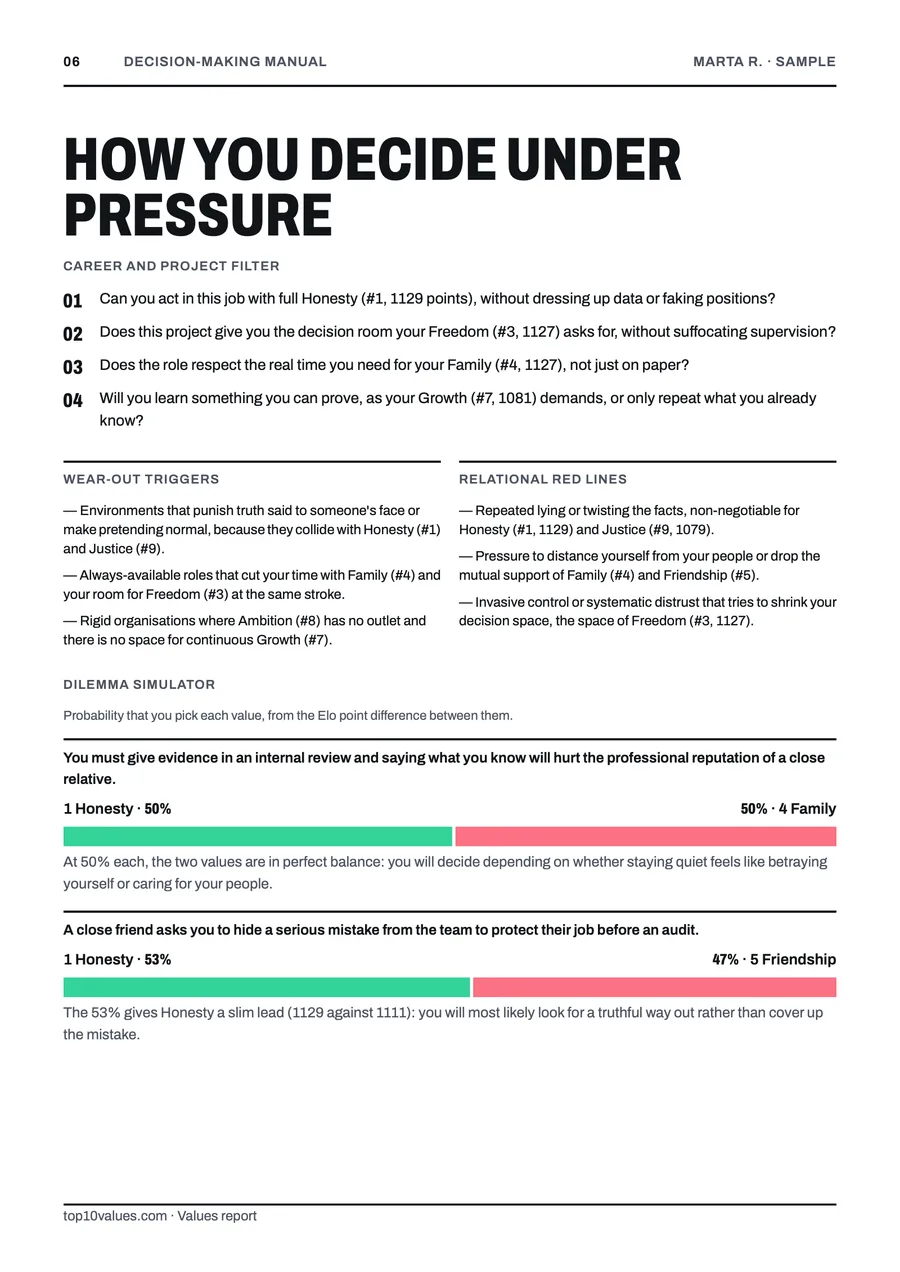
Sample page with fictional data (Marta R.), not yours. Your report is written from your own choices.