Relationships
Loyalty
Commitment and faithfulness.

Loyalty is the sustained commitment to the people, groups or causes you have chosen, even when difficulties arise or more convenient short-term alternatives appear. People who value loyalty don't abandon a relationship, a team or a project at the first obstacle, and they expect the same level of reciprocal commitment from those around them. This doesn't mean tolerating any treatment or staying in harmful situations out of habit, but sustaining the bond as long as a foundation of mutual respect remains. Loyalty creates deep, trusting relationships over the long term, although it can also become a challenge when it conflicts with your own personal boundaries.
What does this value mean?
Loyalty is the commitment to stay on the side of a person, a group or a cause when it is no longer comfortable or convenient, and to act consistently with that commitment even when nobody is checking. It is a value that can only be shown over time: nobody proves loyal on a quiet Tuesday, only when the bad month arrives, or the tempting offer, or the awkward conversation. And it involves choosing, because you cannot be faithful to everything and everyone at the same level.
It stands for the decision that some bonds are not renegotiated every time a better offer appears. People who value loyalty defend their own when they are not in the room, stay through the lean years and don't leave the moment the ship tilts. You see it above all in what you do when it costs you: turning down a better job so you don't abandon your team in the middle of a crisis, still visiting a friend who has been ill for years and no longer tells funny stories, or keeping a secret when sharing it would win you points in a conversation. You also see it in small details: turning up on time to the house move you promised to help with, not liking the comment that mocks someone in your circle, or returning the call of someone who helped you years ago even though you need nothing now. The philosopher Josiah Royce, in The Philosophy of Loyalty (1908), described it as a person's practical, sustained devotion to a cause; he did not reduce it to a feeling but treated it as a way of organising a life. That is a useful reminder: loyalty is not what you feel for someone, it is what you do for them when feeling it is not enough. In the Nicomachean Ethics, Aristotle distinguished friendships of utility or pleasure, which end when the benefit disappears, from those based on the goodness of the other person, which last longer. Loyalty lives mostly in the second kind.
What it does NOT mean
It does not mean blind obedience, covering up the mistakes of your people or putting up with abuse because you “owe” them. Nor is it the same as staying put: you can leave a company honourably and remain loyal to the people you met there. Loyalty that demands silence about real harm has already become complicity. It doesn't consist of agreeing with everything or refusing criticism: in fact, someone who tells you what you don't want to hear, kindly, is often more loyal than someone who applauds you all the time. It isn't dependence, or fear of being left alone, or a debt collected through emotional blackmail (“after everything I've done for you”). And it should not be confused with having no judgement and following whoever shouts loudest: healthy loyalty chooses its commitments and can review them when what supported them changes.
Related concepts
Why might it matter to you?
Almost everything built with other people takes years: a team that understands each other without talking, a friendship that survives a move across the country, a couple that gets through an illness, a small family business that rides out a bad patch. That only happens if each side knows the other won't walk away at the first difficulty. Loyalty offers something hard to buy: knowing who stays when things go badly. That certainty frees up energy, because you don't have to prove your worth every week or keep checking whether you are about to be dropped. Behind this value there is usually a need to belong to something stable and to be someone others can count on, sometimes because at some point that stability was missing for you. Loyalty also organises your decisions: when you know who you owe what, turning down a plan or accepting a sacrifice becomes simpler, because you aren't deciding from scratch each time. In Exit, Voice, and Loyalty (1970), the economist Albert Hirschman observed that when an organisation declines you can leave, protest or stay on out of loyalty, and that loyalty tends to push you towards protesting and trying to fix things before leaving. That is a handy clue: the most valuable loyalty isn't the silent kind, it is the kind that stays and speaks up.
How can you live this value?
- Stand up for people who aren't present. If someone in a meeting makes an unfair remark about an absent colleague, say something as simple as “that's not what I've seen”. Then, if there is a real problem, raise it directly with that person. Defending is not denying: it is not convicting someone before they can answer.
- Keep in touch during other people's bad times, not only the good ones. A message to a friend who has just lost their job counts for more than ten birthday greetings. You don't need to say anything brilliant; “I'm here, can I ring you tomorrow?” is enough, as long as you do ring.
- When an offer arrives that would leave someone in a delicate position, talk to that person or team first. Loyalty doesn't mean turning the offer down; it means not leaving behind their backs and helping the exit do as little damage as possible: decent notice, an orderly handover, availability for questions during the first few weeks.
- Choose who you owe loyalty to. You can't be unconditional with everyone: write down three or four bonds you truly want to protect and give them your time before you spread it around. Choosing isn't abandoning the rest; it is ceasing to promise what you cannot deliver.
- Keep the small promises. Loyalty is built from things like arriving on time, returning what you borrowed or answering the person who wrote to you. If you can't do something, say so early and offer an alternative; cancelling in good time is far more loyal than going quiet.
- Practise loyal frankness. When someone close is about to make a mistake, tell them in private, kindly and with a concrete example, and offer your help whatever they decide. Saying the uncomfortable thing to their face is a form of respect that flattery cannot replace.
Advertisement
What happens when you don't live up to this value?
Without loyalty, bonds turn transactional: you stay while it pays and leave when it stops paying. Your friends know that if circumstances change, they may not be able to count on you, and you notice it in the way they tell you fewer important things. A certain loneliness appears even with plenty of contacts, because nobody dares to lean on you and you don't lean on anyone. At work you switch projects so fast that you never build real trust with anybody, and you end up with a long CV and few people to call when you need something. In a couple, every big disagreement is lived as a possible exit, and that prevents intimacy: it is hard to open up fully to someone when you both know any crisis could be the last. There is an inner effect too: people who break their commitments easily end up distrusting their own. If you have said “count on me” many times and haven't followed through, you start doubting your own word, and that doubt is more corrosive than any reproach from others. Finally, a lack of loyalty often goes with a life of constant comparison: there is always another plan, another group, another offer, and you never quite settle in any of them.
The healthy side and the shadow
When does this value stop helping you and start limiting you?
Healthy expression
Commitment with judgement
In excess
Blind loyalty
Loyalty becomes a problem when it moves from people to the institution and stops looking at what that institution does. It's the employee who hides a fraud because “the company put food on my table”, the friend who covers for behaviour that hurts third parties, or the person who stays for years in a relationship that wears them down so as not to “betray” the other. It also appears in the group that expels whoever disagrees, in the family that protects an abuser to avoid a scandal and in the team that punishes whoever raises the alarm. Another form is loyalty to the past: carrying on with a business, a friendship or a cause that no longer makes sense because you can't admit it has changed, or because “we've already put in too much”. And there is a quieter excess, loyalty as an eternal debt: feeling you must always repay, without limit, someone who once helped you, even when they ask for more each time. The useful question is whether your loyalty protects someone or only avoids an awkward conflict. Being faithful to a person sometimes includes telling them they are making a mistake; and being faithful to a cause sometimes includes walking away from those who have betrayed it.
This value at work
Loyalty at work is no longer about staying thirty years in one company; it is about how you behave while you are there: you don't leak information, you don't speak ill of the team behind their backs, you give notice in good time if you leave and you hand over documented work. It also shows in how you treat the people who hired you and those who work alongside you: if a manager gave you a chance when nobody else did, one form of loyalty is protecting their reputation without hiding problems from them. Your usual dilemma is where to draw the line: being loyal to your boss, your team or your company doesn't always line up, and when they clash it is usually better to be loyal to the people and to the specific commitments you made, not to a brand. If you lead, loyalty runs both ways: don't ask your team for commitment if you aren't prepared to defend them to your own superiors, to be clear about their future and not to sacrifice them at the first pressure. A redundancy delivered with respect and with help finding another job is a form of loyalty people remember for years. Pay attention to loyalty with clients and suppliers too: honouring those who trusted you when you were small, even if cheaper alternatives now exist, is something that tends to be repaid. Above all, tell apart a job you leave from a team you abandon: you can do the first without the second.
This value in relationships
In friendship, loyalty shows in concrete things: keeping a secret, not repeating what a friend told you about their ex, keeping your word to help with their move even though your weekend got complicated, turning up in a hospital waiting room without being asked. It breaks most easily the other way round: telling “just one person” what you were told in confidence, or vanishing when someone stops being useful or interesting. A loyal friendship also tolerates the other person changing, growing and telling you they no longer agree with everything. With the years, friendships thin out because of children, moves and work schedules; loyalty doesn't require meeting every week, but that when you do meet you are both still dependable, and that a phone call in the small hours gets an answer. One delicate case is when two of your friends fall out: loyalty doesn't oblige you to choose a camp, but it does stop you from using what one told you against the other. Another is when a friendship starts to hurt you, perhaps through constant criticism or the way they treat other people: being loyal can also mean saying clearly what you can no longer accept before drifting away in silence.
This value in love
In a couple, loyalty is usually linked to sexual fidelity, but it covers more: speaking well of your partner in front of others, not turning their insecurities into anecdotes for your friends, and staying by their side through unemployment, illness or depression. Every couple sets its own agreements; what matters is that they are explicit and that you keep them. The trouble starts with the exceptions you grant yourself and don't grant the other person. There are kinds of disloyalty that appear in no agreement yet hurt deeply: confiding your intimate problems to someone at work before your partner, keeping a debt or a big purchase secret, or comparing your partner with someone else in front of other people. It is also loyal to recognise when a bond can no longer be sustained and to say so frankly, rather than stretching it out with kind lies. In a long crisis, loyalty usually means staying to do the uncomfortable work of talking, asking for professional help if needed and not making final decisions in the heat of the moment. And don't forget loyalty to what you built together: projects, routines, shared stories. When a relationship ends, one last act of loyalty remains: not using against the other person what you learned while you loved each other.
This value in family
In families, loyalty often comes with old debts: the brother who looked after your parents, the uncle who lent money twenty years ago, the grandmother who raised the grandchildren while their parents worked. This is where conflicts of loyalty appear, for example when a couple has to choose between spending the holidays with one set of parents or the other, or when you have to decide whose side you are on in a quarrel between siblings. It helps to stop seeing loyalty as choosing a camp and to see it as not ceasing to care for anyone just because you took a position. Another common tension is loyalty to customs: the recipe, the Sunday lunch, the family business nobody wants to take on. Honouring what you received doesn't oblige you to repeat it exactly; you can keep the spirit and change the form. With children, loyalty is taught by example: if they see you speak ill of your in-laws behind their backs and smile to their faces, they learn a very different version from the one you preach. And when there are secrets or abuse in a family, loyalty properly understood protects the vulnerable person, not the family name. Staying silent to “keep the peace” has a price that almost always ends up paid by whoever has least power.
This value and yourself
Having loyalty among your top values says you treat your word and your bonds as serious things. You probably remember who defended you and also who left when you needed them most, and you may find the second hard to forgive. You may have been told you “get too involved” or that you are someone who stays longer than you should, and you may have felt the pain of being loyal to someone who was not loyal to you. It can also mean you struggle to let go of bonds that no longer do you good. It is worth checking whether you stay out of loyalty to the person or out of fear of loss, and whether what you are defending is the bond as it is today or the memory of how it used to be. Ask yourself too what you are most naturally loyal to: people, groups, ideas, brands, your own past. Each carries different risks. And if you value loyalty highly, you probably expect it as well: check whether your expectations of others are realistic, because every person has their own way of showing it.
What are you willing to sacrifice for this value?
Would you give up a career opportunity, money or a group's good opinion rather than let down someone who trusted you? Would you spend a hard year looking after a family member who needs it, knowing you will set your own plans aside? Think of an occasion when loyalty cost you something concrete. If you would do it again, this value is well rooted. If you remember it with resentment, perhaps you were being loyal to someone else's expectation and not to a conviction of your own. Loyalty carries a cost, but it needn't be a permanent, one-sided sacrifice. It is worth asking what you have legitimately asked for in return, and whether anyone, out of loyalty to you, is giving more than they should. Healthy sacrifices usually have a clear limit and are talked about; harmful ones are accepted in silence and collected later.
Signs you're betraying this value
You betray loyalty when you speak ill of someone behind their back and smile at them face to face, when you retell what was confided to you as if it were an anecdote, or when you side with the stronger party in a conflict to avoid trouble. Also when you move to a competitor taking information that wasn't yours, when you stop answering a friend going through a rough patch because you “don't know what to say”, or when you accept a favour and forget it the moment it stops being convenient. Other signs: promising “count on me” with no real intention of following through, taking sides in someone else's quarrel just to please whoever has more power, or leaving someone without support at a key moment with an excuse you couldn't say to their face. And a less obvious one: demanding loyalty from others while keeping for yourself the right to an exception.
Turning the value into goals
Value
Loyalty
Behavior
Reach out to someone going through a bad time and offer something concrete, such as a weekly call or help with an errand
Goal
Keep up your support for two key people in your life for the next three months without expecting anything in return
Habit
Every Sunday, review who has had a hard week and who you haven't written to yet
Questions to reflect on
- Who do you owe more loyalty than you are giving now, and what is stopping you?
- In which bond do you stay out of loyalty, and in which out of fear of losing what you already have?
- When did you defend someone who was absent, and what happened? And when did you stay quiet?
- What would you do if you discovered that someone you are loyal to had done something that harms another person?
- Who has been loyal to you when they had no obligation to be, and have you thanked them clearly?
- Is there a commitment you keep honouring only because you have never asked yourself whether you want it?
How much are you living this value?
From 1 to 10, how closely does what you say about someone when they're not there match what you'd say with them in the room? If it's below 7, spend a week saying nothing about anyone that you wouldn't say to their face. Then add a second measure: from 1 to 10, how often do you do what you promise to the people who count on you most? If it's below 7, check whether you promise too much or deliver too little.
When two values clash
Loyalty clashes with Honesty when someone close makes a mistake and saying so aloud feels like betrayal: silence protects the bond in the short run but wears it down in the long run. It clashes with Justice when the friend or relative has done something that harms a third party, and then you have to decide whether your fidelity goes that far. It clashes with Integrity when you are asked to lie or cover up to protect your team. And it clashes with Freedom when the bond keeps you from changing city, job or way of life; that conflict is common with Family and with lifelong Friendship, and it can leave you feeling you are abandoning those who stay. With Growth there is another struggle: growing sometimes means leaving behind groups and habits you felt faithful to. With Courage it is an ally, because it often takes nerve to keep a commitment when everyone else is leaving. With Gratitude it complements, though it helps to separate gratitude, which is expressed and returned, from unconditional loyalty, which cannot be an eternal debt. With Trust it goes hand in hand: loyalty is what makes trust reasonable. And with Humility it crosses paths when you must admit that the person you defended was wrong. There is no single rule. It often helps to see that the deepest loyalty is to the person and the best of them, not to their worst decisions, and that sometimes the most loyal act is the most uncomfortable one.
Is “Loyalty” one of your top 10 values?
Find out by playing and comparing this value with the other 49
How the Elo ranking works and its limits in the methodology.
What does the paid report include?
When you finish the 100 comparisons you will see your Top 10 on screen. If you want to go further, there is a PDF report on your personal values: €9.95 (VAT included), one-off payment. To buy it you need to save your game with a Google account.
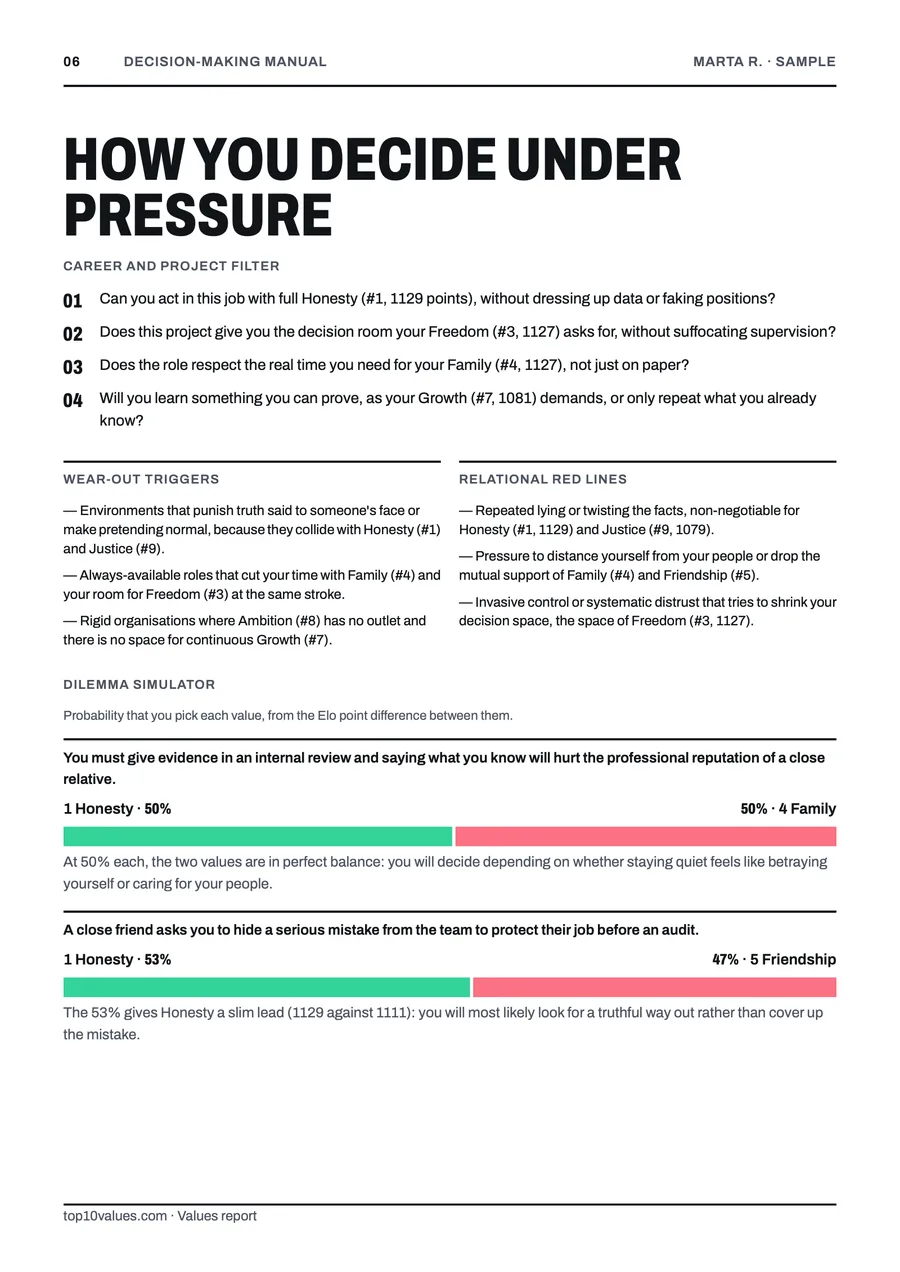
Sample page with fictional data (Marta R.), not yours. Your report is written from your own choices.
Frequently asked questions
What is the difference between loyalty and obedience?
Obedience follows an order; loyalty follows a commitment to a person or a cause and can include disagreement. A loyal colleague tells their manager they are making a mistake; one who only obeys stays silent and lets them crash. Obedience looks upwards; loyalty looks at what the relationship is trying to achieve. That is why loyalty can say “no” when something harms the people it wants to protect, and obedience almost never does.
Can you be loyal to someone and still leave them?
Yes. Leaving a job or ending a relationship can be done loyally: giving notice in good time, not speaking ill afterwards, respecting what you shared and keeping what you were trusted with. Disloyalty lies in how you leave, not in leaving. A loyal exit includes explaining your reasons if asked, helping the transition run smoothly and not using against anyone what you learned on the inside.
How do I know if I'm being too loyal?
Be concerned if you cover up harm to third parties, if you stay in a bond that wears you down out of guilt, or if the other person wouldn't do the same for you even in the basics. Healthy loyalty is mutual, not a debt that only you pay. Another sign is that you stop doing things that matter to you, such as looking after your health, your friendships or your work, to meet the demands of a single person. If in doubt, talk it through with someone you trust who is outside the bond.
What should I do if someone I'm loyal to asks me to cover for them?
Distinguish between keeping a secret and covering up harm. Keeping a confidence about their private life is loyalty; hiding a fraud, mistreatment or a risk to other people is not. Talk to them before deciding: ask what they plan to do, offer to be there while they own up or put it right, and give a reasonable deadline. If they don't act and the harm continues, your loyalty cannot be sustained at the expense of third parties, and alerting whoever needs to know can be, deep down, an act of fidelity to the best in that person.
Does loyalty still make sense in a world of constant change?
Yes, but it changes shape. It no longer usually means staying in the same place for life, but doing what you promise while you are there, treating well the people you leave behind and keeping in touch with those who matter even when circumstances change. In an environment where everything seems replaceable, being someone who can be trusted becomes rarer and therefore more valuable. What does deserve regular review is who and what you are loyal to, so that your commitment remains a choice and not a habit.
When Loyalty clashes with…
Invented scene. Nuria has been friends with Dani for ten years, and he now runs a small bike shop. Working as his outside bookkeeper, she notices that Dani takes cash from some customers and leaves part of his sales undeclared. He has never asked her to take part, yet he keeps sharing his plans as if nothing were wrong. Loyalty says you do not turn a friend in at the first sign of trouble, and that he stood by her when nobody else trusted her. Honesty answers that her signature is on those books and that staying quiet is also a way of taking part. Justice thinks of the rival shops that do pay their taxes. And freedom asks the opposite question: if she cannot say no without losing Dani, maybe the friendship has turned into an obligation she never chose. A first step is to tell him to his face what you will not sign. More cases in conflicting values.