Personal Growth
Justice
Standing for fairness.
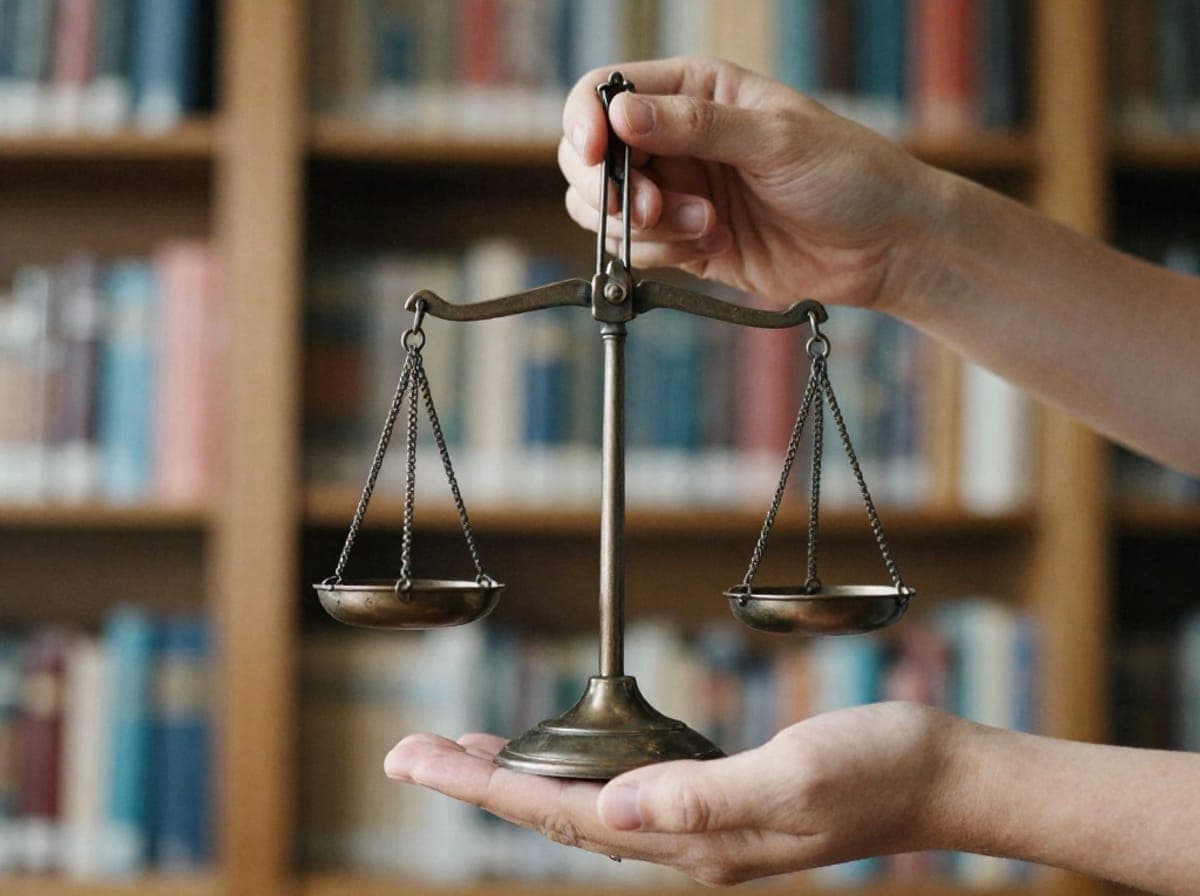
Justice is the commitment to fairness and to people receiving treatment proportionate to their circumstances, rights and merits. People who value justice feel uncomfortable with unjustified privileges or with situations where someone is treated unequally without a legitimate reason, and they often step in actively to correct those imbalances, even when they aren't directly affected. This value can be expressed by defending collective causes, mediating conflicts impartially, or simply insisting on clear rules applied equally within a group. Justice distinguishes between formal equality and real fairness, seeking an outcome that is genuinely just for all the parties involved.
What does this value mean?
Justice is the conviction that every person deserves fair treatment, under clear rules applied on the merits and not out of fondness, together with the commitment to act when that treatment is missing. It has two sides that are worth keeping apart: one looks at how things are shared out (money, work, recognition, burdens) and the other at how we respond when someone causes harm. To value justice is to care about both.
It stands for the decision not to look away from what is unfair, even when it doesn't touch you directly. People who value justice notice whether the rules apply equally to the director and the intern, whether the chores at home are divided reasonably and whether someone is carrying the consequences of a mistake they didn't make. It is measured in small decisions: handing out a prize by clear, published criteria, crediting the person who never makes it into the team photo, paying a freelancer on time when they can't afford to chase the invoice, or dropping a funny story about a colleague once you realise it makes them look foolish. In Book V of the Nicomachean Ethics, Aristotle separated the justice that distributes things according to merit or need from the justice that corrects a harm already done, and the split is still useful. In daily life the first shows up when you decide who gets the good shift or the scarce help, and the second when you have to answer for a mistake, yours or someone else's. One image that can help comes from the philosopher John Rawls, in A Theory of Justice (1971): imagine designing the rules without knowing which place you will end up in. If you didn't know whether you would be the manager or the trainee, the landlord or the tenant, the carer or the person being cared for, which rules would seem reasonable? The exercise doesn't settle every case, but it forces you to look from the uncomfortable side of the table.
What it does NOT mean
It does not mean punishing, always being right or applying an identical rule to everyone without looking at circumstances. Fair treatment isn't always identical treatment: giving everyone the same slice can be unfair when they start from very different places, as when you demand the same deadline from someone in good health and someone recovering from surgery. Nor is it revenge in polite language: some people say “I only want justice” when what they really want is for someone else to suffer what they suffered. It isn't rigidity, it doesn't turn you into the prosecutor of your friendship group, and it doesn't oblige you to have an opinion on every argument that is none of your business. It is not the same as legality either: something can follow the rule and still be unfair, and something can be fair without appearing in any rulebook. Finally, it does not consist of being outraged at everything; constant indignation is tiring and rarely corrects anything.
Related concepts
Why might it matter to you?
When people perceive the rules as arbitrary, they stop committing. You see it in a team where the same few people always win, in a family where some siblings carry everything while others turn up only at Christmas, or in a group of friends where one person always pays more and nobody mentions it. Justice is what lets you live alongside people who are different from you without every disagreement turning into a war: if you know there will be a reasonable criterion and that it will apply to everyone, you can accept an outcome you dislike. Without that confidence, every decision feels like a personal attack. Behind this value there is often an early sensitivity to unequal treatment, sometimes born of having suffered or witnessed it at school, at home or in a first job, and a need for the world to make a certain kind of sense. Putting weight on justice also gives you a practical test for deciding. Faced with a split, a sanction or a promotion, you ask what rules you would apply if the case belonged to someone else. And it gives you a reason to act at the moments when the comfortable thing would be to shrug. In The Idea of Justice (2009), the economist Amartya Sen argues that you don't need a perfect theory of the ideal society to recognise a concrete injustice and begin to reduce it. That is the most useful version for everyday life: you don't wait for the theoretical debate to be settled, you fix what is in front of you.
Advertisement
How can you live this value?
- Before choosing between two people, write down the criteria you will use. If you can't explain them without naming anyone, you are probably deciding out of liking. Share the criteria before you decide, not afterwards: a rule announced in advance can be discussed calmly, while a rule invented after the result smells like an excuse.
- When you hear only one version of a conflict, ask “what does the other side say?” before forming an opinion. You don't have to agree with everybody, just avoid judging on half the story. If the person involved isn't there, make a mental note that your opinion is provisional.
- Once a year, review who carries what at home or at work: invisible tasks, overtime, caring duties, admin. Put the list on the table instead of waiting for someone to explode. Include what nobody sees, such as remembering birthdays, booking medical appointments or taking the minutes.
- Apply Rawls's veil of ignorance to your own decisions: before setting a rule in your team, your residents' association or your household, ask whether you would accept it without knowing which role you will get. If it only seems reasonable because it favours you, revisit it.
- When an unfair rule works in your favour, such as a discount you shouldn't be entitled to, a till error in your favour or a shift swap that hurts someone else, acknowledge it and put it right, even if nobody asks. It is the cheapest rehearsal for what you would do with something bigger.
- Practise proportionate correction. When someone makes a mistake, match your response to its real seriousness and to what can be repaired: a private word for an oversight, a formal consequence for fraud. Reacting the same way to everything, whether with shouting or with silence, is another form of injustice.
What happens when you don't live up to this value?
Without justice, resentment sets in. Those who lose out build a silent list of grievances, and those who win get used to not asking why. In a company, talented people leave or disengage and nobody asks them the reason. At home, one person does the invisible work and the other says they “help”, as if the house belonged to only one of them. In a circle of friends, it is always the same person who organises, who makes the calls and who fronts the money, until one day they stop and everyone is surprised. And you feel a constant discomfort: you know something doesn't add up and you're unsure whether it's your place to say so. Sometimes the most damaging effect is not what happens, but what you get used to tolerating. If you see unequal treatment five times and stay quiet, the sixth already looks normal, and the person on the receiving end learns they can't count on you. Over the years, someone who holds justice dear and sets it aside tends to end up more cynical: they conclude that “that's just how things work” and that caring is pointless, a conclusion they never chose but that settled in a little at a time.
The healthy side and the shadow
When does this value stop helping you and start limiting you?
Healthy expression
Fairness with humanity
In excess
Moral rigidity
Justice becomes a problem when it is confused with keeping score of everything. It is the person who won't forgive a small mistake because “rules are rules”, who demands the other side pay exactly what is owed, and who judges others harshly without having lived what they lived. It is the colleague who notes down every time someone arrives late, and the partner who keeps a tally of who has washed more dishes. It can also harden into permanent indignation: seeing injustice in every disagreement and forgetting that sometimes the other person has a reason of their own, or that what happened was carelessness and not malice. There is a subtler variant, the urge to be the referee of everything: you feel responsible for every argument ending with the blame correctly distributed, and you end up stepping in where nobody asked your opinion. And another: selective justice, applied strictly to strangers or institutions and relaxed for your own people. The useful question is whether you want something put right or want someone to admit you were right. If it is the second, you are probably defending your pride and not justice.
This value at work
At work, justice shows in promotions, in how workload is split and in how mistakes are handled. If you manage people, acting justly means the rules are the same for your best employee and for the one you like least, that evaluation criteria are explained beforehand and not afterwards, and that criticism comes with concrete facts and in private. A simple example: two people ask to work from home one day; if you grant one request and refuse the other, you need a reason you can say out loud without embarrassment. If you don't manage anyone, it means not appropriating other people's ideas, giving credit in public to whoever earned it and not passing on rumours. It also appears in the unglamorous things: who writes up the action points, who cleans the office kitchen, who covers the holiday rota. Your usual challenge is deciding when to speak: pointing out unequal treatment can be costly, so it helps to have dates, facts and an ally before you do. Start with the gentlest route that might work, a direct conversation with whoever decides, and keep the formal routes, such as HR or a whistleblowing channel, for when the first one isn't enough or the matter is serious. And remember justice downwards: how you treat people who can do nothing for you, whether a small supplier, a trainee or the person who cleans the offices.
This value in relationships
In friendship, justice appears in everyday things: who organises, who treats, who always listens and who always talks, who travels to meet and who waits to be visited. A balanced friendship doesn't count pennies, but it doesn't let one person always give while the other always receives. On trips and group dinners, splitting the bill is a classic test: dividing it evenly can be unfair to the person who only had a salad, and demanding the exact penny can be mean towards someone who has been out of work for months. The fair thing is usually to talk about it beforehand and agree a rule that everyone accepts. When two friends fall out and each asks you to take a side, justice asks you to hear both and say what you see, even if it isn't what either wants to hear; sometimes it means refusing to be one person's confidant against the other. Be careful with loyalty misunderstood, too: you can love a friend dearly and still admit that this time they are in the wrong. And don't forget the other face of it: being fair to someone who has drifted away from you, without telling their side of the story to third parties in a slanted way.
This value in love
In a couple, justice is at stake in how things are divided: money, childcare, decisions about where to live, who gives up an opportunity when one of you is offered a job in another city. It isn't always fifty-fifty, but it does call for explicit agreements that both people consider reasonable. A couple in which one earns much more might decide that each contributes in proportion to income; what matters is that both decide it and either can revisit it. One delicate area is the mental load: the person who remembers the vaccinations, the clothes sizes or that the washing powder is running out does work that is barely visible and rarely thanked. Put names on those tasks so they can be shared out. Trouble comes when one partner silently accepts an imbalance and, years later, presents the bill in the form of reproach, or when old grievances are produced in an argument like evidence at a trial. Justice in a couple also covers how you argue: not using what you know of the other's weak spots as a weapon, not demanding what you don't offer and admitting early when you are wrong. If there is a break-up, justice is still there: dividing what you share by sensible criteria and not using the children as bargaining chips.
This value in family
In families, justice is tested by inheritance, the care of older relatives and comparison between siblings. Whoever looks after the parents most is usually the one who gives up most, and the rest take it for granted; if that person also lives closer or has no children, their availability is simply assumed. Talking about it early, with a rota and a split of tasks and costs, prevents resentment piling up until the day the will is read. When there is an inheritance, each family needs to decide what it means by fair treatment: dividing equally, compensating the one who did the caring or honouring the wishes of the person who died; what matters is that it is discussed in good time and not discovered by surprise. If you are raising children, it is more useful to explain why each child gets different things than to pretend everything is identical, because children notice what they consider unfair before anyone else: “you give him more” is a sentence nearly all of us have said. A practical rule is to give each child what they need and explain the criterion, rather than counting presents. And don't overlook justice between generations: what is expected of the young in a household, what is owed to the old and who decides in each case.
This value and yourself
Having justice among your top values says that what happens to other people affects you even when it isn't your business. You probably remember clearly the first time you saw someone treated unfairly, and you may find it hard to let an unequal split pass even when it doesn't harm you. You may have been called fussy or a stickler for pointing out an error in a bill or a rule being ignored, and you may have learned to stay quiet to avoid the reputation. It can also mean that you sometimes struggle to forgive, because forgetting feels like agreeing with whoever acted badly. It is worth knowing yourself in two respects: the situations in which you react fast (the division of work, the treatment of the weakest, favouritism) and those in which you are more tolerant than you would admit. If you meet someone else who values justice highly, you will probably get on well, but watch out if each of you has your own idea of what is fair: two people with the same top value can argue bitterly because they apply different criteria, one based on merit and the other on need.
What are you willing to sacrifice for this value?
Would you give up your comfort, a good relationship with your manager or a group's goodwill to defend someone being treated unfairly? Would you give up a benefit you received without deserving it? Think of the last time you witnessed unequal treatment and said nothing. If your silence still bothers you, justice is asking something of you that you haven't done yet, and you may still be in time to talk to the person affected, even just to say “I saw what happened and I thought it was wrong”. If you spoke up and would do it again, the value is well rooted. For this value, the cost is usually social: being alone in a meeting, being the one who “complicates things”, losing an invitation. Ask yourself what price you accept paying and which one you don't; your justice stays credible only if you know the answer.
Signs you're betraying this value
You betray justice when you apply a strict rule to someone you dislike and bend it for someone you like, when you accept a privilege without asking where it comes from, or when you stay silent about an abuse because the person committing it is useful to you. Also when you judge someone without letting them explain, when you share out the credit for joint work by keeping the visible part, when you demand that others follow the rules while you skip them yourself, or when you use your position to collect a favour you are not owed. A more discreet sign: reserving compassion for people who think like you and strictness for everyone else. And one more common than it seems: telling a partial version of a conflict to look good, knowing the other person isn't there to correct it.
Turning the value into goals
Value
Justice
Behavior
Write down the criteria before making a decision that affects several people, and share them with those people
Goal
Identify and correct one specific imbalance at home or in your team over the next quarter
Habit
Every month, review a recent decision and ask yourself whether you would have decided the same with a different person in the same position
Questions to reflect on
- Which inequality around you have you learned to see as normal when it isn't?
- When have you treated fairly someone you disliked? And treated unfairly someone you liked?
- In which situation are you expected to be impartial and aren't, even if you hide it?
- What costs you more: staying quiet in the face of injustice or paying the price of speaking up?
- If you designed the rules of your home or workplace without knowing which role you would get, which one would you change first?
- What privilege or advantage do you have that you have never stopped to ask where it comes from?
How much are you living this value?
From 1 to 10, how closely does the way you treat people you dislike match the way you treat people you like? If it's below 7, pick one person you've been harsher with than necessary and review how you treat them this week. Then run the exercise in reverse: think of someone you like and ask yourself whether you have forgiven them something you would not have forgiven in someone else.
When two values clash
Justice clashes with Loyalty when someone close has done something that harms others and staying silent feels like a way of looking after them. A typical case: a close friend pads their expenses at the company, or a relative drives after drinking. Speaking up can break the trust; staying silent makes you a party to it. It clashes with Empathy, or with Kindness, when the rule demands a hard consequence for someone who is already suffering enough, for example dismissing a colleague who made a serious error while going through a separation. It clashes with Freedom when what one person considers fair limits what another wants to decide for themselves, as when a “fair” holiday rota is imposed on someone who would rather choose their own. With Honesty it usually goes hand in hand, but the two part company when telling the whole truth would harm an innocent person. With Gratitude there is another crossing: what someone deserves under the rules and what they deserve for what they have done for you don't always coincide. With Security they can collide if a uniform rule protects everyone but is unfair in one particular case. With Humility the tension is more personal: to be fair you have to admit that your own view of what is fair may be biased. There is no formula. It often helps to ask who comes off worst under each option and whether that person had a say in the decision, and to remember Rawls's veil: choose as if you could be any of the people involved.
Is “Justice” one of your top 10 values?
Find out by playing and comparing this value with the other 49
How the Elo ranking works and its limits in the methodology.
What does the paid report include?
When you finish the 100 comparisons you will see your Top 10 on screen. If you want to go further, there is a PDF report on your personal values: €9.95 (VAT included), one-off payment. To buy it you need to save your game with a Google account.
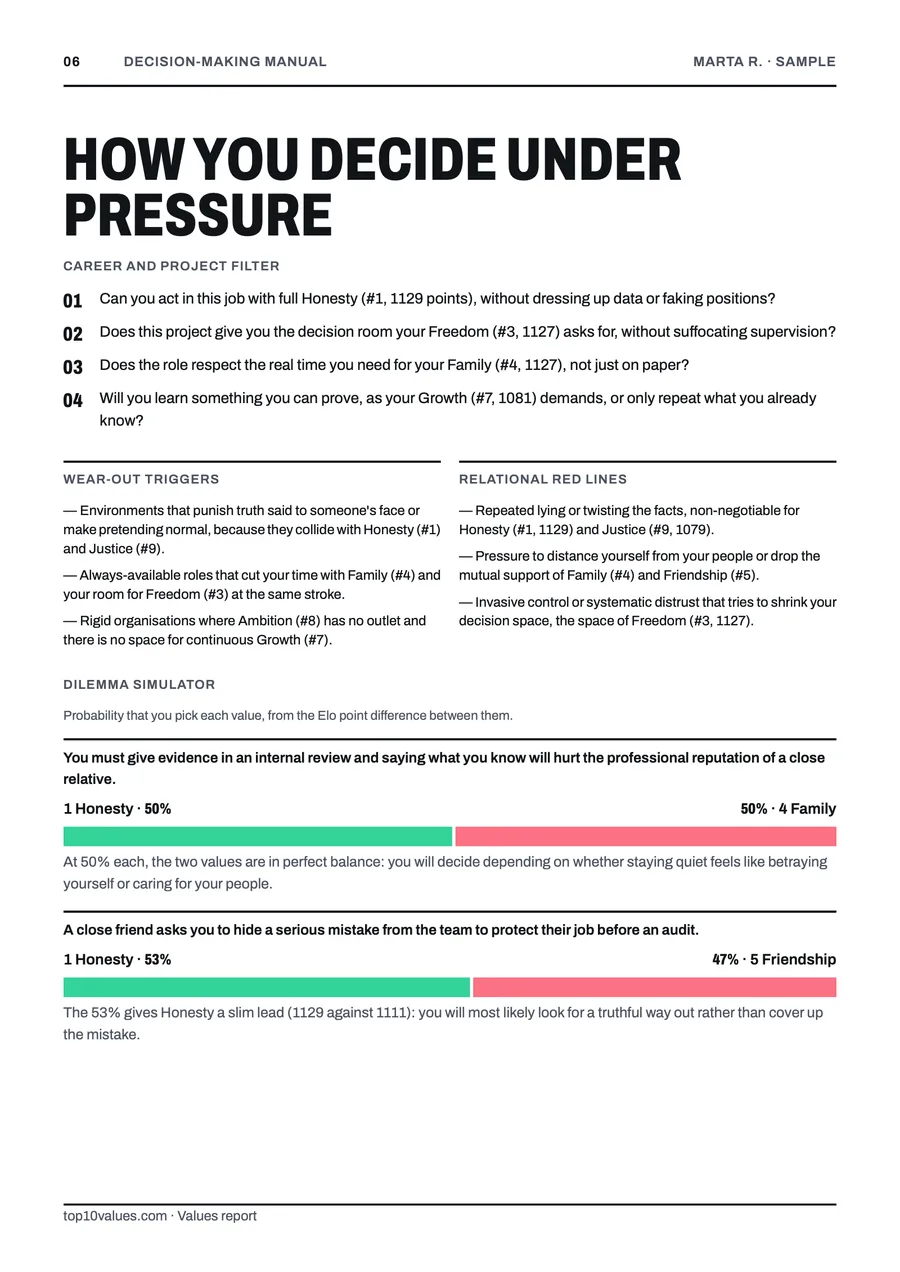
Sample page with fictional data (Marta R.), not yours. Your report is written from your own choices.
Frequently asked questions
What is the difference between justice and equality?
Equality gives everyone the same; justice gives each person what they need to be on comparable terms. Giving the same deadline to someone on medical leave as to someone who isn't is equal, but not necessarily fair. Equality still matters, though: when there is no relevant reason to treat people differently, the fair thing is to treat them alike. The key is knowing when a difference is relevant (a need, an effort, a prior commitment) and when it is a prejudice in disguise.
How can I react to an injustice without becoming bitter?
Pick your battles: document what happened, talk to whoever can change it and look for allies. Acting on one specific thing is less tiring than being outraged at everything. And remember that not all unequal treatment is bad faith: sometimes it is carelessness, and a calm question settles more than an accusation. Look after what keeps you going too: sleep, talking with people you trust and having spaces where justice is not the topic. Bitterness tends to appear when you feel you carry the world alone; shared action takes the edge off it.
Does being fair mean not forgiving?
No. Forgiving doesn't erase responsibility: you can acknowledge what someone did, ask them to repair what they can and still let go of the resentment. Justice with no room for forgiveness ends up as punishment. And forgiveness with no demand for repair can leave the person who was harmed without a voice. Between the two extremes, the usual path is proportionate repair, a credible apology and a change you can check; after that, each person decides how much trust to give back and at what pace.
Is it unfair that I have advantages I never chose?
Having advantages is not a moral failing in itself: nobody chooses the family, the country or the health they are born with. The question is what you do once you notice. Being aware that some of your opportunities did not depend only on your effort helps you judge people who have had less with less arrogance, support rules that open opportunities more widely and use your position, when you can, to open doors. That is more useful than feeling guilty in the abstract.
What should I do if reporting an injustice at work could hurt me?
Weigh the risk calmly, without heroics or cowardice. Gather facts with dates and, if you can, evidence or witnesses; first ask someone experienced in confidence (a union rep, a mentor, an employment lawyer) and check what formal channels exist and what protection they give. Speaking to the person who decides can be a reasonable first step. If the matter is serious, such as fraud or a risk to other people's safety, don't handle it alone. And remember that not acting is also a decision, and it can carry a moral cost.
When Justice clashes with…
Invented scene. In a shared flat of four, chores are set out on a weekly chart stuck to the fridge. Andrés has not cleaned the bathroom in two months because his mother is in hospital and he travels every weekend. His flatmates Julia, Noa and Berta have quietly covered for him, until Noa mentions it in the group chat. Justice asks that the chart apply to everyone and that nobody carry someone else's share without knowing it. Empathy answers that applying the same rule to someone in the middle of a crisis keeps the letter and misses the situation. Julia's loyalty, as Andrés's friend since university, pushes her to smooth it over so nobody gets angry. It may help to say it out loud, admit the chart never anticipated a case like this, and agree a temporary change with a review date, so the exception belongs to everyone instead of being a hidden favour. More examples in conflicting values.