Schwartz's theory of basic values: the 10 values, the circle, and what it can and cannot tell you
By Juan Alejandre · Published · Reviewed
Industrial engineer and consultant, 25 years working with teams
Schwartz's theory of basic values proposes that people across cultures recognize ten broad personal values, that those values form a circle, and that what differs from person to person is the order of priority when two of them pull apart. This guide explains the ten basic values, the four groups they form, how the theory is measured, its main criticisms, and a 20-minute exercise to read your own Top 10 against the circle.
top10values is not a Schwartz test, not the Portrait Values Questionnaire (PVQ), and not an adaptation of his instruments. It is a pairwise comparison game using Elo ratings, without validation as a psychometric instrument. If you need the academic questionnaire for a study or paper, you will not find it here: below we explain what those instruments are and where they are used. What you will find here is a clear explanation of the model and a practical exercise to apply it to your own priorities.
Who is Shalom H. Schwartz and what does the theory claim?
Shalom H. Schwartz is a social psychologist and cross-cultural researcher, professor emeritus at the Hebrew University of Jerusalem. He presented the model in 1992 in "Universals in the Content and Structure of Values," published in Advances in Experimental Social Psychology with data from 20 countries. One of his most cited summaries is his 2012 article in Online Readings in Psychology and Culture, which is openly available and reviews findings from 82 countries.
Advertisement
The theory rests on three claims:
- A small set of basic values is recognized across cultures. Each value expresses a distinct motivational goal tied to basic requirements of human life.
- Values form a circle. Neighboring values share compatible motivations, while values on opposite sides of the circle tend to clash.
- What varies between people is the priority order. Almost everyone recognizes all ten values; the difference lies in which one comes first when you cannot satisfy both.
What counts as a value in Schwartz's model (and what does not)
Schwartz's 2012 overview separates values from attitudes, traits, norms, and beliefs. With everyday examples:
- "Cities should build more bike lanes" is an attitude toward a specific policy.
- "I am quiet in large meetings" is a personality trait: how you usually act, whether or not you prefer it.
- "Our team does not send messages after seven" is a norm: a shared group rule.
- "Remote workers get overlooked for promotion" is a belief: a claim about facts that can be checked.
- "Choosing where and how I work" is a value: a goal that guides decisions across many situations.
If you want to separate values from beliefs in your own decisions, our guide on values vs beliefs walks through a comparison table and four test questions.
The 10 basic values, grouped by higher-order dimension
The descriptions below are in our own words, not verbatim quotes from the questionnaires. The four headings match the standard groups of the model; a note on hedonism follows the list.
Openness to change
- Self-direction: independent thought and action—choosing, creating, and exploring. It shows up when you prefer to figure out your own method rather than follow a script, close to freedom, independence, curiosity, and creativity.
- Stimulation: excitement, novelty, and challenge. It shows up when routine bores you and you look for unfamiliar projects or places, much like adventure.
Self-enhancement
- Achievement: personal success through demonstrating competence by social standards. It shows up when you care about mastering a craft and hitting clear benchmarks, linked to ambition and success.
- Power: social status, prestige, and control over people or resources. It shows up when you want decision-making authority or material margin, touching leadership, recognition, and wealth.
- Hedonism: pleasure and sensory gratification. It shows up when enjoying food, rest, and everyday comfort is treated as worthwhile in itself, close to joy.
Conservation
- Security: safety, harmony, and stability of society, relationships, and oneself. It shows up when a six-month savings buffer and predictable routines let you sleep well; see security.
- Conformity: restraint of actions or impulses likely to upset others or break social norms. It shows up when you keep agreed rules even when inconvenient, touching discipline and respect.
- Tradition: respect and commitment toward the customs and ideas of your culture or religion. It shows up when preserving inherited rituals and family practices matters to you, often paired with humility.
Self-transcendence
- Benevolence: caring for the welfare of the people you deal with often. It shows up when helping your partner, family, or close friends comes before convenience, reflected in family, loyalty, kindness, and friendship.
- Universalism: understanding, tolerance, and protection for the welfare of all people and nature. It shows up when fairness toward strangers and care for the environment weigh on your choices, linked to justice, empathy, and service.
A note on hedonism. Hedonism sits on the border between openness to change and self-enhancement: it shares novelty with stimulation and self-focused satisfaction with achievement. Different summaries place it slightly differently. Here we include it under self-enhancement; check the primary source if you cite it in academic work.
Summary table of the 10 universal values
| Basic value | Higher-order group | Motivational goal (plain words) | Everyday sign | Related pages on top10values |
|---|---|---|---|---|
| Self-direction | Openness to change | Think and act independently | You redesign a workflow instead of copying the template | Freedom, Independence, Curiosity |
| Stimulation | Openness to change | Seek novelty and challenge | You volunteer for an unfamiliar project when routine sets in | Adventure, Creativity |
| Hedonism | Self-enhancement / Openness | Enjoy life and sensory pleasure | You protect unhurried time for a meal or a weekend away | Joy, Happiness |
| Achievement | Self-enhancement | Demonstrate competence and succeed | You track your progress against a demanding goal | Ambition, Success, Mastery |
| Power | Self-enhancement | Gain status, influence, and control | You step forward to lead the budget or strategy call | Leadership, Recognition, Wealth |
| Security | Conservation | Protect safety and stability | You keep a strict savings floor before taking a career risk | Security, Health |
| Conformity | Conservation | Honor shared rules and expectations | You follow team protocol even when a shortcut tempts you | Discipline, Respect |
| Tradition | Conservation | Maintain inherited customs and rituals | You keep a family gathering alive year after year | Humility, Family |
| Benevolence | Self-transcendence | Care for people in your close circle | You drop your plans when a close friend needs a hand | Kindness, Loyalty, Friendship |
| Universalism | Self-transcendence | Protect fairness for all and nature | You refuse a supplier whose practices harm outsiders | Justice, Empathy, Service |
Three nuances worth keeping in mind:
- Benevolence and universalism have different scopes. Benevolence focuses on people close to you; universalism extends to strangers and nature.
- Security, conformity, and tradition are not identical. Security seeks stability, conformity avoids breaking social expectations, and tradition preserves what was handed down.
- Spirituality was tested and excluded. In 1992 Schwartz examined spirituality as a possible eleventh value and dropped it because it did not show a single consistent meaning across cultures.
The 4 groups and the two opposing axes of the circle
| Higher-order group | What it brings together | Basic values |
|---|---|---|
| Openness to change | Following your own interests in new and uncertain directions | Self-direction, stimulation |
| Self-enhancement | Pursuing personal success and influence | Achievement, power, and (here) hedonism |
| Conservation | Preserving order, stability, and continuity | Security, conformity, tradition |
| Self-transcendence | Looking beyond personal interest toward others and nature | Benevolence, universalism |
The circle has two opposing axes: openness to change versus conservation (autonomy and novelty versus order and restraint) and self-enhancement versus self-transcendence (personal status and success versus the welfare of others).
This structure is the most practical part of the theory. A flat list tells you what matters; the circle tells you what is hard to combine. If you value both novelty and security, you will feel tension when planning a career move. When those tensions turn into concrete choices, our guide on conflicting values offers a method to decide.
Three everyday scenes (invented examples)
These are invented scenes: fictional characters that illustrate the circle in action, not clinical cases or study data.
Kofi and the pull between achievement and benevolence
Kofi, 24, ranks his Top 10 and finds it split down the middle: ambition, mastery, and recognition sit next to kindness, loyalty, and empathy. Promoted to lead a software project with tight deadlines, he feels drained whenever he has to push a teammate to rewrite slow code. On Schwartz's circle, his list spans two opposite quadrants: self-enhancement and self-transcendence. Seeing this helps him separate standards from tone: he sets clear technical benchmarks on Monday (achievement) and reserves Friday afternoons to pair-program and mentor junior teammates (benevolence).
A seminar teacher comparing ratings with pairwise choices
Dr. Miller introduces Schwartz's ten values in a university seminar. First, she asks twenty students to rate each value from 1 to 7. Eight of the ten values average between 5.8 and 6.4—almost everyone rates benevolence, self-direction, security, and universalism near the top. Next, she asks them to choose between pairs in concrete work dilemmas, such as self-direction versus conformity when a client asks for a questionable format. The flat averages vanish: half the room protects autonomy first, and the other half protects team coordination.
Maya and Liam on opposite ends of openness and conservation
Maya and Liam are deciding how to use their savings. Maya wants to spend a year working remotely abroad (adventure and freedom, openness to change); Liam wants a down payment on a flat near his parents (security and family, conservation). They argue about rent numbers until they map their lists onto the circle and see they sit at opposite ends of the openness-versus-conservation axis. Naming the real trade-off lets them agree on a three-month trial abroad while keeping a fixed savings floor untouched.
How the theory is measured: SVS, PVQ, and the European Social Survey
Researchers measure the model with standardized questionnaires:
- Portrait Values Questionnaire (PVQ): presents short descriptions of people and asks how much each portrait resembles you. A well-known 40-item version was designed to be accessible to ages 11 to 14 and works consistently with adults.
- Schwartz Value Survey (SVS): around 57 items presenting values as abstract nouns and adjectives.
- European Social Survey (ESS) scale: a 21-item scale developed by Schwartz (who served on the ESS scientific advisory board from 1998 to 2016) to compare populations across countries.
In 2012, Schwartz and colleagues published a refined 19-value circle in the Journal of Personality and Social Psychology (PMID 22823292), tested across 15 samples in 10 countries ($N = 6,059$). For personal reflection, the 10-value map is simpler; for research, consult the published papers directly.
Criticisms and practical limits of Schwartz's model
- Broad categories hide everyday trade-offs. Both family and friendship fall under benevolence, yet holiday plans often force you to choose between them.
- Rating scales let everything score high. On a 1-to-7 scale, people often rate almost every value high unless statistical centering is applied.
- Self-report is not behavior. Words like "power" or "tradition" shift meaning across cultures, and calm questionnaire ratings do not always match choices under pressure. Neither the theory nor our game evaluates mental health.
Schwartz's questionnaires vs ranking your own values in pairs
| Aspect | Schwartz questionnaires (PVQ / SVS) | Pairwise comparisons (top10values) |
|---|---|---|
| What you do | Rate how much each portrait or item resembles you | Choose one value out of two in 100 pairs |
| What you get | Scores across 10 (or 19) universal categories | An ordered Top 10 from 50 concrete values |
| Example result | "High in benevolence, low in power" | "Honesty, family, and freedom come first" |
| Best suited for | Academic research and group comparisons | Personal reflection and concrete decisions |
| Evidence base | Decades of studies across 82 countries | Not a validated psychometric test; uses Elo math |
| Main limit | Categories are broad; ties are common | Closed list of 50 values; measures rank order only |
Three differences matter in practice:
- Rating versus choosing. In pairwise comparisons one value rises and the other falls (starting at 1,000 Elo points, up to $K = 32$ per choice), forcing trade-offs that rating scales postpone.
- Universal categories versus your own words. "Benevolence" is a research bucket; family, loyalty, and kindness point to distinct commitments.
- Validation. Schwartz's scales have cross-cultural psychometric validation. Our game does not; we document our exact calculation on the methodology page.
A 20-minute exercise: read your Top 10 against Schwartz's circle
- Write your Top 10. Use your result from the personal values test in our comparison game, or pick ten values on paper with the exercises in knowing my personal values.
- Assign each value to a group. As a guide: freedom and authenticity fit openness to change; ambition fits self-enhancement; security fits conservation; empathy and justice fit self-transcendence. Family and loyalty can sit in conservation or self-transcendence depending on what they mean to you.
- Count. Tally how many fall into each of the four groups.
- Spot opposing pairs. Check whether you have top values in opposite quadrants (openness vs. conservation, or self-enhancement vs. self-transcendence) and recall one recent decision where they clashed.
- Draft a one-sentence rule. Write a tie-breaker for that tension—for example: "When work and family clash, I decide by who needs me more that week."
- Review in three months. When your life stage shifts, re-rank using our values hierarchy guide.
Frequently asked questions
What are the 10 basic values in Schwartz's theory?
Self-direction, stimulation, hedonism, achievement, power, security, conformity, tradition, benevolence, and universalism. They form four higher-order groups around a circle: openness to change, self-enhancement, conservation, and self-transcendence.
Is there an official Schwartz values test online?
Researchers use the Portrait Values Questionnaire (PVQ), the Schwartz Value Survey (SVS), or the 21-item European Social Survey scale. Some websites offer informal versions, but we cannot guarantee their quality or scoring. For academic work, use the version published by the authors.
Is top10values a Schwartz values test?
No. Our game does not use Schwartz's questionnaires or his ten categories, and it is not a validated psychometric instrument. It uses pairwise comparisons with Elo scoring over a list of 50 personal values.
What are the main criticisms of Schwartz's theory of basic values?
Its ten categories are broad enough that two values inside the same group (such as family and friendship inside benevolence) can still collide in daily life, rating scales allow respondents to score everything high without statistical centering, and self-reports do not always predict real behavior.
How is rating values different from comparing them in pairs?
When you rate values on a scale, several can tie at the top. Comparing two at a time forces you to give one up in every pair, producing a clear order, though it measures relative rank rather than absolute importance.
Do personal values change over time?
Your priorities can shift with life stages, a career change, or a major loss. Treat your Top 10 as a snapshot of what weighs most today and revisit it when your circumstances change.
Related guides
- Personal values test: how pairwise comparisons work and how to read your Top 10.
- Knowing my personal values: six practical exercises to identify your values.
- Values hierarchy: how to rank your personal values step by step.
- Values vs beliefs: how to avoid confusing a value with a belief.
- Conflicting values: what to do when two of your values collide.
Next step
Schwartz's theory gives you a map; ranking your values shows where you stand on it. To see your own order, compare your values in pairs in the game and apply the 20-minute exercise above. You can also browse all 50 personal values or read our about page.
Sources
- Schwartz, S. H. (1992). Universals in the Content and Structure of Values: Theoretical Advances and Empirical Tests in 20 Countries. Advances in Experimental Social Psychology, 25, 1-65.
- Schwartz, S. H. (2012). An Overview of the Schwartz Theory of Basic Values. Online Readings in Psychology and Culture, 2(1). https://doi.org/10.9707/2307-0919.1116
- Schwartz, S. H. et al. (2012). Refining the theory of basic individual values. Journal of Personality and Social Psychology, 103(4), 663-688. PMID 22823292.
- European Social Survey. Human Values Scale (21-item source questionnaire documentation). https://www.europeansocialsurvey.org/methodology/ess-methodology/source-questionnaire
Sources
Find your top 10 values with 100 quick comparisons
What does the paid report include?
When you finish the 100 comparisons you will see your Top 10 on screen. If you want to go further, there is a PDF report on your personal values: €9.95 (VAT included), one-off payment. To buy it you need to save your game with a Google account.
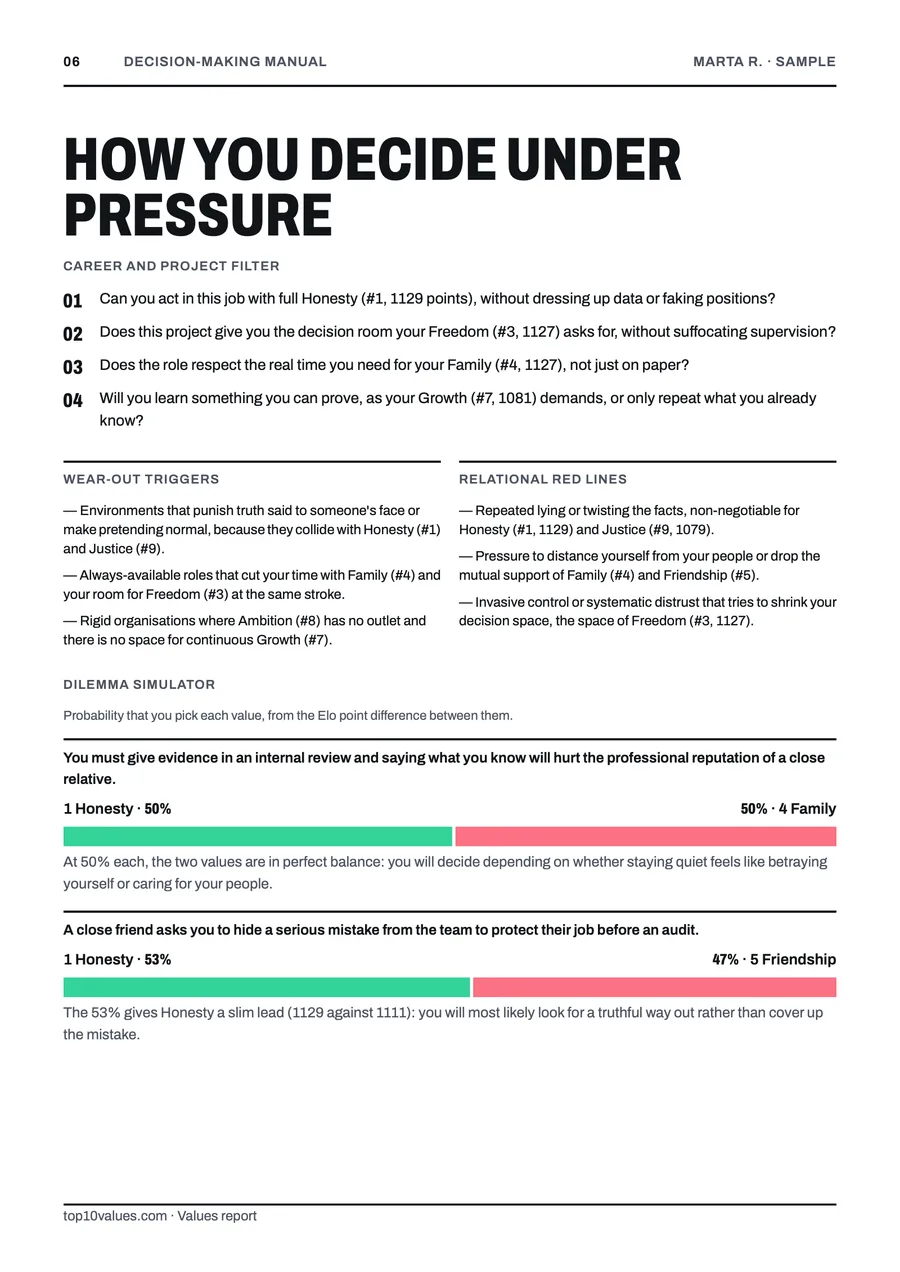
Sample page with fictional data (Marta R.), not yours. Your report is written from your own choices.