Personal Growth
Service
Actively helping others.

Service is the vocation of actively helping others in a concrete and direct way, putting your own abilities at the service of real needs in other people. People who value service don't stop at wishing others well in the abstract; they look for tangible opportunities to step in: supporting a colleague, attending to a customer with genuine dedication, or giving time to causes that directly benefit their community. This value differs from contribution in that it emphasizes immediate interpersonal help rather than abstract collective impact. People guided by service often find professional meaning precisely in the concrete usefulness their work has for others.
What does this value mean?
Service, as a value, is the habit of putting your time, your hands and your skills to work on what another person needs, not on what you would most like to give them. What sets it apart is its direction: someone who serves starts from a specific need that belongs to someone else (a house move, a queue at the counter, a patient who cannot get to the clinic alone, a customer with a problem they cannot quite explain) and adjusts what they do to fit it, even when the task is modest, repetitive or invisible. When this value guides you, the first thing you do on seeing someone struggling is ask “what do you need?”, and you answer that question with actions rather than kind words alone.
People who put service near the top of their list usually know it from ordinary moments. The night-shift nurse who, at four in the morning, still notices that the patient in bed 214 has had his water glass left out of reach. The neighbour on the third floor who carries shopping up to the woman on the fifth every Thursday in a building with no lift, and who no longer thinks of it as a favour but as part of the week. The clerk at the council counter who, instead of repeating “that’s not this desk”, steps out from behind it to point an elderly man to the right door and tells him in advance which document he will be asked for. The retired man who drives other patients to their dialysis sessions in a charity’s car three mornings a week. The friend who turns up at eight on moving day with a drill and a borrowed van, and the teenager who spends December Saturdays sorting tins at a food bank. What they have in common is not a sweet temperament or a religious calling, though some of them have one, but a way of looking: they see jobs that need doing where others see a nuisance, and stepping in feels natural to them. Service is often learned in trades that carry the word in their name, such as hospitality, healthcare, customer service, the civil service or the emergency services, but it does not stay there. In private life it shows in one detail: people know whom to ring when they need someone to turn up.
What it does NOT mean
Serving is not servility. A servile person obeys to avoid conflict or win favour, and gives up their own judgement; someone who truly serves keeps their judgement and uses it on the other person’s behalf, which sometimes means saying “what you’re asking for won’t help you” or “I won’t do that”. Nor is it people-pleasing: giving everyone what they ask for in the moment does not always meet what they need, and a good waiter knows it when they tell a table that two sharing plates will be plenty. It is not identical to contribution, though the two are close: contribution looks at the lasting effect you leave behind (a resource, an improvement, someone who has learned a trade from you), while service looks at the act of meeting a particular need, even if it is used up on the spot, like keeping someone company for an afternoon in A&E. It is not kindness either, which is about tone and manner: you can serve with few words and a serious face, and you can be very pleasant without lifting a finger. It needs no institution, formal volunteering scheme or faith, although many religious and civic traditions have cultivated it. And it does not mean your time is worth less than other people’s: serving is a choice you make from a place of dignity, not a debt you pay for lacking it.
Related concepts
Why might it matter to you?
Much of what makes daily life liveable depends on people who serve: whoever answers when you ring the GP surgery, whoever cleans the stairwell, whoever explains a bill you do not understand without rushing you, whoever drives you to the airport at six in the morning. Holding service as a value puts you on the side of the people who keep that network going, and that has concrete effects. The first is meaning: small, repeated tasks stop feeling like wasted time once you know who they are for, and an unglamorous working day can end with the certainty that you sorted out five people’s problems. The second is connection: practical help builds a kind of trust that words do not, and the person who was there for a house move, a hospital stay or a funeral is remembered for years. The third is character: serving trains you to look outward, to notice what is missing in a room, to anticipate what someone is about to need and to put your own comfort on hold without making a drama of it. That kind of attention is useful in any job and any relationship. There is also a less obvious effect: people who serve regularly tend to have a more realistic picture of how things work, because they know the labour behind what others take for granted, from school dinners to bin collections. Martin Luther King Jr. put it bluntly in his sermon “The Drum Major Instinct”, preached at Ebenezer Baptist Church in Atlanta on 4 February 1968: everybody can be great, because everybody can serve, and you do not need a college degree to do it. It is a demanding idea and a deeply democratic one: service does not depend on what you have, but on what you do with it.
How can you live this value?
- Ask before you act, and listen to the whole answer. “What would help?” works better than “leave it to me”. Sometimes the person needs a lift to the hospital; sometimes they need you to mind the children so they can go without rushing. If you offer what you happen to be good at instead of what is needed, service turns into a present nobody asked for.
- Make specific offers: name the day and the hour. “Give me a shout if you need anything” is almost never taken up, because it forces the other person to ask. “I’ll come round at seven on Tuesday, take your bins out and bring the shopping up” usually is. After a bereavement, during an illness or in the first days with a new baby, one concrete offer counts for more than ten encouraging messages.
- Choose one small, regular commitment rather than several heroic ones. Two fixed hours a month at a community kitchen, walking a neighbour to the market every week or taking your nephew to football practice on Tuesdays will hold up far better than one big day a year. Regularity lets people count on you, and being dependable is much of what people end up thanking you for.
- Take on the unglamorous jobs. Washing up after the club dinner, filling in the residents’ association form, staying behind to stack the chairs when the event is over. A simple test of whether the value is alive is whether you also do the things nobody will see or thank you for in public.
- Set your limits before you volunteer, not once you are running on empty. Decide how many evenings a week you can give without taking them from your health or your household, and say so: “Mondays I can do; Thursdays I can’t.” Service with a timetable is more reliable than service that depends on how long you can hold out.
- Let yourself be served as well. When someone offers to help you, accept without justifying yourself or rushing to pay it back. People who only know how to give leave everyone else in an awkward position, permanently in their debt, and deny them the chance to return the favour. Receiving well is part of the value.
Advertisement
What happens when you don't live up to this value?
When service is absent, it rarely shows as a crisis; it shows as a kind of distance. You walk past what needs doing without seeing it: the older person who cannot reach the top shelf in the supermarket, the new colleague who has spent a week not knowing where to order supplies, the group of parents who need someone to organise the coach for the school trip. It is not ill will; your attention is simply taken up by your own lane. At work it comes out as a very recognisable sentence, “that’s not my job”, used even when fixing the thing would take two minutes. At home it shows when the caring tasks always land on one person and you do not notice until that person is exhausted. If service matters to you and life has pulled you away from it, through a job where you only produce reports or a period of heavy demands of your own, the feeling is a practical emptiness: you do a great deal, but none of it for anyone with a face and a name. A good way to spot it is to ask when someone last thanked you for something you did with your hands, rather than for a message.
The healthy side and the shadow
When does this value stop helping you and start limiting you?
Healthy expression
Meeting real needs without giving up your judgement
In excess
Servility and the rescuer role
Service has two opposite shadows. The first is servility: you attend so closely to what others ask that you stop asking whether it makes sense, and end up running errands that are not yours, putting up with treatment you would never accept for someone you love, or covering for a boss’s mistakes because “that’s what you’re there for”. In that version you are no longer serving anyone; you are just obeying. The second shadow is the rescuer: you decide what other people need, arrive before you are called and struggle to let go of the role, because being the helper gives you a safe place to stand. It shows in the quiet resentment you feel when someone manages without you or turns your help down. In families and in caring professions a third shadow appears, which is wear and tear: the person looking after a dependent parent, covering for every colleague and also running the residents’ association can reach a level of exhaustion where they can no longer care well for anyone. The psychologist Christina Maslach, who studied burnout among people working in human services, described exactly that picture: emotional exhaustion, a growing detachment from the people you are meant to help and a sense that your effort no longer achieves anything. The healthy version of service has three recognisable traits: it keeps its judgement (“this won’t help you”), it respects the other person’s decision even when you disagree, and it knows how to hand over the shift without feeling like desertion.
This value at work
At work, service shifts the centre of gravity of the day: what you deliver is not enough on its own; what matters is who it is for and whether it actually helps them. In customer-facing jobs it shows immediately. The waiter who notices a child with an allergy at table six and warns the kitchen without being asked twice; the support technician who, rather than closing the ticket with a stock answer, rings the customer two days later to check the fault has not come back; the pharmacist who takes a minute to explain to an elderly woman when to take each tablet and writes it on the box. In jobs with no public contact, service appears as attention to the people inside the organisation who depend on you: you write the report for someone who will read it in a hurry, you document the process for whoever covers you during holidays, you answer the email that is blocking another department before the one you find interesting. If you manage a team, there is an explicit tradition close at hand: in his essay “The Servant as Leader” (1970), Robert K. Greenleaf described a leader who asks first whether the people they serve are growing and becoming more autonomous, and only then how to direct them. In practice that means clearing obstacles out of the team’s way, sharing the credit and keeping the thankless part of some problems for yourself. Service does carry a clear career risk, though: support tasks (taking minutes, organising the Christmas party, training whoever has just joined, putting out other people’s fires) eat up hours and rarely appear in a performance review. If you are the person who always puts a hand up, make that work visible and negotiate it: asking for part of it to count towards your objectives does not betray the value; it makes it sustainable. And it helps to tell serving a customer apart from submitting to one: good service includes saying clearly what cannot be done, and a company that expects you to swallow any treatment has confused attentiveness with docility.
This value in relationships
In friendship, service is what makes you the person people ring when their car breaks down on the motorway or when they need someone to look after the dog for a week. It shows less in long conversations than in short, well-timed appearances: the soup you leave on a friend’s doorstep when she has flu, the airport run at an impossible hour, the afternoon spent putting up shelves in someone else’s new flat. If this is your value, you probably remember important dates in order to help, not just to send congratulations: the day of the court hearing, the first week with the baby, the mother’s operation. Some friendships are built almost entirely on this practical exchange and are very solid, because each side knows the other will be there. The risk is getting stuck as the useful friend and nothing more: the one people call for house moves but do not invite to dinner, or the one who always listens and never gets to talk. If you notice that your friendships consist mostly of requests, the problem is not your generosity but the balance. Try asking for something yourself, even something small, and notice who responds. And watch out for helping as a way of passing judgement: reorganising a friend’s kitchen while doing them a favour, or sorting out their paperwork and then remarking on what a mess it was, turns service into a lesson nobody asked for.
This value in love
In a couple, service is played out in the least romantic and most decisive part of living together: who gets up when the baby cries at three, who remembers to book the dentist, who goes out for bread when it is raining. Serving your partner does not mean acting as a servant or a personal assistant; it means taking care of whatever is weighing on the other person right now, even when it is not your turn, and that willingness running in both directions. It shows in very specific gestures: filling up the car the night before their long drive, making the call to the insurer they have been putting off for a week, staying with their mother at the hospital so they can sleep at home for one night. For it to work you need to know what counts as help for the other person: some people feel looked after when you take a task off their hands, while others experience it as interference because they prefer to do it their own way. Asking “shall I help, or would you rather do it yourself?” prevents a lot of misunderstandings. Two risks deserve attention. The first is bookkeeping: if every gesture is mentally logged to be cashed in during the next argument (“I picked you up that time”), service turns into debt. The second is the unequal split that settles in without anyone deciding it: one partner ends up carrying the invisible work of the household and the wider family, and what began as generosity ends in tiredness and resentment. Reviewing that split every so often, with the list of tasks in front of you and without hunting for culprits, is also a way of serving the relationship.
This value in family
Family is the first place where people learn to serve, and often the place that asks the most of them. With children, service is passed on through jobs more than speeches: a five-year-old can lay the cutlery, a ten-year-old can carry their grandmother’s bag up the stairs and a teenager can help a younger brother with homework one afternoon a week. The point is that the job genuinely helps someone and that this is noticed, not that it is a punishment in disguise. With older relatives, service takes the form of care: going along to appointments, filling the weekly pill organiser, handling the bank paperwork once their eyesight can no longer manage the small print. This is where a very common tension appears in midlife, when you are looking after children who still depend on you and parents who are starting to, and you need to learn to share the load among siblings instead of shouldering it out of inertia. A family meeting with a concrete rota, who goes on which day and who handles which errand, stops everything falling on whoever lives closest or whoever never says no. It also helps to serve in a way that lets the other person keep their dignity: letting your father choose his own clothes even when it takes him longer, or letting your grandmother keep making the Sunday stew even though it tires her, is more respectful than doing everything for them. And there is a part that gets forgotten: letting older relatives serve you while they still can, by minding the grandchildren or teaching you a recipe, because hardly anyone enjoys suddenly becoming only the one who receives.
This value and yourself
If service ranks among your first values, you probably notice straight away what is missing in a room: the chair someone needs, the person left on the edge of the conversation, the empty glass. You may end a day spent solving other people’s problems more satisfied than one spent moving your own projects forward, and find it hard to sit still while others are working. There is a reverse side to check as well. How much of your help was asked for, and how much do you offer before asking? Can you say no without giving five reasons? What do you feel when someone turns down your help or accepts it without a thank-you? Do you let yourself be helped, or does it make you so uncomfortable that you would rather do everything? The answers will tell you whether you serve by choice or because you need to be useful to earn your place. If it ranks lower for you, that does not mean you are selfish: your energy may currently be going into building something of your own, recovering from a long stretch of caring for someone, or other values that also benefit people indirectly. It is enough that you know it, and that at home clearing the table does not always fall to someone else.
What are you willing to sacrifice for this value?
Serving costs time, comfort and sometimes status. Would you give one Saturday a month to a shift at a community kitchen even if it took away your only day without a schedule? Would you cut your hours for a few months to support a relative through treatment, knowing your salary and perhaps your career would feel it? Would you take on a low-profile task at work, such as training newcomers or reviewing what others hand in, even if it never showed up in your appraisal? Would you get up in the middle of the night to collect a friend from the station? Would you tell the person who pays you or the person you report to “this isn’t in your interest”, at the risk that they would not like hearing it, because serving them properly demands it? Find a recent example of paying a price like that. If you did so without presenting the bill afterwards, service genuinely shapes your decisions. If help only appears when it costs nothing or when someone is watching, you may value looking helpful more than actually serving.
Signs you're betraying this value
You betray service when you answer “not my problem” to something you could fix in two minutes, when you look after people who can return the favour better than those who cannot, or when your way of helping follows what makes you look good rather than what is needed. Also when you offer help in the abstract (“anything you need”) to avoid committing to anything specific, or when you vanish in the boring phase: you turn up on moving day but not on the day the van has to go back. There is a subtler betrayal: helping in a way that leaves the other person indebted or diminished, by making it clear how much it cost you or by telling others about it later. And there is one that turns inward: accepting humiliating treatment in the name of service, mistaking devotion for giving up your dignity.
Turning the value into goals
Value
Service
Behavior
Before offering help, find out what the other person actually needs and propose something specific, naming the day and the hour
Goal
Keep up one regular, clearly bounded service commitment for three months in a row, for example two hours every fortnight at a local organisation or Thursday afternoons with a relative who needs it
Habit
Block out a fixed slot in your diary for that commitment and, every Sunday, review whom you served that week and whether you let anyone help you
Questions to reflect on
- Whom have you helped with something practical this month, and had they asked you, or did you decide on your own?
- Which unglamorous task do you do without anyone knowing, and which do you always leave to others?
- With whom have you long been giving far more than you receive, and what stops you raising it?
- When did you last turn down help you actually needed, and what excuse did you give yourself?
- What help did you once receive that changed a difficult week, and who could you offer something similar to now?
- Where, for you, does serving someone end and doing work that should be theirs begin?
How much are you living this value?
Think about the last four weeks and look for two moments: one when you met someone’s specific need with your time or your hands, and one when you saw that help was needed and walked past. Score from zero to ten how much real service your weeks contain: help you checked with the other person first and kept up over time, not goodwill alone. Below six? Pick one person or local organisation and offer something specific before Sunday. If it is a ten and you notice you are running out of strength, check whether you are keeping any of that care for yourself.
When two values clash
Service clashes with Independence and Freedom because committing to serve ties you down: if you drive your neighbour to physiotherapy every Tuesday, you cannot say yes to a last-minute trip that day, and anyone who prizes their autonomy feels the weight of every fixed commitment. With Health and Balance, the clash comes during periods of intensive caring, when looking after someone stops being part of your life and starts to fill all of it; serving well then means asking for relief, even if it feels like failure. With Ambition and Success there is career friction: time spent on support work inside an organisation rarely turns into promotion, and the person who always volunteers can watch others move ahead on more visible projects. With Authenticity, the tension arises when your surroundings expect you to serve without an opinion, for instance in jobs where “the customer is always right” or in families that assign someone the carer’s role without asking. With Honesty, when serving someone properly means saying what nobody wants to hear, such as that a business will not work on that plan or that a parent should no longer be driving. With Justice, the question is who does the serving: in many homes and workplaces caring and support tasks are shared out unevenly, and healthy service means reviewing that split, not just doing your own share. With Family the pull goes in two directions: it is the natural home of service, but also the place where help given to outsiders (the association, the team, the clients) most easily eats into what the people at home need, or the other way round. Service also has clear allies. Humility, because serving means accepting small tasks without feeling above them. Empathy, which picks up on what someone needs before they say it. Kindness, which sets the tone of the gesture. Contribution, which shares its roots but looks at lasting effects, while service attends to the need in front of you. And Leadership, which in its servant form puts the team before the title.
Is “Service” one of your top 10 values?
Find out by playing and comparing this value with the other 49
How the Elo ranking works and its limits in the methodology.
What does the paid report include?
When you finish the 100 comparisons you will see your Top 10 on screen. If you want to go further, there is a PDF report on your personal values: €9.95 (VAT included), one-off payment. To buy it you need to save your game with a Google account.
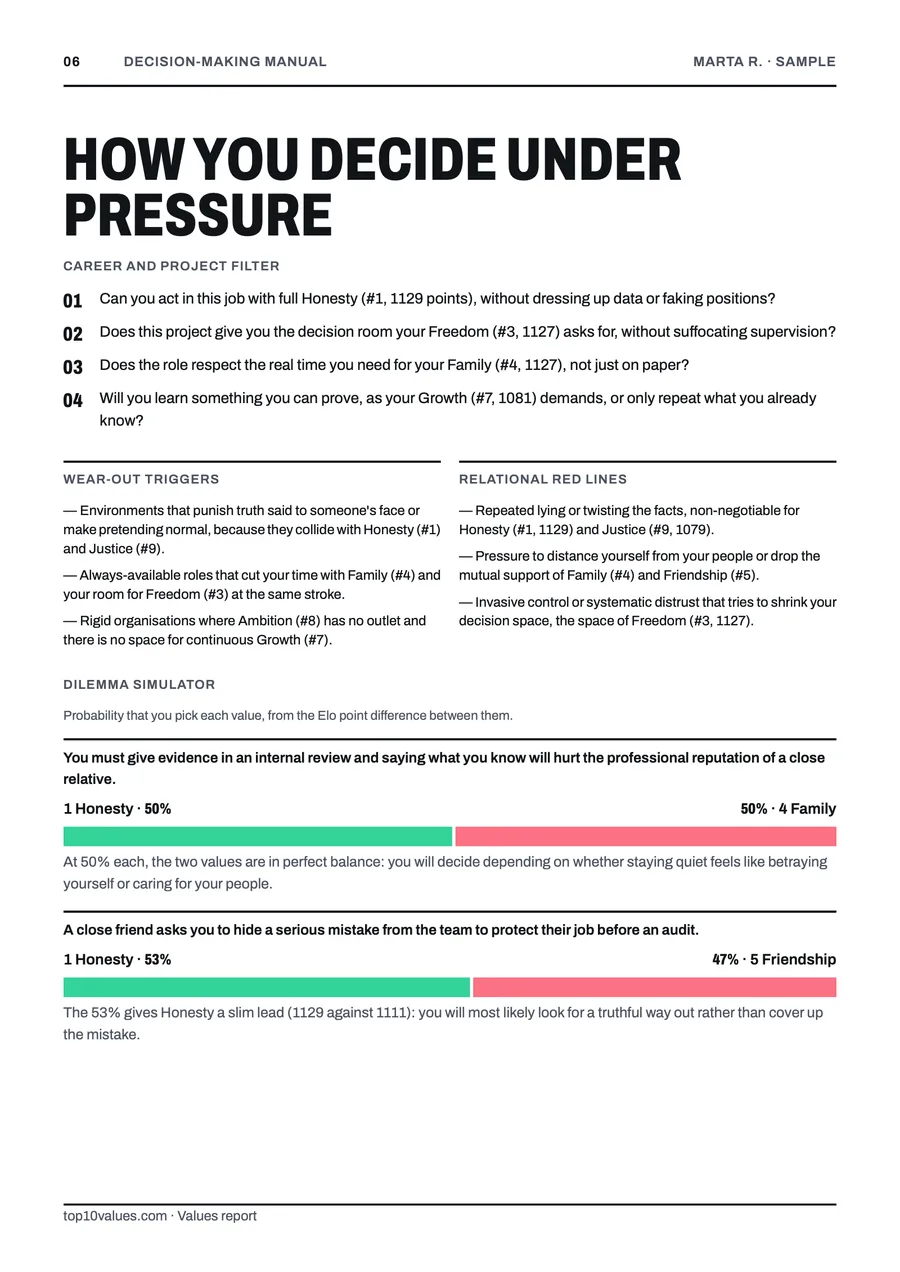
Sample page with fictional data (Marta R.), not yours. Your report is written from your own choices.
Frequently asked questions
What is service as a value? Everyday examples
Valuing service means caring a great deal about actively helping other people by attending to what they need at that moment. Everyday examples: carrying shopping upstairs for an older neighbour, minding friends’ children so they can get to a medical appointment, patiently walking someone through a procedure at work they do not understand, giving two hours a month to a food bank, or going with a relative to the hospital. What links them is that the help starts from someone else’s specific need and is delivered through action, not good intentions.
What is the difference between service, contribution and kindness?
They sit close together but answer different questions. Contribution looks at what you leave behind: an improvement, a resource, a new habit in a group. Service looks at meeting the need in front of you, even if it leaves no lasting trace, such as sitting with someone through a night in A&E or resolving a customer’s problem. Kindness is about manner and tone, and can exist without any practical help at all. Many people hold all three, but they weigh differently: someone who values contribution most asks about impact; someone who values service most asks whether they were there when it mattered.
What is the difference between serving and being servile?
Serving is a choice you make with your own judgement in order to meet someone’s need; being servile is obeying to please, to avoid conflict or to get something, even when it goes against your judgement or your dignity. One simple test: someone who serves can say “this isn’t good for you” or “I won’t do that”, while someone servile does not dare. Another: after serving, you feel at peace; after giving in out of servility, you are left with the sense of having handed over something you did not want to give.
What is servant leadership?
It is an approach to leading teams set out by Robert K. Greenleaf in his essay “The Servant as Leader” (1970). Its central idea is that a leader asks first whether the people they serve are growing, becoming more autonomous and better able to do their work, and puts their decisions at the service of that. Day to day, it means listening before deciding, clearing obstacles from the team’s path, sharing credit and taking on thankless tasks. It does not mean giving up authority or dodging hard calls: a servant leader still corrects, still says no and, when necessary, still lets people go.
How can I serve others if I have very little time?
Look first at what is happening around you and start with commitments that are small but fixed. Half an hour a week with a neighbour who lives alone, one specific task for your residents’ association or the school, or offering to run an errand when you are already running your own all add up to more than you might think. At work, serving can be as simple as answering first the messages that are holding someone else up. What does not work is promising in general terms: a small offer you keep is worth more than unlimited availability that never turns into anything concrete.
How do I help others without burning out?
Set limits before you need them: decide how many hours you can give, to whom and on what terms, and say so clearly. Share the load: in family caring, a rota split between siblings or friends stops everything landing on whoever never says no. Watch for signs of wear, such as snapping at the person you look after, feeling that nothing you do makes a difference, or sleeping badly before every shift, because they mean the service is no longer sustainable. And if you care for someone who depends on you, asking for professional support or turning to social services is not abandoning them: it is a way of continuing to care for them well.
Is it bad that I like feeling useful?
No. Feeling satisfied when you help is normal, and it helps the value last. The problem starts when that feeling becomes the condition: if you need to be useful in order to feel you deserve your place, you will find it hard to accept a no, to delegate or to let others help you. To check, ask yourself whether you would help in the same way if nobody knew it was you, and whether you are genuinely pleased when someone sorts things out without needing you.
When Service clashes with…
Committing to help, versus your autonomy, your own exhaustion or moving ahead in your career.