Personal Growth
Contribution
Adding value to the world.

Contribution is the desire to add real value to your surroundings, beyond your own immediate benefit. People who prioritize this value want their work, time or knowledge to have a tangible positive effect on other people, on a community or on a specific cause. It differs from abstract philanthropy in that it usually takes the form of direct, measurable actions: mentoring someone, solving a practical problem, or devoting resources to a collective project. People guided by this value tend to measure success not only by what they earn, but by the verifiable impact their effort leaves on those around them.
What does this value mean?
Valuing contribution means needing your time in a place (a team, a neighbourhood, a family, a profession) to leave behind something other people keep using after you have stopped watching. It is measured not by your intentions or by how good helping makes you feel, but by the effect: a problem solved, a person who can now do something they couldn't, a resource that didn't exist before. Once it is one of your values, every decision about where your time, money or skills go comes with an extra question, “who else does this serve, apart from me?”, and the answer changes the choice.
Contribution is easier to recognise in scenes than in definitions. The retired electrician who spends Tuesday mornings at the community centre testing the lamps and extension leads that neighbours bring in carrier bags. The developer who, after two days wrestling with a bug, writes up the fix on the team wiki so nobody else loses those two days. The resident who chases quotes for the broken entrance door in the building's group chat, knowing that if nobody takes it on, it will stay broken another winter. The sixth-former who tutors the younger kids on the street in maths and asks for nothing except to see them pass. The person who gives blood every few months and barely mentions it. What links these scenes isn't sacrifice; it's an underlying question: what's left when I walk away? When this value is one of your strongest, a day feels worthwhile when you've left something slightly better than you found it, and an achievement that serves no one but you tends to feel oddly thin.
What it does NOT mean
Contribution isn't people-pleasing, and it isn't being available for everything. Nor is it charity in the sense of giving away what you don't need so your conscience can rest, or a portfolio of good deeds to show off. It doesn't require an NGO, a formal volunteering role or a grand gesture: fixing the documentation of a shared project, explaining to a new colleague how the department really works, or looking after the community garden all count. It doesn't mean deciding on other people's behalf what they need either: help that nobody asked for, and that meets your need to be useful more than their actual problem, is something else. And it isn't the opposite of ambition or of making money. Many of the most lasting contributions come from a well-paid job, a business that works, or a trade practised with care.
Related concepts
Why might it matter to you?
Much of what makes your ordinary day work exists because someone contributed without you noticing: whoever wrote the manual you rely on at work, whoever set up the local food bank, the teacher who stayed an extra afternoon to explain what you didn't get. Treating contribution as a value means choosing to be part of that chain deliberately, not only as someone who benefits from it. It changes how you experience work: a routine task carries different weight once you know whose hands the result ends up in, and an impressive job loses some of its shine if you can't see who it serves. It changes your relationships: people who give without keeping score are usually the ones others turn to, trust, and miss when they leave. And it reshapes your sense of time. The psychoanalyst Erik Erikson used the word “generativity” for the concern with guiding the next generation and leaving something to it, and described it as the central challenge of middle adulthood, set against stagnation. You don't need to have read Erikson to feel it: at some point, asking what you've achieved starts to matter less than asking what you've made possible for others. Finally, contribution protects you from a common trap, which is measuring your worth only by what you accumulate. Making something another person uses brings a kind of satisfaction that doesn't depend on salary or job title, and doesn't vanish when those change.
How can you live this value?
- Pick one area and stay with it for at least a year. Scattering a little help across ten places feels busy but leaves a faint mark. A sustained commitment to one organisation, one group of students or one project lets you learn what is really needed, and lets people count on you. Consistency beats intensity: two hours a week for twelve months usually adds up to more than one heroic weekend a year.
- Ask before you help, and ask what, not whether. “What would actually be useful?” gives the other person room to name what they need, which often isn't what you were planning to offer. An older neighbour may not want someone to do the shopping for them; they may want someone to show them how to order it by phone so they can keep doing it without depending on anyone.
- Offer what you're good at, not just your hours. A lawyer who reviews a tenants' association's leases without charging, an accountant who sorts out the books for the local football club, or a designer who redoes the poster for the animal shelter contributes more than if they spent that time handing out leaflets. Ask yourself what comes easily to you and is hard for most people: that's usually where your most valuable contribution lies.
- Check the effect. If you give money, read the organisation's annual report or ask where it went. If you give time, ask whoever coordinates the work, every so often, what has changed because of it and what isn't needed any more. A contribution that's never reviewed can spend years solving a problem that no longer exists, or quietly making another one worse.
- Leave things ready for someone else to carry on. Write down how you do what you do, train someone who could cover for you, and resist becoming indispensable. A contribution that collapses when you're away for a week depends too much on you; the one that keeps working without you is the one that lasts.
- Set a limit before you start. Decide how many hours a month or what share of your income you'll give, and review it from time to time instead of adding a new commitment every time someone asks. A clear limit lets you say yes gladly rather than resentfully, and keeps your contribution going for years rather than months.
Advertisement
What happens when you don't live up to this value?
When contribution is missing from your life, the symptom is rarely dramatic. The days run, the work gets delivered, the bills get paid, yet now and then an awkward question surfaces: who actually cares about what I do? You might notice it on a Sunday evening, looking back over a week of meetings without being able to name a single person whose situation you changed. It shows in the way you talk, too: your neighbourhood, your company or your profession become things that work well or badly without you having any part in them. Sometimes a strange envy appears towards people in caring jobs, or towards the friend who coaches the under-nines, even though you wouldn't swap lives with them. If contribution is one of your top values and you aren't living it, the gap grows louder with age or right after a success: you get what you were chasing and the joy fades quickly, because part of you expected that achievement to serve someone else as well. A good test is to recall the last time someone told you “because of you, I was able to…” and work out how long ago that was.
The healthy side and the shadow
When does this value stop helping you and start limiting you?
Healthy expression
Leaving something that lasts and works without you
In excess
Needing to be indispensable
The most common shadow of contribution appears when it stops revolving around the person receiving and starts revolving around the person giving. You can spot it when you need to be needed: you help before anyone asks, you struggle to delegate because nobody will do it quite as well, you never write down how you do it, and it bothers you, even if you never say so, when the project runs just as well in the weeks you're away. A second shadow is martyrdom: taking on every committee, every extra shift and every new cause until there's no rest left, and then sending the bill as reproach (“after everything I do for you”). A third is a sense of moral superiority, which quietly judges people who don't volunteer or donate, as if your way of giving were the only valid one. The psychologist Adam Grant, in Give and Take (2013), distinguishes between generous people who burn out by giving indiscriminately and those who thrive because they choose whom, how and when to help. In its healthy form there are three signs: you ask before helping, you're glad when others learn to manage without you, and you can say no without feeling you've betrayed who you are.
This value at work
At work, this value shows first in where you choose to work. Faced with two comparable offers, you lean towards the one that lets you see who your effort reaches: the patient, the student, the specific customer, the colleague who uses what you produce. A role where nobody knows what the monthly report you prepare is for can drain you faster than a heavier one with a visible effect. Day to day, it shows in the things you do that aren't in your job description: looking after a new starter during their first days, writing the guide everyone had been missing, reviewing a colleague's work properly, joining the group that fixes a broken process. The engineer Tanya Reilly used the term “glue work” for this kind of task, the work that holds a team together and often doesn't count in performance reviews. That's where the risk lies: if you pour yourself into it and nobody sees it, you can end up with a team that runs because of you and a career that stalls. It helps to make it visible without boasting: mention it in check-ins, ask for it to be part of your objectives, and share it out so it doesn't always land on whoever complains least. If you manage people, contribution asks for something harder than helping: creating the conditions for others to contribute and take the credit. And if your job has no obvious social impact, that isn't a verdict. The payroll clerk who processes maternity leave without a single error, the cashier who stays patient with someone fumbling a payment, the technician who leaves the machines in better shape than they found them are all contributing. Sometimes you don't need a new job so much as a different place to put your attention within the current one, or a contribution outside working hours that your job doesn't give you.
This value in relationships
In friendship, contribution shows in what you bring to your friends' lives beyond having a good time together. It's the person who offers to go over the CV of a friend who's been job-hunting for months, who goes along to a friend's first meeting with the divorce solicitor, who introduces two people from different corners of their life because they suspect those two could help each other. There's a collective version as well: the friend who keeps the group alive by organising the annual dinner, booking the cottage, remembering birthdays. If this value is high for you, you're probably the one people call when there's a house move or a practical mess, which is both a compliment and a hazard. The compliment is that they trust you; the hazard is that the friendship starts working like a favours counter and you stop receiving. One warning sign is realising that no friend has asked how you are in a long while, because you're always the one asking. Another, less obvious, is refusing to be helped: turning down favours, always picking up the bill, handling everything without asking for anything. A friendship needs giving to flow both ways, even if not in equal measure. Letting a friend do something for you is also a contribution to the friendship, because it gives them the chance to matter to you.
This value in love
In a couple, contribution plays out in something less romantic than grand gestures: the division of everything that keeps a shared life running. If this value weighs heavily for you, you probably notice what the household needs before anyone says it, which is a virtue as long as it doesn't turn into a silent ledger of who does more. Talking openly about the split, including the invisible part (remembering the car's MOT, booking the children's check-ups, noticing that the olive oil is about to run out), stops one person from carrying nearly everything and ending up resentful. Contribution in a relationship also means backing what your partner gives elsewhere: covering an evening so they can go to their volunteering, or accepting a leaner year so they can work on something they consider important. Some couples share a cause (a housing co-op, the school's parents' association, a project in the village) and it binds them; others contribute in very different ways, and what matters is that neither looks down on the other's. The risk specific to this value is treating the relationship as one more front on which to be useful: fixing your partner's problems when they only wanted to tell you about them, or feeling that if you aren't doing something for them, you aren't loving them. Sometimes the best contribution is simply being there and doing nothing at all.
This value in family
In families, contribution starts early and changes shape with age. A six-year-old who lays the table or waters the plants isn't doing anyone a favour: they're learning that the household depends on them too, and taking those jobs away to save time teaches the opposite. With teenagers, real responsibility (doing the weekly shop on a budget, organising a family meal, showing their grandparents how to use online banking) usually works better than odd requests for help that feel like punishment. In adulthood, family contribution often concentrates in care, sometimes for young children and ageing parents at once, the situation now widely described as the sandwich generation. That's where a familiar tension between siblings appears: whoever lives closest to the parents ends up doing almost everything, and whoever lives far away feels that their contribution, financial or remote, goes unrecognised. Writing down who does what and reviewing it every few months saves a great deal of resentment. Grandparents, for their part, contribute in ways that rarely get named: collecting grandchildren from school, telling them what the family was like before, passing on recipes and skills. Saying so out loud matters, because an older person who stops feeling useful loses more than a task. And there's a risk particular to this area: making the family the only place where you contribute, until the children leave home and there's nowhere else.
This value and yourself
When contribution ranks among your top values, an achievement that benefits only you is probably hard to enjoy, and you judge people more by what they build for others than by what they own. You may catch yourself offering help before checking whether you have the time, or sketching an improvement for your street or your workplace while doing something else entirely. Now for the less comfortable part. Of all your commitments, how many did you choose, and how many did you accept because you couldn't say no? Do you help in the same way when nobody will find out? Can you ask for help, or only give it? Is there something you keep contributing out of habit even though it no longer serves anyone? Ranking it lower doesn't make you selfish. You may need to focus on your health, your training or keeping your family afloat right now, and that's legitimate too. But it helps to make it a conscious choice, because contribution postponed until “when I have time” rarely arrives on its own.
What are you willing to sacrifice for this value?
The price of contributing is paid in hours, in income and, sometimes, in credit that goes to someone else. Would you give two evenings a month for a year to a project that will never appear on your CV? Would you accept earning a bit less in a job whose effect you can see clearly? Would you give a fixed share of your income even if nobody would ever know? Would you let someone else present a project you pushed forward as their own, if that's what gets it over the line? Would you train the person who could one day take your job? Would you drop a cause that makes you feel good in favour of one that does more good, even if it looks less impressive? Recall when you last paid that kind of price. If it's recent and you'd pay it again, contribution is already making real decisions for you. If you keep leaving it for when things calm down, it may still be an intention rather than an effect.
Signs you're betraying this value
You betray contribution when you hold on to knowledge that would save others work just so you stay indispensable, when you sign up to a cause for the photo and vanish once the dull part begins, or when you keep helping in a way you know no longer works because changing it would mean admitting as much. Also when you help in exchange for a debt you plan to collect, when you talk about what you give more than you actually give, or when you dismiss other people's contributions because they don't look like yours. And there's a quiet betrayal: using “I already do enough” as an excuse never to check whether what you do still serves anyone.
Turning the value into goals
Value
Contribution
Behavior
Every Friday, write down one specific thing you did that someone else used or thanked you for, and one thing you could have done and let slide
Goal
Keep one concrete commitment beyond your obligations going for twelve months, such as mentoring a student, maintaining the documentation of a shared project or helping out with a local residents' group
Habit
Two fixed hours every week, or one day a month blocked in the calendar, with a quarterly check-in where you ask whoever coordinates what is working and what isn't needed
Questions to reflect on
- What exists today in your workplace, your neighbourhood or your family that wouldn't exist without you, and who uses it?
- What comes easily to you and is hard for most people, and who are you offering it to?
- Which of your ways of helping respond to what others need, and which respond mainly to your need to feel useful?
- If you stopped everything you do for others tomorrow, what would be missed within a month, and what would nobody notice?
- Who made a decisive contribution to getting you where you are, and how could you pass something similar on to someone who is now where you were?
- What contribution would you like someone to remember you for in twenty years, and how much of it have you already started?
How much are you living this value?
Look at the past four weeks and find one concrete thing you did that improved someone else's situation without any gain for you: someone you taught, a shared problem you solved, a resource you left ready. Give your contribution a score, out of ten, for how lasting and useful it is, not merely how well-meant. Below a seven, settle on one area, ask what's needed there, and block out the first three sessions now.
When two values clash
Financial security is the first friction point when the contribution you care about most pays little or nothing: leaving a stable job to work for a charity, going part-time to care for a relative, or giving a fixed share of a tight income are decisions about meaning and about money at once, and it's wise to run the numbers before taking the step. With Family, the tension appears when evenings at the residents' association or the community project come out of time your children or partner were counting on; it's the paradox of looking after the neighbourhood while neglecting your own home. With Health and Balance, the friction is exhaustion: in caring professions and intensive volunteering it's common to keep giving long after there's nothing left, and a contribution that makes you ill can't last. With Recognition the relationship is delicate: wanting what you give to be seen isn't vanity, but if applause becomes the condition, you end up choosing causes for their visibility rather than their usefulness. With Freedom and Independence it collides because sustained contribution ties you down: a group of students or a team that relies on you limits your plans. With Respect, the conflict comes when your eagerness to help overrides the other person's autonomy. With Justice there's an old debate: helping whoever needs it today, or working to change whatever makes them need it; both are contribution and each has its limits. With Ambition and Success there isn't always a clash: a business that grows and creates good jobs contributes too. The natural allies are Purpose, which gives your contribution a direction, Kindness, which takes care of the manner, and Empathy, which helps you see what's needed. When values pull against each other, it often helps to ask which contribution only you can make, and which someone else could make in your place.
Is “Contribution” one of your top 10 values?
Find out by playing and comparing this value with the other 49
How the Elo ranking works and its limits in the methodology.
What does the paid report include?
When you finish the 100 comparisons you will see your Top 10 on screen. If you want to go further, there is a PDF report on your personal values: €9.95 (VAT included), one-off payment. To buy it you need to save your game with a Google account.
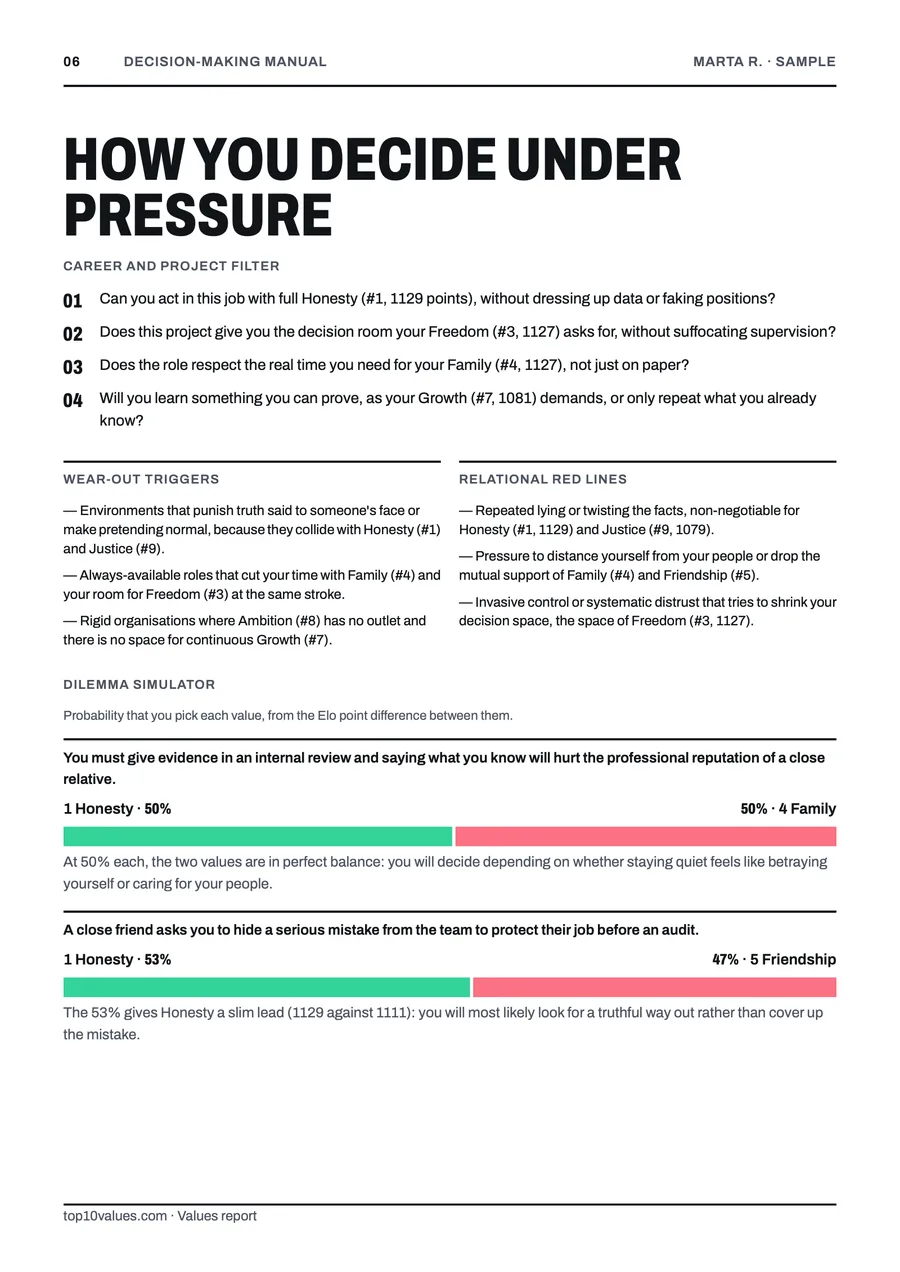
Sample page with fictional data (Marta R.), not yours. Your report is written from your own choices.
Frequently asked questions
What is contribution as a value, with everyday examples?
Holding contribution as a value means caring that your time, knowledge or resources improve something beyond your own interest. Everyday examples: showing a new colleague the shortcuts it took you months to find; mending the fence at the community garden; giving blood; writing a useful, honest review of a local service; coaching your daughter's basketball team; interpreting for a neighbour who doesn't speak the language at a GP appointment; or keeping the building's residents' group up to date. The common thread is that someone else uses the result, and it keeps working when you're no longer in the room.
What's the difference between contribution, kindness and purpose?
They're related, but they measure different things. Kindness is about manner: treating people considerately in each interaction, even if nothing changes in the long run. Purpose is about direction: knowing where your life is heading and why. Contribution is about effect: what you leave done that other people use. You can be very kind without contributing anything lasting, have a purpose centred on your own development that benefits nobody else, or contribute enormously with little kindness, like the grumpy neighbour who has spent twenty years repairing the local children's bikes without charging a penny. Ideally, the three reinforce each other. With service the boundary is different: serving means responding to what someone needs right now; contributing means looking at what is still working afterwards.
Does contribution have to mean volunteering or donating money?
No. Volunteering and donations are clear forms of it, but not the only ones. You contribute when you do a job well that other people depend on, when you teach what you know, when you care for a family member, when you take part in the school's parents' association, or when you post online the solution to a problem that took you ages to crack. Paid work can be a significant contribution too, as long as you keep in mind who it serves. What counts is that someone else genuinely benefits, and that you aren't doing it only out of obligation or for appearances.
Is it selfish to feel good about helping?
Not necessarily. The satisfaction of helping is one of the reasons people keep doing it, and it doesn't take anything away from what they give. The problem starts when that satisfaction becomes the only thing that matters: you choose the help that feels most rewarding rather than the help that's most needed, or you keep doing a task that no longer serves anyone because it makes you feel good. A useful check: if you found out someone else could do what you do better, would you hand over your place with relief or with irritation? And could the person you're helping comfortably tell you they'd prefer something different?
How can I contribute if I have little time or money?
Start with what you already do. Many contributions fit into a normal routine: writing down what you learn at work, giving a lift to a colleague without a car, checking whether the older neighbour needs anything when you go to the shops, answering a question in detail on a forum for your trade. If you want something more structured, one hour a month with a single organisation, kept up over time, usually helps more than many hours scattered without continuity. And if money is tight, remember that your professional skills may be worth more to a small association than a modest donation: a look over their accounts, a simple website, or an hour of legal advice.
How do I know whether my help is actually useful?
Ask and watch. Ask the person you're helping, or whoever coordinates the project, what has changed and what they'd rather you did differently, and be ready to hear that some of what you do isn't needed. Watch whether the situation improves over time or stays the same however much you put in, because that may mean you're covering up a problem rather than solving it. With donations, many organisations publish annual reports showing how funds were used; reading them, or choosing organisations that publish them, is an easy way to check.
I feel I give far more than I get back. What can I do?
First, separate the areas of your life. In volunteering or a cause, getting nothing back is normal, and the problem may be your rest rather than the balance. In a relationship, a friendship or a job, though, a large and lasting imbalance usually ends in resentment. Name it: say what you do, what you'd like to change and what you need. If the response is indifference, scale back gradually and see what happens. Sometimes others step forward once you leave a gap; sometimes you find out the relationship was resting almost entirely on your effort, and that's useful to know as well.
When Contribution clashes with…
Contributing to something bigger than you, versus your finances, your family's time or your own health.