Personal Growth
Leadership
Guiding and inspiring others.

Leadership is the ability and willingness to guide others toward a shared goal, taking the initiative when a situation calls for clear direction. People who value leadership don't necessarily seek the spotlight, but the responsibility of organizing resources, making hard decisions and sustaining the group's motivation even in moments of uncertainty. This value combines strategic vision with communication skills, since leading requires both knowing where to go and getting others to want to come along. Good leadership is measured less by the formal authority exercised and more by the genuine trust the rest of the team voluntarily places in that direction.
What does this value mean?
Leadership as a value is a willingness to take charge of a shared direction: to see where a group needs to go, say so out loud, and help other people get there, whether or not anyone has given you the job. It is measured less by how many people report to you than by what those people manage because you were there. It is responsibility for a collective result, not for your own profile.
It is the moment someone steps forward while everyone else stays put. The charge nurse who, on a chaotic night shift, splits the ward so nobody is juggling two emergencies at once. The tenant who calls the first meeting about the broken lift and then hands the chair to someone else. The under-nines football coach who makes sure the quiet kid gets proper minutes, not just the last five. And the less visible act of saying «I'll make this call, and if it goes wrong, that's on me» when the room is waiting for somebody else to commit. Leadership nearly always starts before the title arrives, and often the title never does.
What it does NOT mean
Leadership is not giving orders. Telling people what to do is easy when the org chart backs you up; leading is getting people to follow when they have no obligation to. It is not charisma either: some charming people would be followed by nobody in a crisis, while some quiet ones are exactly whose judgement the team seeks when things go sideways. It does not mean always having the answer, since much of the work is asking good questions and actually listening to what comes back. It does not mean doing everything yourself, which is the most common way of bottlenecking a team. And it is not a trait you either have or lack from birth. It looks more like a craft, learned by making mistakes with real people, owning them and adjusting.
Related concepts
Why might it matter to you?
Almost every group, whether a company, a residents' association or a family in the middle of a house move, hits a point where someone has to sort out the priorities. If nobody does, the gap is filled by whoever is loudest or least scrupulous. Valuing leadership means accepting that the role carries a cost and that sometimes it falls to you anyway. People who rank it high have often seen both sides: a good manager who changed how they worked and a bad one who made them dread Monday mornings. That contrast teaches something no training course quite captures, which is that people perform and develop very differently depending on who sets the course. It also changes you. Making decisions on behalf of a group forces clearer thinking, because your doubts no longer affect only you.
How can you live this value?
- Volunteer for a small problem nobody wants: sorting the holiday rota, tidying the shared drive, organising the reunion. Low-stakes tasks are where leadership is learned before much is riding on it.
- Before any decision that affects a group, ask the people who will carry it out what they can see that you cannot. Then decide, and explain the reason in two sentences. Listening does not oblige you to do what you are told, but it does oblige you to show you took it into account.
- Delegate outcomes, not chores. Instead of «make these ten slides», try «the client needs to understand in ten minutes why our price is going up; how would you approach it?». Accept that they will do it differently from you.
- Share credit in public and own mistakes in the first person. When a project goes well, name the people who did the work; when it goes badly, start with what you could have done differently.
- Have difficult conversations early. A delay raised on day one costs a schedule tweak; one kept quiet for three weeks costs the team's trust. Put the conversation you have been avoiding into your calendar with a date.
- Once a quarter, ask for anonymous or candid feedback on how you lead, using one pointed question: «what do I do that slows you down?». When several people say the same thing, it is rarely a coincidence.
Advertisement
What happens when you don't live up to this value?
When leadership is on your list but you do not exercise it, a particular kind of frustration sets in: you can see clearly what the group ought to do and you watch it do something else. You catch yourself criticising whoever is in charge by the kettle without ever having offered an alternative. In meetings, the idea you had prepared gets voiced by a colleague ten minutes later and goes ahead with their name on it. Over the years, «nobody round here ever decides anything» becomes a refrain that also describes you. Private life can follow the same pattern: the family holiday nobody plans, the conversation about an ageing parent's care that nobody starts, the rift in a friendship group that everyone notices and nobody addresses.
The healthy side and the shadow
When does this value stop helping you and start limiting you?
Healthy expression
Direction that makes the group stronger
In excess
A need to control everything
The shadow of leadership is control. It begins with good intentions, because you know how it should be done and want it done well, and it ends with a team that decides nothing without checking with you first. The details give it away: reviewing work that did not need reviewing, replying to emails addressed to other people, struggling to go on holiday without the laptop. Another form of excess is mistaking the group for your personal project and judging people by how neatly they fit your plan. A third is quieter: needing the leader's role to feel worth something, so that any capable person beside you looks like a threat. One clear test is to ask what would happen if you vanished for a month. If the answer is that everything would stop, you have built a dependency, not a team.
This value at work
Work is where this value shows most sharply, and also where it gets most confused with job titles. You can lead without any direct reports: proposing a fix for the issue nobody wants to touch, onboarding the new starter, or being the person who writes up what was actually agreed after a muddled meeting. When the title does arrive, the nature of the job changes. You are no longer paid to do the work but to make sure other people can do it well. That shift is why organisations so often promote their best engineer, lose a great engineer and fail to gain a good manager, a pattern the educator Laurence J. Peter famously satirised as the Peter Principle. Before accepting a promotion, ask whether you are drawn to managing or mainly to the pay rise. If you already manage, protect regular one-to-ones: half an hour with each person tends to resolve more than any all-hands meeting.
This value in relationships
Among friends, leadership shows up as initiative. Someone has to suggest the plan, find the date that suits most people, or point out that the group has not met since spring. If that someone is usually you, watch for two traps. The first is carrying all the organising and quietly resenting that nobody else lifts a finger; now and then, ask someone else to pick the place or take the lead. The second is initiative turning into imposition. Not every friendship needs steering, and sometimes what a friend wants from you is a listening ear rather than a fix. Leading among equals follows a simple rule: the authority you have is on loan from the group, and it is recalled the moment you use it for your own benefit.
This value in love
A couple has no hierarchy, which is why this value needs adjusting at home. What works is splitting leadership by territory: perhaps you take the lead on money and your partner on your social life, or one of you runs the kitchen renovation while the other plans the trips. What wears a relationship down is one person deciding for both, again and again, on the grounds of being better at it. If you notice your partner has stopped offering opinions, ask yourself whether that is trust or a lesson learned that their view changes nothing. A useful practice for big decisions (moving, having children, changing jobs) is for each of you to set out your full position before any debate starts, so that whoever talks fastest does not frame the whole discussion.
This value in family
In families, leading usually means taking on the coordination nobody else wants: the sibling call about a parent who can no longer live alone, sorting out an estate, the Christmas rota when there are two sets of in-laws. Doing it well demands even-handedness, because the moment you seem to favour someone you lose the ability to mediate. With children, leadership resembles that of a good team: clear rules, explained, and more and more decisions handed over as they grow. A teenager who has never decided anything reaches eighteen with no practice in the thing they will need most. Inherited roles are worth reviewing too. If you were always the one who sorted things out, your brothers and sisters may simply have stopped trying.
This value and yourself
Having leadership among your top values says you care about the direction of the groups you belong to and are not content just to grumble about it. The uncomfortable question is how much of that drive serves the group and how much serves your place at the centre. Both usually coexist, and that is fine, but the balance shapes your choices: someone who leads for the group is glad when another person shines, while someone who leads for the position experiences it as a loss. Notice, too, how you behave when it is not your turn to lead. Following someone else well, with loyalty and judgement, belongs to this value as well, and it is one of the best preparations for the next time you are at the helm.
What are you willing to sacrifice for this value?
Leadership has costs that never appear in the job description. Would you make an unpopular decision knowing that, for months, part of the team will see you as the problem? Would you deliver a redundancy or a budget cut face to face rather than leaving it to HR? Would you give up the work you enjoy most, the technical or creative part, to spend your time unblocking others? Some closeness goes too: it is hard to be the person doing appraisals and the one everyone confides in. And you lose the comfort of complaining, because once you are in charge you can no longer blame the people upstairs. Consider which of these losses seems hardest. It often tells you what kind of leadership suits you.
Signs you're betraying this value
You drift from this value when you wait for a situation to fix itself because stepping in would expose you, when you present a colleague's work as your own, or when your position shifts depending on who is in the room. Also when you delegate a task and then quietly redo it without saying why, which teaches people not to bother. Another sign is treating information as power: knowing first what is coming and keeping it back to stay ahead. At the other extreme, you drift from it when you avoid every decision that might upset anyone and call it «building consensus». Look at the last three difficult decisions your group faced. If you did not say what you really thought in any of them, this value lives more in what you say about yourself than in what you do.
Turning the value into goals
Value
Leadership
Behavior
Hold a thirty-minute one-to-one every fortnight with each person you work closely with, asking what is getting in their way and what they need from you
Goal
Within six months, have at least one important task that currently depends on you running without your involvement because someone else has learned to own it
Habit
Every Friday, write down one decision you made, who you consulted beforehand and what you would do differently
Questions to reflect on
- Who is the best person who has ever managed you, and what exactly did they do that you do not do yet?
- Which group you belong to needs a direction nobody is providing, and what stops you from stepping up?
- If your team could change one thing about how you lead, what do you think they would pick?
- Which task do you keep doing yourself because «it's quicker», and who are you denying the chance to learn it?
- When did you last follow someone willingly, and what won you over?
- Are you drawn more to the group's result or to the recognition of having led it?
How much are you living this value?
From 1 to 10, how visible is your leadership in what other people can now do, rather than in what you do? Think of the people you work or live with: how many have become more independent over the past year thanks to you? If the score is low, pick one task you control and teach it to someone this week, committing not to correct their approach for a month unless something seriously goes wrong.
When two values clash
Leadership clashes with Humility when leading seems to demand confidence you do not fully feel; the answer is not to fake it but to say «I'm not certain, but here's my proposal and we'll review it in two weeks». With Kindness, it surfaces in decisions that hurt one person to protect the group, such as restructuring a team or not renewing a contract. With Loyalty, it appears when you must choose between promoting the person who has been with you from the start and the person best prepared for the role. With Independence, because leading ties you to other people's rhythms, problems and holidays. With Balance, since responsibility does not switch off at six. And with Recognition the tension is internal: leadership done well makes the credit look as if it belongs to the team. In each clash, it helps to ask which decision you could explain tomorrow, face to face, to everyone affected.
Is “Leadership” one of your top 10 values?
Find out by playing and comparing this value with the other 49
How the Elo ranking works and its limits in the methodology.
What does the paid report include?
When you finish the 100 comparisons you will see your Top 10 on screen. If you want to go further, there is a PDF report on your personal values: €9.95 (VAT included), one-off payment. To buy it you need to save your game with a Google account.
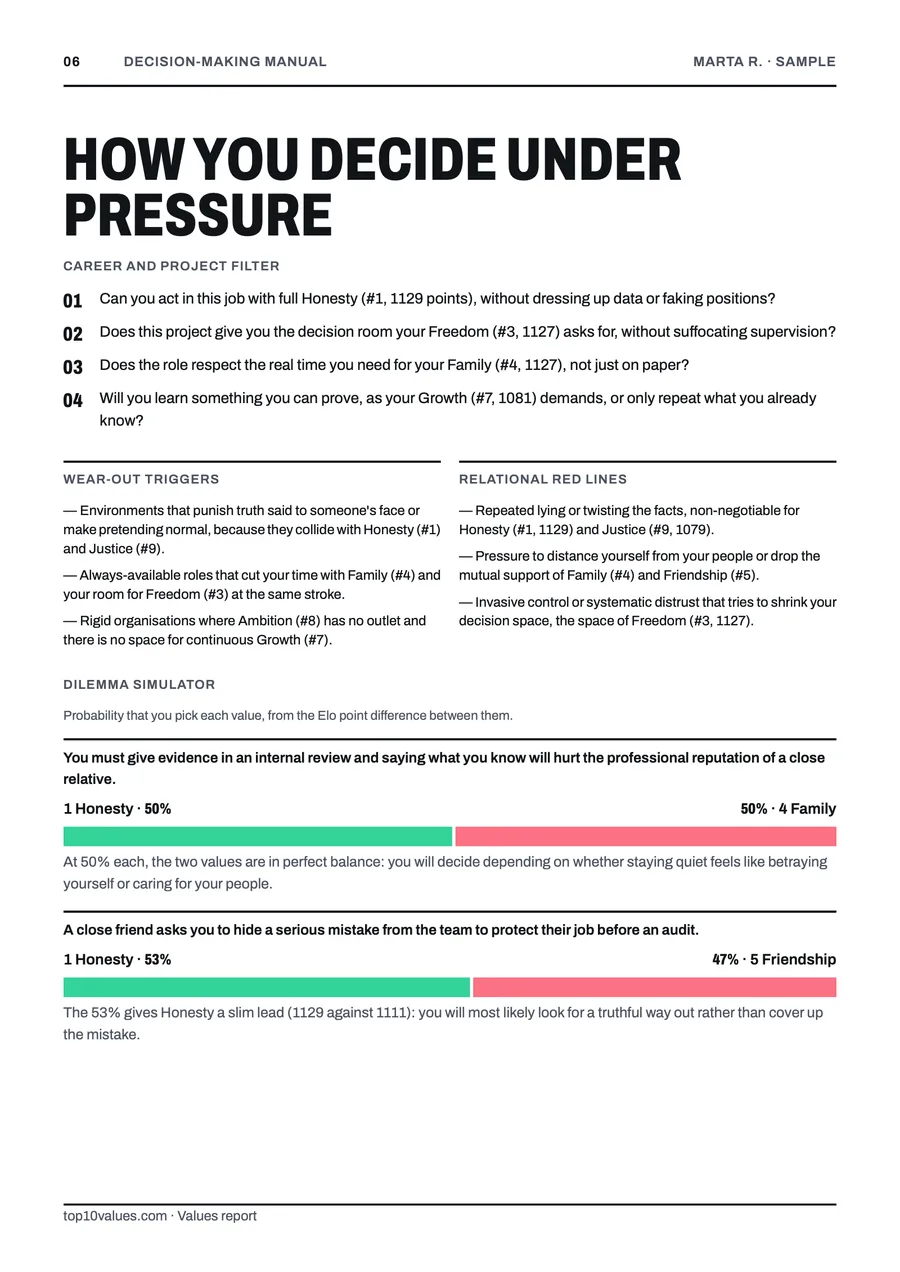
Sample page with fictional data (Marta R.), not yours. Your report is written from your own choices.
Frequently asked questions
Can you lead without being the boss?
Yes, and it is the best place to start. Proposing a fix for a problem nobody tackles, coordinating colleagues on a cross-team project or bringing a new starter up to speed are all genuine leadership. People who build influence without a title also learn to persuade rather than impose, a skill that is badly missed when the title eventually arrives.
What is the difference between leadership and authority?
Authority is granted by an organisation: an appointment, a contract, a box on the org chart. Leadership is granted by people when they choose to follow you. You can have authority without leadership (a manager who is obeyed but not listened to) and leadership without authority (the colleague everyone goes to for advice). Ideally the two coincide, but they often do not.
I'm an introvert. Can leadership still be one of my values?
Absolutely. Many of the core tasks of leading, such as listening, preparing decisions carefully and holding one-to-one conversations, suit a reserved temperament well. What helps is recognising what drains you, like long meetings or networking events, and planning time to recharge, rather than giving up on the value.
How should I answer a leadership question in a job interview?
With one specific example instead of adjectives. Describe the situation, what you did to move the group, the result and what you learned. A small, real example, like reorganising a shift pattern or helping a new colleague settle in, convinces more than a general claim about «motivating teams».
What if I don't want to lead but it falls to me?
It happens all the time: a colleague leaves, a project has no owner, a relative falls ill. You can take it on as something temporary, with a review date, and tell the group exactly that. Ask for specific help, delegate from day one, and notice which parts of the role you find manageable. Sometimes it turns out the reluctance was about the title, not the responsibility.
When Leadership clashes with…
Deciding for the group, versus voicing doubts, protecting one person or staying loyal to your own.