Achievement
Success
Achieving important goals.

Success is the orientation toward achieving concrete, recognizable goals, both your own and socially validated ones: a promotion, a completed project, a target reached within a deadline. People who value success need to see tangible results from their effort and often set new goals soon after reaching the last one. This value provides clear direction and motivation, but it can create dissatisfaction if the definition of success depends too heavily on comparison with others rather than on your own criteria. The people who balance it best combine the drive to achieve with a personal definition of what really counts as a meaningful win.
What does this value mean?
Success as a value is the importance you place on achieving visible, measurable results in what you take on: finishing what you start, reaching the targets you set and seeing your effort turn into something you can point to. What counts is not how much you achieve compared with other people, but whether you have decided for yourself what winning means and whether your results are moving towards that definition.
It is the satisfaction of closing something off. The baker who opens a second shop after ten years of four a.m. starts. The nurse who qualifies as an advanced practitioner on her second attempt and finally gets the role she wanted. The person who pays off a car loan six months early. It also covers achievements nobody else sees: running 10K without stopping for the first time, finishing an Open University degree while raising two children, keeping a family business alive through a bad year. People who value success tend to keep a mental tally of goals met, and that tally gives them a sense of themselves that effort alone does not.
What it does NOT mean
Success is not the same as wealth or fame, though the three are constantly confused. You can have plenty of money and have achieved nothing you cared about, and you can meet every goal you set while living quietly. It is not ambition either: ambition is the desire and the direction, success is the result. It does not mean always winning or someone else losing, outside genuinely competitive settings. And it is not a permanent state. One successful project does not make you a successful person for life, any more than one failure defines you. Be wary, too, of the success stories that fill social media and business biographies. They only feature the cases that worked out, a distortion known as survivorship bias; for every founder who dropped out of university and made it, many more tried the same thing and nobody interviews them.
Related concepts
Why might it matter to you?
Results give you information that intentions cannot. You may believe you work well, but the delivered project, the client who comes back or the exam you pass is what confirms it. Understood healthily, success works like a mirror: it shows you whether your way of doing things actually works. It also opens specific doors. A first recognised achievement makes the next contract, the next loan or the next opportunity easier to get, and that compounding advantage is real in almost every field. For many people it carries an element of repair as well: proving that someone from a council estate, a family with no university graduates or a very public failure could get there. Valuing success is not shallow. What is shallow is letting other people decide what yours should look like.
How can you live this value?
- Write your own five-line definition of success for the next three years without looking at what your friends or old classmates are doing. Include at least one criterion that is not financial, such as free time, health or who you work with.
- Break each big goal into milestones you can check monthly. «Run my own design studio» becomes three direct clients this year, a portfolio site with five projects and six months of expenses saved.
- Celebrate a result before you set the next target. A dinner out, a day off or simply telling someone helps the achievement register as one, instead of disappearing under the next demand.
- Examine your failures as coolly as your wins. After every project, good or bad, answer three questions in writing: what went as expected, what did not, and what is within my power to change.
- Look for the setting where your kind of success is possible. If what you care about is building a product of your own, a large corporation with rigid processes may not be the place, however well it pays.
- Once a year, check whether the scoreboard you are using is still yours. Targets you set at twenty-five may have expired, and chasing them out of habit is a kind of failure that goes unnoticed.
Advertisement
What happens when you don't live up to this value?
When success matters to you and it does not arrive, or you do not let yourself go after it, an uncomfortable mix of frustration and comparison sets in. You watch people your age move forward and feel your own life is on hold, even if from the outside it looks perfectly reasonable. You may put off the projects you care about for fear they will go wrong, because as long as you do not try, nobody can say you failed. Sometimes a self-doubt settles in that feeds itself: you do not try, you get no results, and the lack of results confirms you were not capable. At worst the value curdles into bitterness towards those who do succeed, with every success around you put down to luck, connections or cheating.
The healthy side and the shadow
When does this value stop helping you and start limiting you?
Healthy expression
Focus on results by your own standards
In excess
Identity tied to the scoreboard
The excess appears when your worth as a person depends on your latest result. A poor appraisal, a lost client or a promotion that goes to someone else feels like a verdict on who you are. That dependence pushes towards bad decisions: choosing only challenges you are sure to win, massaging figures, not asking for help so nobody sees you struggling. It also creates a race without a finish line, where each achievement lasts a few days before something bigger is needed. Psychologists call this tendency to get used to whatever we gain hedonic adaptation, and it explains why the promotion that looked like the summit becomes the new floor within months. A useful signal: if you cannot remember the last time you enjoyed an achievement without already thinking about the next one, the scoreboard is running your life.
This value at work
At work, success is nearly always measured by someone else's criteria: sales targets, appraisals, promotions. It makes sense to know them and meet them, but also to keep your own, because company metrics change with every new leadership team. One useful habit is agreeing with your manager at the start of each year what concrete results would make it a good year, and putting it in writing. That way you do not discover in December that you were being judged on something else. Make your achievements visible without showing off: a short email when a project closes, with the outcome and who contributed, is useful information rather than boasting. And watch the cost. A promotion that means travelling three weeks a month can be a win on the org chart and a loss everywhere else. Ask what you would have to stop doing to get there before you say yes.
This value in relationships
Among friends, success tests generosity in both directions. When things go well for you, it is hard to share the news without seeming to brag, and some friendships cool if people feel you are pulling away. When things go well for a friend, the temptation is to compare, especially with someone who started out at the same time as you. Solid friendships survive these imbalances because each person celebrates the other's wins without turning them into a yardstick. If you feel a twinge of envy, treat it as a clue: it usually points to something you want for yourself and may not have dared to pursue. And try not to let your catch-ups shrink to career updates. People who care about you also want to know how you are when there is nothing new to report.
This value in love
In a couple, success raises questions of fairness. When one partner's career takes off much faster, unspoken tensions can follow: whose schedule bends to whose, whose job wins when an offer comes up in another city, how money is shared when incomes are very different. Talking about it early prevents resentment. How you celebrate each other's achievements matters too. A partner who is genuinely glad about your promotion, even though it means more for them to carry at home, is making a big investment in the relationship, and that deserves acknowledging. Be careful about bringing the scoreboard home, though. A relationship is not a project with quarterly targets, and measuring it like one turns it into another job.
This value in family
In families, success often comes loaded with inherited expectations: the degree you were meant to do, the business you were meant to take over, the comparison with a sibling or cousin. Working out which part of your idea of success is yours and which part belongs to your parents frees up a great deal of energy. With children, the challenge is passing on a taste for achievement without making their worth a matter of grades or trophies. Praising effort and strategy as well as results helps them keep going when something does not come easily. It also helps if they see you fail now and then and talk about it calmly. A parent who only ever shows victories teaches, without meaning to, that getting things wrong is shameful.
This value and yourself
Having success among your core values means you want your effort to leave a visible mark, and you are motivated by challenges with a clear finish. The key question is whose scoreboard you are using. If you have never written down what success means to you, you are probably using your surroundings' default: salary, title, house, car. Watch how you react when you achieve something. If the joy fades quickly and your mind jumps straight to the next thing, you may be seeking achievement as proof of your worth rather than as an end in itself. And notice how you feel about other people's successes, which often says more about your relationship with this value than your own results do.
What are you willing to sacrifice for this value?
Success nearly always asks for payment up front. Would you accept years of long hours building a business with no guarantee it will work? Would you move to another city, away from family and friends, for the role you are after? Would you give up a comfortable, well-paid position to try something of your own with more risk? You also give up the safety of not putting yourself on the line: trying something seriously means that if failure comes, it will be public too. And sometimes the price is peace of mind, because significant results bring responsibilities that do not switch off when you leave work. Before chasing a goal, decide which part of that price you are willing to pay and which you are not, so you do not find out halfway.
Signs you're betraying this value
You betray this value when you say you want to achieve something but never let yourself be judged on it: you do not pitch the project, send off the manuscript or ask for the meeting. When you switch goals every few months, just as things start to get hard. When you get results through shortcuts you could not describe out loud, such as inflating numbers or taking credit for someone else's work; that is not success but a debt with a due date. Also when you chase a success you do not actually want, only because it is the one expected of you. Look at the list of things you set out to do a year ago. If nothing moved forward and nothing was consciously dropped, this value is on hold.
Turning the value into goals
Value
Success
Behavior
Set aside a fixed four-hour block each week for your main goal, and every Friday review which specific milestone moved forward
Goal
Within twelve months, reach a measurable result you defined in writing at the start, such as a number of clients, a qualification or a published project
Habit
Every Sunday, note one achievement from the week, however small, and one thing you will do better next week
Questions to reflect on
- If nobody else would ever find out, which achievement would satisfy you most five years from now?
- Which parts of your idea of success did you inherit from your family or surroundings without questioning them?
- What has been your biggest achievement so far, and what did it teach you about how you work best?
- Which goal have you avoided pursuing for fear of it going wrong in public?
- Whose success makes you envious, and what does that tell you about what you want?
- What would you give up to reach your next goal, and what would you refuse to trade for anything?
How much are you living this value?
From 1 to 10, how closely do your results over the past year match what you consider success, as opposed to what is expected of you? If you have no written definition, start there: five lines on what would need to happen for next year to feel like a good year. Then pick the smallest milestone on that list and give it a date within this month.
When two values clash
Success clashes with Health when results come at the expense of sleep, your back or your mood: the year-end push that leaves its mark for months. With Family, during the years when career and child-rearing compete for time and there is none to spare. With Honesty, it appears when a rounded-up figure, an inflated promise or a shared achievement told in the first person singular would help you win. With Enjoyment, because chasing targets can turn every activity into a means and drain the pleasure from things you once did for fun. With Humility, in the temptation to believe that the result proves you were right about everything. And with Growth the friction is less obvious: success rewards repeating what already works, while learning something new means accepting a spell of worse results. It helps to ask which success you could describe in full, including everything it cost, while looking the listener in the eye.
Is “Success” one of your top 10 values?
Find out by playing and comparing this value with the other 49
How the Elo ranking works and its limits in the methodology.
What does the paid report include?
When you finish the 100 comparisons you will see your Top 10 on screen. If you want to go further, there is a PDF report on your personal values: €9.95 (VAT included), one-off payment. To buy it you need to save your game with a Google account.
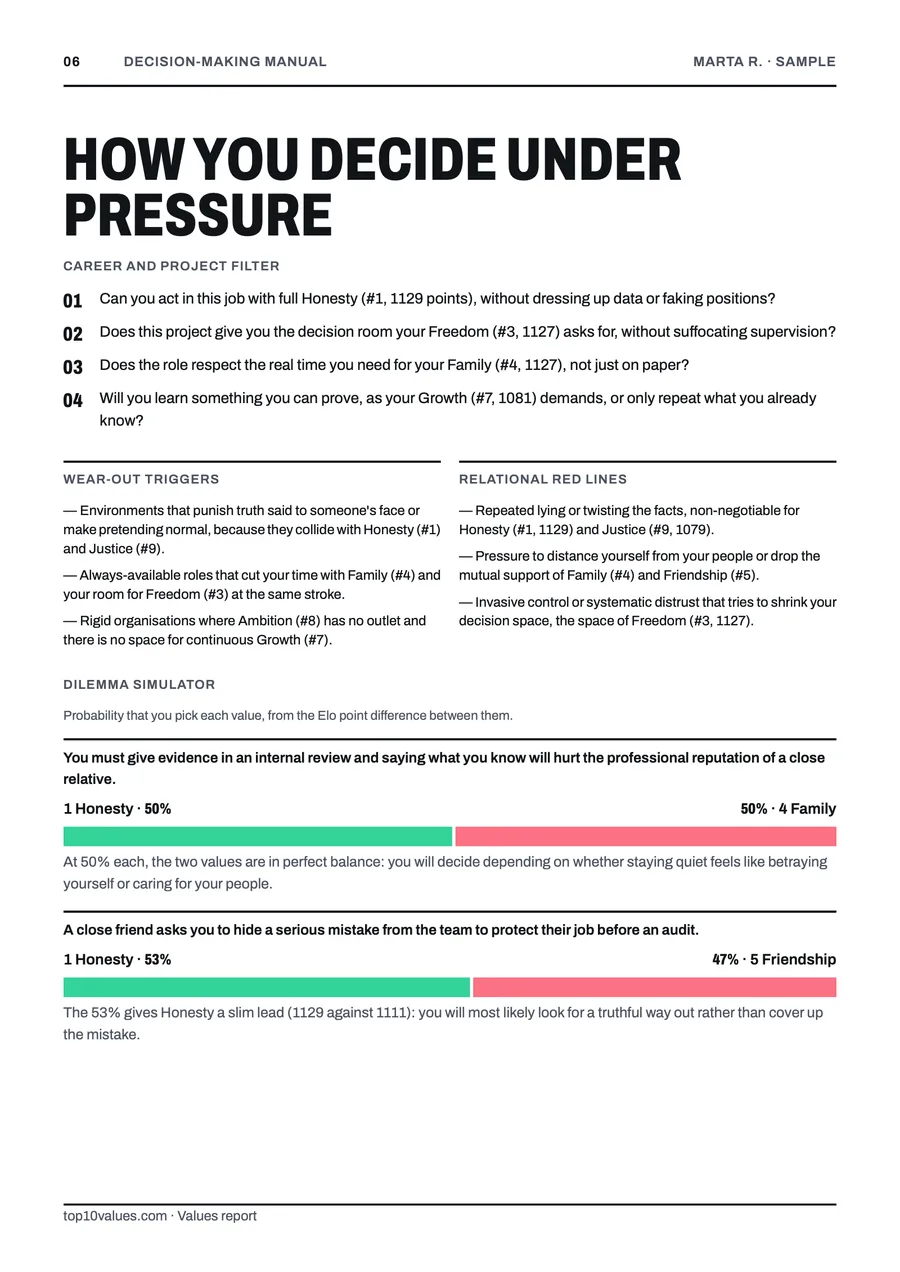
Sample page with fictional data (Marta R.), not yours. Your report is written from your own choices.
Frequently asked questions
What is the difference between success and ambition?
Ambition is the drive to want more or go further; success is the result when you get there. You can have plenty of ambition and few successes, for instance if you keep switching projects before finishing them, and you can collect successes with little ambition by meeting modest goals well. The two reinforce each other when ambition has a concrete direction.
Is it shallow to value success?
Not if you define it yourself. Wanting your effort to bear fruit is reasonable and part of a meaningful life. It becomes shallow when success shrinks to whatever impresses other people, like a job title or a brand, with no link to what you actually care about.
How do I define my own success?
Start by imagining an ordinary day five years from now that you would consider a good day: where you are, who you work with, how you spend your time, how much you need to earn. Then turn that picture into three or four criteria you can check. Review them every year, since they change with each stage of life.
Why do I feel flat after reaching a goal?
It is more common than people admit. It often means the goal was not entirely yours, or that you expected the achievement to fix something it cannot, such as feeling valued. Give yourself time before setting the next one and ask what you were hoping to feel. Sometimes the answer changes the direction of the next few years.
How do I cope with failure if success matters so much to me?
By separating the result from your worth. A failed project says something about a strategy, a moment or a set of conditions, not about who you are. Work out what depended on you, what did not, and what you would do differently. Many careers now told as success stories include failures that looked final at the time.
When Success clashes with…
Invented scene. Bruno is a salesperson who is three sales short of closing the quarter with a bonus. A client has said they will sign next week; if he logged it now, nobody would check until January. Or he could work the weekend to speed up other deals. Success measures results, and those numbers are what lead to a promotion. Honesty stops him from calling closed what is not closed. Health asks how many quarters he can sustain that pace, and family points out that Saturday was already spoken for. A useful question: which definition of success will you want to have used five years from now, the quarter's or the year's? When two values pull at once, conflicting values offers a three-question method.