Achievement
Productivity
Using time effectively.
Productivity is the orientation toward using the available time and resources effectively to generate the greatest possible result. People who value productivity organize their day with clear systems, prioritize tasks by their real impact and feel uneasy about time spent on activities that don't advance any concrete goal. This value differs from efficiency in that it emphasizes the volume of results generated, rather than only optimizing the process. Well managed, productivity lets you achieve more with the same number of hours; poorly managed, it can become a constant pressure to always be doing something measurable.
What does this value mean?
Holding productivity as a value means caring, quite a lot, that your time ends up as finished things: a piece of work handed in, a shelf put up, a chapter written, a vegetable patch planted, a problem solved that stops taking up room in your head. It does not measure how hard you try or how many hours you spend with a full diary, but what is done when the day, the week or the year comes to an end. Having it on your list means that, as you look back over a day, the question that weighs most is not "have I been busy?" but "what exists now that did not exist this morning?", and that being able to point to it feels good. It is a value of output, of results you can see. And like every achievement value, it needs a second question to keep it straight: produce, yes, but what, for whom and at what cost?
People who rank productivity near the top often see themselves in very recognisable scenes. The baker who has the first batch on the counter by half past six and enjoys the moment when the night's work becomes something you can touch. The student revising for a professional exam who does not count the hours spent in the library but the topics he can recite from memory, and who knows that a nine-hour afternoon with his phone beside him may be worth less than three without it. The new mother writing a novel in the forty-minute stretches while the baby naps, who has learned to sit down and write without warming up first. The freelance designer who invoices per finished project rather than per hour, and so lives with one eye on getting things over the line. And the fifteen-year-old determined to finish, before September, the pallet bench he started in July, even though his friends are already at the lido. What they share is not hurry or ambition but a very particular satisfaction: closing things off. Anyone can start things. Someone who lives productivity as a value feels the weight of what is started and unfinished, and gets something back from what is done.
What it does NOT mean
It is not being busy. A packed diary, answering messages every few minutes and rushing about all day can sit alongside finishing nothing; in fact they often do. Nor is it efficiency, although the two look alike: efficiency asks how much it costs you to achieve something, productivity asks how much you get done. You can get a great deal done wastefully, working twice as hard as you need to, and you can be very efficient while choosing to get very little done. It is not discipline, which is the ability to keep going when you do not feel like it; discipline is one of productivity's tools, but you can be steady at something that never gets finished. It is not excellence: excellence asks whether something is done well, productivity asks whether it is done. Sometimes they agree and sometimes they fight. It does not mean working longer hours or owning the latest to-do app. Above all, it is not measuring your worth as a person by what you produce: that is the value's shadow, not the value.
Related concepts
Why might it matter to you?
Intentions change nothing until they turn into something done. The letter you meant to write to your grandmother, the business you have been imagining for three years, the thesis missing one chapter and the flat tyre on the bike in the shed all have something in common: until they are finished, they do not exist for anyone else, yet they take up space in your head. Treating productivity as a value means taking that gap between thinking and doing seriously. It has a direct effect on the trust you earn: people rely on those who deliver what they promise, and that reliability opens doors that talent alone does not. It has an effect on your mood: many people find that their low feeling comes not from working a lot but from working a lot without seeing anything closed, and that finishing one small thing brings more relief than nudging ten forward. And it has an effect on your freedom: someone who knows how to get things done can afford to choose, for instance leaving a job to start something of their own without the rest of their life falling apart. It is only worth it, though, if you know what deserves producing, because finishing quickly what does not matter is a very tiring way of standing still.
How can you live this value?
- Define the day's output with nouns, not verbs. "Work on the report" never ends; "the report sent to Sarah with the October figures" does. Before you open your email, write down no more than three things you want to exist by the end of the day. If you have closed one of them by evening, the day has produced something, even if everything else went sideways.
- Cap what you have on the go. Keep a visible list of what is "in progress" and do not open a new front until you have closed one, especially with personal projects: the guitar course, the bathroom refit, the blog, clearing out the loft. Five things half-done gives a feeling of great activity and almost never produces anything; two things finished changes the week.
- Set aside one long, uninterrupted block for whatever is hardest. An hour and a half with your phone in another room, notifications off and a single task in front of you yields more than a whole morning hopping between messages. Put it at the time of day when your head is clearest and guard it like a meeting with someone important.
- Hand things over before they feel ready. Show a draft at seventy per cent to the person who will use it, whether that is your manager, your client or your partner if it is the holiday plan. What they tell you at that point will save you more time than any polishing on your own, and protect you from the project that sits in a drawer for years waiting to be perfect.
- Keep a done list, not just a to-do list. At the end of the day, note in two lines what you have finished, however small: the call to the insurer, the quote checked, the children's wardrobe sorted. To-do lists only grow; a done list shows you where the day went and which kinds of day work for you.
- Do a short weekly review. A fixed slot, say Friday lunchtime or Sunday afternoon, to look at three things: what got finished, what is stuck and what the next physical step is for each open project ("ring the plumber", not "bathroom refit"). David Allen made this review one of the central pieces of his method in "Getting Things Done", and it is useful whether or not you follow the rest: all it takes is looking at the whole picture once a week before it drags you along.
Advertisement
What happens when you don't live up to this value?
When productivity is neglected, it shows as a pile-up. Started projects stack up in the loft, on the laptop or in your head: the wedding photo album you were going to put together, the course you are halfway through, the broken blind you have got used to. At work, it shows in important tasks being pushed to next week, always behind something more urgent, and in reaching Friday without being able to say what you have actually delivered. A kind of tiredness appears that does not match the effort made, because what wears you out is not working but carrying everything that is pending. Sometimes it disguises itself as perfectionism ("it's not ready to show yet") or as a diary so full of small obligations that there is no room left for what matters. If productivity is high on your list and you have gone a while without finishing anything you care about, the signal is usually an unease that is hard to name: you are not on holiday, you are not resting, but you are not making anything either; you are in a waiting room. A simple test is to ask yourself what you have finished in the last month that nobody asked you for.
The healthy side and the shadow
When does this value stop helping you and start limiting you?
Healthy expression
Finishing what matters and knowing when to stop
In excess
Being worth only what you produce
The most common shadow of productivity is confusing it with your worth as a person. It happens when a day with nothing done feels like a day wasted, even if you spent it with your daughter or getting over flu, and when rest is only allowed once it has been earned. The philosopher Byung-Chul Han, in "The Burnout Society", describes an achievement-subject who becomes their own exploiter while believing they are fulfilling themselves; you do not need to share all of his analysis to recognise someone who cannot lie on the sofa without a mental list of what they ought to be doing. A second shadow is shop-window productivity: looking busy, sending emails at odd hours so people notice, talking about how much you do and switching organisation systems every month, which is a way of feeling you are moving forward without producing anything. A third is turning everything into performance: running with a watch logging every kilometre when you only wanted to clear your head, reading novels to hit an annual target, treating a hobby as a second job. And a fourth, quieter one is producing without asking what for, efficiently pushing through projects you do not care about. The healthy version has recognisable features: you know what is worth finishing, you have a time when you stop and you keep to it, and you can spend a Sunday doing nothing useful without feeling you have failed.
This value at work
At work, productivity is the value that gets noticed first and misread most easily. It gets noticed because you become the person who is given the things that have to happen: you meet deadlines, you flag early when something is going to slip, and you do not leave tasks in an "almost there" limbo. It gets misread when an organisation measures it by presence, emails sent or hours online, because those measures reward being busy, not finishing. If it genuinely matters to you, you will look at something else: what you deliver each week that someone uses. That changes small decisions. You will turn down the third meeting of the day if it stops you finishing the quote a client is waiting for. You will ask your manager to rank priorities when everything arrives marked urgent ("if I could only finish one of these two things this week, which would it be?"). And you will learn to break long projects into pieces people can see: the first chapter, the first version of the website, the first floor of the build. If you lead a team, productivity as a value pushes you to remove obstacles rather than tighten the screws: fewer interruptions, clear goals, an agreed definition of done and the habit of celebrating what has been finished rather than what has been started. There is also a risk worth watching. People who get a lot done tend to be given more, and unless you set limits you end up as the one who carries everybody else's work while your own project waits.
This value in relationships
In friendship, productivity shows first as reliability: if you say you will sort the group's birthday present, the present turns up, and if you offer to organise the dinner, the table is booked. It is a much-valued quality in groups where everyone suggests things and nobody pins them down. It can also make you the person who always ends up organising, and it is worth raising before the arrangement starts to grate. The more common risk is a different one: treating time with friends as something that competes with output. Replying to a friend who is having a hard time with "can we talk on Sunday? This week's mad" is reasonable once; every week, it sends a clear message about your priorities. Friendship needs hours that produce nothing visible: a coffee that runs on, a walk with no destination, a conversation that never reaches a conclusion. If you notice you only see people when there is a plan with a purpose, or you check the time during lunch, your productivity may have eaten into a space that is not its own. One way of bringing the two together is doing projects with friends, such as painting one of their flats or starting a shared allotment: productivity becomes an excuse for company.
This value in love
In a couple, productivity plays out mainly in how the house and the time are shared. Someone who has it very high tends to spot what needs doing before anyone else (the boiler service, the school forms, the washing that has been on the airer for two days) and to deal with it, which can be a gift to life together or a source of quiet tension if the other person always feels one step behind. It helps a great deal to talk about what counts as done for each of you: for you, a tidy kitchen may mean clear worktops; for your partner, washed plates even if the frying pan waits until tomorrow. Not everyone rests the same way either: if your ideal Saturday is finishing three outstanding jobs and then going to the cinema, and your partner's is having no obligations at all until five, neither is the right one, but it is worth agreeing how the weekend gets divided. The sign that productivity is invading the relationship is that your time together fills up with logistics: dinner becomes a meeting to go over the week, holidays become a list of sights, and Sunday becomes the chance to get ahead on work. Sometimes the most productive thing a couple can do is spend an afternoon resolving nothing at all.
This value in family
In families, productivity is learned by watching. Children who see their parents finish what they start, whether that is mending a chair, organising a house move or getting a qualification at forty, learn that things can be carried through to the end. With them, what helps is breaking big tasks into steps they can see: the school model is not made the night before, but over three afternoons with one goal each. With teenagers, helping them decide what they want finished by Sunday usually works better than becoming the foreman of their homework. There is also a specific risk: passing on, without meaning to, the idea that you only count when you produce. A child who hears "so what have you done today?" every evening can grow up believing that a quiet day is a failed one. With older relatives, productivity takes another form. Many retired people struggle when they lose the structure of work and need tasks with an outcome, such as the allotment, looking after the grandchildren one afternoon a week, fixing things or writing up the family history; respecting that need, rather than simply telling them to put their feet up, helps them feel useful.
This value and yourself
If productivity ranks among your top values, you probably get an almost physical satisfaction when you cross something off a list, find it hard to start a holiday without having tied things up, and are unsettled by people who say they will do something and then do not. Your mood probably depends quite a lot on what you managed to close that day: a long day with nothing finished leaves you worse off than a short one with one thing delivered. It is worth checking the other side. Can you tell the days when you produce a lot from the days when you produce what matters? Can you spend an afternoon doing nothing useful without feeling guilty? How many of your projects have been on the go for more than a year, and how many have you finished in that time? Do you feel like a lesser person when flu or sick leave forces you to stop? If you recognise that guilt, it helps to separate two things: the value, which pushes you to finish what you choose, and the belief, often inherited, that you only deserve rest once you have earned it. If productivity ranks somewhere mid-table or below for you, it may mean that calm, exploration or relationships matter more to you right now, or that you are in a stage where producing is not the centre of things, such as recovering from an illness or a year of intense early parenting. It is only worth checking that it is not a way of avoiding showing your work for fear that it will not be good enough.
What are you willing to sacrifice for this value?
Really getting things done means giving up things you enjoy and others that look good. Would you stop answering messages for two hours, knowing someone might take offence, to finish something important? Would you turn down an interesting project because you already have three half-done? Would you show imperfect work on time rather than polished work late? Would you get up an hour earlier for three months to write the book you have been putting off for years? Would you explicitly drop a project that no longer makes sense, rather than letting it die half-finished, even though that means admitting you will never complete it? And in the other direction, can you give up a little output to look after your health or your people without experiencing it as a defeat? Think of the last time you gave something up to finish what mattered. If it was recent and you are glad you did, productivity is already a practice. If you always postpone what matters until a quiet moment comes along, it may be more a wish than a value.
Signs you're betraying this value
You betray productivity when you mistake motion for progress: spending the morning tidying your inbox, switching to-do apps or preparing the perfect plan while the important thing still has not been started. Also when you say yes to everything and then deliver late and badly, or when you open a new project every time the last one gets difficult, right at the point where it was starting to demand real effort. A clear sign is leaving things indefinitely "nearly finished", because finishing them would mean someone could judge them. The reverse betrayal counts as well: sacrificing your health, your sleep or the people you love to produce more, until your body or your relationship forces you to stop and you can no longer produce anything at all.
Turning the value into goals
Value
Productivity
Behavior
Every morning, before opening email or messages, write down no more than three things you want to be finished by the end of the day
Goal
Finish, this quarter, a personal project that has been half-done for a long time, with a delivery date and a person to show it to
Habit
A daily ninety-minute block without your phone for the hardest task, and a half-hour review every Friday of what got done and what is stuck
Questions to reflect on
- What have you finished in the last three months that you are proud of, and what conditions made it possible?
- Which project has been started for longest in your life, and what would need to happen to finish it or drop it for good?
- How do you feel at the end of a day when you have produced nothing visible but spent it with someone you love?
- Which part of your week looks like work but produces nothing anyone will use?
- Who taught you to measure your days by what you do, and do you agree with that measure?
- If you could only finish one thing this year, what would it be, and how much time are you giving it now?
How much are you living this value?
Look back over the last two weeks and write down what you have genuinely finished, not what you have started or what is nearly there. Then mark which of those things mattered to you. Give yourself two marks out of ten: one for how much of your time is turning into results you care about, and one for how hard you find it to rest without guilt. If the first number is low, choose a single project and define what finished means. If the second is high, set a stopping time for working days and stick to it for two weeks.
When two values clash
Productivity clashes with Balance in the most predictable way: every hour you spend getting something done comes from somewhere, and it usually comes from sleep, exercise or family. The answer is not to pick one, but to decide in advance how many hours of production your week has and what happens when they run out. With Inner peace and Enjoyment the tension is more personal: someone who measures days by what is finished finds it hard to be in the present without a goal, and can turn even leisure into a task. With Creativity and Imagination the friction is daily, because they need aimless stretches that productivity tends to cut back; many ideas arrive precisely when you stop trying to produce. With Excellence the clash is about the finishing point: excellence wants to polish and productivity wants to deliver, so it is worth deciding which pieces of work deserve your best version and which only need to be done. Something similar happens with Learning: learning something new reduces how much you get done for weeks, and someone who cannot tolerate that dip never improves their method. With Efficiency it is a neighbourly relationship with some friction: one looks at how much you do, the other at what it costs, and you can get a great deal done while burning resources that efficiency would object to. With Kindness and Friendship it appears every time someone asks for your time at a bad moment. Discipline is its most direct ally, because it sustains effort when you do not feel like it, and Purpose is the compass it lacks: without knowing what you are producing for, productivity becomes a wheel spinning on its own. Success and Ambition reinforce it, which is exactly why it is worth making sure that the combination does not leave you without a life outside work.
Is “Productivity” one of your top 10 values?
Find out by playing and comparing this value with the other 49
How the Elo ranking works and its limits in the methodology.
What does the paid report include?
When you finish the 100 comparisons you will see your Top 10 on screen. If you want to go further, there is a PDF report on your personal values: €9.95 (VAT included), one-off payment. To buy it you need to save your game with a Google account.
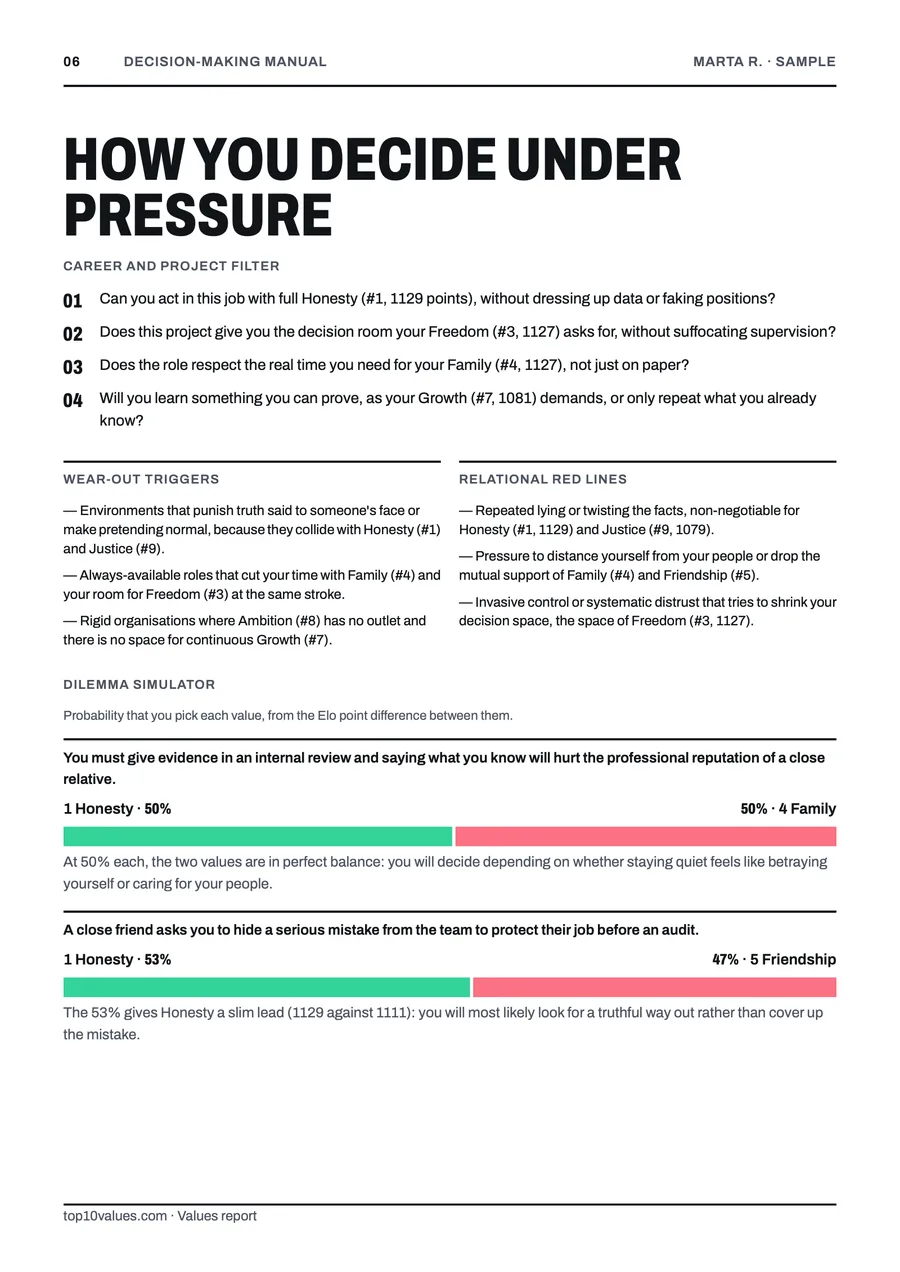
Sample page with fictional data (Marta R.), not yours. Your report is written from your own choices.
Frequently asked questions
What does it mean to hold productivity as a personal value, and how does it show day to day?
It means caring that your time turns into finished things that matter to you, not just into activity. Everyday examples: deciding in the morning the three things you want done by the evening; finishing painting one room before starting another; sending the quote to a client instead of tweaking it again; noting at the end of the week what you have closed; completing the course you began before signing up for another; or getting your son's grant forms in on the day they were due. The common thread is moving from "I'm on it" to "it's done".
What is the difference between productivity, efficiency and discipline?
They are three neighbouring values that look at different things. Productivity looks at the result: how much you get done and whether what you get done matters. Efficiency looks at the cost: how much time, money or energy it took. Discipline looks at consistency: whether you keep up the effort when you do not feel like it. They combine in many ways. Some very disciplined people finish nothing because they persist with the wrong method; some very productive people work twice as hard as they need to; and some very efficient people deliberately produce little. Someone with productivity high on their list usually needs the other two as support, but their central question is different: what has actually been done?
Why do I feel guilty when I rest?
It is a very common experience among people who rank productivity highly. Part of it may come from your history: families where sitting around was frowned upon, jobs where only being seen to be there was valued. Part of it is cultural. Max Weber, in "The Protestant Ethic and the Spirit of Capitalism", analysed how constant work came to be understood as a moral duty, and Byung-Chul Han, in "The Burnout Society", describes how that demand is internalised until nobody forces you except yourself. It helps to remember that rest is not a reward but a condition for carrying on producing and, above all, for living. In practice, planning rest as seriously as a task (a stopping time, a day with nothing pending) works better than waiting to feel you have earned it. If the guilt is so strong that you can never sleep or switch off, it is worth talking it through with a professional.
Is being busy the same as being productive?
No, and it is often the opposite. The feeling of running flat out usually comes from lots of small tasks, interruptions and other people's urgencies, while the important work, which needs concentration, is left without time. Cal Newport, in "Deep Work", distinguishes between deep work, which requires sustained attention and produces results that are hard to replicate, and shallow work, such as answering emails or attending routine meetings, which fills the day with little added value. A simple check is to look at your week and separate the hours in which you moved forward on something someone will use from the hours in which you only reacted to whatever came in.
Which productivity method works best?
There is no single one that suits everyone, and switching method every month is one of the most common traps. Some are well known for good reasons: the Pomodoro Technique, developed by Francesco Cirillo in the late 1980s, splits work into short timed blocks with brief breaks; David Allen's "Getting Things Done" proposes getting every commitment out of your head into a reliable system and defining the next concrete action for each project; and deep-work blocks protect long stretches for difficult tasks. What they have in common is modest: decide what matters, reduce what you have open, protect time to do it and review regularly. Choose a simple method, use it for two months before judging it and fit it to your life, not the other way round.
How do you stay productive with young children or very little spare time?
By changing the scale, not the ambition. With little time, long blocks are a luxury, so it pays to set tasks up so you can start them cold: leave the document open at the sentence where you stopped, keep your materials to hand, decide the night before what you will do in the next gap. Twenty minutes a day for six months adds up to a great deal, from a whole course to the first draft of a book. It also helps to adjust the yardstick: during a stage of early parenting or caring for someone, keeping the household running and the people in it looked after is already a lot of output, even if it never appears on a CV.
What should I do if I have so many things started that I never finish any?
Take stock. Write down everything you have half-done, at work and outside it, and for each one choose one of three options: finish it, park it with a review date, or drop it explicitly. Dropping something out loud, like the course that no longer interests you or the renovation you will not do this year, frees more mental space than continuing to drag it along. Then choose no more than two things to finish in the next month and start nothing new until they are closed. Oliver Burkeman, in "Four Thousand Weeks", reminds readers that you will never get to everything and that accepting that limit is what allows you to choose well; finishing almost always begins with deciding what you are not going to do.
When Productivity clashes with…
Getting the most out of every hour, versus resting, being calm or enjoying something with no purpose.