Achievement
Efficiency
Achieving more with less effort.
Efficiency is the pursuit of the best possible result with the least time, effort or resources needed. People who value efficiency feel uncomfortable with redundant processes or meetings that lead nowhere, and tend to optimize systems, routines and workflows almost automatically. This value isn't about doing more pointless things, but about removing unnecessary friction so the energy left over can go to what really matters. In excess it can create impatience with processes that naturally need time, but well applied it makes these people resourceful and highly valued in complex work environments.
What does this value mean?
Efficiency, as a value, is the importance you give to keeping what you achieve in proportion to what it costs: time, money, energy, attention, and the effort of other people as well. It is not about doing a lot or doing it fast. It is about not wasting: reaching the result you want by the route that uses up the fewest resources, and without the result getting worse for the sake of saving. Holding it as a value means waste bothers you wherever you spot it (the meeting that could have been a message, the car journey to buy a single item, the form that asks for your address three times) and that, before you start on something, you ask whether there is a simpler way to get it done. The full question, though, always has two halves. The first is “what does this cost?”; the second, which is easy to forget, is “efficient for what?”. Without a clear goal, efficiency has nothing to measure itself against and turns into a habit of shaving off minutes.
People who rank efficiency high tend to recognise themselves in unremarkable scenes. The warehouse picker who puts the fastest-moving stock at waist height and the items ordered once a month on the top shelf, because he has counted how many times a day he bends down. The freelance translator who keeps a glossary for each client so she never researches a term twice. The retired man who strings Tuesday’s errands into one loop (chemist, bank and market) and is home before the afternoon heat. The person who cooks three bases on Sunday (a tomato sauce, a pot of beans, a tray of roast vegetables) and combines them in different ways through the week. The student who builds a template for her lab reports in the first term and saves an evening on every write-up after that. The plumber who carries in his van the parts that most often fail in the old terraces of his patch and skips the trip back to the merchant. The common thread is an eye trained on waste: repeated steps, waiting, back-and-forth, work done twice because the first version was never saved. Industry gave this a name decades ago. Taiichi Ohno, one of the architects of the Toyota Production System, popularised the Japanese word muda for everything that consumes resources without adding anything to the result, such as unnecessary transport, waiting and surplus stock. Someone who lives efficiency as a value carries that way of seeing out of the factory: into the kitchen, the diary, the way a holiday or a house move gets organised.
What it does NOT mean
It is not hurry. Speed and efficiency sometimes coincide, but they often part ways: the email dashed off in two minutes that triggers five replies asking what you meant has turned out expensive, and the flat-pack wardrobe assembled without reading the instructions, then half taken apart again, is the classic case of speed you pay for twice. Nor is it stinginess. Spending little is not efficient if the cheap thing lasts one winter and has to be bought again, and saving on a plumber is not efficient if it ends in a flooded kitchen. It is not identical to productivity, though the two are related: productivity looks at how much you get done; efficiency looks at what it cost you to get it done. A print works can break its output record while binning one sheet in five, and a hand bookbinder who makes ten books a month and finds a use even for the leather offcuts is highly efficient while turning out very little. It is not automating everything, or filling your phone with organisation apps; building a system that costs more hours than it saves is the exact opposite of what this value is after. And it is not simplicity. Simplicity wants fewer things, fewer commitments, less noise; efficiency will accept complexity if it cuts waste, like the workshop with a hundred tools on the wall, each in its outline, so nobody spends half an hour hunting for a spanner.
Related concepts
Why might it matter to you?
Everything you do is drawn from a limited supply. The hours in a day do not stretch, attention runs out before the day does, money has a bottom, and so does the patience of the people around you. Treating efficiency as a value means taking that limit seriously: if you lose an hour looking for a document you did not file properly, that hour is not going to your daughter, your rest or the project you care about. Understood properly, efficiency does not compete with what matters to you; it makes room for it. It also carries a kind of respect that rarely gets noticed. When you call eight people into an hour-long meeting with no agenda, you are not spending one hour but eight; when you leave a task half done without explaining where everything is, the colleague who picks it up pays for your mess. Being efficient is largely a matter of not loading other people with costs you could have avoided yourself. It eases a very particular kind of tiredness, too: the feeling of running all day without getting anywhere. That tiredness often comes not from the important work but from friction: waiting, forgetting, doubling back, doing things twice. Removing friction does not make you a different person, but it gives you slack back.
Advertisement
How can you live this value?
- Decide what counts as finished before you look for the shortcut. Write the outcome you want in one sentence (“the report lets the client decide whether to renew”, “the kitchen is clear for breakfast”) and only then think about how to get there with less effort. Optimising without a goal is the quickest way to do something very well that never needed doing.
- Look for what repeats. For one week, jot down every task you do more than three times: the email answering the question everyone asks, the hunt for your keys, the shopping list written from scratch. Anything that repeats deserves a template, a fixed place or a saved list; anything you do once a year deserves no system at all.
- Remove before you speed up. Faced with a heavy process, ask in this order whether it can stop being done, whether it can be simplified and, only last, whether it can be automated or handed over. The most efficient step is the one that no longer exists: a report nobody reads does not improve by being written faster.
- Count the full cost, not just yours. Before you call something sorted, think about the time it will take other people to understand it, check it or fix it, and what it will cost to undo if it goes wrong. The quick fix that leads to three phone calls full of questions has saved nothing; it has only moved the bill.
- Batch similar things. Do your errands in one trip, answer messages at two or three set points in the day rather than at every ping, and gather pending phone calls into a single slot. Every switch between tasks makes your mind settle in again, and that settling-in time never shows up in any diary.
- Decide what you will not optimise. Write a short list of things you want slow on purpose: the long Sunday lunch, the walk with the dog, the chat with your son before bed, coffee with a friend. Having them on paper stops your eye for waste from quietly turning them into chores.
What happens when you don't live up to this value?
When efficiency is neglected you rarely see one big failure; you see a slow leak. You look for your keys most mornings. You pay for two subscriptions you no longer use because cancelling them needs ten minutes that never arrive. You redo a document because you did not save the last version. You go to the supermarket three times in a week because you never check what is missing before you leave, and you throw out food that went off at the back of the fridge. At work, the leak takes the form of meetings that start late, end without decisions and require another meeting; emails with five people copied in who did not need to know anything; processes done this way “because that is how we have always done it”, though nobody remembers why. The clearest symptom is an exhaustion that does not match what you have achieved: you reach the end of the day feeling you have not stopped and unable to say what you have actually done. If efficiency is one of your values and you live or work somewhere that ignores it, the discomfort is different: a low-level irritation at every avoidable queue, every duplicated form, every hour you watch being wasted without being able to change anything. A simple indicator is to count how many things you did twice this week for no good reason.
The healthy side and the shadow
When does this value stop helping you and start limiting you?
Healthy expression
Looking after resources in the service of what matters
In excess
Optimising everything, people included
The most recognisable shadow of efficiency is applying it where it does not belong. People are not processes, and treating a conversation like a transaction (“right, so what do you need?”) leaves the other person feeling dealt with. It happens with children who take ages to get dressed, with elderly parents who tell a story slowly, and with the new colleague who asks what seems obvious to you. A second shadow is efficiency that shifts costs elsewhere: a two-line message with no context is efficient for you but leaves everyone else guessing; dropping a check is efficient for one department, but the error surfaces three weeks later in another. A third is the trap of saved time. The naval historian Cyril Northcote Parkinson put forward in 1955, in a satirical essay in The Economist, the idea that work expands to fill the time available for its completion; if you save an hour and fill it straight away with more tasks, you have gained nothing, only made the wheel spin faster. A fourth is optimisation as a hobby: hours spent configuring to-do apps, trying out productivity methods and designing systems that save minutes at the cost of whole evenings. Healthy efficiency knows what it is saving for, it decides what to do with what it saves, and it leaves out of the calculation the moments that are valuable precisely because they produce nothing.
This value at work
At work, efficiency is probably the easiest value to see and to reward, which also makes it the easiest to distort. It shows in specific habits: you call a meeting only when a message will not do, and when you do call one it has an agenda and an end time; you write down how a task is done so it does not depend on your memory; you spot the step in a process nobody uses and suggest dropping it. When choosing a job, this value makes you look at things the advert does not mention: whether you will be allowed to change what is not working, whether decisions take a week or three months, whether internal bureaucracy eats half the day. It helps to tell local efficiency from overall efficiency. A salesperson who closes deals in record time by promising impossible delivery dates is very efficient in their own stretch and very expensive for the production team. A support line that measures success by call length gets short calls and customers who ring back. Before you celebrate a saving, ask where the cost reappears. If you manage people, efficiency asks for something less obvious: not mistaking it for busyness. A team that always looks flat out may be stuck in waiting and rework, and one that takes time to think before starting may be the one wasting least. Technical trades pass around a classic warning: the computer scientist Donald Knuth said in 1974, in his Turing Award lecture (“Computer Programming as an Art”), that premature optimisation is the root of all evil, or at least most of it, in programming. The idea travels well beyond software: first understand which part of the work matters and which part genuinely repeats; optimising before you know is effort spent in the wrong place.
This value in relationships
In friendship, efficiency has a side people love and a side worth keeping an eye on. The side people love belongs to the friend who organises the group trip: books early, shares a spreadsheet for costs, flags the train times and somehow gets seven people with impossible diaries into the same place for a weekend. Without someone like that, plenty of plans would never leave the group chat. It is also efficiency, and a form of respect, to answer clearly and promptly: saying “I can’t do this Saturday, how about the one after?” instead of leaving a plan hanging for five days. The side to watch appears when the logic of saving reaches the relationship itself. Listening to a friend’s voice notes at double speed, wrapping up with “ok, so basically” before the other person has finished, slotting friends into forty-five-minute gaps between errands, or replacing the monthly coffee with a birthday message once a year: each gesture on its own seems reasonable, and together they slowly hollow a friendship out. Friendship feeds precisely on time that serves no particular purpose: the meal that runs on, the walk with no destination, the story told with every detour. A good rule is to use efficiency for the logistics (fixing a date, booking, splitting the bill) and to put it away for the meeting itself. Organise with precision and, once you arrive, stop counting.
This value in love
In a couple, efficiency can be a great ally of shared life or a source of daily friction. As an ally, it shows in the shared logistics: a shopping list you can both see on your phones, a joint calendar with medical appointments and birthdays, a clear split of chores that heads off “I thought you were doing it”. That organisation frees up time and, above all, cuts down on arguments, because many couples’ rows are not about big issues but about whose turn it was to put the bins out. But very specific frictions also appear. One person loads the dishwasher with a system and the other puts things in “wrong”; one wants to leave at nine sharp and the other treats departure time as approximate; one suggests doing the shopping separately to save time and the other misses Saturday morning at the market together, which for them was never an errand. When one of you holds efficiency as a central value, it is worth asking before optimising: “is this a chore for you, or is it our time?”. There is one especially delicate area, which is arguments. Getting to the point can help solve a practical problem, but when your partner needs to tell you what happened in full, the rush towards a solution comes across as lack of interest.
This value in family
In families, efficiency is tested every weekday morning. Breakfast, school bags, uniforms, packed lunches, the bus at ten past eight: homes with small children run better with clear routines, clothes laid out the night before and everything in its place. There, efficiency is a form of care, because it means less shouting and less rushing. The conflict comes when it collides with children’s pace, which is inefficient by nature. A five-year-old takes four minutes to tie the laces you could tie in ten seconds. Doing it for them is efficient today and costly for years; letting them learn is slow now and frees up everyone’s time later. With teenagers, efficiency changes hands: many become experts at doing homework or tidying their room with the absolute minimum of effort. It is worth teaching them the difference between efficient and slapdash: the first gets the result while spending little; the second spends little and does not get the result. With elderly parents the risk is different. It is tempting to “modernise” their lives so everything is quicker: move their banking to an app, switch their shopping to online delivery, swap their appointments at the surgery for video calls. Some of those changes genuinely help; others take away independence, or the social life that came with the queue at the bank and the chat with the cashier. Ask before you optimise someone else’s routine.
This value and yourself
If efficiency is among your highest values, you probably recognise some of these habits: you notice which queue is moving fastest, you rearrange the dishwasher after someone else has loaded it, aimless meetings make you restless, and you feel a small, real satisfaction when you find a shortcut that works. It is probably hard, too, for you to watch other people do something the slow way without stepping in. It is worth checking the other side. What do you do with the time you save? If the answer is “more tasks”, efficiency may have become an end in itself. Do the people close to you feel well looked after, or hurried? Is there any time in your week that you deliberately leave unused, or does everything have a function? Do you optimise what matters, or what is easy to measure? If you rank it in the middle or low down, that is not a flaw. You may value process over outcome, the pleasure of doing things slowly, improvisation or depth. It is only worth checking who pays for your disorder, if anyone does: sometimes a person’s lack of efficiency is sustained because someone else at home or on the team quietly tidies up behind them.
What are you willing to sacrifice for this value?
Efficiency demands investments that look like losses at first. Would you spend a whole afternoon clearing out the loft, building a template or documenting a process, knowing that the afternoon produces nothing visible and the saving will arrive months later? Would you tell your manager that nobody reads the weekly report and suggest dropping it, even though you are the one who writes it? Would you let a colleague learn a task at their own pace, slower than yours, so that a year from now they do not depend on you? And the other way round: would you give up efficiency when it does not belong, staying in a conversation that feels unproductive because the other person needs it? Think about the last time you made one of these sacrifices. If it was recent, efficiency is guiding your decisions; if other people’s waste annoys you but you never invest in reducing your own, the value lives more in the complaint than in the practice.
Signs you're betraying this value
You betray efficiency when you repeat the slow procedure for years because changing it feels like a hassle, when you keep important papers “somewhere” and lose half a morning each time you need them, or when you keep paying for things you do not use. You also betray it, less obviously, when you confuse speed with efficiency and hand over something quickly that others will have to redo, or when you save at the expense of others spending more. Spending more time organising your tasks than doing them is a clear sign. And there is a betrayal that dresses up as a virtue: being permanently in saving mode with people, cutting conversations short, finishing other people’s sentences and feeling every unplanned moment as a loss.
Turning the value into goals
Value
Efficiency
Behavior
Before starting a task that repeats, ask whether it can be removed, simplified or set up in advance for next time
Goal
Win back two hours a week this quarter that currently go on waiting, searching and repeated work, and decide in writing what you will use them for
Habit
Every Friday, ten minutes to note what you did twice that week and choose a single improvement for the next one
Questions to reflect on
- Which weekly task costs you more than it should, and what is stopping you from fixing it once and for all?
- Where in your life has efficiency won you time for something you care about, and where has it taken away something you valued?
- What did you do with the last hour you managed to save: did you spend it on something you chose, or did it fill itself with more tasks?
- Who are you passing costs on to without noticing, for example through messages with no context, half-finished tasks or quick decisions that others have to fix?
- Which part of your week do you want to protect from the logic of output, and what would need to change so that nobody, you included, turns it into a chore?
- If someone watched a whole day of your life, where would they see the most waste: at work, at home or on your phone?
How much are you living this value?
Go back over the last week and find one moment when you achieved something with less effort than before, and one when you lost time or money through disorder, haste or habit. On a scale of one to ten, rate how far the way you organise yourself leaves you time and energy for what matters, rather than simply for doing more. If it comes out below seven, pick one task that repeats, run it through the sequence of remove, simplify and prepare, and check in a month how much time it has given back.
When two values clash
Efficiency clashes with Excellence over one specific question: efficiency wants to know when something is already worth the effort put in, and excellence when it lives up to what it could be. Both hate redoing work, but they disagree about when to stop; to settle it, it helps to separate the tasks that need your best from the ones where good enough is genuinely enough. With Creativity the friction is almost unavoidable: creating means trying routes that lead nowhere, tolerating mess and spending time on ideas that get thrown away, all of which efficiency labels as waste. A practical way out is to split the phases: explore without a stopwatch and, once the idea is chosen, carry it out in an orderly way. Something similar happens with Learning: being a beginner is inefficient by definition, and anyone who cannot bear doing something worse for a while never gets to do it better. With Trust it appears when you delegate: doing it yourself is faster today, but it stops others learning and turns you into a bottleneck. With Empathy and Kindness the clash happens in conversation, because listening well is rarely quick. With Inner Peace and Enjoyment it clashes when every minute has to serve a purpose and none is left for simply being. With Family it clashes when the pace of children or older relatives starts to feel like an obstacle. With Balance the relationship cuts both ways: efficiency frees up time, and balance makes sure that time is not swallowed by more work. Simplicity and Discipline are natural allies, because removing what is surplus and repeating what works both reduce waste. Productivity is its closest neighbour but not its synonym: one measures how much you do, the other what it costs you to do it. And Wisdom answers the question efficiency cannot answer alone: what is worth saving for.
Is “Efficiency” one of your top 10 values?
Find out by playing and comparing this value with the other 49
How the Elo ranking works and its limits in the methodology.
What does the paid report include?
When you finish the 100 comparisons you will see your Top 10 on screen. If you want to go further, there is a PDF report on your personal values: €9.95 (VAT included), one-off payment. To buy it you need to save your game with a Google account.
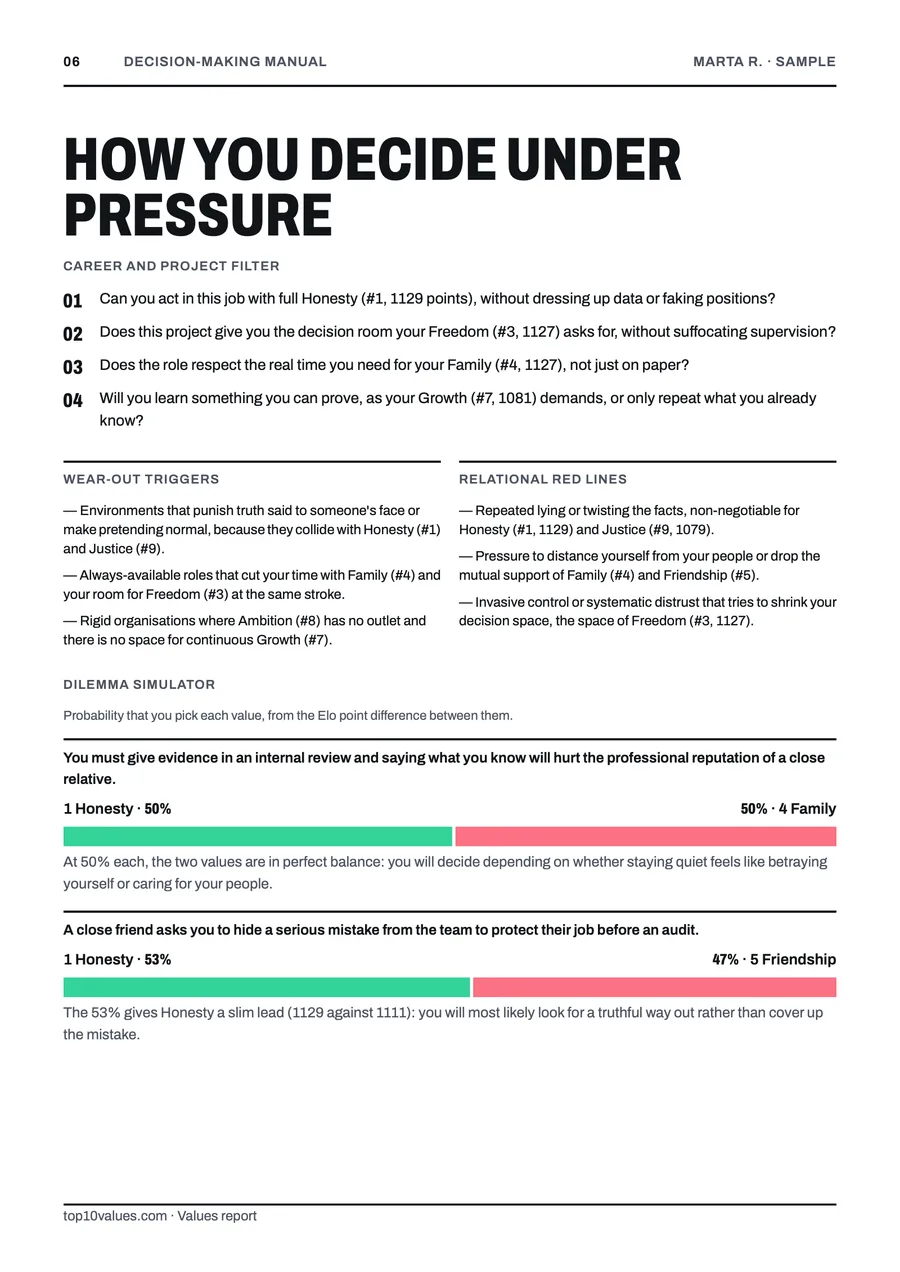
Sample page with fictional data (Marta R.), not yours. Your report is written from your own choices.
Frequently asked questions
What is efficiency as a personal value, and what are some everyday examples?
Efficiency as a value is the importance you give to getting what you are after without wasting time, money, energy or other people’s effort. Everyday examples: writing the shopping list after checking the cupboard so you do not go three times in a week; combining errands into one trip; keeping a template for an email you write often; giving a meeting an agenda and an end time; laying out the children’s clothes the night before; or asking the plumber which part is needed before the visit, so they do not have to come back. The common thread is that you notice what is surplus and take it out.
What is the difference between efficiency, effectiveness and productivity?
Effectiveness is achieving the result you were after; efficiency is achieving it with the least reasonable use of resources; productivity is the amount of result you get in a given time. In “The Effective Executive”, Peter Drucker argued that what managers are paid for above all is effectiveness, getting the right things done, and not merely doing things right; that is the source of the much-repeated line that efficiency is doing things right and effectiveness is doing the right things. In practice you can be highly efficient at a pointless task, effective while wasting a great deal, and very productive at producing things nobody needs. The sensible order is effectiveness first (what needs to be achieved) and efficiency second (how to achieve it without waste).
Does being efficient mean doing things faster?
Not necessarily. Speed is one way of saving time, but efficiency looks at every cost, including the ones that come later. Reading the instructions before assembling a piece of furniture is slower at the start and more efficient by the end. Checking a quote for ten minutes before sending it is slower than sending it as it stands and far more efficient than correcting an error in front of the client. Sometimes the efficient thing is even to wait: buy when you know what you need, decide when you have the facts, or let an argument cool down before picking it up again.
Why does being more efficient seem to give me more work?
It is a common experience, and there are well-known precedents for it. Cyril Northcote Parkinson wrote in 1955, in a satirical vein, that work expands to fill the time available. And the economist William Stanley Jevons observed in “The Coal Question” (1865) that more efficient steam engines did not reduce Britain’s coal consumption but increased it, because they made coal cheaper to use. Something similar happens in personal life: if every hour you save fills itself with new tasks, efficiency only makes the wheel turn faster. The answer is not to be less efficient but to decide in advance what you will do with the time you gain, and to defend it, even if the plan is to do nothing at all.
How can I be efficient without coming across as cold?
Keep the logistics separate from the meeting. Be efficient when arranging things (proposing a specific date, replying promptly, preparing what is needed) and stop being efficient once you are with the person. At work, say how much time you have at the start (“I’ve got twenty minutes, shall we take it properly?”) rather than glancing at the clock halfway through. Avoid finishing other people’s sentences or summing up before they are done. And remember that with people, waste is measured differently: a long stretch of listening that leaves someone calmer is not time lost but time well spent.
How do I know whether efficiency is really one of my values?
Look at what you invest in when nobody asks you to. It is a value when you have spent your own time sorting out a process, documenting something or changing a slow routine even though the benefit took a while to arrive; when other people’s waste bothers you but you have also tackled your own; and when you choose jobs, homes or ways of living with an eye on how much friction they will save. If it only shows up as impatience with others, it may be more a temperament than a value. A simple test is to ask what you have cut out of your life in the past year because it was not worth what it cost.
Is it worth building a system or automating every task?
Only for tasks that repeat often enough. A practical rule is to compare the time it takes to set up the system with the time it saves each go, multiplied by the number of times you will do the task in a year. A template for an email you send every week pays for itself straight away; an elaborate spreadsheet for something you do twice a year probably does not. Before automating, check whether the task can disappear altogether. And be wary of organisation as a pastime: if you spend more time tweaking your method than using it, the system has become one more task.
When Efficiency clashes with…
Getting things done with the least effort, versus polishing the work, trying new paths or stopping to learn.