Personal Growth
Wisdom
Deep understanding of life.

Wisdom is the ability to understand life in depth, integrating knowledge, experience and perspective to make sound decisions beyond the mere accumulation of facts. People who value wisdom seek to understand the root causes of situations, learn from their own mistakes and those of others, and often bring a calm perspective in moments of collective confusion. Unlike learning, which centers on acquiring information, wisdom involves knowing how to apply that knowledge with judgment and practical sense in real and often ambiguous contexts. People guided by this value are often consulted by others precisely for their ability to see beyond the obvious in any situation.
What does this value mean?
Wisdom as a personal value is the commitment to judge well when it counts: to see what really matters in a situation, choose a sensible course, and know when the right move is to wait, ask or say nothing, drawing on what you have lived, learned and thought through.
Wisdom, as a value, is the habit of acting on judgement rather than reflex, mood or whatever everyone else is doing. It appears in small, recognisable scenes. A GP says «let's wait a fortnight and see» instead of reaching for a prescription. A manager holds off sacking someone until asking the colleague who knows that person's work best. A friend reads an angry message, closes the laptop and replies the next morning with two lines instead of twelve. A grandfather on his allotment knows which year's advice to ignore and which to keep. Aristotle called this skill phronesis, usually translated as practical wisdom, and set it apart from theoretical knowledge: you can know a great deal and still choose badly. In Plato's Apology, Socrates says he is wiser than the people he questions in one respect only, that he does not think he knows what he does not. People who hold this value tend to share three habits: they observe before they opine, they study their own mistakes, and they seek out people who know more than they do.
What it does NOT mean
Wisdom is not the same as intelligence. Plenty of brilliant people make a mess of their money or their marriages, and plenty with modest schooling give reliably good advice. It is not piling up facts or quotations either: someone who has read widely and parades it in every conversation may be learned without being wise. It is not simply age, though experience helps; some people repeat one mistake for forty years, while some twenty-somethings listen, question and think with unusual maturity. It does not mean having advice for everything, since one mark of wisdom is recognising the edge of what you know. And it is not coldness or dithering: wise people feel, doubt and sometimes get it wrong, but they can tell when they have enough information to decide and do not hide behind «we need to think about it a bit more» to dodge the risk.
Related concepts
Why might it matter to you?
A life is shaped by a handful of big choices: what to study, who to share your days with, when to leave a job, how to respond to a betrayal or a diagnosis. There is no manual for those moments, and what helps is judgement. Treating wisdom as a core value means taking that seriously: making time to think over what has happened, reading or listening to people further along the road, and testing whether your beliefs survive contact with the facts. It also pays off for others, because people with sound judgement save those around them from mistakes; they are the ones phoned when something difficult has to be decided. Behind choosing this value there is often a painful episode you wanted to learn from: an investment that went wrong, a relationship whose end you saw coming too late, or a row you could have avoided with ten seconds of silence.
Advertisement
How can you live this value?
- Before a major decision, take a sheet of paper and list three columns: what you know, what you are assuming, and what you still need to find out. Sorting things this way often shows that you are about to commit on the strength of an assumption you never checked.
- Ask for advice from two people who think differently from you and one who has already been through what you face. Not so they decide for you, but to expose blind spots. When someone disagrees, ask what would change their mind.
- Build in a pause before answering anything that makes you bristle: a day for a stinging email, a night for a large purchase, a week before resigning. Most regrets come from decisions made while angry, tired or flattered.
- Keep a decision journal. Note what you chose, why, and what you expect to happen, then read it back after six months. It is the most direct way to learn where your judgement is reliable and where it fools you, and it turns experience into learning rather than just memories.
- Each week, read one piece that argues against you and does it well, such as a history book, a long interview or an essay you suspect you will disagree with. Write out the strongest version of the opposing case before you rebut it.
What happens when you don't live up to this value?
When this value slips, you repeat the same errors in new clothes: another relationship with the old pattern, another venture started before checking anyone would pay, another family argument that ends exactly as the last. You speak with confidence on subjects you have barely studied and bristle when corrected. Big decisions get made under tiredness or pressure and are then defended after the fact. You surround yourself with people who agree and stop listening to those who push back. Eventually people stop asking your opinion because they can tell you answer on reflex. If wisdom is among your priorities, the usual feeling is a nagging one: that the years are passing without you understanding your own life any better, or that others seem to learn from experience faster than you do.
The healthy side and the shadow
When does this value stop helping you and start limiting you?
Healthy expression
Judgement held with humility
In excess
Pedantry, analysis paralysis and unsolicited advice
Wisdom goes wrong when it becomes an identity to defend. Then you meet the know-all who gives a lecture in every conversation, the person who answers a friend's problem with a quotation instead of listening, the one who feels above people who «haven't thought about it as much». Another distortion is paralysis: researching for months before moving house, comparing fifteen options for a simple purchase, or delaying a conversation until you have the perfect argument. Meanwhile life goes on without you. There is also over-caution dressed up as judgement: never taking a chance because you are «just being realistic». To see which way you lean, ask yourself: when did I last say «I was wrong» or «I don't know»? Do I offer advice only when asked? Do I decide within a reasonable time, or is there always one more fact missing? If the first two are hard to answer, what your opinions are protecting may be your pride.
This value at work
At work, wisdom shows in the meeting where someone asks «what if we're wrong about this?» before an investment is approved, in the colleague who remembers that the last similar project failed for one specific reason and puts it on the table, and in the person who knows when to escalate a problem and when to fix it quietly. It also means knowing whom to ask: accepting that the technician who has been there ten years understands the process better than any report. If you lead a team, it means deciding on incomplete information without waiting for total certainty, while leaving room to change course. The usual trap is mistaking experience for habit: «we've always done it this way» is not wisdom, it is inertia. A good test is to ask what you have changed your mind about in your trade this year; if the answer is nothing, you are probably not learning. Wisdom also decides which hill to die on: not every email deserves a reply-all, and not every disagreement deserves a stand.
This value in relationships
In friendship, wisdom is mostly knowing when to speak and when to hold your tongue. Some friends need advice, others only want to vent, and mixing them up does harm. It shows in choosing your battles: telling a friend their partner treats them badly may be the most loyal thing you can do, but timing, manner and persistence matter. A wise friend recognises seasons: a friendship may cool for a while and return, and is not scrapped over one misunderstanding. They also keep a healthy distance from gossip, understanding that people who tell you about others so easily will tell others about you. When a friend tells you about a decision that looks like a mistake, «what led you to that?» opens the conversation better than «I wouldn't».
This value in love
In a couple, wisdom means telling apart what can be changed from what has to be accepted. A sensible person does not expect a partner to swap personalities, but does ask for specific changes in behaviour: texting when running late, sharing the chores, not putting you down in front of others. They also choose the moment: a difficult conversation at eleven at night, tired and after a long dinner, usually goes badly, whereas the identical one over Saturday breakfast does not. They notice the patterns in arguments (always about money, always about the in-laws) and talk about the pattern rather than fighting afresh over each episode. And they think long term: a relationship is judged not by one bad month or one great holiday but by how thousands of small decisions are handled. Before issuing an ultimatum or making a final call, it helps to let time pass and ask whether the trouble lies in the relationship or in the stage of life.
This value in family
In the family, wisdom is tested when a group has to decide: the care of an elderly parent, dividing an inheritance, a child's wedding to someone not everybody likes. It helps to hear each person alone before bringing everyone together, because in a group the loudest voice wins. With children it means knowing which battles are worth fighting: a messy bedroom can wait, humiliating a sibling cannot. It also means passing on what you have learned without turning it into a sermon: «something similar happened to me and I got this part wrong» lands better than «I told you so». With older relatives, it means respecting what they have lived through without treating it as infallible: you can learn a great deal from your grandfather's experience and still decide differently, because the world you live in is no longer his.
This value and yourself
Choosing wisdom suggests you would rather understand than react, and that repeating mistakes bothers you. You may spend time thinking over what has happened to you, seek conversations with people who know more than you do, and prefer a well-put question to a quick answer. It can also suggest that you find it hard to act before you have understood, or that you sometimes demand flawless judgement of yourself. It is worth watching whether you use reflection to decide better or to put off what frightens you.
What are you willing to sacrifice for this value?
Wisdom costs time and pride. Time, because thinking well needs pauses, reading and conversations that a packed diary does not allow. Pride, because learning means admitting you were wrong: telling your team that the decision you defended firmly was a bad one, or conceding to the person who argued with you. Would you give up winning an argument in order to understand the other person better? Would you pass on a quick, showy opportunity to wait for a sounder one? Would you stay silent on a subject you do not know well, even though everyone else has a view? And consider the opposite sacrifice: how often have you postponed a brave decision by claiming you needed more information?
Signs you're betraying this value
You are betraying this value when you decide with the certainty of someone who has not listened, when you repeat an opinion you never checked, or when you always blame others for what goes wrong. Also when you avoid people who contradict you and read only what confirms what you already think. Another sign is giving confident advice on things you do not know, or postponing an important decision indefinitely in favour of more research. And the quietest one: having the same argument for the tenth year running without asking what part you play in it.
Turning the value into goals
Value
Wisdom
Behavior
Write down each important decision in a notebook, with your reasons and what you expect to happen
Goal
In six months, go back over the ten decisions you recorded and draw three conclusions about how you decide
Habit
Before replying to something that irritates you, wait at least an hour and reread what you were about to say
Questions to reflect on
- Which mistake have you made more than once in different forms, and what does it say about how you decide?
- Whom do you turn to when you need judgement, and what does that person have that others lack?
- On what subject do you hold strong views without having studied it properly?
- Which of your beliefs has changed in the past five years, and what made it change?
- Which decision are you putting off on the grounds that you lack information, and what fact are you really waiting for?
- When did you last say «I don't know» out loud, and how did it feel?
How much are you living this value?
Out of 10, how much do you learn from what happens to you, and how far does it change what you do? To answer, recall two mistakes from the past year and check whether you would act differently today in a similar spot. If your score is below 6, begin with the decision journal: note the next big decision you make and read it back in three months.
When two values clash
Wisdom clashes with Freedom and spontaneity when thinking too much stops you leaping in: not everything worth doing is settled with a list of pros and cons. It clashes with Ambition and speed, because judgement asks for pauses that competitive settings do not reward. With Courage, which sometimes means acting without all the facts; wise caution is not fear, but the line between them is thin. With Honesty, when telling the whole truth at the wrong moment does more harm than good, and wisdom decides the when and the how, not the whether. And with Loyalty, if your judgement says someone you love is doing something they should not. It pairs well with Humility, which keeps you willing to learn, with Growth, which turns experience into improvement, and with Inner peace, which lets you decide without the urgency of fear. Often attributed to the theologian Reinhold Niebuhr, the Serenity Prayer asks for wisdom to know the difference between what can and cannot be changed. A practical hint: if you have been torn between two options for weeks, both may be acceptable, and the wise move is to pick one and commit.
Is “Wisdom” one of your top 10 values?
Find out by playing and comparing this value with the other 49
How the Elo ranking works and its limits in the methodology.
What does the paid report include?
When you finish the 100 comparisons you will see your Top 10 on screen. If you want to go further, there is a PDF report on your personal values: €9.95 (VAT included), one-off payment. To buy it you need to save your game with a Google account.
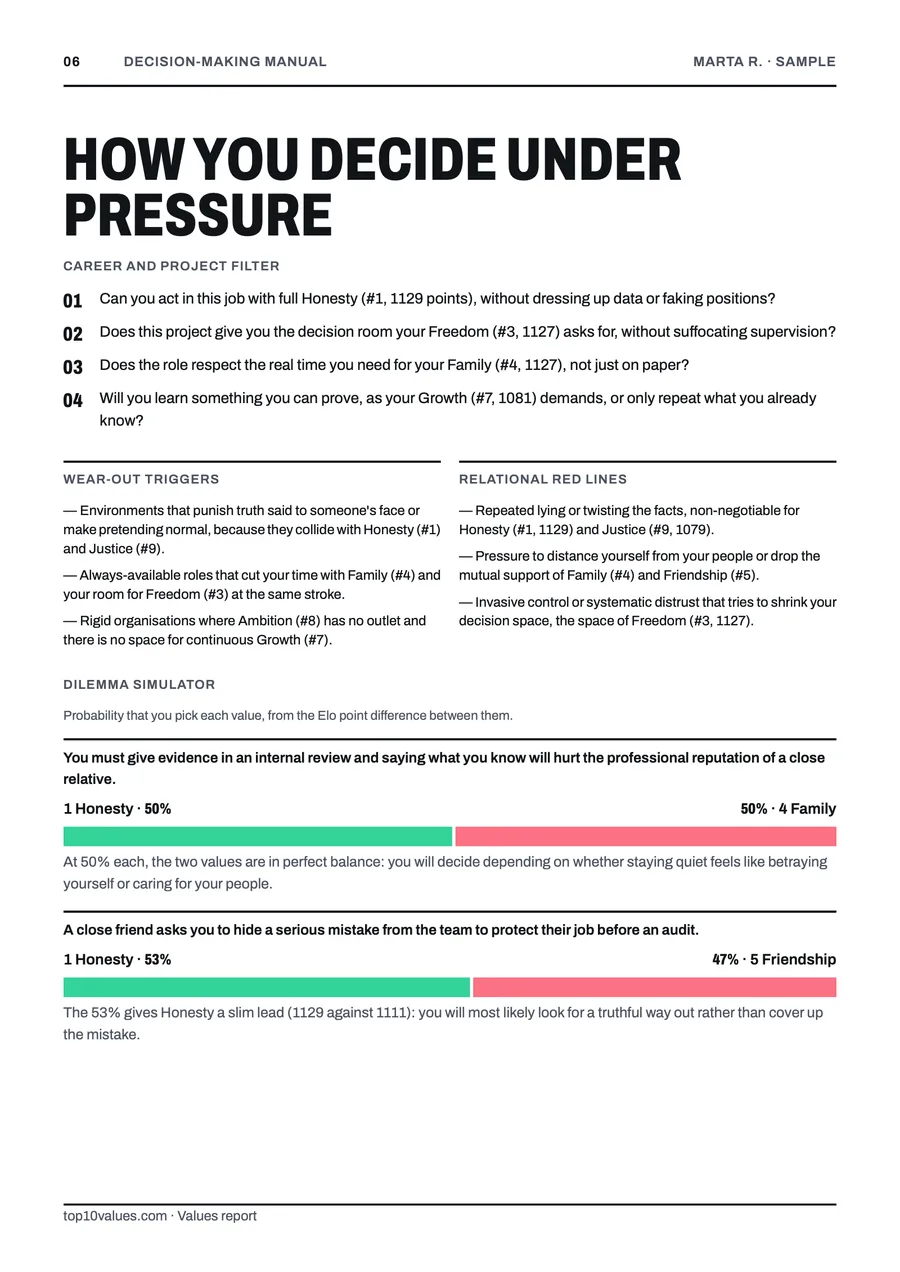
Sample page with fictional data (Marta R.), not yours. Your report is written from your own choices.
Frequently asked questions
What is wisdom as a personal value, in plain terms?
It is caring about good judgement: wanting to understand a situation before acting on it, learning from what has gone wrong, and being willing to be corrected. Someone who ranks wisdom highly asks «what is really going on here?» more often than «what do I want to say?». It shows up in decisions about money, work and people far more than in what you can quote.
What is the difference between wisdom and intelligence?
Intelligence is usually understood as the ability to reason, learn and solve problems quickly. Wisdom is about applying that well in real situations, with uncertainty and other people involved. You can be very clever and still make clumsy choices through arrogance, impatience or inexperience. Wisdom adds humility, a sense of what matters and the habit of learning from mistakes, and depends less on speed than on the quality of your conclusions.
Can a young person be wise?
Yes, although experience helps. What counts is not how much you have lived but how much you learn from it. A twenty-five-year-old who listens, asks for advice, reviews their mistakes and doubts their own certainties can show better judgement than someone who repeats habits for decades. Age supplies the material; reflecting on it is what turns it into wisdom.
How do you build wisdom day to day?
Through small, repeated practices: separating facts from assumptions before deciding, leaving a gap before reacting, seeking out opposing views, and keeping a record of your decisions and reviewing it. Reading slowly, talking with people from other generations and trades, and asking after a mistake what you would do differently all help. There are no shortcuts: it is a habit of attention trained over years.
I keep making choices I regret. What can I do?
Look for the pattern first: do you decide in a rush, under pressure, to please someone, or out of fear? Spotting when you tend to go wrong lets you set a simple rule, such as never deciding anything big when hungry, exhausted or furious. Ask someone you trust before major decisions and review afterwards what happened. Getting things wrong is part of learning; the trouble starts when you repeat it without asking why.
When Wisdom clashes with…
Waiting to see the full picture before acting, versus deciding quickly when it takes courage, saying what you think or seizing an opportunity.