Personal Growth
Self-awareness
Understanding your inner motivations.

Self-awareness is the ability to honestly observe your own emotions, motivations, strengths and behavior patterns. People who value this trait set aside time for introspection: they reflect on why they react a certain way, what needs lie behind their decisions and how others perceive them. This value is the foundation of almost any deliberate personal change, because it is hard to improve something you haven't first recognized. Self-awareness doesn't seek perfection, but clarity: understanding your own limits lets you ask for help in time, choose environments more compatible with the way you are, and communicate with greater precision.
What does this value mean?
Self-awareness is the ability to see clearly what you feel, what drives you and how others experience you, and to use that information to decide better. It has two halves that need each other: the inward look (your emotions, your motives, your limits, what gives you energy and what drains it) and the outward look (the effect you actually have on other people, which can differ a lot from the one you intended).
It stands for the habit of asking "why did I react like that?" before blaming circumstances. People who put self-awareness first can tell when tiredness is making them irritable, which kind of criticism really stings and what gives them energy or drains it. They have a fairly accurate picture of their strengths and blind spots, and they look for information outside their own head to fill in the gaps. It shows up in small, concrete ways: you know better than to answer a tense email after lunch on a bad night's sleep, you know you struggle to say no when someone asks a favour in front of other people, and you know that your "I'm fine" sometimes means "please ask me twice". The idea is ancient: the maxim "know thyself" was inscribed at the temple of Apollo at Delphi, and Socrates made it a lifelong task. A more recent picture is the Johari window, devised by the psychologists Joseph Luft and Harry Ingham in 1955. It sorts what can be known about you into four areas: what you and others both see, what only you know, what only others see (your blind spots) and what nobody has discovered yet. Getting to know yourself means widening the shared area, and that takes both looking inward and asking outward.
What it does NOT mean
It is not spending the whole day analysing yourself or turning over every emotion. Replaying how badly something went without reaching any conclusion is rumination, and it usually leaves you worse off. Nor is it taking a personality test and keeping the label: a four-letter code can be a starting point, but it doesn't explain why you made one particular decision yesterday. It isn't the same as high self-esteem: you can know yourself very well and not like what you see, or think highly of yourself and know very little. It isn't self-criticism either, because criticising yourself non-stop gives you noise, not information; and it doesn't mean having a tidy story about yourself, since it is easy to invent explanations that sound convincing and aren't true. Finally, knowing yourself doesn't give you authority to explain why other people behave as they do. Your understanding of you is not a manual for reading everyone else.
Related concepts
Why might it matter to you?
Nearly every important decision, from choosing a partner to accepting a job, depends on knowing what you need. If you don't, you choose by what is expected or by what the neighbours did, and a few years later you find yourself in a life that looks fine from outside and doesn't fit from inside. Self-awareness also buys you room between what you feel and what you do: if you notice you're angry before replying to a message, you can wait ten minutes and write something else. And it makes change possible, because nobody corrects a pattern they can't see. Picture someone who ends every job arguing with whoever supervises them. As long as they treat it as bad luck, the next job will end the same way. Once they notice that they bristle at any correction they read as distrust, they have something to work with. People who value self-awareness tend to be uneasy with life on autopilot and with those who repeat the same mistake without asking why. Behind it there is often an earlier experience: a breakup you didn't understand, a burnout you didn't see coming, or a conversation in which someone handed back an image of you that you didn't recognise. After that you realise that good intentions aren't enough; you need reliable information about how you work. That information is built slowly, through repeated observation and with the help of other people, not through a sudden revelation.
How can you live this value?
- At the end of the day, write three lines: what happened, how you felt and what you did about it. It doesn't need to be pretty; it needs to be specific. "Ten o'clock meeting: I went quiet when they criticised my proposal, felt embarrassed and spent the afternoon distracted" is worth more than "bad day". After a few weeks, rereading those notes shows you patterns you couldn't see in the moment.
- When you notice a strong reaction, such as a pang of envy or an out-of-proportion irritation, put an exact name on it before acting: "I feel ignored" says more than "I feel bad". A useful question is what you needed at that moment and didn't get: respect, time, recognition, security. The precise name lowers the intensity and tells you what to ask for.
- Ask two people who know you well to describe one thing you do that you're probably not aware of. Pick someone who loves you and someone you work with, because they won't see the same things. Listen without justifying yourself, say thank you and wait a day before deciding which part is useful. If two different people point to the same thing, treat it as data, not as opinion.
- Learn your physical stress signals: clenched jaw, shallow breathing, eating too fast, shoulders up around your ears, an urge to check your phone every two minutes. They warn you earlier than any thought does. When you spot them, take a short pause before carrying on, even if it is just getting up for a glass of water.
- Once a quarter, look back over the last three months and note which activities gave you energy and which took it away. Don't judge whether you ought to enjoy them; just record what happened. Adjust your calendar accordingly: if long meetings empty you, protect the hour afterwards; if cooking for other people recharges you, do it more often.
- Before an important decision, write down why you think you want what you want. If the answer starts with "because I should", keep digging until you find a reason that is yours. Also check how much of the decision depends on how you feel today and how much will still be true in six months.
- Learn your avoidance patterns: which tasks you postpone, which conversations you dodge, which subjects you change when they come up. What you repeatedly avoid usually points to an emotion you haven't looked at yet. Choose one small avoidance this week and meet it with a concrete step, such as sending the pending email or making the call.
Advertisement
What happens when you don't live up to this value?
Without self-awareness you repeat situations without understanding why: three jobs with a boss who wears you down, relationships that end the same way, arguments that begin over something trivial and finish with an old grievance. You blame others or bad luck because you can't see your part. You miss your strengths too, underrating or overrating yourself without evidence. Some people spend years convinced they are "no good at public speaking" because one school presentation went badly, without ever testing it as an adult; others think of themselves as great listeners while their friends describe someone who steers every chat back to themselves. Your emotions steer without your noticing, so what looks like a rational decision is often a reaction of fear or pride dressed in borrowed arguments. The body joins in: exhaustion piles up because you ignore the signals, and one day you hear yourself say "I don't know how I got here". Over time other people's trust suffers too. Those close to you learn they can't tell you certain things because you react badly, and they stop telling you. You lose the mirror you most need.
The healthy side and the shadow
When does this value stop helping you and start limiting you?
Healthy expression
Honest curiosity about yourself
In excess
Obsessive self-analysis
The excess appears when looking inward becomes a way of not living: you analyse the conversation instead of having it, hunt for the perfect cause of your anxiety before taking a step, and put decisions off until you "know yourself better". Rumination can pass itself off as reflection: you go round the same thing for hours, nothing new comes out and you end up more tired. One way to tell them apart is the outcome. Reflection ends in a new question, a decision or a change; rumination ends where it started. There is a less discussed shadow too, self-knowledge used as an alibi: "I know I'm impatient" becomes a way of apologising in advance and carrying on being impatient. Knowing something about yourself doesn't excuse you from doing something with it. Then there is over-interpretation, reading deep meaning into every gesture, dream or mood swing when sometimes there is only tiredness, hunger or a bad night. The healthy version has a practical limit: you ask yourself what you need in order to act, and then you act. Knowing yourself is a tool, not a destination. And if it exhausts you more than it clarifies, talking to a mental health professional may help more than thinking harder.
This value at work
At work, self-awareness lets you know what you are good at and what you aren't, and ask for tasks that fit. It helps you notice that you prepare meetings badly when anxious, or that you do your best work in the morning, and to schedule hard tasks accordingly. If you know you tend to say yes to everything so as not to let anyone down, you can rehearse an exit line ("let me check my calendar and I'll come back to you this afternoon") instead of discovering on Thursday that you have accepted four incompatible requests. It is also the foundation for receiving uncomfortable feedback without feeling attacked: someone who knows themselves can tell "they're saying something I did didn't work" from "they're saying I'm worthless". A frequent risk is mistaking your self-image for reality, so asking colleagues and your manager how they see you checks whether what you believe you project is what actually comes across. If you manage people, this value pays off even more, because your blind spots multiply: the tone you use when you're rushed, the habit of interrupting or the look on your face in meetings weigh more when you hold authority. Ask your team regularly what to do more of, less of and stop doing, and set it up so that telling the truth carries no cost. When choosing a direction, knowing yourself prevents two errors: accepting a promotion that takes you away from what you enjoy simply because it is your turn, and staying in a comfortable post long after it stopped stretching you. A good personal assessment separates three things: what you can do, what you enjoy doing and what the market needs. They don't always overlap, and knowing where they cross saves you from blind choices.
This value in relationships
In relationships, knowing yourself stops you from dumping on others what belongs to you. If you always feel abandoned by friends, what needs looking at may be how you ask for attention, not other people's lack of affection. Knowing what hurts you and what you need lets you say it clearly instead of hoping people guess: "when you cancel at the last minute I end up thinking I don't matter to you; I know that's not what you mean, but I need a heads-up" is easier to hear than three days of offended silence. It also teaches you how long you take to recover after a social day, so you can explain it as a trait and not as a snub. In long friendships, self-awareness helps you notice when you have played a part for years (the organiser, the one always available, the peacemaker) and decide whether you still want it. Be careful not to become your friends' therapist or to explain everyone else's motives: understanding yourself does not give you the right to diagnose anyone. And watch for a common trap, assuming your way of processing things is the right one. Some people need to talk about a problem as soon as it appears and others need to go quiet for a couple of days. Knowing which camp you belong to, and finding out which one the other person is in, heads off many misunderstandings.
This value in love
In a couple, self-awareness shows up in arguments. Someone who knows themselves can say "I'm getting defensive right now because this reminds me of something from before" and keep a passing remark from becoming a three-hour fight. It also helps you choose: understanding what you really look for, not only what attracts you at first, cuts down on relationships that repeat the same script. If your last three relationships ended for similar reasons, it is worth looking at what you bring to all of them, without sliding into self-blame: it could be a way of choosing, a tendency to fall quickly or a difficulty asking for what you need. And it lets you share your rhythms, fears and limits with your partner so they stop being mysteries to decode. Some things worth knowing about yourself in a relationship: how you behave when you're tired, what you need after an argument (to talk straight away, some time alone, a physical gesture), what makes you feel loved (words, time, practical help, touch) and what makes you feel lonely even when you're not alone. When your partner does the same work, conversations get lighter: instead of guessing at each other, you consult each other. And if one of you doesn't feel like looking inward, it doesn't have to become a battle; you can offer your own clarity as an example without demanding theirs.
This value in family
Family is the hardest place to observe yourself, because you slip back into old roles almost without noticing: at forty, the youngest sibling still feels small. Recognising when you react as an adult and when you react as the child you were changes the dynamic. A simple test is to watch your body and your tone of voice at the next family meal: if you suddenly speak more quietly, faster or with more sarcasm, an old role has probably walked on stage. With your own children, knowing where your impatience or your fear of their failing comes from keeps you from handing them burdens that aren't theirs. Sometimes the hurry you feel to get them dressed has nothing to do with them and everything to do with your own dread of being late, learned in a home where lateness was costly. And understanding how your childhood shaped you doesn't oblige you to blame your family; it only asks you to decide what you want to keep and what you don't. It also helps to know yourself as a daughter, son or carer: how much of your availability is love and how much is fear of disappointing, and where the limit lies on what you can sustain without wearing out. Talking about this with siblings or parents rarely goes well the first time. It often helps to begin with something of your own ("I noticed that when you ask about work I get defensive") before pointing at anyone else.
This value and yourself
Having self-awareness among your values suggests you like understanding the why behind things, distrust quick answers, and have probably been through a crisis or a change that made you ask who you are. You may find criticism easier to hear than most people do, or be the one in a group who asks the awkward question, "but why are we doing this?". Small talk may wear you out, and you probably look for people who dare to speak about what they feel. Ask yourself whether you sometimes use reflection to avoid acting, or whether you know your own emotions well but have little sense of how others see you. Watch two imbalances: if you only know yourself from inside, you risk building a comfortable picture you never test; if you only know yourself through other people's opinions, you risk living by a distorting mirror. And if you meet someone else who values self-awareness, a deep friendship can follow, though be careful that you don't become a mutual analysis club that never gets round to doing anything.
What are you willing to sacrifice for this value?
Would you listen to a harsh criticism of yourself from someone you trust without defending yourself in the moment? Would you set aside time each week to be alone with your thoughts, even when it's uncomfortable? Would you accept that your success, or your failure, has more to do with you than you'd like? Would you give up a heroic story about yourself if the facts tell a different one? Think of the last time you discovered something unflattering about yourself. If you could accept it without collapsing or denying it, it is a good sign that the value is well rooted. For this value the price is usually comfort: losing the flattering version of your own story, admitting you have avoided something for years and taking charge of the change that asks for. If there is a conversation, a memory or a habit you have been steering around for a while, that is probably where the information you most lack is hiding.
Signs you're betraying this value
Self-awareness is dodged in very ordinary ways: when you always blame others without asking about your part, when you fill every silence with screens so you don't have to hear yourself, when you reject an honest comment because it hurts, or when you make an important decision without stopping to ask what you feel. You also betray it when you hide behind a label ("it's my star sign, it's my personality type") so nothing has to change. And when you watch your emotions so closely that you stop living them. Other signs: asking for an opinion and rebutting every answer, surrounding yourself only with people who agree with you, always telling the same flattering version of a conflict, answering "I'm fine" without asking yourself whether it's true, and mistaking tiredness for character ("I'm just a negative person") when you have in fact been sleeping badly for weeks.
Turning the value into goals
Value
Self-awareness
Behavior
Name exactly what you feel before you react
Goal
Identify within this month the three triggers that most unsettle you and what lies behind each one
Habit
Every Sunday, spend ten minutes reviewing the week: what gave you energy, what drained it and what you would do differently
Questions to reflect on
- What situation keeps recurring in your life with different people, and what part do you play in it?
- Which criticism, heard more than once, have you dismissed without really considering it?
- When did an emotion last lead you to say or do something you didn't intend, and what was underneath it?
- How does your picture of yourself resemble the one held by people who know you, and where does it differ?
- Which activity makes you lose track of time, and how much room does it get in your week?
- What do you systematically avoid (a conversation, a task, a place), and what emotion do you suspect is behind it?
- What explanation do you usually give for your failures, and what would people watching from outside say?
How much are you living this value?
On a scale of 1 to 10, how precisely could you explain why you reacted as you did the last time you were angry or sad? If it's below 7, begin this week with the three-line note at the end of the day and ask someone close for an honest opinion. Then ask a second question: how much of what you believe about yourself have you checked with another person? If the answer is "hardly any", that is your next exercise.
When two values clash
Self-awareness collides with Humility at a delicate point: to know yourself you need to acknowledge your strengths as clearly as your flaws, and many humble people resist the first. The difference is that humility concerns how you measure yourself against others, while self-awareness concerns how you work. It also strains against spontaneity and Curiosity about the world, because stopping to analyse every impulse can drain the freshness from a life you wanted to enjoy, and because sometimes you only find out who you are by doing, not by thinking. With Loyalty there is another clash, when understanding what you need leads you to reconsider a bond or a company you gave years to. With Honesty it sits well in theory but gets harder in practice: being honest with yourself is the condition for being honest with others, even when what you find is awkward and you feel tempted to keep it to yourself. With Security the tension appears when finding out who you are demands changes that disturb a settled life. With Peace, because self-knowledge sometimes starts by stirring things up rather than calming them; there are periods when looking within brings more noise than calm, and it helps to have company. And with Kindness, when something you learn about yourself (say, that a loved one's habit irritates you) is true but doesn't need to become a reproach. It often helps to set a limit: give a fixed amount of time to looking inward, use what you learn for a real decision, and go back to living.
Is “Self-awareness” one of your top 10 values?
Find out by playing and comparing this value with the other 49
How the Elo ranking works and its limits in the methodology.
What does the paid report include?
When you finish the 100 comparisons you will see your Top 10 on screen. If you want to go further, there is a PDF report on your personal values: €9.95 (VAT included), one-off payment. To buy it you need to save your game with a Google account.
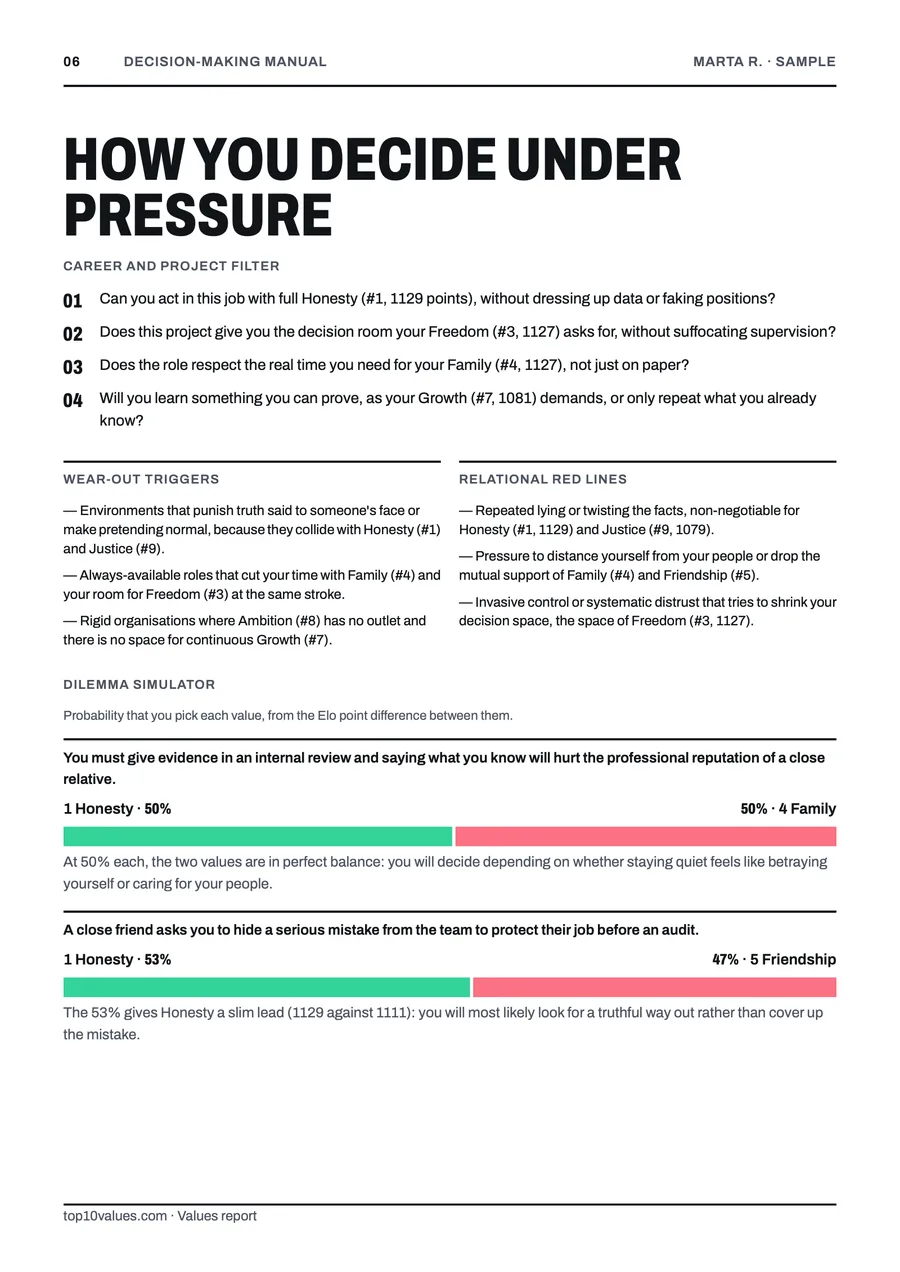
Sample page with fictional data (Marta R.), not yours. Your report is written from your own choices.
Frequently asked questions
How do I start knowing myself better if I never have?
Start with something small and regular, such as noting each night what happened, how you felt and what you did. After a few weeks you will see patterns. Then add other people's view: ask people you trust how they see you. Tests can work as a starting point as long as you treat them as hypotheses rather than verdicts. If you don't know what to write, try three fixed questions: what gave me energy today, what took it away and what did I avoid.
Is thinking a lot about myself selfish?
Not necessarily. Knowing yourself usually makes you fairer to others, because you stop projecting on them what belongs to you. It becomes a problem when everything always revolves around you or when looking inward replaces acting. The test is practical: if what you discover changes what you do, it is useful. And if it helps you listen better to other people, it is no longer a private matter: it benefits everyone around you.
When is it worth seeking professional help?
When reflection turns into constant rumination, when an emotion overwhelms you often, or when you can't see a repeating pattern on your own. A psychologist can offer tools and an outside view that a journal can't. Asking for that support is an act of self-awareness, not a failure.
How do I ask for honest feedback without it being awkward?
Make it concrete and small. Instead of "how do you see me?", ask "what would make my explanations in meetings clearer?" or "what do I do that makes things harder when we're under pressure?". Choose people who like you but aren't afraid to disagree, and thank them for what you hear even if you don't agree; if you react with offence they will stop telling you the truth. You don't have to accept everything: weigh what keeps coming back from several voices.
Can someone change once they know what they are like?
Knowing is the first step, not the only one. Understanding your pattern lets you catch it earlier and try a different response, even if the habit takes time to give way. It tends to work best to pick one very specific change (wait ten seconds before answering, tell people when you're running late, ask for help instead of putting up with it) and repeat it until it stops costing you effort. If something keeps recurring painfully despite your efforts, it is reasonable to look for outside support.
What is the difference between knowing myself and judging myself?
Knowing yourself is describing: "I react with anger when I feel unheard". Judging yourself is sentencing: "I'm an unbearable person". The first sentence gives you something to work with; the second just adds shame, and shame tends to push you into hiding. Try watching yourself the way you would watch a friend you value: precisely, with curiosity and without drama.
When Self-awareness clashes with…
Seeing your limits versus pushing on, or knowing what you feel versus always showing it.