Personal Growth
Honesty
Telling the truth.

Honesty is the commitment to tell the truth and act without deception, even when doing so is uncomfortable or carries an immediate social cost. People who value honesty prefer a difficult but sincere conversation to a relationship built on comfortable half-truths. This includes honesty toward others—not promising what you don't intend to deliver—as well as honesty toward yourself, acknowledging mistakes and limitations without self-deception. This value builds lasting trust in personal and professional relationships, although in the short term it can create friction when the truth doesn't match what the other person expected to hear at that moment.
What does this value mean?
Honesty means that what you know, what you say and what you do do not contradict one another: you do not deceive others, and you do not deceive yourself when the truth is uncomfortable. It covers facts (not inventing or dressing up figures), promises (not promising what you will not deliver) and the image you give of yourself (not pretending to be what you are not).
It is the decision that your word should be worth something. That includes small things, like saying «I don't feel like that plan» instead of inventing a work dinner, and big ones, like admitting to a client that you got the quote wrong. Someone who lives it accepts a short-term cost (a tense conversation, a lost sale, a bruised ego) so that others, and you too, can rely on what you say. Over time the cost pays for itself: you do not have to remember which version you told to whom.
What it does NOT mean
It does not mean saying everything you think at any moment, or using «I'm just that sincere» as a licence to hurt. Staying silent about something nobody asked and which changes nobody else's decision is not lying; inventing, denying or dressing things up is. Nor is it integrity, which is about acting on your principles even when no one sees, or authenticity, which is about being true to who you are. Honesty centres on the truth of what you communicate. And it is not the same as trust: you can be sincere and still not do what you said, and then your truthfulness is worth little.
Related concepts
Why might it matter to you?
Every time someone believes you, they are saving time: they do not need to check your data, look for the double meaning in a sentence or ask a third party whether it is true. That makes honest relationships and teams faster, not just more pleasant. A lie, by contrast, needs maintenance: it has to be remembered, protected with other lies, and lived with the worry that it will come out. An uncomfortable truth told in time usually costs a conversation; that same truth found out late costs a relationship. Behind valuing honesty there is often a need for inner calm: going to bed with no outstanding accounts with other people or with yourself.
How can you live this value?
- When you make a mistake, say so before anyone finds out and add what you will do to fix it. «I got the delivery date wrong; the new one is Thursday and here is what I'm changing so it doesn't happen again» is almost always received better than silence.
- Before promising something, work out whether you can really deliver. If not, say «I don't know», «I can't» or «not right now». A clear no today costs less than a yes that drags on for three weeks and ends in an excuse.
- When giving a difficult opinion, separate the fact from the person: «the report has three errors in the figures» instead of «you're a disaster». And say what is good too, if something is, so the criticism does not sound like a verdict.
- Answer what you are asked. Replying with a half-truth to keep a door open («well, there's something in that») is an elegant way of deceiving. If you do not want to answer, say you would rather not talk about it.
- Once a week, review what you are avoiding saying: a complaint to a colleague, an outstanding debt with a friend, a doubt about your partner. Set a date and decide how you will say it. Postponing it indefinitely is lying by omission, to yourself first.
- Watch the small social fib. The «I'm on my way, nearly there» from your sofa, the «I hadn't seen it» when you had. They seem harmless, but they teach the people around you that your word has a margin of error.
Advertisement
What happens when you don't live up to this value?
When you do not live honesty, a tiredness that is hard to name appears. You keep count of what you have not said, soften figures to avoid arguments, promise to look good and then look for a way to slip out of it. Relationships become more fragile because they rest on a version of you that is not quite real, and any detail that does not fit makes you anxious: an innocent question, a mutual acquaintance, an old email. At work it shows in meetings where everyone says «it's going fine» until it stops going fine. The most corrosive form is self-deception: going on telling yourself that this job, this relationship or this habit is fine while you sense that something does not add up.
The healthy side and the shadow
When does this value stop helping you and start limiting you?
Healthy expression
Sincerity with tact
In excess
Bluntness that hurts
Honesty becomes a problem when it is used as permission not to care about form: blurting out truths nobody asked for, at the worst moment or in front of others. The useful question is not only «is it true?» but also «is it the right moment?», «is it mine to say?» and «am I saying it to help or to unload?». A truth delivered with cruelty tends to provoke defence rather than change, so it defeats its own purpose. There is also a subtle version: boasting of transparency while revealing details that were not yours to share, such as a friend's secrets or a colleague's problems.
This value at work
You are the person who warns that the deadline will not be met while there is still room to react, and who says «I don't know» in a meeting instead of improvising an answer. That makes you valuable, though sometimes uncomfortable in cultures that reward optimism and punish the bearer of bad news. Some typical scenes: a client asks whether the product does something it does not yet do; a boss asks you to dress up a metric so it looks better; a colleague takes credit for your part of the work. In each there is an easy version and an honest one, and the second works best with data, a proposal and no drama. «This figure leaves out the last month; if we present it this way, we should say so» is a sentence that protects everyone.
This value in relationships
Your friends know that if they ask «what do you think?» they will get a real answer, which attracts people who want to grow and puts off those who only want approval. It is valuable when someone is about to sign a doubtful lease or send a message they will regret. Learn to ask first: «do you want my opinion or just for me to listen?». There are moments when someone needs comfort and not analysis, and saying so frankly is also a form of sincerity. Beware selective honesty: the kind handed out generously to others and withdrawn when it is time to talk about your own matters. An honest friendship works in both directions.
This value in love
In a couple, honesty includes the small things: saying that something bothered you instead of storing it up, admitting you do not feel like a plan, owning up to spending more than planned or to feeling distant yesterday. Lies «so as not to hurt» usually hurt more when they come out, because what stings afterwards is not just the fact but finding out you had decided for the other person what they could bear. You do not need a daily report of your thoughts either: having a private inner life is not lying. The boundary lies in whether what you keep quiet affects shared decisions such as money, health, children or fidelity. Intimacy grows when both can say difficult things without fear of losing the other, and for that the person receiving the truth must be able to hear it without punishing it.
This value in family
In families, honesty often clashes with the old roles: the child who does not want to worry their parents with a money problem, the mother who stays silent to avoid arguments, the grandfather nobody mentions because «it's better not to stir things up». Living it at home usually means talking about what everyone knows and nobody names, with affection and without seeking culprits. With children it matters especially: when they ask about an illness, a divorce or someone's death, answers can be adapted to their age, but not lies they will have to unlearn later. A child forgives «I don't know» more easily than discovering years later that they were told something false.
This value and yourself
Having honesty among your priorities says that it matters to you to be able to look yourself in the mirror. You prefer a clear no to a false yes, and you probably find it hard to deal with people who say one thing and do another. It may also mean you tolerate awkward silence worse than others, and sometimes say something aloud just to relieve your own tension. It is worth observing whether your sincerity serves the other person or your own relief, and whether you demand from others a transparency you do not always offer.
What are you willing to sacrifice for this value?
Would you accept losing an opportunity, a client or an important person's approval rather than lie? And admitting a mistake in front of the whole team, knowing nobody would have found out? Think of the last time the truth cost you something. If it was worth it, this value is well established; if you regret it, perhaps you value honesty more in others than in yourself. Sometimes the sacrifice is not losing something but giving up an image: that of the person who knows everything, never makes mistakes, or for whom everything goes well.
Signs you're betraying this value
There are everyday signs that you are falling short: you exaggerate an achievement in an interview, say «I'm swamped» to avoid admitting you do not want to go, let someone else carry a mistake of yours, or tell a version of events in which you always come out well. Also when you turn a promise into «we'll see» knowing it will be a no, or lend your signature to a figure you know is doubtful. And the least visible one: deceiving yourself, telling yourself it is not that bad, that you will sort it out later, that everyone does it.
Turning the value into goals
Value
Honesty
Behavior
Say in time what is not going well, with a concrete fact and a proposal
Goal
Over the next month, have the pending conversation you have been avoiding
Habit
Every Friday, write down one thing you did not say that week, why you did not say it and when you will say it
Questions to reflect on
- What truth about your work, your health or your relationship are you avoiding telling yourself?
- With whom is it hardest to speak with complete sincerity, and what do you fear would happen if you did?
- When did you use sincerity to hurt rather than to help?
- What promise have you made that you already know you will not keep, and who do you owe that news to?
- What small lie do you repeat often, and what does it give you or spare you?
- Who told you a hard truth that helped you, and how did you react at the time?
How much are you living this value?
From 1 to 10, how closely does what you say about yourself match what you actually do? To answer, go over your last seven days and count how many times you said something that was not entirely true. If the result falls below 7, start with the smallest thing: one excuse you will stop using this week.
When two values clash
Honesty often clashes with Kindness: do you tell someone close that their project does not convince you just when they are most excited about it? With Loyalty, when sincerity means acknowledging a mistake by your team, your family or a friend who asked for discretion. With Inner peace, because telling the truth often brings weeks of tension before relief arrives. With Ambition and Success, when a touched-up figure or an exaggerated promise would help win the contract. And with Respect: some truths, said in public or without permission, humiliate the person who receives them. There is no fixed rule. It often helps to tell the truth in private, early, about concrete facts and with a proposal, and to distinguish between what you are obliged to say (what affects other people's decisions) and what you may keep to yourself.
Is “Honesty” one of your top 10 values?
Find out by playing and comparing this value with the other 49
How the Elo ranking works and its limits in the methodology.
What does the paid report include?
When you finish the 100 comparisons you will see your Top 10 on screen. If you want to go further, there is a PDF report on your personal values: €9.95 (VAT included), one-off payment. To buy it you need to save your game with a Google account.
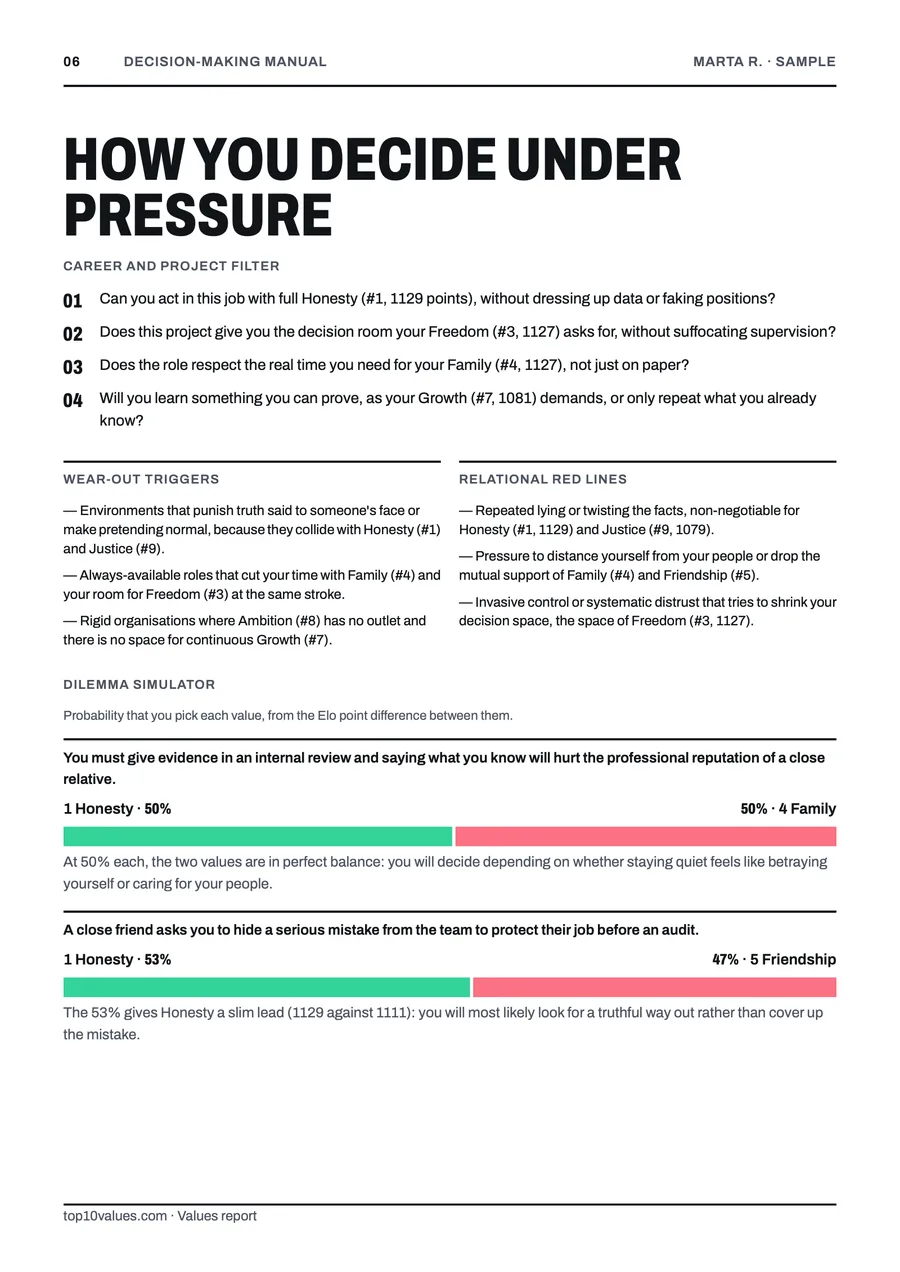
Sample page with fictional data (Marta R.), not yours. Your report is written from your own choices.
Frequently asked questions
Does lying to avoid hurting someone go against honesty?
It depends on what you are protecting. Leaving out a detail that adds nothing is not deceiving; inventing or denying something that affects the other person is, because it takes away information they need to decide. Before a «white lie», ask yourself whether you would want to know. There is almost always a third way: saying something true, kind and useful, such as «the plan is ambitious, I'm worried about the schedule».
How do I tell the truth without coming across as harsh?
Talk about facts and how they affect you, not about what the other person is like. Choose a private moment, start with what does work if something does, and pair the criticism with a proposal. Most people accept the truth better when they sense you are saying it to help and not to be right.
Do I have to tell my partner everything?
No. Honesty does not require a log of every thought. What you do owe is whatever influences shared decisions or the trust the other person places in you: money, health, fidelity, future plans. For the rest, it is worth asking whether you keep quiet out of respect or out of fear.
What should I do if I am asked to lie at work?
Start by asking, neutrally, for the request in writing («to make sure I understand, do you want us to state X?»). Propose a truthful alternative that meets the goal. If they insist, consider who to consult inside the company and what risk you take on if you sign. In some cases, such as fraud or risks to health, there are formal channels and legal advice available.
How do I make up with someone I have lied to?
Acknowledge the fact without embellishment or long justifications, say what really happened and what you will do differently, and accept that the other person may need time. Avoid «I did it for your own good», because it shifts the focus from what you did to what you felt. After that, the test is consistency: small, truthful actions repeated over weeks.
When Honesty clashes with…
Invented scene. Paula finds out that her colleague Iván sent a client an invoice that was 300 euros too low. Iván asks her: "Don't say anything, I'll make up for it next month." Honesty does not let her pretend she has not seen it, especially if the client trusts that figure. Loyalty tells her that Iván made a mistake once and that going to his boss is not the same as helping him fix it. Kindness adds a nuance: Iván has been overwhelmed for weeks. There is a practical difference between not volunteering something that is not yours to tell and covering something that affects a third party. One way out is to give him a short deadline to tell the client himself and to say that, if he does not, you will. That way loyalty is not broken and the truth does not go unsaid. More examples in conflicting values.