Kindness vs honesty: three everyday situations and a way to decide
By Juan Alejandre · Published · Reviewed
Industrial engineer and consultant, 25 years working with teams
Short answer
Kindness and honesty clash only when kindness means "saying nothing that could hurt" and honesty means "saying everything you think". Read that way, every conversation is a trade-off. Read differently, they usually fit: kindness shapes how, when and why you say something, and honesty decides whether it is true.
Advertisement
- Kindness is acting with care for how another person is doing, even when it costs effort and nobody asked.
- Honesty is keeping what you say and do in line with what you know to be true, without leaving a false impression on purpose.
Below you get three made-up situations, four questions for the moments when the two really pull apart, and three kinds of sentence that keep both. It is not advice about any specific relationship, and nothing here promises a conversation will go well.
Three situations
These are invented scenes. They show where the tension sits and what a version that respects both might look like. They do not say what anyone must do; in each one, reasonable people would choose differently.
A friend asks if you like her business idea, and you have doubts
Example. Leila tells her friend Joaquín she wants to open a small bookshop-café in her neighborhood and has already seen a unit. Her eyes are bright. "What do you think? Honestly." Joaquín likes the idea but knows the street: rents are high and weekday foot traffic is thin.
- What honesty asks. Not to say "it's perfect" if he does not believe it. She asked for an opinion, and an empty one is a non-answer.
- What kindness asks. To notice that she is excited and has told very few people. A cold list of objections, delivered on the spot, may end the conversation before it is useful.
- What courage adds. The easy compliment is cheaper for him, not for her; saying the uncomfortable thing is often the harder choice.
A version that keeps both: "I love that you want to do this, and I can picture you running it. Can I tell you what worries me about that street? I would rather say it now than watch you find out later." Then he asks what she has already checked. The doubt is still there in full; what changed is that it arrives as a question to work on together, not a verdict.
The cost is still real: she may be hurt for a day, or disagree. Honesty has a price.
A colleague's presentation has an error and the manager is about to see it
Example. Priya is about to present quarterly numbers to the director in twenty minutes. Marcus, beside her, notices that one slide shows last year's figures under this year's heading. He has seen how nervous she is.
- What respect asks. To treat Priya as someone able to take a correction, not someone to shield from it. Letting her walk in with the error treats her as fragile.
- What integrity asks. Not to act as though he saw nothing, and not to be the person who later says "I noticed it at the time".
- What trust asks. That she can count on a colleague to tell her privately, before it costs her in public.
The tension here is mostly timing and audience, and the kind move and the honest move turn out to be one: lean over and say quietly, "Slide six has last year's numbers under this year's title. You have a minute to fix it." What helps nobody is waiting until the director spots it, or raising it afterwards in front of others.
For more on naming this at your own job, see values at work.
A relative asks about a decision you disagree with, after it is made
Example. Rosa tells her brother Daniel that she has sold the flat she inherited from their aunt and put the money into a business with her partner. It is signed. Weeks later she asks, "You think I did the right thing, don't you?" Daniel does not.
- What empathy asks. To hear what the question is really asking. After the fact, "did I do the right thing?" often means "I am scared and need to know you are still with me".
- What love asks. To stay on her side as a person, which is not the same as agreeing with every choice.
- What humility asks. To accept he may be wrong. He sees the risk; she knows things about her partner, her work and her limits that he does not.
This is where a white lie tempts most: the decision cannot be undone, so an honest opinion looks useless. But honesty is not only advice; it is also not building a false picture in her mind. Daniel can say: "I was worried when I heard, and I still have some doubts. What I am sure of is that I want it to go well, and that you can call me if it gets complicated." Every word is true, he has not pretended to certainty, and he has not reopened something she cannot reverse.
If Rosa had not signed yet, silence would cost more. For how family and partner talks bring out these pairs, see values in a relationship.
Four questions to decide
Try these in order. They do not give you the answer; they help you see the situation before you speak.
- What does the other person need? Not only what they asked for. Someone who says "be honest" may need information, or may need not to feel alone. Often both.
- Can they still act on it? If the truth can change something (a slide, a lease not yet signed), withholding it removes the chance to act. If nothing can change, ask whether saying it serves them or only relieves you.
- What is the cost of silence? Name it concretely. Silence about a typo costs nothing; silence about a figure the director will repeat to the board costs something. When staying quiet costs more than the discomfort of speaking, honesty usually gains weight.
- How would I say it if I also valued them? The wording that comes is rarely the one you would use in anger, nor the one that avoids the subject.
If you still do not know, write both versions and read each as if you were the one hearing it.
Compassion vs honesty vs integrity: when the pair is really another pair
People also search for "compassion vs honesty" and "kindness vs integrity". They are close to this dilemma, but not always the same one.
- Compassion and honesty is usually kindness and honesty in a heavier moment: bad news, a loss. The question moves from "should I say it?" to "how do I stay with someone while it is said?". Much of the answer lies in what you do next.
- Kindness and integrity clash when being nice would mean acting against something you stand for, such as praising work you think is poor in a review others will rely on. The stake is less the other person's feelings and more your own consistency.
- Honesty and loyalty. If you are weighing whether to betray a confidence, the pair is different. See honesty vs loyalty.
For a method that works for any pair, see conflicting values.
Phrases that keep both
These are patterns, not scripts. Use your own words; a borrowed sentence said flatly sounds worse than a clumsy true one.
- Name what is good, then the concern, then an offer. "The structure is clear and I enjoyed the second half. The opening lost me. Want me to read it again after you rework it?" The praise has to be true, or this becomes flattery with a sting.
- Say what you see and ask, rather than conclude. "The numbers on this page look different from last year's, and I may be missing something. Can we check?" It leaves room for you to be wrong.
- Say what you can and cannot say. "I do not have a clean answer. What I can tell you is that I am worried, and that I am on your side whatever you decide." It is honest about its own limits and avoids a polite fiction.
None of these promises the other person will take it well.
What the game shows
A reliable way to see which value you lean on is to choose between them again and again without time to build a justification. The top10values game does that: you pick one of two values about a hundred times and get an ordered Top 10. Look at where kindness and honesty land. If kindness sits clearly above honesty, in the moment you probably protect the other person's feelings first. That does not make you dishonest, nor say whether it is good; it is a pattern worth noticing. If honesty is far ahead, check whether your timing and manner leave room for kindness.
The result describes what you choose today, not who you are. It is a self-knowledge tool, not a psychological test. The methodology page explains how it is calculated.
Frequently asked questions
Is kindness more important than honesty?
There is no answer valid for everyone. In most situations you can serve both. When you cannot, it depends on what is at stake, who is affected and which you place higher.
Can you be honest and kind at the same time?
Very often, yes. Most apparent clashes dissolve when you separate the content (true) from the delivery (considerate). Choosing the moment and the words does not make something less true. When the truth hurts however you say it, kindness shows in staying present, not in softening facts until they are no longer facts.
What is the difference between kindness and honesty?
Kindness is care for another person's wellbeing. Honesty is the truth of what you say and do. One answers "how does this affect them?", the other "is this true?". They overlap constantly and are in tension only at particular moments.
Is it kind to tell a white lie?
People differ, and it depends on the lie. A polite phrase at a door ("lovely to see you") is understood by both sides as courtesy. It gets less clear when someone will base a decision on your answer, because then the comfortable reply may cost them more than the true one. One test: would the person want to know, if they could see your doubt? If yes, a gentle truth probably serves them better.
What is the difference between being honest and being blunt?
Being honest is saying what is true. Being blunt is saying it without regard for how it lands, often with "I am only being honest". Bluntness is a choice about manner, not a higher degree of truth.
Related guides
- Honesty vs loyalty: a different kind of clash, with three scenes and five questions.
- Conflicting values: a general method for deciding between two values.
- Values in a relationship: kindness and honesty between partners.
Next step
Play the values game and see where kindness and honesty fall in your own Top 10. If you prefer to read first, browse the full list of values, or continue with honesty vs loyalty for a different kind of clash.
Sources
Find your top 10 values with 100 quick comparisons
What does the paid report include?
When you finish the 100 comparisons you will see your Top 10 on screen. If you want to go further, there is a PDF report on your personal values: €9.95 (VAT included), one-off payment. To buy it you need to save your game with a Google account.
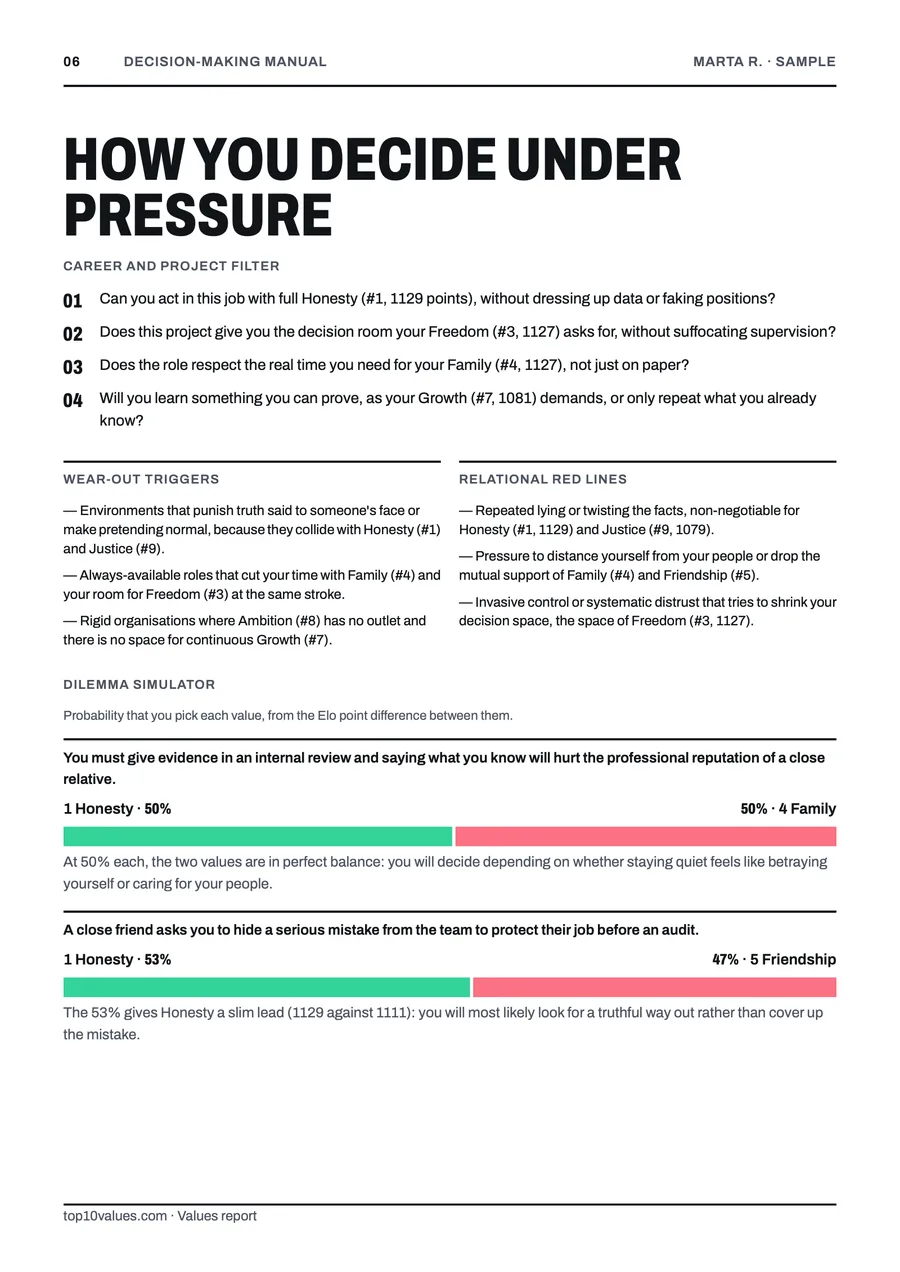
Sample page with fictional data (Marta R.), not yours. Your report is written from your own choices.